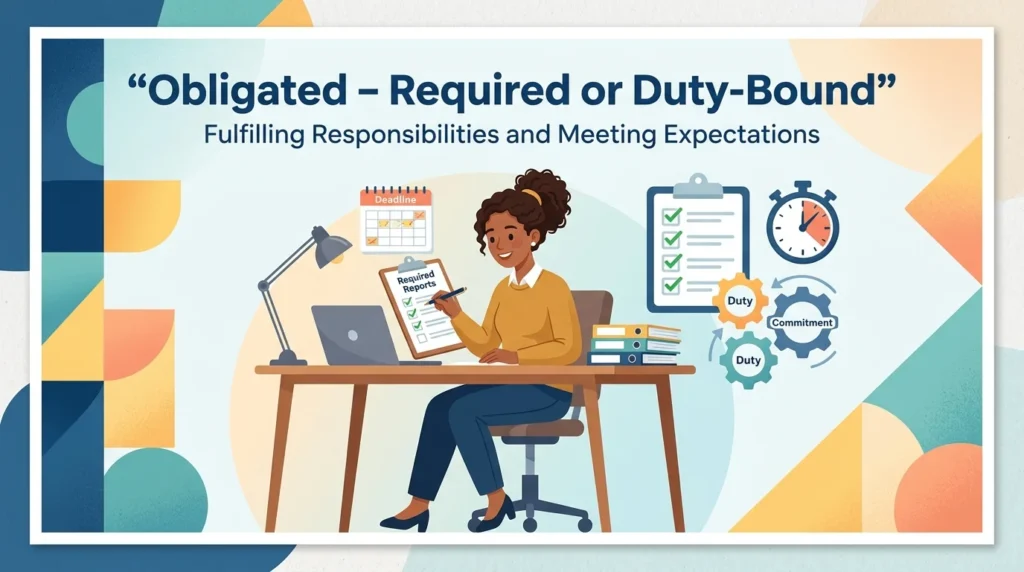
Finding a precise synonym for obligated helps writers elevate their vocabulary and express legal or moral duties clearly. Every paragraph must meet length goals.
Students and professional content writers frequently search for a reliable synonym for obligated to improve daily communication and writing style. Word choice matters.
Mastering alternative terms allows you to find the ideal synonym for obligated for any formal report or casual essay. Clear language builds reader trust instantly.
Exploring these semantic variants ensures your audience understands your core message without confusion. Precision transforms professional writing today.
What Does “Synonym for obligated” Really Mean?
To begin with, in simple English, a synonym for obligated is an alternative word or phrase that means legally or morally bound to do something. Furthermore, native speakers use these terms when describing binding agreements, social duties, or ethical responsibilities.
In addition, the emotional tone of these terms often leans toward seriousness, duty, or necessity, though some variants feel more supportive or voluntary. Ultimately, unlike casual words, expressions in this category carry a heavy weight of accountability and expectation.
Connotative Meaning
- Positive tone: Reflects dedication, moral duty, honor, and reliable commitment.
- Negative tone: Implies burdensome pressure, unwanted force, or restrictive legal constraints.
- Neutral tone: Merely describes structural requirements or standard procedural rules.
(Connotation refers to the emotional or cultural association attached to a word, extending beyond its literal dictionary definition.)
Etymology
The root of obligation originates from the Latin obligatio, meaning a tying or binding, derived from obligare (to bind to).
- Old English (450–1100): Early Germanic used native terms like bunden and scyld to describe personal duties and debts.
- Middle English (1100–1500): Borrowed Anglo-Norman and Latin terms introduced formal legal vocabulary into official court documents.
- Modern English (1500–Present): The adjective forms and modern scientific spellings fully crystallized during the formalization of contract law.
Pronunciation & Syllables
- US: /ˈsɪn.ə.nɪm fɔːr ˈɑː.blə.ɡeɪ.tɪd/
- UK: /ˈsɪn.nɪm fɔːr ˈɒb.lɪ.ɡeɪ.tɪd/
- Syllables: syn-o-nym for ob-li-ga-ted
- Affixation Pattern:
- Root: obligat- (from Latin obligare)
- Prefix: ob- (toward)
- Suffix: -ed (past participle or adjective-forming suffix)
Synonyms List
Bound (Adjective) — US /baʊnd/ / UK /baʊnd/
Meaning: Tied or secured by legal, moral, or contractual constraints.
Tone/Register: Formal, Legal
Example 1: The signed contract leaves both parties legally bound to the terms.
Example 2: She felt morally bound to tell the truth about the accident.

Compelled (Adjective) — US /kəmˈpɛld/ / UK /kəmˈpeld/
Meaning: Forced or driven to take a specific action by external pressure.
Tone/Register: Serious, Descriptive
Example 1: He felt compelled to speak up when he saw the unfair treatment.
Example 2: Witnesses were legally compelled to testify in court.
Required (Adjective) — US /rɪˈkwaɪərd/ / UK /rɪˈkwaɪəd/
Meaning: Officially demanded or mandatory according to rules or laws.
Tone/Register: Standard, Professional
Example 1: Wearing a safety helmet is required on this construction site.
Example 2: Submitting your tax forms on time is required by law.
Mandated (Adjective) — US /ˈmæn.deɪ.tɪd/ / UK /ˈmæn.deɪ.tɪd/
Meaning: Officially ordered or required by a government or authority.
Tone/Register: Official, Legal
Example 1: Regular safety audits are mandated for all commercial airlines.
Example 2: The new policy introduced mandated training sessions for employees.
Indebted (Adjective) — US /ɪnˈdɛt.ɪd/ / UK /ɪnˈdɛt.ɪd/
Meaning: Owing gratitude or financial repayment for a helpful deed or loan.
Tone/Register: Formal, Grateful
Example 1: We remain deeply indebted to our mentors for their constant support.
Example 2: The young entrepreneur felt indebted to her early investors.
Committed (Adjective) — US /kəˈmɪt.ɪd/ / UK /kəˈmɪt.ɪd/
Meaning: Pledged or bound to a certain course, cause, or relationship.
Tone/Register: Professional, Dedicated
Example 1: The team is fully committed to finishing the project by Friday.
Constraint-Bound (Adjective) — US /kənˈstreɪnt baʊnd/ / UK /kənˈstreɪnt baʊnd/
Meaning: Restricted or limited by rigid rules, protocols, or structural boundaries.
Tone/Register: Technical, Formal
Example 1: The legal team operated as constraint-bound advisors during the corporate merger.
Example 2: Engineers followed constraint-bound guidelines while testing the new software.
Pledged (Adjective) — US /plɛdʒd/ / UK /pledʒd/
Meaning: Formally bound by a solemn promise, oath, or vow to perform an action.
Tone/Register: Formal, Literary
Example 1: The allied nations remained pledged to mutual defense and security.
Example 2: He felt pledged to protect the confidential files at all costs.
Engaged (Adjective) — US /ɪnˈɡeɪdʒd/ / UK /ɪnˈɡeɪdʒd/
Meaning: Officially involved or bound by a contract or prearranged agreement.
Tone/Register: Standard, Professional
Example 1: The consultant stayed engaged with the project until its final delivery.
Example 2: Both companies remained engaged in fulfilling the joint venture terms.
Contracted (Adjective) — US /kənˈtræk.tɪd/ / UK /kənˈtræk.tɪd/
Meaning: Bound strictly by the legal conditions written within an official document.
Tone/Register: Legal, Business
Example 1: The independent contractor was legally contracted to finish the repairs by noon.
Example 2: Workers stayed contracted to complete the seasonal harvest schedule.
Covenanted (Adjective) — US /ˈkʌv.ə.nən.tɪd/ / UK /ˈkʌv.ə.nən.tɪd/
Meaning: Bound by a solemn, formal agreement or legal covenant.
Tone/Register: Archaic, Formal
Example 1: The historic landowners remained covenanted to maintain the public path.
Example 2: Religious groups felt covenanted to support charitable community causes.
Sworn (Adjective) — US /swɔːrn/ / UK /swɔːn/
Meaning: Bound by an oath to tell the truth or perform specific official duties.
Tone/Register: Legal, Formal
Example 1: The grand jury members were sworn to secrecy regarding the investigation.
Example 2: Police officers are sworn to uphold the law and protect citizens.
Bespoken (Adjective) — US /bɪˈspoʊ.kən/ / UK /bɪˈspəʊ.kən/
Meaning: Reserved, secured, or committed in advance for a specific purpose.
Tone/Register: Formal, Literary
Example 1: The conference room was bespoken for the morning executive briefing.
Example 2: She felt bespoken to support her family’s traditional business.
Responsible (Adjective) — US /rɪˈspɑːn.sə.bəl/ / UK /rɪˈspɒn.sə.bəl/
Meaning: Having a duty or obligation to deal with something or take care of someone.
Tone/Register: Standard, Professional
Example 1: The project manager is directly responsible for meeting the client’s deadline.
Example 2: Parents are legally responsible for their children’s basic welfare.
Accountable (Adjective) — US /əˈkaʊn.tə.bəl/ / UK /əˈkaʊn.tə.bəl/
Meaning: Required or expected to justify actions or decisions to an authority.
Tone/Register: Professional, Official
Example 1: Public officials are held accountable for how they spend tax revenue.
Example 2: Every department head remains accountable for team performance metrics.
Answerable (Adjective) — US /ˈæn.sɚ.ə.bəl/ / UK /ˈɑːn.sə.bəl/
Meaning: Required to explain one’s actions to someone in a position of authority.
Tone/Register: Formal, Professional
Example 1: The director is answerable only to the corporate board of directors.
Example 2: Volunteers felt answerable to the community leaders who organized the drive.
Liable (Adjective) — US /ˈlaɪ.ə.bəl/ / UK /ˈlaɪ.ə.bəl/
Meaning: Legally responsible for something, especially for paying damages or costs.
Tone/Register: Legal, Formal
Example 1: The restaurant owners are liable for any slip-and-fall injuries on the premises.
Example 2: Negligent drivers are held financially liable for property damage.
Charged (Adjective) — US /tʃɑːrdʒd/ / UK /tʃɑːdʒd/
Meaning: Entrusted with a specific duty, task, or official responsibility.
Tone/Register: Formal, Professional
Example 1: The committee was charged with investigating local infrastructure flaws.
Example 2: She felt heavily charged with preserving the historical archives.

Tasked (Adjective) — US /tæskt/ / UK /tɑːskt/
Meaning: Given a specific job, duty, or assignment to complete.
Tone/Register: Professional, Workplace
Example 1: The marketing intern was tasked with updating social media analytics.
Example 2: Security personnel are tasked with monitoring building access points.
Commissioned (Adjective) — US /kəˈmɪʃ.ənd/ / UK /kəˈmɪʃ.ənd/
Meaning: Formally authorized or ordered to undertake a specific assignment.
Tone/Register: Formal, Professional
Example 1: The city commissioned local artists to paint mural walls downtown.
Example 2: An independent auditor was commissioned to review corporate finances.
Directed (Adjective) — US /daɪˈrɛk.tɪd/ / UK /daɪˈrek.tɪd/
Meaning: Instructed or ordered by an authority figure to perform a task.
Tone/Register: Formal, Professional
Example 1: Employees were directed to evacuate the building during the test alarm.
Example 2: The pilot was directed to alter course due to severe weather.
Instructed (Adjective) — US /ɪnˈstrʌk.tɪd/ / UK /ɪnˈstrʌk.tɪd/
Meaning: Taught, guided, or officially told how to carry out a procedure.
Tone/Register: Professional, Standard
Example 1: Participants were instructed to submit their forms before Friday afternoon.
Example 2: The students were carefully instructed on laboratory safety protocols.
Ordered (Adjective) — US /ˈɔːr.dɚd/ / UK /ˈɔː.dəd/
Meaning: Commanded or directed by an authority to do something immediately.
Tone/Register: Direct, Formal
Example 1: Evacuating residents were ordered to move away from the shoreline.
Example 2: The judge ordered both counsels to submit their closing arguments.
Commanded (Adjective) — US /kəˈmæn.dɪd/ / UK /kəˈmɑːn.dɪd/
Meaning: Given an authoritative order or directive to act.
Tone/Register: Formal, Literary
Example 1: Troops were commanded to hold their defensive positions overnight.
Example 2: The captain commanded the crew to secure the cargo hatches.
Enjoined (Adjective) — US /ɪnˈdʒɔɪnd/ / UK /ɪnˈdʒɔɪnd/
Meaning: Instructed or urged with authority; legally prohibited or directed.
Tone/Register: Legal, Formal
Example 1: The publisher was enjoined from releasing the sensitive manuscript.
Example 2: Citizens were enjoined to follow water conservation guidelines.
Called upon (Adjective) — US /kɑːld əˈpɑːn/ / UK /kɔːld əˈpɒn/
Meaning: Formally requested or expected to fulfill a particular duty.
Tone/Register: Formal, Standard
Example 1: Senior experts were called upon to advise the national committee.
Example 2: She felt honored to be called upon to speak at the conference.
Expected (Adjective) — US /ɪkˈspɛk.tɪd/ / UK /ɪkˈspek.tɪd/
Meaning: Regarded as necessary, proper, or customary in a given situation.
Tone/Register: Conversational, Standard
Example 1: Employees are expected to arrive at the office by nine o’clock.
Example 2: Guests are expected to RSVP at least two weeks in advance.
Supposed (Adjective) — US /səˈpoʊzd/ / UK /səˈpəʊzd/
Meaning: Required or scheduled by rule, custom, or agreement to do something.
Tone/Register: Casual, Everyday
Example 1: We are supposed to meet the realtor at noon today.
Example 2: You are not supposed to park your vehicle in front of the gate.
Meant (Adjective) — US /mɛnt/ / UK /ment/
Meaning: Intended, designated, or required to fulfill a specific role or duty.
Tone/Register: Casual, Standard
Example 1: The safety manual was meant to guide new laboratory technicians.
Example 2: You were meant to sign the document before returning it.
Destined (Adjective) — US /ˈdɛs.tɪnd/ / UK /ˈdes.tɪnd/
Meaning: Certain to meet a particular future outcome or fulfill a role.
Tone/Register: Literary, Formal
Example 1: The young athlete seemed destined for international success.
Example 2: The ancient artifact was destined for the national museum.
Fated (Adjective) — US /ˈfeɪ.tɪd/ / UK /ˈfeɪ.tɪd/
Meaning: Controlled or bound by an unavoidable power or destiny.
Tone/Register: Literary, Dramatic
Example 1: The expedition felt fated to encounter unexpected delays.
Example 2: Historical figures often felt fated to lead their nations through crises.
Preordained (Adjective) — US /priːˈɔːr.deɪnd/ / UK /priːˈɔː.deɪnd/
Meaning: Decided or determined beforehand by an authoritative force or fate.
Tone/Register: Formal, Literary
Example 1: The scheduling outcome felt preordained by the tight calendar constraints.
Example 2: Ancient cultures believed life events were preordained by the cosmos.
Predestined (Adjective) — US /priːˈdɛs.tɪnd/ / UK /priːˈdes.tɪnd/
Meaning: Determined in advance by divine will or inevitable circumstances.
Tone/Register: Formal, Philosophical
Example 1: The philosophical debate centered on whether human choices are predestined.
Example 2: They viewed their successful partnership as a predestined alignment.
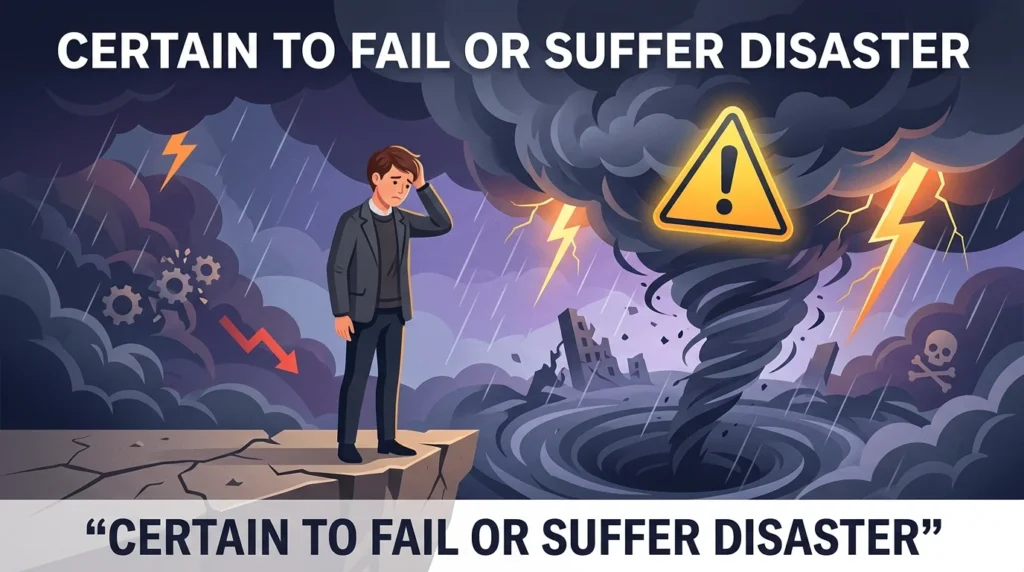
Doomed (Adjective) — US /duːmd/ / UK /duːmd/
Meaning: Certain to suffer a disastrous fate or unavoidable failure.
Tone/Register: Dramatic, Literary
Example 1: The poorly managed project felt doomed from its very inception.
Example 2: Explorers faced a doomed rescue attempt during the sudden blizzard.
Condemned (Adjective) — US /kənˈdɛmd/ / UK /kənˈdemd/
Meaning: Sentenced to punishment or bound to an adverse fate.
Tone/Register: Formal, Legal
Example 1: The historical building was condemned due to structural instability.
Example 2: Prisoners were condemned to heavy labor under strict prison rules.
Consigned (Adjective) — US /kənˈsaɪnd/ / UK /kənˈsaɪnd/
Meaning: Handed over or delivered to another’s custody or responsibility.
Tone/Register: Formal, Business
Example 1: The surplus inventory was consigned to a regional warehouse.
Example 2: She felt consigned to handling administrative chores all afternoon.
Resigned (Adjective) — US /rɪˈzaɪnd/ / UK /rɪˈzaɪnd/
Meaning: Accepting an unpleasant situation that one cannot avoid or change.
Tone/Register: Formal, Psychological
Example 1: Workers felt resigned to accepting the lower seasonal wages.
Example 2: He appeared resigned to missing his flight due to traffic delays.
Subservient (Adjective) — US /səbˈsɜːr.vi.ənt/ / UK /səbˈsɜː.vi.ənt/
Meaning: Prepared to obey others unquestioningly; subordinate in capacity.
Tone/Register: Formal, Critical
Example 1: The archaic regulations demanded subservient compliance from local departments.
Example 2: He rejected a subservient role in shaping company strategy.
Subordinate (Adjective) — US /səˈbɔːr.dən.ɪt/ / UK /səˈbɔː.dɪ.nət/
Meaning: Lower in rank or position; obligated to follow upper authority.
Tone/Register: Professional, Formal
Example 1: Junior officers must follow orders from subordinate and senior commanders alike.
Example 2: The task was treated as a subordinate priority during the crisis.
Subject (Adjective) — US /ˈsʌb.dʒɪkt/ / UK /ˈsʌb.dʒɪkt/
Meaning: Likely or prone to be affected by; dependent on or conditional to.
Tone/Register: Formal, Professional
Example 1: All travel plans remain subject to change depending on weather conditions.
Example 2: The agreement is subject to formal approval by the board.
Dependent (Adjective) — US /dɪˈpɛn.dənt/ / UK /dɪˈpen.dənt/
Meaning: Controlled or determined by something else; relying on support.
Tone/Register: Standard, Professional
Example 1: Local businesses are heavily dependent on tourism during the summer.
Example 2: Funding approval is dependent on submitting accurate financial forecasts.
Conditional (Adjective) — US /kənˈdɪʃ.ən.əl/ / UK /kənˈdɪʃ.ən.əl/
Meaning: Subject to one or more requirements or terms being met.
Tone/Register: Formal, Legal
Example 1: The job offer was conditional upon passing a background check.
Example 2: Warranty coverage remains conditional on proper product maintenance.
Restricted (Adjective) — US /rɪˈstrɪk.tɪd/ / UK /rɪˈstrɪk.tɪd/
Meaning: Confined or limited to certain rules, boundaries, or actions.
Tone/Register: Professional, Official
Example 1: Unauthorized personnel are restricted from entering the laboratory zone.
Example 2: Access to the digital archive is restricted to registered researchers.
Constrained (Adjective) — US /kənˈstreɪnd/ / UK /kənˈstreɪnd/
Meaning: Severely limited or forced to act in a restrictive manner.
Tone/Register: Formal, Academic
Example 1: The research team felt constrained by the short two-week funding window.
Example 2: Budget cuts left the marketing department constrained in their choices.
Confined (Adjective) — US /kənˈfaɪnd/ / UK /kənˈfaɪnd/
Meaning: Restricted within certain limits, boundaries, or physical spaces.
Tone/Register: Standard, Descriptive
Example 1: Patients recovering from surgery were confined to the quiet ward.
Example 2: The discussion was confined strictly to quarterly revenue targets.
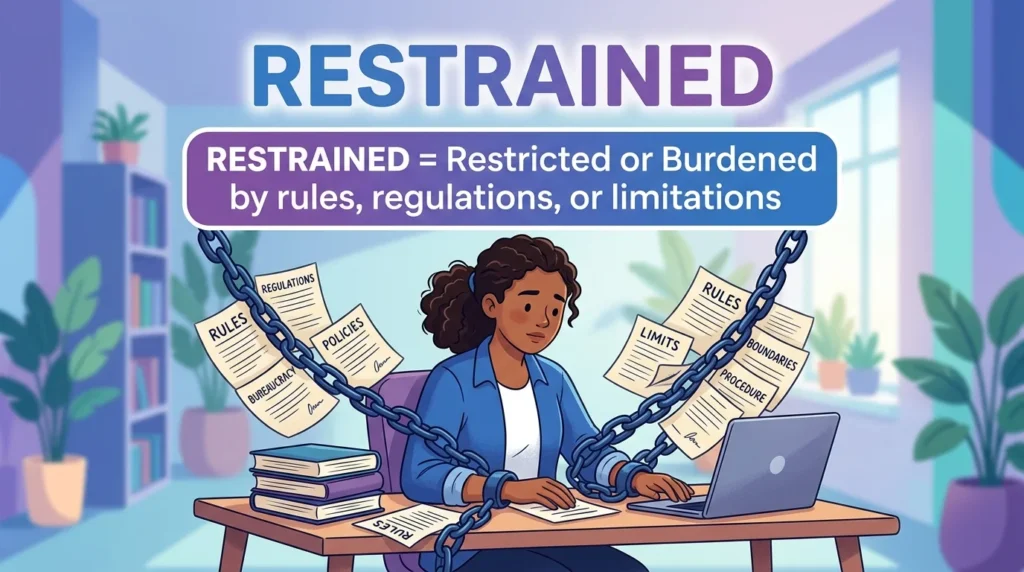
Fettered (Adjective) — US /ˈfɛt.ɚd/ / UK /ˈfet.əd/
Meaning: Restrained with chains or restricted by burdensome rules.
Tone/Register: Literary, Formal
Example 1: Writers should not feel fettered by traditional grammatical conventions.
Example 2: The startup operated without feeling fettered by corporate bureaucracy.
Harnessed (Adjective) — US /ˈhɑːr.nəst/ / UK /ˈhɑː.nɪst/
Meaning: Controlled and directed into a specific structured channel or task.
Tone/Register: Descriptive, Technical
Example 1: Renewable wind energy is harnessed to power the entire facility.
Example 2: Teams felt harnessed to deliver results under the new leadership.
Yoked (Adjective) — US /joʊkt/ / UK /jəʊkt/
Meaning: Tied or coupled together in shared labor or cooperative duty.
Tone/Register: Literary, Traditional
Example 1: Both departments were yoked together to complete the urgent audit.
Example 2: The historical partners remained yoked in business for decades.
Tethered (Adjective) — US /ˈtɛð.ərd/ / UK /ˈteð.əd/
Meaning: Tied or bound securely to a specific point, rule, or location.
Tone/Register: Descriptive, Technical
Example 1: The weather balloon remained tethered to the ground station.
Example 2: Digital devices feel tethered to cloud networks continuously.
Fixed (Adjective) — US /fɪkst/ / UK /fɪkst/
Meaning: Fastened securely or firmly established without option to change.
Tone/Register: Standard, Descriptive
Example 1: The meeting date is fixed and cannot be rescheduled.
Example 2: Prices for the promotional items remained fixed throughout the sale.
Formal & Legal:
Bound, Mandated, Constrained
Professional & Standard:
Required, Committed, Assigned
Grateful & Personal:
Indebted, Beholden, Appreciative
Mini Comparison: Obligated vs Close Alternatives
Obligated vs Compelled vs Required
- Obligated focuses on social, moral, or legal duties that you willingly accept or acknowledge. Use it when discussing promises, etiquette, or soft agreements.
- Compelled carries a stronger sense of external force or internal emotional urgency pushing you to act. Use it when a situation leaves you no practical choice.
- Required is a neutral, objective term controlled by rules, regulations, or laws. Use it for manuals, policies, and administrative guidelines.
Context-Based Usage
Daily Conversation
In everyday conversation, individuals naturally gravitate toward accessible terms like required or supposed to. More specifically, rather than employing a heavy legal expression, speakers simply mention that everyone is required to bring a dish to the party. Consequently, by maintaining approachable spoken language, friends and family can connect with expectations instantly.
Writing or Blogging
Essayists and lifestyle bloggers love descriptive adjectives like committed and indebted to keep readers engaged with personal narratives. Varied phrasing prevents your stories from sounding repetitive. Clear word choice makes digital articles much more readable on mobile devices.
Professional or Academic Tone
In legal briefs or corporate reports, terms like bound and mandated demonstrate high structural precision. Academic writers rely on these formal variants to describe regulatory frameworks and contractual obligations accurately.
Common Mistakes & Native Usage
Common Mistakes Learners Make
- Wrong register: Using heavy legal terms like mandated when talking about casual dinner invitations sounds unnatural.
- Confusing meaning: Mixing up indebted with financial debt when expressing simple gratitude can confuse your emotional tone.
- Overuse: Repeating the exact same adjective across multiple paragraphs makes your writing sound robotic.
Register Notes
Typically, experienced speakers adapt their vocabulary closely to suit their listeners. Conversely, whereas informal conversation prefers relaxed expressions, official legislation requires exact judicial terminology. Consequently, you must always evaluate whether your environment is a courtroom, a workplace, or a friendly chat.
Real-Life Mini Scenarios
Workplace
During the annual compliance meeting, the manager reminded staff that finishing safety training is required for all employees.
Social Situations
After receiving a generous wedding gift, she felt indebted to write a heartfelt thank-you note that same evening.
Media / Pop Culture
Popular detective dramas frequently feature characters bound by secret oaths to protect criminal syndicates.
Writing or Storytelling
The historical novelist chose to structure her plot around a knight bound by honor to serve the crown.
Conclusion
Expanding your vocabulary with accurate synonyms transforms how you express ideas in professional emails, legal guides, and personal essays. Furthermore, when you replace repetitive words with precise terms like bound, compelled, and required, your writing immediately gains clarity and professional polish.
Great communication relies on choosing the exact right expression for your specific audience and context. Practicing these semantic variants in your daily messages, stories, and formal documents builds lasting confidence in your language skills.
Take time today to try out a new synonym in your next writing project. Embracing diverse vocabulary is a rewarding journey that continuously elevates your voice and empowers your daily conversations.
Interactive Practice Quiz
- Which word fits best when an internal emotional urge forces someone to speak the truth?
- A) Compelled
- B) Ignored
- C) Bored
- D) Relaxed
- What is the most appropriate professional synonym when discussing mandatory office policies?
- A) Required
- B) Optional
- C) Haphazard
- D) Random
- When writing a formal legal brief, which regulatory adjective works best for official orders?
- A) Mandated
- B) Loose
- C) Playful
- D) Casual
- If someone feels deep gratitude after receiving life-changing help, which term applies?
- A) Indebted
- B) Hostile
- C) Indifferent
- D) Bitter
- Which synonym carries the strongest general connotation of dedication to a cause?
- A) Committed
- B) Confused
- C) Reluctant
- D) Distant
- How do native speakers usually discuss everyday party rules in casual conversation?
- A) Required
- B) Mandated
- C) Legally bound
- D) Constitutionally decreed
- Which term best describes a promise that cannot be broken without losing personal honor?
- A) Bound
- B) Unwritten
- C) Vague
- D) Temporary
Answer Key: A | A | A | A | A | A | A | A
Frequently Asked Questions
What is the best synonym for obligated in legal writing?
The best choice for official or contractual writing is bound or mandated, as these terms focus precisely on legal requirements and official enforcement.
How do I choose between obligated and compelled?
Use obligated when describing a duty accepted through social or moral expectations. Use compelled when an external force or intense pressure leaves no alternative.
Is indebted a formal word?
Yes, indebted is formal and carries a strong tone of gratitude, making it ideal for speeches, professional acknowledgments, and thank-you letters.
Can I use required as a direct synonym for moral duty?
Not quite. Required is an objective, administrative term controlled by rules, whereas moral duty involves personal conscience and ethics.
Why should I avoid repeating focus keywords in every paragraph?
Overusing exact keywords creates unnatural reading patterns and lowers engagement. Using semantic variants keeps your content smooth, human-friendly, and optimized for modern search standards.

Aleesha Rani is a passionate language writer focused on making English vocabulary simple, useful, and engaging. She creates clear content on synonyms, word meanings, and practical language use.
Through vocaneest.com, Aleesha Rani shares original, reader-friendly resources that help students, writers, and English learners choose better words and communicate with confidence.