A synonym for ornery includes words like grouchy, cantankerous, stubborn, irritable, crabby, surly, and obstinate. The best synonym depends on whether you mean someone who is easily annoyed, difficult to manage, or stubbornly set in their ways. In casual speech, terms like grumpy or testy work best, while formal writing favors obstinate or recalcitrant.
Synonym for ornery search requests usually stem from a desire to describe difficult personalities with precise, vivid language. Imagine trying to describe an old neighbor who gets upset whenever a football rolls onto his lawn. Calling him bad-tempered works, but calling him a synonym for ornery like cantankerous paints a far richer image.
Using varied terms keeps your writing fresh and prevents repetitive language in essays or stories. Native speakers frequently use these semantic alternatives to convey humor, irritation, or stubbornness in daily conversations.
Mastering these alternatives helps students, bloggers, content writers, and English learners express personality traits with subtle emotional shades. Expanding your vocabulary makes your spoken and written communication far more natural and captivating.
What Does “Ornery” Really Mean?
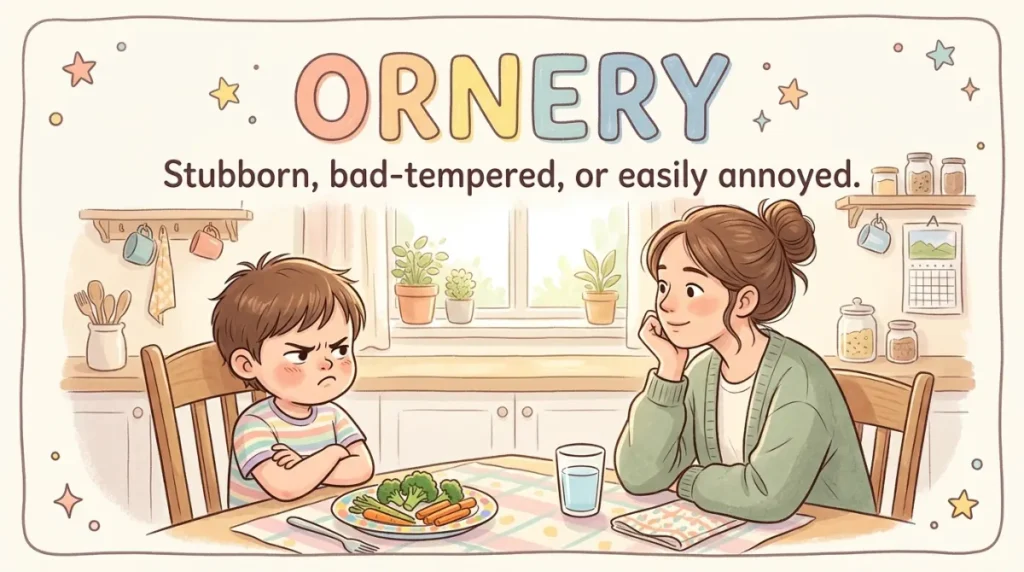
Understanding ornery starts with examining how native English speakers use the word in everyday situations. In modern American English, “ornery” functions primarily as an adjective. It describes someone who is bad-tempered, combative, stubborn, or hard to manage.
Native speakers often view the word with a blend of annoyance and mild affection. It frequently describes people, tired children, or stubborn farm animals. The term appears regularly in storytelling, casual conversations, and descriptive blogging.
- Part of Speech: Adjective
- Simple Definition: Having a difficult, stubborn, or easily irritated disposition that makes a person hard to deal with.
Connotative Meaning
(Connotation refers to the emotional feeling or cultural association that a word carries beyond its dictionary definition.)
- Positive tone: Playfully stubborn, feisty, spirited, or charmingly independent.
- Negative tone: Mean-spirited, aggressive, uncooperative, or unpleasant.
- Neutral tone: Describing a temporary mood of irritation or physical discomfort.
Etymology & History
The word “ornery” has a fascinating origin rooted in American dialect history. It originated in the late 18th century as a casual, spoken corruption of the word “ordinary.” Over time, the meaning shifted from “common” or “plain” to “ugly in temper” and “stubborn.”
- Old English (450–1100): The term did not exist in Old English. Root concepts relied on words like ōwerlic (contrary).
- Middle English (1100–1500): Middle English speakers borrowed ordinarie from Old French, meaning standard or customary.
- Modern English (1500–Present): In 18th and 19th-century American regional English, “ordinary” morphed into “ornery,” permanently taking on its modern meaning of cantankerous or ill-tempered.
Pronunciation
- US IPA: /ˈɔːr.nɚ.i/ or /ˈɑːr.nɚ.i/
- UK IPA: /ˈɔː.nər.i/
Syllables & Structure
- Syllable division: or-ner-y
- Root: Ordinary (from Latin ordinarius)
- Prefix: None
- Suffix: -y (adjectival suffix meaning “having the quality of”)
Synonyms List
Disagreeable (Adjective) — US: /ˌdɪs.əˈɡriː.ə.bəl/ | UK: /ˌdɪs.əˈɡriː.ə.bəl/
Meaning: Unpleasant in temperament, difficult to deal with, and easily displeased.
Tone/Register: Neutral, Professional. Everyday
Examples: The manager’s disagreeable mood made everyone hesitate to ask questions.
Cold rain and heavy traffic made for a thoroughly disagreeable morning commute.
Canty (Adjective) — US: /ˈkæn.ti/ | UK: /ˈkæn.ti/
Meaning: Lively or spirited in a sharp, somewhat argumentative or edgy manner.
Tone/Register: Literary, Regional, Older Usage
Examples:
The old sea captain remained canty and sharp-tongued well into his nineties.
She gave a canty reply whenever anyone questioned her traditional recipes.
Churlish-Tempered (Adjective) — US: /ˈtʃɝː.lɪʃ ˈtem.pɚd/ | UK: /ˈtʃɜː.lɪʃ ˈtem.pəd/
Meaning: Displaying a consistently rude, ill-bred, and ungracious attitude.
Tone/Register: Formal, Literary, Critical.
Examples: His churlish-tempered reaction to the constructive feedback shocked his colleagues.
The host tried to ignore her guest’s churlish-tempered remarks throughout dinner.
Ill-Natured (Adjective) — US: /ˌɪlˈneɪ.tʃɚd/ | UK: /ˌɪlˈneɪ.tʃəd/
Meaning: Naturally spiteful, unkind, or quick to show bad temper toward others. Tone/Register: Neutral, Descriptive, Written Examples: An ill-natured comment scattered tension across the quiet meeting room.
He struggled to hide his ill-natured personality behind a polite smile.
Crusty (Adjective) — US: /ˈkrʌs.ti/ | UK: /ˈkrʌs.ti/
Meaning: Having a harsh, blunt, or easily irritated exterior that masks character.
Tone/Register: Informal, Casual. Characterization
Examples: Beneath his crusty exterior, the rural farmer had a deeply generous heart.
The crusty old judge grumbled before delivering his final verdict.
Splenetic (Adjective) — US: splɪˈnet.ɪk / UK: splɪˈnet.ɪk
Meaning: Given to sudden, violent outbursts of bad temper or spitefulness.
Tone/Register: Elevated, Academic, Literary
Examples:
The columnist launched a splenetic attack against the mayor’s new policy.
Years of frustration produced a bitter, splenetic disposition in the artist.
Vinegarish (Adjective) — US: /ˈvɪn.ə.ɡɚ.ɪʃ/ | UK: /ˈvɪn.ɪ.ɡər.ɪʃ/
Meaning: Sour in manner, expression, or tone; sharply unpleasant.
Tone/Register: Descriptive, Literary, Figurative
Examples:
She offered a vinegarish smirk when her rival’s project failed to impress.
His vinegarish tone quickly ruined the celebratory mood in the room.
Unyielding (Adjective) — US: /ʌnˈjiːl.dɪŋ/ | UK: /ʌnˈjiːl.dɪŋ/
Meaning: Completely inflexible and refusing to soften one’s stance or attitude.
Tone/Register: Formal, Serious, Business
Examples: Negotiators faced an unyielding stance from the union representatives.
Her unyielding determination helped her push past every obstacle.
Wasplike (Adjective) — US: /ˈwɑːsp.laɪk/ | UK: /ˈwɒsp.laɪk/
Meaning: Irritated, quick-tempered, and inclined to deliver sharp, painful remarks.
Tone/Register: Descriptive, Literary, Expressive
Examples: He delivered a wasplike critique that left the young speaker speechless.
Her wasplike nature made it difficult for newcomers to feel welcome.
Curmudgeonly (Adjective) — US: kɚˈmʌdʒ.ən.li / UK: kəˈmʌdʒ.ən.li
Meaning: Characteristic of a crusty, ill-tempered, and stubborn individual.
Tone/Register: Literary, Expressive, Humorous.
Examples:
His curmudgeonly habit of complaining about the weather amused his family.
The store owner gave a curmudgeonly wave as the teenagers walked past.
Ill-Humored (Adjective) — US: /ˌɪlˈhjuː.mɚd/ | UK: /ˌɪlˈhjuː.məd/
Meaning: In a bad mood, disagreeable, or showing annoyance toward surroundings.
Tone/Register: Neutral, Formal, Written
Examples: An ill-humored sigh escaped her lips as the flight departure was delayed again.
He gave an ill-humored response to the reporter’s morning question.
Sharp-Tongued (Adjective) — US: /ˌʃɑːrpˈtʌŋd/ | UK: /ˌʃɑːpˈtʌŋd/
Meaning: Inclined to speak in a harsh, critical, or bitingly sarcastic manner.
Tone/Register: Casual, Descriptive. Spoken
Examples: Her sharp-tongued aunt never missed a chance to point out messy clothes.
The reviewer was known for giving sharp-tongued assessments of new films.
Unamenable (Adjective) — US: /ˌʌn.əˈmiː.nə.bəl/ | UK: /ˌʌn.əˈmiː.nə.bəl/
Meaning: Unwilling to be influenced, persuaded, guided, or cooperated with.
Tone/Register: Formal, Academic, Legal
Examples: The board found the director unamenable to any proposed strategy changes.
He remained unamenable to reason despite overwhelming logical proof.
Snappy (Adjective) — US: /ˈsnæp.i/ | UK: /ˈsnæp.i/
Meaning: Irritable and quick to speak abruptly or unkindly out of frustration.
Tone/Register: Informal, Casual, Everyday
Examples: Be careful talking to the team leader today because she feels quite snappy.
A snappy comment during breakfast made the room go completely quiet.
Short-Tempered (Adjective) — US: /ˌʃɔːrtˈtem.pɚd/ | UK: /ˌʃɔːtˈtem.pəd/
Meaning: Tendency to lose patience and become angry very quickly over minor events.
Tone/Register: General, Everyday, Direct
Examples: Sleep deprivation makes even calm individuals short-tempered with friends.
Our short-tempered coach demanded absolute focus during tactical drills.
Dour (Adjective) — US: /dʊr/ or /daʊɚ/ | UK: /dʊər/ or /daʊər/
Meaning: Stern, gloomy, severe, and stubbornly unyielding in expression or mood.
Tone/Register: Formal, Literary, Descriptive
Examples: The dour security officer checked identity cards without uttering a word.
A dour expression settled over his face when the budget cuts were announced.
Intransigent (Adjective) — US: /ɪnˈtræn.sə.dʒənt/ | UK: /ɪnˈtræn.zɪ.dʒənt/
Meaning: Refusing to compromise or modify one’s position in an extreme way.
Tone/Register: Formal, Political, Business
Examples: Both political parties remained intransigent during the final budget debate.
An intransigent attitude prevented the dispute from settling out of court.
Feisty (Adjective) — US: /ˈfaɪ.sti/ | UK: /ˈfaɪ.sti/
Meaning: Playfully aggressive, spirited, stubborn, and ready to stand up for oneself.
Tone/Register: Casual, Friendly, Expressive
Examples: The feisty terrier barked bravely at the large delivery truck outside.
She gave a feisty speech defending her team’s creative design strategy.
Grumpy (Adjective) — US: /ˈɡrʌm.pi/ | UK: /ˈɡrʌm.pi/
Meaning: Bad-tempered, dissatisfied, and inclined to complain about discomforts.
Tone/Register: Casual, Everyday, Friendly
Examples: He is always grumpy when forced to wake up before six in the morning.
The grumpy customer demanded to speak directly with the branch manager.
Perverse-Minded (Adjective) — US: pɚˈvɝːs ˈmaɪn.dɪd / UK: pəˈvɜːs ˈmaɪn.dɪd
Meaning: Persistent in holding unreasonable or contrary opinions just to be difficult.
Tone/Register: Formal, Critical, Analytical
Examples: His perverse-minded refusal to sign the document halted project development.
She argued with a perverse-minded logic that left the panel confused.
Unbending (Adjective) — US: /ʌnˈben.dɪŋ/ | UK: /ʌnˈben.dɪŋ/
Meaning: Rigidly severe, strict, and unwilling to adapt to changing circumstances.
Tone/Register: Formal, Serious, Descriptive
Examples: The principal maintained an unbending discipline code across the school grounds.
Her unbending principles guided every difficult ethical choice she made.
Sour-Tempered (Adjective) — US: /ˈsaʊ.ɚ ˈtem.pɚd/ | UK: /ˈsaʊ.ə ˈtem.pəd/
Meaning: Having an unpleasant, resentful, and bitter attitude toward daily interactions.
Tone/Register: General, Descriptive, Spoken.
Examples: A sour-tempered receptionist barely acknowledged guests at the front desk.
He grew sour-tempered after sitting in motionless traffic for two hours.
Wayward (Adjective) — US: /ˈweɪ.wɚd/ | UK: /ˈweɪ.wəd/
Meaning: Difficult to control, turn, or predict due to perverse or stubborn impulses.
Tone/Register: Literary, Descriptive, Formal.
Examples: The shepherd spent hours tracking a wayward lamb that strayed off the trail.
Her wayward hair refused to stay neat despite hairpins and spray.
Tough-Minded (Adjective) — US: /ˌtʌfˈmaɪn.dɪd/ | UK: /ˌtʌfˈmaɪn.dɪd/
Meaning: Firm, unyielding, and realistic to the point of appearing stubborn or cold.
Tone/Register: Professional, Business, Neutral.
Examples: The chief executive took a tough-minded approach to cutting company expenses.
Negotiators relied on tough-minded leadership to finalize the trade contract.
Froward (Adjective) — US: /ˈfroʊ.wɚd/ | UK: /ˈfrəʊ.wəd/
Meaning: Stubbornly contrary, disobedient, and difficult to manage or direct.
Tone/Register: Archaic, Literary, Formal
Examples: Ancient literature often depicted froward characters who defied royal decrees.
The tutor struggled to manage a froward pupil who resisted every lesson plan.
Cantankerous (Adjective) — US: /kænˈtæŋ.kɚ.əs/ | UK: /kænˈtæŋ.kər.əs/
Meaning: Unreasonable, bad-tempered, and looking for an argument over small matters.
Tone/Register: Informal, Descriptive, Expressive
Examples:
The cantankerous old cat hissed whenever the puppy trotted past his bed.
Our neighbor grew cantankerous after waiting an hour for his bus to arrive.
Grouchy (Adjective) — US: /ˈɡraʊ.tʃi/ | UK: /ˈɡraʊ.tʃi/
Meaning: Easily annoyed, complaining constantly, and expressing mild bad humor.
Tone/Register: Casual, Everyday, Friendly
Examples:
He always feels grouchy before drinking his morning mug of dark roast coffee.
The tired toddler got grouchy after missing her usual afternoon nap.
Stubborn (Adjective) — US: /ˈstʌb.ɚn/ | UK: /ˈstʌb.ən/
Meaning: Unwilling to change an opinion, plan, or course of action despite good reasons.
Tone/Register: General, Neutral, Common
Examples:
Her stubborn brother refused to wear a heavy raincoat during the downpour.
The mule remained stubborn and stood firmly in the middle of the dirt path.
Crabby (Adjective) — US: /ˈkræb.i/ | UK: /ˈkræb.i/
Meaning: Irritable, easily provoked, and prone to complaining about minor issues.
Tone/Register: Informal, Conversational, Spoken
Examples:
Working long hours without a lunch break made the entire office team crabby.
She gave a crabby response when asked to clean up the shared kitchen counter.
Surly (Adjective) — US: /ˈsɝː.li/ | UK: /ˈsɜː.li/
Meaning: Unfriendly, rude, and bad-tempered in manner or facial expression.
Tone/Register: Neutral, Descriptive, Written
Examples:
The surly clerk handed over the receipt without making any eye contact.
A surly expression settled on his face during the long safety briefing.
Irritable (Adjective) — US: /ˈɪr.ə.t̬ə.bəl/ | UK: /ˈɪr.ɪ.tə.bəl/
Meaning: Having a low threshold for frustration and becoming annoyed very quickly.
Tone/Register: Neutral, Professional, Academic
Examples:
Loud traffic noise makes many city residents irritable after a stressful workday.
Patients often become irritable when dealing with chronic physical pain.
Obstinate (Adjective) — US: /ˈɑːb.stə.nət/ | UK: /ˈɒb.stɪ.nət/
Meaning: Sticking stubbornly to an attitude or position in a firm, unyielding way.
Tone/Register: Formal, Literary, Academic
Examples:
The committee faced an obstinate member who vetoed every reasonable proposal.
Despite clear evidence, the director remained obstinate about his original design.
Testy (Adjective) — US: /ˈtes.ti/ | UK: /ˈtes.ti/
Meaning: Easily irritated and inclined to snap at people over small errors.
Tone/Register: Informal, Casual, Direct
Examples:
The manager gave a testy answer when interrupted during her project presentation.
Lack of sleep left him feeling testy throughout the morning business call.
Crotchety (Adjective) — US: /ˈkrɑː.tʃə.t̬i/ | UK: /ˈkrɒtʃ.ə.ti/
Meaning: Full of strange whims, complaints, and bad humor, often associated with age.
Tone/Register: Informal, Whimsical, Descriptive
Examples:
A crotchety mechanic grumbled while checking under the hood of the broken car.
He became crotchety whenever his favorite evening television show was delayed.
Touchy (Adjective) — US: /ˈtʌtʃ.i/ | UK: /ˈtʌtʃ.i/
Meaning: Overly sensitive, easily offended, and quick to take mild criticism personally.
Tone/Register: Casual, Spoken, Relatable
Examples:
Avoid mentioning office budgets because the department head is very touchy about it.
She felt touchy after working three consecutive weekend shifts without rest.
Irascible (Adjective) — US: /ɪˈræs.ə.bəl/ | UK: /ɪˈræs.ə.bəl/
Meaning: Having a fiery hot temper that ignites into anger at the slightest provocation.
Tone/Register: Formal, Literary, Elevated
Examples:
The irascible chef threw a wooden spoon across the kitchen in frustration.
Historians described the king as an irascible ruler who tolerated zero opposition.
Recalcitrant (Adjective) — US: /rɪˈkæl.sɪ.trənt/ | UK: /rɪˈkæl.sɪ.trənt/
Meaning: Stubbornly resistant to authority, discipline, or guidance from others.
Tone/Register: Formal, Academic, Legal
Examples:
The recalcitrant student refused to hand over his mobile device during the test.
Officers struggled to manage the recalcitrant crowd gathered near the entrance.
Fractious (Adjective) — US: /ˈfræk.ʃəs/ | UK: /ˈfræk.ʃəs/
Meaning: Irritable, unruly, and likely to cause trouble or disagreements.
Tone/Register: Formal, Literary, Descriptive
Examples:
The fractious audience began shouting objections midway through the debate.
Hungry children often turn fractious when forced to stand in long shopping lines.
Peevish (Adjective) — US: /ˈpiː.vɪʃ/ | UK: /ˈpiː.vɪʃ/
Meaning: Discontented, fretful, and showing petty annoyance over trivial matters.
Tone/Register: Neutral, Literary, Written
Examples:
He made a peevish remark about the temperature inside the conference room.
A peevish tone crept into her voice as the train delay stretched past an hour.
Contrary (Adjective) — US: /ˈkɑːn.trer.i/ | UK: /ˈkən.trə.ri/
Meaning: Deliberately inclined to disagree, argue, or do the exact opposite of what is asked.
Tone/Register: General, Casual, Descriptive
Examples:
My contrary sister always picks the restaurant everyone else rejected.
He took a contrary stance during the team meeting just to stir up debate.
Cross (Adjective) — US: /krɑːs/ | UK: /krɒs/
Meaning: Annoyed, ill-humored, or mildly angry with someone over a mistake.
Tone/Register: British English, Informal, Gentle
Examples:
The teacher looked cross when the students forgot to turn in their assignments.
Don’t be cross with him for accidentally spilling a few drops of water.
Bad-Tempered (Adjective) — US: /ˌbædˈtem.pɚd/ | UK: /ˌbædˈtem.pəd/
Meaning: Frequently angry, gloomy, or unpleasant toward people in daily interactions.
Tone/Register: General, Everyday, Direct
Examples:
A bad-tempered driver honked his horn loudly at the bicycle rider ahead.
He turned into a bad-tempered companion after losing his wallet at the park.
Uncooperative (Adjective) — US: /ˌʌn.koʊˈɑː.pɚ.ə.t̬ɪv/ | UK: /ˌʌn.kəʊˈɒp.ər.ə.tɪv/
Meaning: Refusing to work together or assist others in completing a shared task.
Tone/Register: Formal, Business, Official
Examples:
The client proved uncooperative when asked to submit necessary verification documents.
Uncooperative weather conditions delayed the outdoor festival by two weeks.
Sullen (Adjective) — US: /ˈsʌl.ən/ | UK: /ˈsʌl.ən/
Meaning: Silently resentful, gloomy, and refusing to smile or interact with others.
Tone/Register: Literary, Descriptive, Serious
Examples:
The sullen teenager sat in the back row with his arms crossed tightly.
A sullen silence fell over the room following the sudden announcement.
Intractable (Adjective) — US: /ɪnˈtræk.tə.bəl/ | UK: /ɪnˈtræk.tə.bəl/
Meaning: Hard to manage, control, solve, or cure due to deep resistance.
Tone/Register: Formal, Academic, Medical
Examples:
The team spent months dealing with an intractable technical glitch in the system.
Her intractable nature made negotiating a fair compromise nearly impossible.
Churlish (Adjective) — US: /ˈtʃɝː.lɪʃ/ | UK: /ˈtʃɜː.lɪʃ/
Meaning: Rude, mean, and lacking basic good manners or polite behavior.
Tone/Register: Formal, Literary, Critical
Examples:
It felt churlish to decline her generous offer to help carry the heavy boxes.
His churlish behavior at the dinner party shocked the host and other guests.
Refractory (Adjective) — US: /rɪˈfræk.tɚ.i/ | UK: /rɪˈfræk.tər.i/
Meaning: Unmanageable, resistant to treatment, or refusing to obey instructions.
Tone/Register: Academic, Medical, Formal
Examples:
The physician adjusted the dosage to treat a refractory fever in the patient.
A refractory donkey stopped dead on the trail and ignored every command.
Perverse (Adjective) — US: /pɚˈvɝːs/ | UK: /pəˈvɜːs/
Meaning: Showing a deliberate desire to behave in a way that is unreasonable or unacceptable.
Tone/Register: Formal, Psychological, Analytical
Examples:
He took perverse pleasure in arguing against facts everyone in the room accepted.
Her perverse insistence on driving during the blizzard put everyone at risk.
Bilious (Adjective) — US: /ˈbɪl.i.əs/ | UK: /ˈbɪl.i.əs/
Meaning: Extremely spiteful, bad-tempered, or nauseatingly unpleasant in disposition.
Tone/Register: Literary, Formal, Dramatic
Examples:
The critic wrote a bilious review that attacked every aspect of the new play.
His bilious mood ruined what should have been a pleasant family dinner outing.
Snappish (Adjective) — US: /ˈsnæp.ɪʃ/ | UK: /ˈsnæp.ɪʃ/
Meaning: Responding with sharp, quick, irritated words during a conversation.
Tone/Register: Informal, Casual, Conversational
Examples:
She gave a snappish reply when asked where she had placed the missing keys.
Working under tight deadlines made the entire design team feel snappish.
Synonyms by Tone
Grouping synonyms by tone ensures you pick the right word for your target audience:
                  ┌───────────────────────────────┐
                  │   SYNONYMS BY TONAL CATEGORY  │
                  └───────────────┬───────────────┘
                                  │
       ┌──────────────────────────┼──────────────────────────┐
       ▼                          ▼                          ▼
  PLAYFUL/CASUAL              NEUTRAL                    FORMAL
 (Light/Friendly)          (Descriptive)              (Academic/Legal)
 ───────────────          ──────────────              ────────────────
 • Grouchy                • Stubborn                  • Obstinate
 • Crabby                 • Irritable                 • Irascible
 • Crotchety              • Surly                     • Recalcitrant
 • Testy                  • Bad-Tempered              • Intractable
 • Touchy                 • Uncooperative             • Churlish
Playful / Informal:
Grouchy, Crabby, Crotchety, Touchy, Snappish, Cantankerous.
Neutral / General:
Stubborn, Irritable, Surly, Bad-Tempered, Contrary, Uncooperative.
Negative / Harsh:
Churlish, Bilious, Sullen, Perverse.
Formal / Academic:
Obstinate, Irascible, Recalcitrant, Fractious, Intractable, Refractory.
Tone matters because using a formal word in casual conversation can sound awkward. Calling a grumpy friend “recalcitrant” sounds robotic, while calling them “grouchy” feels natural.
Mini Comparison: Cantankerous vs. Stubborn vs. Recalcitrant
| Feature | Cantankerous | Stubborn | Recalcitrant |
| Core Meaning | Argumentative and bad-tempered | Refusing to change mind/position | Defying authority or rules |
| Tone/Register | Informal, expressive | General, neutral | Formal, academic, official |
| Focus Area | Mood and social friction | Personal willpower/rigidity | Rebellion against control |
| Example | “A cantankerous old man.” | “A stubborn child.” | “A recalcitrant worker.” |
Context-Based Usage
Daily Conversation
In casual chats, native speakers prefer simple terms. Use grouchy, crabby, testy, or touchy when describing friends, family members, or co-workers having a bad day.
Writing & Blogging
Bloggers and storytellers benefit from colorful words like cantankerous, crotchety, surly, or sullen. These words help build vivid character descriptions that keep readers engaged.
Professional & Academic Tone
In business reports, academic papers, or legal contexts, opt for obstinate, uncooperative, intractable, or recalcitrant. These words convey objective observations without sounding colloquial.
Creative Writing & Storytelling
Fiction writers can express deep emotional layers using irascible, fractious, churlish, or bilious. These words establish atmosphere and reveal character flaws subtly.
Common Mistakes & Native Usage
- Confusing Stubbornness with Anger: “Stubborn” means refusing to change, while “ornery” combines stubbornness with a bad temper.
- Overusing Formal Synonyms: Words like “irascible” or “refractory” belong in literature or academic reports. Avoid using them in casual text messages.
- Misjudging Sensitivity: “Touchy” means easily offended, whereas “cantankerous” implies actively looking for a fight.
For deeper insights into English word origins and usage patterns, explore linguistic tools on Merriam-Webster.
Real-Life Mini Scenarios
- Workplace: An executive describes a prolonged vendor disagreement as an intractable negotiation issue rather than calling the partner rude.
- Social Situations: A friend excuses her partner’s short answers by explaining he gets grouchy when he skips breakfast.
- Media & Pop Culture: Movie critics often describe iconic grump characters as cantankerous heroes with soft hearts under their rough exterior.
- Storytelling: An author depicts a surly guard standing watch outside a mountain castle gate.
Conclusion
Mastering a synonym for ornery helps you express human emotions and stubborn behaviors with remarkable precision. Diverse terms enrich your spoken and written voice.
Learning semantic alternatives turns repetitive writing into vivid storytelling. Smart word choices improve your essays, blog articles, and daily emails.
Practicing these vocabulary shades builds strong communication confidence over time. Using precise terms allows you to connect better with readers everywhere.
Try using two new synonyms from this guide in your next journal entry or email draft to lock them permanently into your active English vocabulary!
Interactive Practice Quiz
Test your understanding of these synonyms by selecting the correct word for each scenario:
- Which word best describes a tired child who complains constantly before bedtime?
- A) Recalcitrant
- B) Grouchy
- C) Bilious
- D) Intractable
- What is the most formal word for someone who openly resists authority or regulations?
- A) Crabby
- B) Recalcitrant
- C) Touchy
- D) Snappish
- Which term best suits an old movie character who grumbles at everyone but means well?
- A) Refractory
- B) Cantankerous
- C) Bilious
- D) Uncooperative
- Choose the ideal word for a friend who gets easily offended by mild jokes.
- A) Touchy
- B) Sullen
- C) Obstinate
- D) Churlish
- Which synonym fits best in a medical report describing a disease that resists treatment?
- A) Crotchety
- B) Refractory
- C) Crabby
- D) Surly
- What word describes a silent, brooding teenager who refuses to join family conversations?
- A) Testy
- B) Sullen
- C) Fractious
- D) Contrary
- Which term describes a chef with a fiery temper who explodes at minor kitchen mistakes?
- A) Irascible
- B) Touchy
- C) Peevish
- D) Cross
- Choose the British English term often used when someone is mildly annoyed.
- A) Bilious
- B) Cross
- C) Churlish
- D) Intractable
- Which word best describes a person who refuses to change their mind despite clear proof?
- A) Obstinate
- B) Snappish
- C) Fractious
- D) Touchy
- What is the best casual synonym for someone giving sharp, quick answers due to stress?
- A) Snappish
- B) Recalcitrant
- C) Churlish
- D) Refractory
Reflection Task
Write a 2-sentence story about a character dealing with a difficult situation, using at least two synonyms from this guide.
Answer Key:
1: B | 2: B | 3: B | 4: A | 5: B | 6: B | 7: A | 8: B | 9: A | 10: A
Frequently Asked Questions
1. What is the absolute best synonym for ornery in everyday speech?
The most common everyday synonyms are “grouchy,” “grumpy,” or “crabby.” These words capture the bad-tempered, easily annoyed quality of ornery without sounding overly formal or aggressive.
2. Is ornery a negative or playful word?
It can be both. While it literally describes someone ill-tempered or stubborn, native speakers often use it playfully or affectionately to describe spirited people, pets, or toddlers.
3. How does ornery differ from stubborn?
“Stubborn” means simply refusing to change one’s mind or direction. “Ornery” combines stubbornness with irritability and an argumentative attitude, making the person harder to manage.
4. What formal synonym for ornery works best in professional writing?
In professional or business writing, “uncooperative,” “obstinate,” or “intractable” work best. These terms describe difficult behavior objectively without using informal slang.
5. Why is ornery considered a regional American word?
Ornery originated as a 19th-century American dialect pronunciation of “ordinary.” Over decades, rural speakers used it so frequently to mean “bad-tempered” that it became a distinct dictionary word.

Esha loves exploring English words and finding simple ways to explain them. She writes about synonyms, vocabulary, word meanings, and everyday language in a clear and friendly style. Through vocaneest.com, Esha shares useful tips and easy-to-follow language guides for students, writers, and anyone looking to improve their English. Her goal is simple: to help readers choose better words, express their ideas clearly, and feel more confident when writing or communicating.