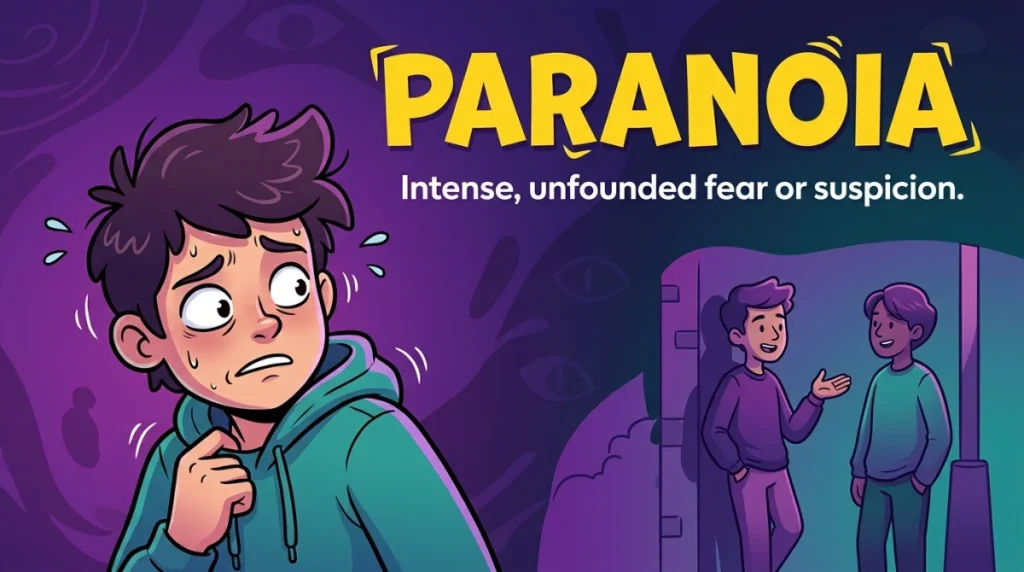
A synonym for paranoia is a word or phrase that describes excessive suspicion, distrust, or an unreasonable fear that others may intend harm. Common alternatives include suspicion, mistrust, distrust, wariness, and persecutory thinking. The best choice depends on the context and intensity of the feeling.
Imagine receiving a short message from a friend that says, “We need to talk.” You begin wondering whether something is wrong, even though you have no evidence of a problem. This reaction may involve suspicion or worry, but one moment of uncertainty does not automatically mean paranoia.
The word paranoia often appears in conversations about relationships, workplace conflicts, mystery stories, and mental health. Choosing a suitable alternative helps you express the exact feeling without exaggerating the situation.
For students, bloggers, and content writers, learning related vocabulary makes essays, articles, and stories more precise. Everyday English users can also communicate feelings clearly by understanding the differences between suspicion, distrust, fear, and anxiety.
When searching for a synonym for paranoia, remember that these words are not always interchangeable. Some describe reasonable caution, while others suggest intense or persistent beliefs that someone intends harm.
What Does “Paranoia” Really Mean?
Paranoia is a noun that describes intense or persistent suspicion, distrust, or the belief that others may be trying to harm, deceive, or threaten someone without sufficient evidence.
In everyday English, people sometimes use the word casually when discussing jealousy, overthinking, or uncertainty. In mental health contexts, however, paranoia can describe more serious experiences that deserve careful, respectful language.
Native English speakers generally understand the word through its context. In a casual conversation, it might describe someone who worries that friends are talking about them. In a psychological discussion, it may refer to persistent beliefs about threats or persecution.
Part of speech: Noun
Simple definition: An excessive or persistent feeling of suspicion or fear that other people may intend harm.
Example: “His paranoia made him question the motives behind every friendly gesture.”
Remember that ordinary caution, occasional insecurity, or asking questions does not necessarily indicate paranoia. The word should not be used as a diagnosis based on one behavior.
Connotative Meaning of Paranoia
(Connotation means the emotional associations or feelings a word carries beyond its basic dictionary definition.)
- Positive tone: Paranoia itself rarely has a genuinely positive connotation. However, in casual speech, people may use it jokingly to describe being extra careful.
- Negative tone: The word commonly suggests excessive suspicion, irrational fear, or difficulty trusting other people.
- Neutral tone: In academic, medical, or analytical writing, paranoia may be used descriptively without intending to insult someone.
Example: “The security team checked every entrance carefully” describes a practical precaution. Calling the same behavior “paranoia” would imply that the concern might be excessive.
Etymology of Paranoia
The word paranoia comes from Greek, through later medical and European usage. Its Greek elements are associated with para, meaning “beside” or “beyond,” and nous, meaning “mind.” Its historical sense developed around disordered thinking.
The word entered English through medical terminology and became established in psychological and general vocabulary. Its meaning has changed across different periods as medical understanding has developed.
Historical Development
- Old English (450–1100): The modern word paranoia was not part of ordinary Old English vocabulary. Related ideas about fear and suspicion were expressed through other words.
- Middle English (1100–1500): English speakers used existing vocabulary to describe distrust, fear, and suspicion. Paranoia was not yet a common English term.
- Modern English (1500–present): The word entered English through medical usage and later spread into everyday conversation, literature, journalism, and discussions of psychology.
Pronunciation (US and UK – IPA)
- US: /ˌpær.əˈnɔɪ.ə/
- UK: /ˌpær.əˈnɔɪ.ə/
Syllables
par-a-noi-a (four syllables)
Affixation Pattern of Paranoia
- Root: Greek paranoia, historically associated with disordered thought.
- Prefix: No productive English prefix is added in the modern word.
- Suffix: The ending -ia appears in many nouns associated with conditions or states.
The word is best learned as a complete noun rather than broken into modern English word-building elements.
Synonyms List
Not every word below is a perfect replacement for paranoia. Some describe distrust, others express fear or concern, and a few are appropriate mainly in psychological or literary contexts. Choose the word that matches the intended meaning.
Disbelief (Noun) — US / UK: /ˌdɪs.bɪˈliːf/
Meaning: An inability or refusal to accept something as true.
Tone/Register: Neutral; everyday and formal.
Example:
He reacted with disbelief when he heard the unexpected accusation.
Her disbelief grew when the explanation changed again.
Skepticism About Motives (Noun Phrase)
Meaning: A tendency to question the reasons behind another person’s actions.
Tone/Register: Neutral; professional and conversational.
Example:
She expressed skepticism about the manager’s sudden generosity.
His skepticism about their motives encouraged him to ask more questions.
Fear of Being Watched (Noun Phrase)
Meaning: A concern that someone is observing one’s activities without permission or consent.
Tone/Register: Neutral; descriptive.
Example:
The character’s fear of being watched creates tension throughout the story.
The article discusses privacy concerns and the fear of being watched online.
Fear of Exposure (Noun Phrase)
Meaning: Anxiety that private information, mistakes, or secrets may become known to others.
Tone/Register: Neutral to emotional.
Example:
His fear of exposure prevented him from discussing the mistake openly.
The story explores a character’s fear of exposure after a secret emerges.
Fear of Conspiracy (Noun Phrase)
Meaning: A concern that people may be secretly cooperating to cause harm or manipulate events.
Tone/Register: Descriptive; context-dependent.
Example:
The film explores a character’s fear of conspiracy within the organization.
The writer shows how fear of conspiracy influences public debate.
Perceived Threat (Noun Phrase)
Meaning: A person, event, or situation that someone interprets as potentially dangerous.
Tone/Register: Formal; academic and professional.
Example:
He interpreted the harmless comment as a perceived threat.
The study examined how people respond to perceived threats in uncertain situations.
Hostile Attribution (Noun Phrase)
Meaning: The interpretation of another person’s behavior as deliberately hostile, even when the intention may be unclear.
Tone/Register: Academic; psychological.
Example:
Hostile attribution caused him to interpret an ordinary disagreement as a personal attack.
The researchers explored hostile attribution during social interactions.
Threat Sensitivity (Noun Phrase)
Meaning: A heightened tendency to notice or react strongly to possible danger.
Tone/Register: Academic; psychological.
Example:
Threat sensitivity influenced how she interpreted ambiguous facial expressions.
The paper examines threat sensitivity in stressful environments.
Hyperawareness (Noun) — US / UK: /ˌhaɪ.pər.əˈwer.nəs/
Meaning: An unusually heightened awareness of one’s surroundings, actions, or other people’s behavior.
Tone/Register: Neutral to clinical; context-dependent.
Example:
His hyperawareness of every conversation made the crowded room exhausting.
The character’s hyperawareness contributes to the suspense of the story.
Overcautiousness (Noun) — US / UK: /ˌoʊ.vərˈkɔː.ʃəs.nəs/
Meaning: The tendency to take more precautions than a situation reasonably requires.
Tone/Register: Neutral to negative.
Example:
Her overcautiousness delayed a decision that required little risk.
The article explains when overcautiousness can interfere with everyday choices.
Defensiveness (Noun) — US / UK: /dɪˈfen.sɪv.nəs/
Meaning: A tendency to react as though one is being criticized, challenged, or attacked.
Tone/Register: Neutral to negative; common in interpersonal discussions.
Example:
His defensiveness increased when colleagues questioned his proposal.
A calm conversation helped reduce her defensiveness during the disagreement.
Resentfulness (Noun) — US / UK: /rɪˈzent.fəl.nəs/
Meaning: A feeling of bitterness about perceived unfair treatment or an unpleasant experience.
Tone/Register: Negative; descriptive.
Example:
Resentfulness grew after she felt repeatedly excluded from important decisions.
The character’s resentfulness shaped his response to the family conflict.
Antagonism (Noun) — US / UK: /ænˈtæɡ.ə.nɪ.zəm/
Meaning: A feeling of opposition or hostility toward another person or group.
Tone/Register: Formal; social and professional contexts.
Example:
Antagonism developed between the departments after the dispute.
The novel portrays growing antagonism between former friends.
Hostility (Noun) — US / UK: /hɑːˈstɪl.ə.ti/ (US), /hɒˈstɪl.ə.ti/ (UK)
Meaning: Unfriendly or aggressive feelings toward another person or group.
Tone/Register: Neutral to negative; formal and conversational.
Example:
She sensed hostility during the tense discussion.
The report describes increasing hostility between the rival groups.
Fearfulness About Intentions (Noun Phrase)
Meaning: Worry that another person may have harmful or dishonest motives.
Tone/Register: Descriptive; conversational.
Example:
His fearfulness about their intentions made the invitation difficult to accept.
The story examines fearfulness about intentions after a series of betrayals.
Distrustfulness (Noun) — US / UK: /dɪsˈtrʌst.fəl.nəs/
Meaning: A tendency to question the honesty or intentions of other people.
Tone/Register: Formal; descriptive.
Example:
His distrustfulness made it difficult to accept reassurances from his team.
The novel explores how distrustfulness affects long-term friendships.
Doubtfulness (Noun) — US / UK: /ˈdaʊt.fəl.nəs/
Meaning: A state of uncertainty about whether something is true or reliable.
Tone/Register: Formal; relatively uncommon.
Example:
Her doubtfulness about the announcement prompted her to seek clarification.
The report reflects doubtfulness about the proposed explanation.
Fear of Betrayal (Noun Phrase)
Meaning: Concern that someone trusted may deceive, abandon, or disappoint you.
Tone/Register: Neutral to emotional; common in relationships and fiction.
Example:
A fear of betrayal prevented her from sharing the full story.
The novel explores how a fear of betrayal affects close relationships.
Interpretive Bias (Noun Phrase)
Meaning: A tendency to interpret information in a particular way instead of considering alternative explanations fairly.
Tone/Register: Academic; analytical.
Example:
Interpretive bias led the reader to assume the message was insulting.
The researcher examined interpretive bias when people evaluated ambiguous evidence.
Interpersonal Mistrust (Noun Phrase)
Meaning: A lack of confidence in the honesty or intentions of people within relationships or social interactions.
Tone/Register: Formal; psychological and social research.
Example:
Interpersonal mistrust prevented the neighbors from resolving their disagreement.
The study explored interpersonal mistrust in newly formed teams.
Interpretive bias (Noun phrase)
Meaning: A tendency to interpret information in a particular way instead of considering alternative explanations fairly.
Tone/Register: Academic; analytical.
Example:
Interpretive bias led the reader to assume the message was insulting.
The researcher examined interpretive bias when people evaluated ambiguous evidence.
Interpersonal mistrust (Noun phrase)
Meaning: A lack of confidence in the honesty or intentions of people within relationships or social interactions.
Tone/Register: Formal; psychological and social research.
Example:
Interpersonal mistrust prevented the neighbors from resolving their disagreement.
The study explored interpersonal mistrust in newly formed teams.
Suspicion of persecution (Noun phrase)
Meaning: A concern or belief that others are deliberately targeting someone or treating them unfairly.
Tone/Register: Formal; psychological and descriptive.
Example:
The character’s suspicion of persecution becomes central to the novel’s conflict.
The report carefully describes suspicion of persecution without assuming that the perceived threat is real.
Suspicion (Noun) — US / UK: /səˈspɪʃ.ən/
Meaning: A feeling that something may be wrong or that someone may have dishonest intentions.
Tone/Register: Neutral; everyday and professional.
Example:
She felt suspicion when her colleague suddenly changed the subject.
His suspicion grew after he noticed several inconsistencies.
Distrust (Noun) — US / UK: /dɪsˈtrʌst/
Meaning: A lack of confidence in someone’s honesty, reliability, or intentions.
Tone/Register: Neutral to negative; common in daily and professional English.
Example:
Years of broken promises created distrust between the partners.
Public distrust increased after the company failed to explain its decision.
Mistrust (Noun) — US / UK: /ˌmɪsˈtrʌst/
Meaning: A feeling that someone or something may not be trustworthy.
Tone/Register: Neutral to negative; slightly formal in some contexts.
Example:
There was mutual mistrust between the two negotiating teams.
Her mistrust of strangers came from an earlier unpleasant experience.
Wariness (Noun) — US / UK: /ˈwer.i.nəs/
Meaning: A careful or guarded attitude caused by the possibility of danger or disappointment.
Tone/Register: Neutral; suitable for formal and informal writing.
Example:
He approached the unfamiliar offer with wariness.
Her wariness disappeared after the organizers answered every question.
Suspiciousness (Noun) — US / UK: /səˈspɪʃ.əs.nəs/
Meaning: The tendency to suspect that someone may be acting dishonestly or secretly.
Tone/Register: Neutral to negative; common in descriptive writing.
Example:
Her suspicion increased when nobody explained the missing documents.
The character’s suspiciousness shaped every conversation in the story.
Apprehension (Noun) — US / UK: /ˌæp.rɪˈhen.ʃən/
Meaning: A feeling of uneasiness or concern about something that may happen.
Tone/Register: Neutral to formal.
Example:
He felt apprehension before meeting the unfamiliar group.
Her apprehension faded when the interview began warmly.
Anxiety (Noun) — US / UK: /æŋˈzaɪ.ə.ti/
Meaning: A feeling of worry, nervousness, or unease about a possible problem or threat.
Tone/Register: Neutral; widely used in everyday and health-related contexts.
Example:
Anxiety made the upcoming presentation seem more difficult.
She discussed her concerns instead of assuming the worst.
Fear (Noun) — US / UK: /fɪr/ (US), /fɪə(r)/ (UK)
Meaning: An emotional response to a perceived danger or threat.
Tone/Register: Neutral; suitable for all registers.
Example:
Fear made him hesitate before entering the unfamiliar building.
The story explores how fear can influence people’s decisions.
Insecurity (Noun) — US / UK: /ˌɪn.sɪˈkjʊr.ə.ti/
Meaning: A lack of confidence that can make someone worry about acceptance, relationships, or personal worth.
Tone/Register: Neutral; common in personal and social contexts.
Example:
Her insecurity led her to misinterpret a friend’s silence.
Open communication helped reduce his insecurity about the new role.
Jealousy (Noun) — US / UK: /ˈdʒel.ə.si/
Meaning: An unpleasant feeling caused by fear of losing someone’s attention, affection, or position to another person.
Tone/Register: Neutral to negative; common in relationships and fiction.
Example:
Jealousy made him question an innocent friendship.
The film explores how jealousy can damage trust.
Doubt (Noun) — US / UK: /daʊt/
Meaning: Uncertainty about whether something is true, reliable, or likely to happen.
Tone/Register: Neutral; widely used.
Example:
She had doubts about the explanation but waited for more information.
His doubt disappeared when he saw the original document.
Skepticism (Noun) — US / UK: /ˈskep.tɪ.sɪ.zəm/
Meaning: An attitude of questioning claims until there is enough evidence to support them.
Tone/Register: Neutral to positive; common in academic and professional writing.
Example:
The researchers approached the surprising claim with skepticism.
Healthy skepticism encouraged the class to check its sources.
Caution (Noun) — US / UK: /ˈkɔː.ʃən/
Meaning: Care taken to avoid possible danger, mistakes, or unwanted consequences.
Tone/Register: Neutral to positive.
Example:
She used caution before sharing personal information online.
A little caution helped the team avoid an unnecessary mistake.
Guardedness (Noun) — US / UK: /ˈɡɑːr.dɪd.nəs/
Meaning: A reluctance to share feelings or information because of uncertainty or a desire for protection.
Tone/Register: Neutral; descriptive and professional.
Example:
His guardedness made it difficult for the interviewer to understand his concerns.
After the disagreement, both friends spoke with unusual guardedness.
Uneasiness (Noun) — US / UK: /ʌnˈiː.zi.nəs/
Meaning: A mild feeling of discomfort, worry, or uncertainty.
Tone/Register: Neutral; conversational and descriptive.
Example:
She felt uneasiness when the meeting ended without an explanation.
A strange silence filled him with uneasiness.
Misgiving (Noun) — US / UK: /ˌmɪsˈɡɪv.ɪŋ/
Meaning: A feeling of doubt or concern that something may be wrong.
Tone/Register: Neutral to formal; often used in the plural, misgivings.
Example:
He had misgivings about signing the agreement so quickly.
Her misgivings proved useful when new details emerged.
Trepidation (Noun) — US / UK: /ˌtrep.ɪˈdeɪ.ʃən/
Meaning: A strong feeling of nervousness or fear about something approaching.
Tone/Register: Formal or literary.
Example:
She entered the unfamiliar workplace with trepidation.
He accepted the challenge despite his initial trepidation.
Paranoia (Noun) — US / UK: /ˌpær.əˈnɔɪ.ə/
Meaning: Excessive or persistent suspicion that others may intend harm, criticism, or deception.
Tone/Register: Informal in casual speech; specialized in psychological contexts.
Example:
The character’s paranoia made every unexpected sound seem threatening.
Constant rumors created an atmosphere of paranoia throughout the office.
Persecutory thinking (Noun phrase) — US / UK: approximately /pəˈsek.jə.tɔːr.i ˈθɪŋ.kɪŋ/
Meaning: A pattern of thinking in which a person believes others are targeting, threatening, or treating them unfairly.
Tone/Register: Clinical or academic.
Example:
The article explains how persecutory thinking can affect a person’s interpretation of events.
The researcher studied the relationship between stress and persecutory thinking.
Persecutory beliefs (Noun phrase) — US / UK: approximately /pəˈsek.jə.tɔːr.i bɪˈliːfs/
Meaning: Beliefs that other people or groups intend to harm, threaten, or target someone.
Tone/Register: Clinical or academic.
Example:
The report described persecutory beliefs without making assumptions about their cause.
The clinician carefully explored the person’s persecutory beliefs during the assessment.
Delusional thinking (Noun phrase) — US / UK: approximately /dɪˈluː.ʒən.əl ˈθɪŋ.kɪŋ/
Meaning: Thinking influenced by a strongly held false belief that remains despite substantial contradictory evidence.
Tone/Register: Clinical or academic.
Example:
The documentary discusses how delusional thinking can affect a person’s understanding of events.
The psychologist used careful questions to assess the patient’s thinking.
Hypervigilance (Noun) — US / UK: /ˌhaɪ.pərˈvɪdʒ.əl.əns/
Meaning: A heightened state of alertness in which someone continually watches for possible danger.
Tone/Register: Clinical, psychological, or formal.
Example:
After the stressful incident, he remained unusually alert to sudden noises.
The report examined hypervigilance in people exposed to prolonged stress.
Alarmism (Noun) — US / UK: /əˈlɑːr.mɪ.zəm/
Meaning: The practice of presenting a situation as more dangerous or alarming than the evidence supports.
Tone/Register: Negative; common in journalism and public discussion.
Example:
The editor removed alarmism from the article and focused on verified facts.
Readers criticized the announcement for encouraging unnecessary fear.
Over-suspicion (Noun) — US / UK: approximately /ˌoʊ.vər səˈspɪʃ.ən/
Meaning: A tendency to suspect people or situations more than the available evidence justifies.
Tone/Register: Descriptive; relatively uncommon compared with excessive suspicion.
Example:
Over-suspicion made ordinary workplace conversations feel uncomfortable.
The writer showed how over-suspicion can weaken friendships.
Distrust of others (Noun phrase) — US / UK: standard pronunciation of each word
Meaning: A general lack of confidence in other people’s intentions or reliability.
Tone/Register: Neutral; clear and accessible.
Example:
His distrust of others made collaboration challenging.
The story traces her distrust of others to a series of broken promises.
Fear of betrayal (Noun phrase) — US / UK: standard pronunciation of each word
Meaning: Concern that someone trusted may deceive, abandon, or disappoint you.
Tone/Register: Neutral to emotional; common in relationships and fiction.
Example:
A fear of betrayal prevented her from sharing the full story.
The novel explores how a fear of betrayal affects close relationships.
Irrational suspicion (Noun phrase) — US / UK: standard pronunciation of each word
Meaning: Suspicion that is not reasonably supported by the available evidence.
Tone/Register: Formal to neutral.
Example:
He recognized that his conclusion was based on irrational suspicion rather than facts.
The essay explains how irrational suspicion can distort communication.
Chronic mistrust (Noun phrase) — US / UK: standard pronunciation of each word
Meaning: A persistent pattern of distrust that continues across situations or relationships.
Tone/Register: Formal or psychological.
Example:
Chronic mistrust made it difficult for the team to build cooperation.
The character’s chronic mistrust gradually isolated him from his friends.
Conspiracy thinking (Noun phrase) — US / UK: standard pronunciation of each word
Meaning: A tendency to explain events through suspected secret plots, especially without reliable supporting evidence.
Tone/Register: Neutral to negative; common in media and social analysis.
Example:
The article examines how conspiracy thinking spreads through online communities.
The teacher encouraged students to verify claims before accepting a theory.
Mistrustfulness (Noun) — US / UK: approximately /mɪsˈtrʌst.fəl.nəs/
Meaning: A disposition toward mistrusting other people or their intentions.
Tone/Register: Formal and uncommon.
Example:
His mistrustfulness affected even routine conversations.
The author presents mistrustfulness as a barrier to reconciliation.
Fearfulness (Noun) — US / UK: /ˈfɪr.fəl.nəs/
Meaning: A tendency to experience fear or feel easily threatened.
Tone/Register: Neutral; descriptive.
Example:
Her fearfulness made the unfamiliar setting feel overwhelming.
The story shows how fearfulness can influence a character’s choices.
Suspicious mindset (Noun phrase) — US / UK: standard pronunciation of each word
Meaning: A habitual way of interpreting situations with doubt about other people’s motives.
Tone/Register: Neutral to formal.
Example:
A suspicious mindset caused him to question even simple explanations.
The novel portrays a suspicious mindset developing after repeated deception.
Extreme distrust (Noun phrase) — US / UK: standard pronunciation of each word
Meaning: A very strong lack of confidence in another person, organization, or group.
Tone/Register: Neutral to negative; useful in analytical writing.
Example:
Extreme distrust prevented the two groups from reaching an agreement.
The report links extreme distrust to years of poor communication.
Synonyms for Paranoia by Tone
The emotional tone of a word affects how readers interpret a sentence. A neutral alternative may sound more respectful, while a stronger term can suggest excessive fear or serious concern.
Neutral synonyms
- Suspicion: When someone questions another person’s motives.
- Distrust: When confidence in someone’s honesty is missing.
- Wariness: When someone remains careful around a possible risk.
- Uneasiness: When a situation creates mild discomfort.
- Apprehension: When someone feels worried about an upcoming event.
- Doubt: When someone is uncertain about a claim.
- Guardedness: When someone avoids revealing too much.
Negative synonyms
- Paranoia: When suspicion becomes excessive or persistent.
- Irrational suspicion: When suspicion lacks sufficient evidence.
- Extreme distrust: When a strong lack of trust affects interactions.
- Alarmism: When danger is exaggerated.
- Conspiracy thinking: When events are interpreted as secret plots without adequate support.
- Delusional thinking: When strongly held false beliefs influence a person’s understanding of reality.
Cautious or relatively constructive alternatives
- Caution: When someone takes sensible steps to avoid a risk.
- Skepticism: When someone questions a claim and looks for evidence.
- Wariness: When someone stays alert without automatically assuming bad intentions.
These words are not direct equivalents of paranoia. They may be more accurate when the situation involves reasonable questioning rather than excessive suspicion.
Formal and academic alternatives
- Persecutory thinking: Useful when discussing beliefs about being targeted or harmed.
- Persecutory beliefs: Appropriate in psychological or clinical discussions.
- Hypervigilance: Describes heightened alertness to potential danger.
- Chronic mistrust: Describes persistent distrust over time.
- Suspiciousness: Describes a tendency to suspect hidden motives.
Playful and informal alternatives
- Overthinking: When someone repeatedly analyzes a situation or its possible meanings.
- Being suspicious: A conversational way to describe doubt about someone’s motives.
- Getting: An informal expression for becoming excessively worried or suspicious.
Overthinking and getting are not exact synonyms. Use them only when they match the situation and intended tone.
“Paranoia” vs. Close Alternatives
Several words overlap with paranoia, but their meanings differ in important ways.
| Word | Main difference | Best use |
|---|---|---|
| Paranoia | Excessive or persistent suspicion that others may intend harm | Strong suspicion or psychological discussion |
| Suspicion | Doubt about a particular person, action, or situation | Everyday concerns and uncertain motives |
| Distrust | Lack of confidence in someone’s honesty or reliability | Relationships, organizations, and professional settings |
| Anxiety | Worry or unease that may concern many possible outcomes | General nervousness or apprehension |
| Skepticism | Questioning claims until evidence supports them | Research, critical thinking, and fact-checking |
When should you use each word?
Use suspicion when you have doubts about a specific action. Use distrust when the main issue is confidence in another person.
Choose anxiety when the emphasis is on worry rather than suspected harmful intentions. Use skepticism when someone is thoughtfully evaluating a claim.
Reserve paranoia for situations where the suspicion is excessive or persistent. In mental health writing, use precise, respectful terminology rather than casually labeling someone.
How Paranoia Synonyms Change by Context
Daily conversation
In everyday speech, suspicion, doubt, and distrust are useful alternatives. They allow you to describe a concern without automatically suggesting a psychological condition.
For example, “I have some doubts about his explanation” sounds measured. “I’m experiencing paranoia about everything he says” communicates a much stronger concern.
Writing and blogging
Bloggers can use mistrust, wariness, fear of betrayal, and irrational suspicion to make their writing more specific.
For instance, an article about online privacy might discuss distrust of unfamiliar websites. A relationship article might explore fear of betrayal or insecurity.
Choose synonyms according to the subject instead of repeating paranoia throughout every paragraph. This improves readability and helps readers understand the precise issue.
Professional and academic writing
Professional writing benefits from precise language. Skepticism may describe a critical approach to evidence, while hypervigilance and persecutory thinking may be appropriate in specialized psychological discussions.
Avoid using clinical expressions as casual labels. Their meanings can be more specific than everyday words, and context matters.
Creative and informal writing
Writers can use suspiciousness, apprehension, misgiving, or trepidation to establish atmosphere and reveal a character’s feelings.
A mystery writer might describe a character’s growing suspicion. A more psychological story might explore persistent mistrust or beliefs about being targeted.
Common Mistakes Learners Make
Using every synonym as an exact replacement
Paranoia, anxiety, jealousy, and skepticism describe different experiences. Replacing one with another without checking its meaning can change the message.
Calling reasonable caution paranoia
Checking an unfamiliar website before entering personal information is sensible caution. The word paranoia suggests something more excessive or persistent than an ordinary precaution.
Confusing suspicion with distrust
Suspicion may concern one event, such as an unexplained absence. Distrust usually refers to a broader lack of confidence in a person or organization.
Using clinical vocabulary casually
Terms such as delusional thinking and persecutory beliefs have specialized meanings. Avoid using them as insults or treating a single unusual statement as proof of a mental health condition.
Repeating the strongest word too often
Using paranoia repeatedly can make writing sound judgmental or imprecise. Consider whether doubt, wariness, mistrust, or apprehension communicates the intended meaning more accurately.
Register notes
Formal alternatives are useful in academic articles, research, and professional reports. Informal expressions work better in casual dialogue, but they can sound dismissive when applied to someone’s genuine distress.
If you are writing about mental health, describe the experience rather than making assumptions about the person.
Real-Life Mini Scenarios Using Paranoia Synonyms
Workplace: Distrust
A team member repeatedly changes agreed deadlines without explaining why. Another colleague develops distrust because earlier promises were not kept.
Social situation: Suspicion
One friend receives an unexpected message and wonders whether something is wrong. The feeling is suspicion, but asking a question may clarify the situation.
Media: Skepticism
A reader encounters a dramatic online claim. Rather than assuming a secret plot, the reader checks credible sources and evaluates the evidence.
Storytelling: Apprehension
A character approaches an unfamiliar house before an important meeting. Apprehension builds suspense without requiring the character to believe anyone intends harm.
Interactive Practice Quiz:
Synonym for Paranoia: Practice Quiz
“Disbelief” always means being afraid that other people are secretly plotting against you.
True
False
Which word best describes a tendency to suspect that other people may have harmful intentions?
A. Distrustfulness
B. Optimism
C. Curiosity
D. Generosity
A person believes coworkers are secretly plotting against them without clear evidence. Which phrase most closely describes this suspicion?
A. Healthy confidence
B. Fear of conspiracy
C. Friendly cooperation
D. Open communication
Which term refers to interpreting another person’s actions as hostile even when their intentions are unclear?
A. Emotional balance
B. Hostile attribution
C. Social confidence
D. Positive reinforcement
Which word best describes being excessively careful because you expect possible danger?
A. Indifference
B. Overcautiousness
C. Carelessness
D. Relaxation
Which word means an antagonistic or unfriendly attitude toward someone?
A. Compassion
B. Admiration
C. Hostility
D. Patience
Which TWO terms are most closely related to mistrusting other people? Select both.
A. Gratitude
B. Distrustfulness
C. Cheerfulness
D. Interpersonal mistrust
“Threat sensitivity” can describe heightened awareness or responsiveness to possible danger.
True
False
Frequently Asked Questions
1. What is the closest synonym for paranoia in everyday English?
Suspicion is one of the closest everyday alternatives when paranoia refers to doubting someone’s motives. However, suspicion can be reasonable and temporary, while paranoia often suggests excessive or persistent distrust. If you mean a general lack of confidence, distrust or mistrust may be more accurate.
2. What is a formal word for paranoia?
Persecutory thinking may be appropriate in formal psychological writing when discussing beliefs that others intend harm. Excessive suspicion is a clearer alternative for general academic writing. The best choice depends on whether you are describing a feeling, a pattern of thinking, or a specific belief.
3. What is the difference between paranoia and overthinking?
Overthinking means repeatedly analyzing a situation, often without reaching a decision. Paranoia involves excessive or persistent suspicion, particularly the belief that other people may intend harm. A person can overthink a conversation without believing that anyone is targeting them.
4. What is a synonym for paranoia in a relationship?
Distrust, jealousy, insecurity, and fear of betrayal may fit relationship situations, depending on the meaning. Distrust concerns confidence in a partner’s honesty, jealousy concerns perceived competition for affection, and insecurity concerns uncertainty about oneself or a relationship. None of these words automatically means paranoia.
5. What is the difference between paranoia and skepticism?
Skepticism means questioning claims and seeking evidence before accepting them. Paranoia generally involves excessive or persistent suspicion, especially concerning other people’s intentions. A skeptical person may change their mind when convincing evidence appears, whereas beliefs can be more difficult to reconsider.
6. Can I use anxiety as another word for paranoia?
Sometimes the words overlap in casual conversation, but they are not interchangeable. Anxiety refers broadly to worry or uneasiness, while paranoia emphasizes suspicion or perceived threats from others. Use anxiety when the main feeling is worry and suspicion when the concern involves someone’s possible motives.
7. Which synonym for paranoia is best for essays and blog articles?
For general essays, suspicion, distrust, mistrust, and excessive suspicion are useful choices. For specialized psychology writing, terms such as persecutory thinking may be more precise when supported by the context. Define technical expressions when necessary and avoid using them merely to sound sophisticated.
8. Does feeling suspicious mean someone has a mental health condition?
No. Occasional suspicion can occur in ordinary situations, especially when information is incomplete or trust has been damaged. A single thought or behavior does not establish a diagnosis. If persistent fears or suspicious beliefs cause significant distress or interfere with daily life, speaking with a qualified mental health professional may help.
Conclusion
Learning a suitable synonym for paranoia helps you describe suspicion, distrust, fear, and uncertainty with greater accuracy. Each alternative has a slightly different meaning and emotional tone.
Strong vocabulary improves essays, blog articles, storytelling, and everyday conversations. Choosing precise words also helps you express difficult feelings without making unfair assumptions about other people.
You do not need to memorize every synonym at once. Start with suspicion, distrust, wariness, and skepticism, then practise using each word in a sentence.
Keep building your vocabulary by trying these alternatives in emails, essays, and daily conversations. A little practice can make your English clearer, more natural, and more confident.
External Link
For a reliable dictionary definition and pronunciation guide, visit the Cambridge Dictionary: Paranoia. It explains the word’s everyday meaning and its specialized psychological usage.

Aqsa Rani is the founder and lead writer at VocaNeest.com, a trusted platform dedicated to helping people improve their English vocabulary and communication skills. She creates well-researched, accurate, and easy-to-understand content covering synonyms, antonyms, word meanings, idioms, phrases, and everyday vocabulary. Her goal is to make learning English simple, practical, and accessible for students, writers, professionals, and lifelong learners.
At VocaNeest.com, every article is carefully researched, fact-checked, and written with a strong focus on accuracy, clarity, and real-world usage. Content is regularly reviewed and updated to ensure it remains helpful, relevant, and aligned with modern language standards. Through reliable vocabulary guides and practical examples, Aqsa aims to help readers write with confidence, expand their vocabulary, and communicate more effectively.