
A synonym for meant is an essential tool for every writer looking to express hidden intentions, subtle implications, and precise ideas clearly.
Imagine trying to explain an awkward comment to a friend, only to feel stuck when clarifying what your words actually intended to convey.
Learning a rich synonym for meant or intention expands your vocabulary effortlessly. Precise terms help you communicate complex thoughts with confidence every day.
Using a synonym for meant elevates your writing style instantly. It benefits students, bloggers, content creators, and daily English speakers across all levels.
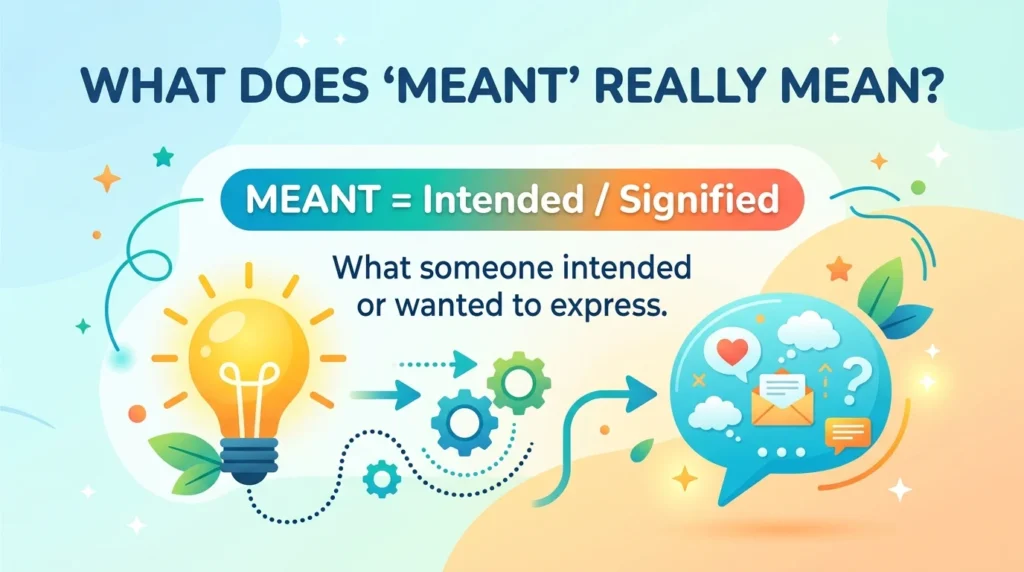
What Does “Meant” Really Mean?
The word meant is the past tense and past participle of the verb mean. Native speakers use it to express an intended purpose, a specific reference, or a designated outcome. It signifies the underlying thought behind a statement or action.
The emotional tone of “meant” is generally neutral. However, its context determines whether it conveys positive intent, negative consequences, or simple factual alignment.
- Part of Speech: Verb (past tense / past participle)
- Simple Definition: Intended to convey, indicate, signal, or bring about a specific outcome.
Connotative Meaning
Connotation is the emotional or cultural association that a word carries beyond its literal definition.
- Positive tone: Implies noble intention, destined outcome, or heartfelt purpose (e.g., “It was meant to help”).
- Negative tone: Implies accidental harm, misunderstood motives, or sinister plans (e.g., “It was meant as an insult”).
- Neutral tone: Simply states reference, definition, or translation (e.g., “The sign meant stop”).
Etymology
- Origin: Derived from the Old English word mǣnan, which meant to intend, signify, or tell. It shares Germanic roots with terms referring to mind and memory.
- Old English (450–1100): Mǣnan referred strictly to holding an intention in the mind or communicating a specific thought.
- Middle English (1100–1500): Evolved into menen, expanding to cover symbolic representation and legal intent.
- Modern English (1500–Present): Settled into meant as the irregular past tense form, covering personal intent, symbolic definitions, and predestined outcomes.
Pronunciation (IPA)
- US: /ment/
- UK: /ment/
Syllables & Structure
- Syllables: meant (1 syllable)
- Root: mean
- Prefix: None
- Suffix: -t (historical past-tense marker)
Synonyms list
Intended (Verb / Adjective) — US: /ɪnˈten.dɪd/ | UK: /ɪnˈten.dɪd/
- Meaning: Planned or purposed to achieve a specific goal or outcome.
- Tone/Register: Formal / Professional
- Example 1: She intended the message to inspire the entire team during the project.
- Example 2: The extra budget was intended solely for emergency repairs.
Signified (Verb) — US: /ˈsɪɡ.nə.faɪd/ | UK: /ˈsɪɡ.nɪ.faɪd/
- Meaning: Served as an official symbol, indication, or sign of something.
- Tone/Register: Academic / Formal
- Example 1: The ringing bells signified the end of the long workday.
- Example 2: Her quiet nod signified full agreement with the proposal.
Denoted (Verb) — US: /dɪˈnoʊ.t̬ɪd/ | UK: /dɪˈnəʊ.tɪd/
- Meaning: Stated or indicated the literal, explicit meaning of a symbol or term.
- Tone/Register: Academic / Technical
- Example 1: The red marker on the map denoted the central meeting hall.
- Example 2: In this formula, the letter X denoted the unknown variable.
Aimed (Verb) — US: /eɪmd/ | UK: /eɪmd/
- Meaning: Directed effort or words toward reaching a targeted audience or goal.
- Tone/Register: General / Conversational
- Example 1: He aimed his presentation at young entrepreneurs seeking guidance.
- Example 2: The new campaign aimed to boost local community engagement.
Purposed (Verb) — US: /ˈpɝː.pəst/ | UK: /ˈpɜː.pəst/
- Meaning: Set out deliberately with a firm resolution or design.
- Tone/Register: Literary / Formal
- Example 1: They purposed to complete the entire trek before sunset.
- Example 2: She purposed in her heart to build a sanctuary for wildlife.

Designated (Verb / Adjective) — US: /ˈdez.ɪɡ.neɪ.t̬ɪd/ | UK: /ˈdez.ɪɡ.neɪ.tɪd/
- Meaning: Officially assigned or specified for a particular function or person.
- Tone/Register: Formal / Business
- Example 1: The manager designated this room for client interviews.
- Example 2: Officers designated the quiet zone for deep research work.
Implied (Verb) — US: /ɪmˈplaɪd/ | UK: /ɪmˈplaɪd/
- Meaning: Expressed or suggested an idea indirectly without stating it aloud.
- Tone/Register: Professional / Conversational
- Example 1: His gentle tone implied that everything would turn out fine.
- Example 2: The report implied that major structural changes were necessary.
Indicated (Verb) — US: /ˈɪn.də.keɪ.t̬ɪd/ | UK: /ˈɪn.dɪ.keɪ.tɪd/
- Meaning: Pointed out, showed, or made something known clearly.
- Tone/Register: General / Professional
- Example 1: The gauge indicated that the engine was overheating quickly.
- Example 2: Surveys indicated strong public support for the new park.
Connoted (Verb) — US: /kəˈnoʊ.t̬ɪd/ | UK: /kəˈnəʊ.tɪd/
- Meaning: Suggested additional emotional shades of meaning beyond the literal definition.
- Tone/Register: Academic / Literary
- Example 1: For many readers, the word home connoted warmth and safety.
- Example 2: The dark imagery connoted a feeling of impending mystery.
Targeted (Verb) — US: /ˈtɑːr.ɡə.t̬ɪd/ | UK: /ˈtɑː.ɡɪ.tɪd/
- Meaning: Directed actions or communications specifically at a selective group.
- Tone/Register: Business / Marketing
- Example 1: The workshop targeted small business owners looking to grow online.
- Example 2: Developers targeted the app redesign to improve accessibility.
Destined (Verb / Adjective) — US: /ˈdes.tɪnd/ | UK: /ˈdes.tɪnd/
- Meaning: Intended or predetermined by fate, plan, or natural course.
- Tone/Register: Literary / Expressive
- Example 1: Everyone felt that she was destined to lead the organization.
- Example 2: The old theater seemed destined for demolition before volunteers stepped in.
Contemplated (Verb) — US: /ˈkɑːn.t̬əm.pleɪ.t̬ɪd/ | UK: /ˈkɒn.təm.pleɪ.tɪd/
- Meaning: Considered or thought about doing something as a future intention.
- Tone/Register: Formal / Personal
- Example 1: He contemplated taking a sabbatical to travel and write.
- Example 2: The committee contemplated several options before voting.
Projected (Verb) — US: /prəˈdʒek.tɪd/ | UK: /prəˈdʒek.tɪd/
- Meaning: Estimated or planned based on present trends and data.
- Tone/Register: Business / Analytical
- Example 1: Analysts projected a strong recovery for the market next quarter.
- Example 2: The team projected completion of the bridge within two years.
Envisioned (Verb) — US: /ɪnˈvɪʒ.ənd/ | UK: /ɪnˈvɪʒ.ənd/
- Meaning: Pictured or imagined as a future possibility or intentional design.
- Tone/Register: Creative / Professional
- Example 1: The architect envisioned an eco-friendly park in the city center.
- Example 2: She envisioned a workplace where creativity flourished daily.
Proposed (Verb) — US: /prəˈpoʊzd/ | UK: /prəˈpəʊzd/
- Meaning: Put forward a plan or intention for consideration by others.
- Tone/Register: Business / Academic
- Example 1: The committee proposed a new schedule to accommodate remote workers.
- Example 2: He proposed an alternative route to avoid holiday traffic.
Calculated (Verb / Adjective) — US: /ˈkæl.kjə.leɪ.t̬ɪd/ | UK: /ˈkæl.kjə.leɪ.tɪd/
- Meaning: Planned deliberately with careful thought about the likely effects.
- Tone/Register: Professional / Strategic
- Example 1: Taking the new job was a calculated risk for her career.
- Example 2: His remarks were calculated to ease the tension in the room.

Designed (Verb) — US: /dɪˈzaɪnd/ | UK: /dɪˈzaɪnd/
- Meaning: Planned and fashioned systematically for a specific purpose or function.
- Tone/Register: General / Technical
- Example 1: The software was designed to simplify daily accounting tasks.
- Example 2: This comfortable chair was designed specifically for long study sessions.
Insinuated (Verb) — US: /ɪnˈsɪn.ju.eɪ.t̬ɪd/ | UK: /ɪnˈsɪn.ju.eɪ.tɪd/
- Meaning: Suggested or hinted at something unpleasant in an indirect, subtle way.
- Tone/Register: Conversational / Dramatic
- Example 1: His subtle comment insinuated that the mistake was intentional.
- Example 2: She never directly accused anyone, but her tone insinuated guilt.
Presupposed (Verb) — US: /ˌpriː.səˈpoʊzd/ | UK: /ˌpriː.səˈpəʊzd/
- Meaning: Tacitly assumed or required something as a necessary precondition.
- Tone/Register: Academic / Philosophical
- Example 1: The advanced physics course presupposed a strong foundation in calculus.
- Example 2: Her argument presupposed that all parties agreed on basic facts.
Portended (Verb) — US: /pɔːrˈten.dɪd/ | UK: /pɔːˈten.dɪd/
- Meaning: Served as an omen or warning that a future event was about to happen.
- Tone/Register: Literary / Formal
- Example 1: The dark, heavy clouds portended a severe afternoon storm.
- Example 2: Economic indicators portended significant changes across the sector.
Foreshadowed (Verb) — US: /fɔːrˈʃæd.oʊd/ | UK: /fɔːˈʃæd.əʊd/
- Meaning: Gave a vague indication or warning of a future event in advance.
- Tone/Register: Literary / Creative
- Example 1: The opening scene foreshadowed the dramatic twist at the story’s end.
- Example 2: Early budget cuts foreshadowed the eventual closure of the branch.
Represented (Verb) — US: /ˌrep.rɪˈzen.t̬ɪd/ | UK: /ˌrep.rɪˈzen.tɪd/
- Meaning: Stood for, symbolized, or acted as a direct expression of something.
- Tone/Register: General / Professional
- Example 1: The trophy represented years of relentless effort and practice.
- Example 2: Each color on the map represented a different elevation level.
Shadowed Forth (Verb Phrase) — US: /ˈʃæd.oʊd fɔːrθ/ | UK: /ˈʃæd.əʊd fɔːθ/
- Meaning: Mystically or vaguely prefigured an upcoming concept or event.
- Tone/Register: Rare / Literary
- Example 1: The ancient prophecy shadowed forth the rise of a new era.
- Example 2: The painter’s early sketches shadowed forth his final masterpiece.
Marked (Verb) — US: /mɑːrkt/ | UK: /mɑːkt/
- Meaning: Indicated, celebrated, or pointed to a significant milestone or meaning.
- Tone/Register: General / News
- Example 1: The celebration marked twenty years of continuous service.
- Example 2: Her promotion marked a major turning point in her professional life.
Spelled (Verb) — US: /speld/ | UK: /speld/
- Meaning: Signaled or resulted in a specific, usually negative, outcome.
- Tone/Register: Informal / Expressive
- Example 1: The sudden drop in temperature spelled trouble for the fruit crops.
- Example 2: For the home team, that missed penalty spelled immediate defeat.
Conveyed (Verb) — US: /kənˈveɪd/ | UK: /kənˈveɪd/
- Meaning: Communicated or imparted a thought, feeling, or meaning directly or indirectly.
- Tone/Register: Professional / Formal
- Example 1: Her thoughtful response conveyed deep empathy for the affected families.
- Example 2: The artist’s subtle brushstrokes conveyed a sense of overwhelming solitude.
Intimated (Verb) — US: /ˈɪn.t̬ə.meɪ.t̬ɪd/ | UK: /ˈɪn.tɪ.meɪ.tɪd/
- Meaning: Hinted at or stated indirectly.
- Tone/Register: Formal / Literary
- Example 1: The board chairman intimated that a leadership change was approaching.
- Example 2: His quiet remark intimated that negotiations were failing behind closed doors.
Symbolized (Verb) — US: /ˈsɪm.bə.laɪzd/ | UK: /ˈsɪm.bə.laɪzd/
- Meaning: Served as a character, emblem, or representation of an abstract idea.
- Tone/Register: General / Academic
- Example 1: The white dove symbolized peace during the global summit.
- Example 2: For centuries, the crown symbolized supreme sovereign authority.
Supposed (Verb / Adjective) — US: /səˈpoʊzd/ | UK: /səˈpəʊzd/
- Meaning: Expected, required, or intended to do something based on rules or duties.
- Tone/Register: Conversational / General
- Example 1: You were supposed to hand in the report before noon.
- Example 2: The new policy was supposed to streamline the approval process.
Slated (Verb / Adjective) — US: /ˈsleɪ.t̬ɪd/ | UK: /ˈsleɪ.tɪd/
- Meaning: Scheduled or designated to happen or take place at a specific time.
- Tone/Register: News / Business
- Example 1: The product launch was slated for early October.
- Example 2: She is slated to deliver the opening address at the conference.
Premeditated (Verb / Adjective) — US: /ˌpriːˈmed.ə.teɪ.t̬ɪd/ | UK: /ˌpriːˈmed.ɪ.teɪ.tɪd/
- Meaning: Considered, planned, or plotted intentionally in advance.
- Tone/Register: Legal / Formal
- Example 1: The defense argued that the action was not a premeditated decision.
- Example 2: Every step of the strategic expansion was carefully premeditated.
Alluded To (Verb Phrase) — US: /əˈluːd.ɪd tuː/ | UK: /əˈluːd.ɪd tuː/
- Meaning: Made an indirect reference to a person, event, or concept.
- Tone/Register: Academic / Professional
- Example 1: The author alluded to classical mythology throughout the novel.
- Example 2: The CEO alluded to upcoming budget adjustments during the meeting.
Expressed (Verb) — US: /ɪkˈsprest/ | UK: /ɪkˈsprest/
- Meaning: Made thoughts, feelings, or intentions known through words or actions.
- Tone/Register: General / Professional
- Example 1: The customer expressed complete satisfaction with the service.
- Example 2: He expressed a clear interest in joining the international team.
Prefigured (Verb) — US: /ˌpriːˈfɪɡ.jɚd/ | UK: /ˌpriːˈfɪɡ.əd/
- Meaning: Acted as an early sign or representation of something that happened later.
- Tone/Register: Literary / Historical
- Example 1: Early architectural sketches prefigured the building’s final design.
- Example 2: The political tension prefigured the broader conflict that followed.
Earmarked (Verb) — US: /ˈɪr.mɑːrkt/ | UK: /ˈɪə.mɑːkt/
- Meaning: Designated or set aside money or resources for a specific purpose.
- Tone/Register: Financial / Business
- Example 1: The council earmarked funds specifically for public park renovation.
- Example 2: These grant dollars are earmarked exclusively for scientific research.
Imported (Verb) — US: /ɪmˈpɔːr.t̬ɪd/ | UK: /ɪmˈpɔː.tɪd/
- Meaning: Carried or conveyed a particular significance or meaning.
- Tone/Register: Archaic / Formal
- Example 1: The subtle phrasing imported a grave warning to the delegates.
- Example 2: His mysterious reply imported more than anyone at the table realized.
Adumbrated (Verb) — US: /ˈæd.əm.breɪ.t̬ɪd/ | UK: /ˈæd.əm.breɪ.tɪd/
- Meaning: Outlined or foreshadowed vaguely without full detail.
- Tone/Register: Academic / High Literary
- Example 1: The initial proposal adumbrated the major goals of the ten-year plan.
- Example 2: Her early essays adumbrated theories she fully developed years later.
Manifested (Verb) — US: /ˈmæn.ə.fes.tɪd/ | UK: /ˈmæn.ɪ.fes.tɪd/
- Meaning: Showed, demonstrated, or made an intention or quality clearly visible.
- Tone/Register: Formal / Expressive
- Example 1: The team manifested a strong commitment to quality craftsmanship.
- Example 2: Her underlying anxiety manifested through constant restlessness.
Purported (Verb / Adjective) — US: /pɚˈpɔːr.t̬ɪd/ | UK: /pəˈpɔː.tɪd/
- Meaning: Claimed or professed to be or mean something, often with implied doubt.
- Tone/Register: Legal / Journalistic
- Example 1: The letter purported to contain official government authorization.
- Example 2: The document purported that the agreement was binding across all parties.
Inferred (Verb) — US: /ɪnˈfɝːd/ | UK: /ɪnˈfɜːd/
- Meaning: Deduced or understood a specific meaning from evidence rather than explicit statements.
- Tone/Register: Academic / Analytical
- Example 1: Readers inferred a darker message between the lines of the narrative.
- Example 2: From the data provided, analysts inferred a shift in consumer demand.
Slated For (Verb Phrase) — US: /ˈsleɪ.t̬ɪd fɔːr/ | UK: /ˈsleɪ.tɪd fɔː/
- Meaning: Earmarked or designated for a specific future outcome or assignment.
- Tone/Register: Business / News
- Example 1: The old facility was slated for complete structural renovation.
- Example 2: Several historical documents were slated for digital preservation.
Preconceived (Verb / Adjective) — US: /ˌpriː.kənˈsiːvd/ | UK: /ˌpriː.kənˈsiːvd/
- Meaning: Formed an idea or intention in advance, often before having full knowledge.
- Tone/Register: Formal / Psychological
- Example 1: She entered the negotiation without any preconceived expectations.
- Example 2: The strategy relied on a preconceived plan created months prior.
Deliberated (Verb) — US: /dɪˈlɪb.ə.reɪ.t̬ɪd/ | UK: /dɪˈlɪb.ə.reɪ.tɪd/
- Meaning: Carefully pondered or planned an action with intentional thought.
- Tone/Register: Legal / Professional
- Example 1: The committee deliberated for hours before announcing their verdict.
- Example 2: He deliberated every word of his response to avoid misunderstanding.
Embodied (Verb) — US: /ɪmˈbɑː.diːd/ | UK: /ɪmˈbɒd.iːd/
- Meaning: Expressed, represented, or gave concrete form to an idea or quality.
- Tone/Register: Formal / Expressive
- Example 1: The new charter embodied the core principles of equal opportunity.
- Example 2: Her dedication embodied the true spirit of community service.
Presumed (Verb) — US: /prɪˈz uːmd/ | UK: /prɪˈzjuːmd/
- Meaning: Took for granted, supposed, or intended as a baseline truth.
- Tone/Register: Formal / Analytical
- Example 1: The research design presumed that participants had basic computer literacy.
- Example 2: He presumed that the invitation extended to his entire research group.

Synonyms by Tone
Choosing the right synonym depends heavily on your intended emotional tone. Utilizing tone effectively ensures your written message matches your exact audience expectations.
Positive Tone
- Envisioned: Suggests optimistic planning and creative foresight.
- Destined: Implies inspiring purpose, fate, and natural alignment.
- Purposed: Highlights noble resolution and deliberate positive intent.
Neutral Tone
- Intended: Directly states planned outcomes without emotional bias.
- Indicated: Clearly points to data, signs, or simple directions.
- Designed: Focuses on functional planning and structural creation.
- Represented: Expresses symbolic representation objectively.
Negative Tone
- Insinuated: Carries a shady, indirect, or accusatory implication.
- Spelled: Frequently points to impending disaster, failure, or trouble.
- Portended: Implies dark omens, serious warnings, or negative developments.
Informal / Playful Tone
- Aimed: Keeps intentions casual, direct, and conversational.
- Marked: Offers an easy, everyday way to highlight significant events.
“Meant” vs. Close Alternatives
| Feature | Meant | Intended | Implied |
| Primary Meaning | Broad term for personal purpose or literal definition. | Direct emphasis on conscious planning and goal-setting. | Suggesting meaning indirectly without stating it directly. |
| Tone | Neutral, general, everyday. | Formal, structured, professional. | Subtle, analytical, reflective. |
| Best Usage | Conversational explanations. | Official plans, essays, and business goals. | Analyzing spoken subtext or reading between the lines. |
Context-Based Usage
Daily Conversation
In casual speech, native speakers prefer simple, direct terms. You will often hear “meant” paired with everyday words like aimed or intended. For example: “I meant to call you earlier, but work got busy.”
Writing & Blogging
Bloggers and web writers use dynamic variants to keep paragraphs engaging. Replacing “meant” with designed, envisioned, or targeted improves flow and readability across digital articles.
Professional & Academic Tone
Formal documents demand precision. Academics favor denoted, signified, presupposed, or indicated to explain research findings or defined terms clearly without sounding casual.
Common Mistakes & Native Usage
Common Misuses
- Confusing Intended with Implied: Intended refers to what the speaker planned. Implied refers to the hidden message suggested by the words.
- Overusing “Meant”: Repeating “meant” multiple times in a single paragraph makes prose sound robotic. Swap it with designed or aimed.
- Using “Insinuated” for Positive Contexts: Insinuated almost always carries a negative or manipulative connotation. Avoid using it for kind gestures.
Real-Life Mini Scenarios
- Workplace: “The new training module was designed to help onboarding employees pick up tools faster.”
- Social Situations: “She didn’t mean to offend anyone; her casual comment was simply intended as a lighthearted joke.”
- Media & Storytelling: “The dark, eerie soundtrack in the opening scene foreshadowed the unexpected mystery ahead.”
Conclusion
Expanding your daily vocabulary opens exciting doors for effective personal expression. Mastering these refined words empowers you to craft clearer emails, persuasive essays, and engaging stories effortlessly.
Exploring diverse linguistic terms helps you replace repetitive phrasing. Consequently, your daily writing naturally becomes far more captivating, precise, and authoritative across every platform.
We strongly encourage you to apply these fresh vocabulary options throughout your routine writing tasks. Regular practice builds lasting communication confidence across your academic and professional life.
Start incorporating your favorite new terms into your next written project today! Share this vocabulary guide with friends to keep expanding your language skills together.
Interactive Practice Quiz
Test your understanding of these synonyms by picking the best word for each scenario.
- Which word best fits a formal scientific paper defining a variable?
- A) Spelled
- B) Denoted
- C) Insinuated
- D) Aimed
- If a dark sky signals an upcoming bad storm, the clouds _____ disaster.
- A) purposed
- B) spelled
- C) designated
- D) intended
- “Her subtle glance suggested she knew the secret.” Which synonym replaces “suggested”?
- A) Implied
- B) Designated
- C) Designed
- D) Denoted
- Select the formal synonym for planning a corporate strategy.
- A) Spelled
- B) Intended
- C) Insinuated
- D) Portended
- Which word carries a negative connotation involving sneaky hints?
- A) Envisioned
- B) Insinuated
- C) Represented
- D) Indicated
- An architect creating a blueprint for a modern park has _____ a sustainable space.
- A) portended
- B) envisioned
- C) insinuated
- D) spelled
- The letter ‘R’ on a map standing for ‘River’ means it _____ the waterway.
- A) represented
- B) insinuated
- C) portended
- D) contemplated
- Which word fits best when someone feels destined for greatness?
- A) Calculated
- B) Destined
- C) Insinuated
- D) Presupposed
- A deliberate risk taken after careful thought is called a _____ risk.
- A) calculated
- B) portended
- C) spelled
- D) connoted
- The sign pointed directly to the exit. It _____ the clear way out.
- A) indicated
- B) insinuated
- C) contemplated
- D) shadowed forth
Reflection Task
Write one original sentence about a personal goal using the synonym envisioned or intended.
Answer Key:
1: B | 2: B | 3: A | 4: B | 5: B | 6: B | 7: A | 8: B | 9: A | 10: A
Frequently Asked Questions
What is the most formal synonym for meant?
The most formal synonyms for “meant” include signified, denoted, and indicated. These terms work exceptionally well in academic research papers, legal documents, and official business reports where exact terminology is required.
Can “meant” and “intended” be used interchangeably?
Yes, in most contexts involving personal plans or purposed outcomes, “meant” and “intended” are interchangeable. However, “intended” sounds slightly more professional and structured than “meant.”
What is a good literary synonym for meant?
Literary alternatives include foreshadowed, portended, and purposed. These words add emotional weight, depth, and atmospheric tone to narrative storytelling and creative fiction.
How does “meant” differ from “implied”?
“Meant” refers directly to the target goal or literal definition intended by the speaker. “Implied” specifically describes meaning suggested indirectly beneath the surface of spoken words.
Why is expanding synonyms important for SEO writers?
Using semantic variations prevents keyword stuffing while signaling topic depth to modern search engines. It enhances readability, keeps users engaged longer, and helps content rank for long-tail search queries.

Aqsa Rani is the founder and lead writer at VocaNeest.com, a trusted platform dedicated to helping people improve their English vocabulary and communication skills. She creates well-researched, accurate, and easy-to-understand content covering synonyms, antonyms, word meanings, idioms, phrases, and everyday vocabulary. Her goal is to make learning English simple, practical, and accessible for students, writers, professionals, and lifelong learners.
At VocaNeest.com, every article is carefully researched, fact-checked, and written with a strong focus on accuracy, clarity, and real-world usage. Content is regularly reviewed and updated to ensure it remains helpful, relevant, and aligned with modern language standards. Through reliable vocabulary guides and practical examples, Aqsa aims to help readers write with confidence, expand their vocabulary, and communicate more effectively.


Pingback: Synonyms for Making Sense: Vocabulary Guide (2026)