
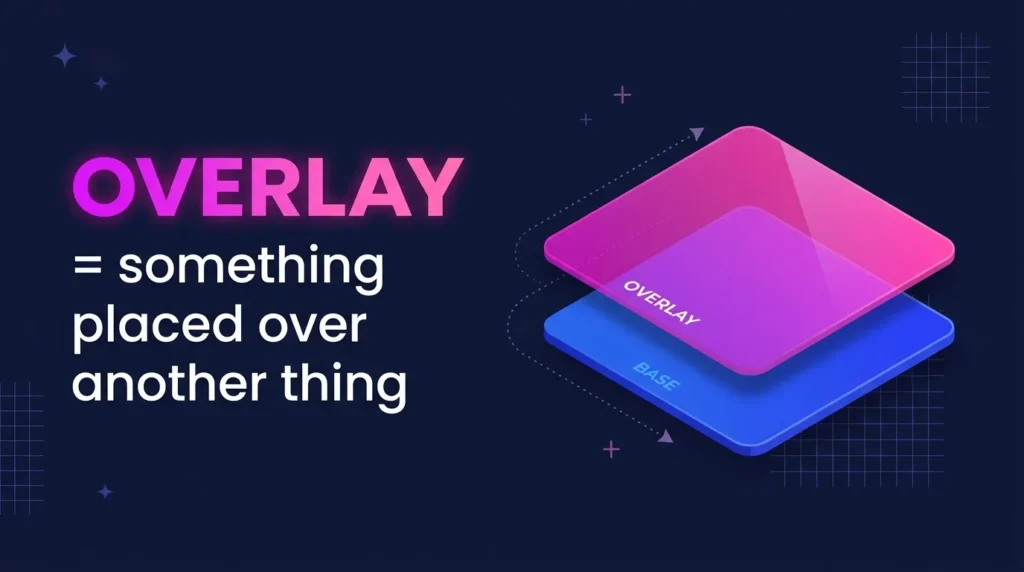
A synonym for overlay is a word or phrase that describes placing, covering, or adding one thing over another. Depending on context, useful alternatives include layer, cover, superimpose, overlap, coating, veil, mask, and top layer. The best choice depends on what is being placed over something else.
A synonym for overlay can be useful when you are editing an image and want to describe a text layer placed above a photograph.
Imagine adding a transparent graphic over a video. You could call it an overlay, but another word may explain the action more precisely.
Learning a synonym for overlay helps students, bloggers, writers, and everyday English users avoid repetition and choose clearer words.
Because overlay is common in design, writing, technology, and everyday speech, knowing its alternatives makes communication more flexible.
What Does “Overlay” Really Mean?
Overlay generally means to place one thing over another, either partly or completely. It can also refer to something that has been placed over an existing surface, image, object, or layer.
As a verb, overlay means to cover or place something over another thing.
Simple definition:
Overlay means to put one thing over another while the original thing may still remain visible or present underneath.
For example:
The designer overlaid text on the photograph.
As a noun, overlay means an additional layer placed over something else.
The map has a weather overlay showing rainfall.
Native speakers use overlay in many contexts, including graphic design, maps, photography, software interfaces, construction, textiles, decoration, and ordinary descriptions of covering.
The word is usually neutral in tone. Its meaning changes mainly according to context rather than emotional attitude.
Connotative Meaning
Connotation (the feeling or association a word carries beyond its basic dictionary meaning) can vary slightly depending on how overlay is used.
Positive Tone
In creative or technical contexts, overlay can suggest enhancement, improvement, or added information.
The designer added a useful data overlay to the image.
Negative Tone
The word can sometimes suggest that something is covering or obscuring another element.
The heavy text overlay made the picture difficult to see.
Neutral Tone
Most uses of overlay are neutral and simply describe one element being placed over another.
A transparent layer was overlaid on the map.
Etymology of “Overlay”
The word overlay is formed from over + lay.
The element over comes from Old English ofer, meaning “above,” “across,” or “beyond.”
The word lay comes from Old English lecgan, meaning “to put,” “place,” or “set.”
Together, the original idea behind overlay was essentially “to lay over something.”
Old English: 450–1100
The underlying components were already present in Old English. Words related to ofer expressed the idea of being above or across something, while lecgan described placing or laying something down.
Middle English: 1100–1500
During Middle English, related forms developed as English vocabulary and spelling changed. The idea of putting one object over another remained clear.
Modern English: 1500–Present
Modern English developed overlay into a versatile word used as both a verb and noun. Today, it appears frequently in digital design, photography, maps, construction, textiles, and general writing.
Pronunciation
US: /ˌoʊvərˈleɪ/
UK: /ˌəʊvəˈleɪ/
Syllables
o-ver-lay
Affixation Pattern of “Overlay”
Root/base elements: over + lay
Prefix: over-
Suffix: none
Here, over- contributes the idea of being above or across something, while lay provides the action of placing.
Synonyms List
The best synonym for overlay depends heavily on context. Some alternatives describe the object itself, while others describe the action of placing one thing over another.
1. Superimposition (Noun) — US /ˌsuːpərɪmpəˈzɪʃən/ | UK /ˌsuːpərɪmpəˈzɪʃən/
Meaning: The act of placing one image, element, or layer over another.
Tone/Register: Technical, academic
Example:
The superimposition of the images revealed the differences.
The editor used superimposition to combine two scenes.

2. Overburden (Verb/Noun) — US /ˌoʊvərˈbɜːrdən/ | UK /ˌəʊvəˈbɜːdən/
Meaning: To place too much material, responsibility, or weight over something.
Tone/Register: Formal, technical
Example:
The extra material overburdened the structure.
The soil was covered by a thick overburden.
3. Overprint (Verb/Noun) — US /ˌoʊvərˈprɪnt/ | UK /ˌəʊvəˈprɪnt/
Meaning: To print one image, color, or text directly over another printed element.
Tone/Register: Technical, printing
Example:
The printer overprinted the text in black.
The overprint created a darker effect.
4. Overwrite (Verb) — US /ˌoʊvərˈraɪt/ | UK /ˌəʊvəˈraɪt/
Meaning: To write or place new information over existing information, often replacing it.
Tone/Register: Technical, computing
Example:
The new data overwrote the old information.
Be careful not to overwrite the original file.
5. Overlaying (Verb) — US /ˌoʊvərˈleɪɪŋ/ | UK /ˌəʊvəˈleɪɪŋ/
Meaning: The act of placing one thing over another.
Tone/Register: Neutral, technical
Example:
Overlaying the text made the image easier to understand.
The designer is overlaying a logo onto the video.
6. Interpose (Verb) — US /ˌɪntərˈpoʊz/ | UK /ˌɪntəˈpəʊz/
Meaning: To place something between two other things or in the path of something.
Tone/Register: Formal
Example:
A screen was interposed between the two areas.
The barrier interposed itself between the objects.
7. Insert (Verb) — US /ɪnˈsɜːrt/ | UK /ɪnˈsɜːt/
Meaning: To put something into or into the position of something else.
Tone/Register: Neutral, technical
Example:
Insert the graphic above the background.
She inserted a caption into the image.
8. Impose (Verb) — US /ɪmˈpoʊz/ | UK /ɪmˈpəʊz/
Meaning: To place or apply something onto another thing, especially an idea, image, or restriction.
Tone/Register: Formal
Example:
The designer imposed a pattern over the photograph.
The effect was imposed on the original image.
9. Adjoin (Verb) — US /əˈdʒɔɪn/ | UK /əˈdʒɔɪn/
Meaning: To place next to or directly against something else.
Tone/Register: Formal, academic
Example:
The new section adjoins the original structure.
The two areas adjoin each other.
10. Attach (Verb) — US /əˈtætʃ/ | UK /əˈtætʃ/
Meaning: To join or fasten one thing to another.
Tone/Register: Neutral, everyday
Example:
Attach the label to the image.
She attached a graphic to the document.
11. Affix (Verb/Noun) — US /əˈfɪks/ | UK /əˈfɪks/
Meaning: To attach or fix something onto another surface.
Tone/Register: Formal
Example:
Affix the label to the package.
The seal was affixed to the document.
12. Laminate (Verb) — US /ˈlæməneɪt/ | UK /ˈlæmɪneɪt/
Meaning: To cover or combine something with a protective layer.
Tone/Register: Technical, practical
Example:
The document was laminated for protection.
The surface is laminated with a clear material.
13. Impregnate (Verb) — US /ˈɪmprɛɡneɪt/ | UK /ˈɪmprɛɡneɪt/
Meaning: To fill or saturate a material with another substance.
Tone/Register: Technical, scientific
Example:
The fabric was impregnated with a protective substance.
The material is impregnated with resin.
14. Saturate (Verb) — US /ˈsætʃəreɪt/ | UK /ˈsætʃəreɪt/
Meaning: To fill or cover something thoroughly with another substance.
Tone/Register: Neutral, technical
Example:
The fabric was saturated with water.
The color saturated the entire surface.
15. Plaster (Verb/Noun) — US /ˈplæstər/ | UK /ˈplɑːstə/
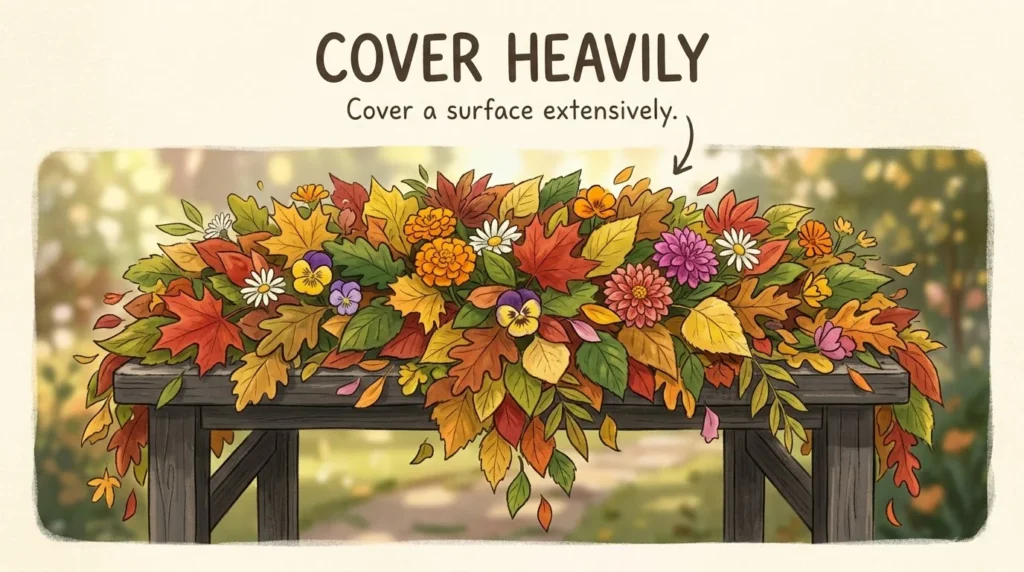
Meaning: To cover a surface heavily or extensively with something.
Tone/Register: Informal, descriptive
Example:
The walls were plastered with posters.
The streets were plastered with advertisements.
16. Smother (Verb) — US /ˈsmʌðər/ | UK /ˈsmʌðə/
Meaning: To cover something completely or heavily.
Tone/Register: Descriptive, informal
Example:
The garden was smothered in fallen leaves.
The hills were smothered by thick fog.
17. Swathe (Verb/Noun) — US /sweɪð/ | UK /sweɪð/
Meaning: To cover or wrap something in a broad layer or area of material.
Tone/Register: Literary, descriptive
Example:
The valley was swathed in mist.
The hills were swathed in morning fog.
18. Overlayment (Noun) — US /ˈoʊvərleɪmənt/ | UK /ˈəʊvəleɪmənt/
Meaning: The act or result of placing one element over another.
Tone/Register: Specialized, uncommon
Example:
The overlayment of the graphics changed the final design.
The process involved several layers of overlayment.
Note: This is a specialized and uncommon term, so overlay or superimposition is usually more natural.
19. Incase (Verb) — US /ɪnˈkeɪs/ | UK /ɪnˈkeɪs/
Meaning: To surround or cover something with another material.
Tone/Register: Formal, technical
Example:
The wires were encased in protective material.
The object was encased in a transparent shell.
20. Suffuse (Verb) — US /səˈfjuːz/ | UK /səˈfjuːz/
Meaning: To spread a color, light, or quality throughout or over something.
Tone/Register: Literary, descriptive
Example:
Soft light suffused the room.
A warm glow suffused the landscape.
Layer (Noun/Verb) — US /ˈleɪər/ | UK /ˈleɪə/
Meaning: A layer is one level or thickness placed above, below, or alongside another level.
Tone/Register: Neutral, everyday, technical
Example:
The designer added another layer to the image.
The cake has a thin layer of cream.
Layer is one of the closest general alternatives to overlay, especially when discussing graphics, materials, clothing, or physical structures.
Cover (Noun/Verb) — US /ˈkʌvər/ | UK /ˈkʌvə/
Meaning: Cover means to place something over another thing so that it is partly or completely hidden.
Tone/Register: Neutral, everyday
Example:
The cloth covered the table.
Dark clouds covered the sky.
Unlike overlay, cover often suggests that the original surface becomes less visible.
Superimpose (Verb) — US /ˌsuːpərɪmˈpoʊz/ | UK /ˌsuːpərɪmˈpəʊz/
Meaning: Superimpose means to place one image, shape, or element over another while keeping both identifiable.
Tone/Register: Formal, technical, academic
Example:
The editor superimposed the logo over the video.
Scientists superimposed the two images for comparison.
This is an especially strong alternative to overlay in photography, video editing, and scientific imaging.
Overlap (Verb/Noun) — US /ˌoʊvərˈlæp/ | UK /ˌəʊvəˈlæp/
Meaning: Overlap means that two things partly cover or extend across the same area.
Tone/Register: Neutral, academic, everyday
Example:
The two shapes overlap in the center.
Their responsibilities overlap slightly.
Overlap focuses on shared space rather than deliberately placing one element on top of another.
Coating (Noun) — US /ˈkoʊtɪŋ/ | UK /ˈkəʊtɪŋ/
Meaning: A coating is a thin material applied to the surface of something.
Tone/Register: Technical, neutral
Example:
The metal received a protective coating.
The coating helps prevent corrosion.
Use coating when the added material becomes a surface covering rather than a separate visible graphic or layer.
Coat (Verb/Noun) — US /koʊt/ | UK /kəʊt/
Meaning: To coat something means to cover its surface with a layer of another substance.
Tone/Register: Neutral, everyday, technical
Example:
Coat the surface with a thin layer of paint.
The chocolate coated the strawberries.
Coat works well for paint, food, chemicals, and physical surfaces.
Veil (Noun/Verb) — US /veɪl/ | UK /veɪl/
Meaning: Veil means to cover something partly, often making it less clear or visible.
Tone/Register: Literary, descriptive
Example:
A light mist veiled the mountains.
A veil of clouds covered the moon.
This word is more expressive than overlay and often appears in creative writing.
Mask (Noun/Verb) — US /mæsk/ | UK /mɑːsk/
Meaning: Mask means to cover, hide, or block part of something.
Tone/Register: Neutral, technical, digital
Example:
The editor used a mask to hide the background.
The trees masked the view of the road.
In graphic design and software, mask has a specialized meaning involving selective visibility.
Superposition (Noun) — US /ˌsuːpərpəˈzɪʃən/ | UK /ˌsuːpəpəˈzɪʃən/
Meaning: Superposition refers to one element being placed over another or existing simultaneously in the same space.
Tone/Register: Academic, scientific, technical
Example:
The diagram shows the superposition of two patterns.
The researchers studied the superposition of the signals.
This is more specialized than everyday overlay.
Top Layer (Noun Phrase) — US /ˈtɑːp ˌleɪər/ | UK /ˈtɒp ˌleɪə/
Meaning: A top layer is the uppermost part placed above other layers.
Tone/Register: Neutral, descriptive
Example:
The top layer contains the title.
Add a top layer to the design.
It is particularly clear when explaining digital graphics to beginners.
Upper Layer (Noun Phrase) — US /ˈʌpər ˌleɪər/ | UK /ˈʌpə ˌleɪə/
Meaning: An upper layer is a layer positioned above another layer or surface.
Tone/Register: Neutral, technical
Example:
The upper layer contains the labels.
Water is collected in the upper layer of the material.
It is useful when the position of the layer matters.
Surface Layer (Noun Phrase) — US /ˈsɜːrfəs ˌleɪər/ | UK /ˈsɜːfɪs ˌleɪə/
Meaning: A surface layer is material located directly on the outside or top of something.
Tone/Register: Technical, academic
Example:
The surface layer protects the material.
The researchers examined the surface layer closely.
This term is common in science, engineering, and materials research.
Film (Noun) — US /fɪlm/ | UK /fɪlm/
Meaning: A film is a very thin layer covering a surface.
Tone/Register: Technical, everyday
Example:
A thin film formed over the water.
The screen has a protective film.
Film works particularly well when the added layer is extremely thin.
Glaze (Noun/Verb) — US /ɡleɪz/ | UK /ɡleɪz/
Meaning: Glaze means a thin, often glossy layer applied over a surface.
Tone/Register: Culinary, artistic, technical
Example:
The baker added a sweet glaze to the cake.
The pottery received a blue glaze.
It is not a universal synonym, but it fits contexts involving decorative or protective layers.
Blanket (Noun/Verb) — US /ˈblæŋkɪt/ | UK /ˈblæŋkɪt/
Meaning: Blanket means to cover something broadly or completely.
Tone/Register: Neutral, figurative
Example:
Snow blanketed the fields overnight.
The policy blankets several departments.
This word often emphasizes broad coverage rather than a simple visual layer.
Drape (Verb/Noun) — US /dreɪp/ | UK /dreɪp/
Meaning: Drape means to place or hang something loosely over another object.
Tone/Register: Neutral, descriptive
Example:
She draped a cloth over the chair.
The fabric was draped across the table.
Use drape when the covering hangs loosely rather than sitting flat.
Cloak (Verb/Noun) — US /kloʊk/ | UK /kləʊk/
Meaning: Cloak means to cover or conceal something, often in a figurative or literary way.
Tone/Register: Literary, formal
Example:
Fog cloaked the valley.
The story cloaked the truth in mystery.
It is more expressive than overlay and often implies concealment.
Shroud (Verb/Noun) — US /ʃraʊd/ | UK /ʃraʊd/
Meaning: Shroud means to cover something completely or obscure it from view.
Tone/Register: Literary, dramatic
Example:
Clouds shrouded the mountain peak.
The building was shrouded in darkness.
This word usually has a stronger and darker emotional effect.
Encase (Verb) — US /ɪnˈkeɪs/ | UK /ɪnˈkeɪs/
Meaning: Encase means to surround or cover something completely with another material.
Tone/Register: Formal, technical
Example:
The object was encased in glass.
The wires were encased in protective material.
Unlike overlay, encase usually suggests complete surrounding or enclosure.
Envelop (Verb) — US /ɪnˈveləp/ | UK /ɪnˈveləp/
Meaning: Envelop means to surround or cover something completely or almost completely.
Tone/Register: Literary, formal
Example:
Mist enveloped the village.
Warm light enveloped the room.
It often creates a strong visual or atmospheric effect.
Obscure (Verb) — US /əbˈskjʊr/ | UK /əbˈskjʊə/
Meaning: Obscure means to make something difficult or impossible to see or understand.
Tone/Register: Formal, academic
Example:
The large graphic obscured the text.
Clouds obscured the view.
It is useful when the important idea is hidden, rather than simply placing something above something else.
Conceal (Verb) — US /kənˈsiːl/ | UK /kənˈsiːl/
Meaning: Conceal means to hide something deliberately from view or knowledge.
Tone/Register: Formal, neutral
Example:
The design conceals the wires.
He tried to conceal the damaged area.
Conceal focuses on hiding rather than layering.
Superpose (Verb) — US /ˌsuːpərˈpoʊz/ | UK /ˌsuːpəˈpəʊz/
Meaning: Superpose means to place one thing directly over another.
Tone/Register: Technical, scientific
Example:
The software can superpose several images.
The researcher superposed the two diagrams.
It is particularly useful in technical and scientific contexts.
Add Over (Verb Phrase) — US /æd ˈoʊvər/ | UK /æd ˈəʊvə/
Meaning: Add over describes placing an additional element on top of an existing one.
Tone/Register: Informal, explanatory
Example:
Add the title over the background image.
She added a transparent shape over the photo.
This phrase is understandable but less precise than overlay in professional writing.
Place Over (Verb Phrase) — US /pleɪs ˈoʊvər/ | UK /pleɪs ˈəʊvə/
Meaning: Place over means to position something above or across another thing.
Tone/Register: Neutral, everyday
Example:
Place the label over the picture.
He placed a cover over the box.
It is simple and useful when clarity matters more than specialized vocabulary.
Lay Over (Verb Phrase) — US /leɪ ˈoʊvər/ | UK /leɪ ˈəʊvə/
Meaning: Lay over means to put something across or on top of another surface.
Tone/Register: Neutral, descriptive
Example:
Lay the fabric over the frame.
A thin sheet was laid over the surface.
This phrase is more literal than overlay.
Apply a Layer (Verb Phrase) — US /əˈplaɪ ə ˈleɪər/ | UK /əˈplaɪ ə ˈleɪə/
Meaning: Apply a layer means to put a new layer of material or content onto an existing surface.
Tone/Register: Technical, instructional
Example:
Apply a thin layer of paint.
The editor applied a new layer to the image.
This expression is useful in instructions and educational writing.
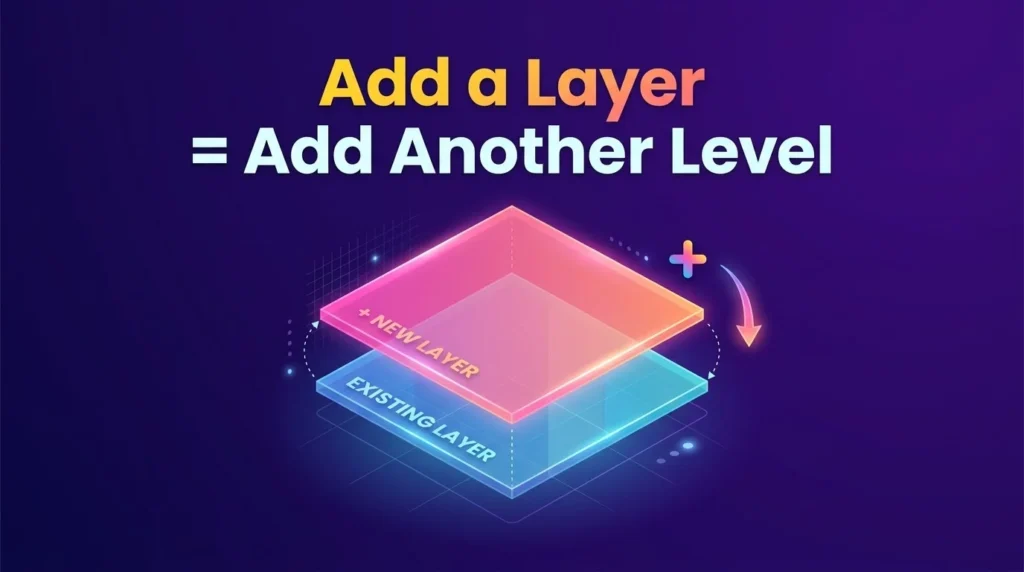
Add a Layer (Verb Phrase) — US /æd ə ˈleɪər/ | UK /æd ə ˈleɪə/
Meaning: Add a layer means to introduce another level or element above an existing one.
Tone/Register: Neutral, technical
Example:
Add a layer for the text.
The artist added another layer of color.
It is especially common when explaining visual design concepts.
Synonyms for “Overlay” by Tone
Choosing a synonym is not only about meaning. Tone matters because different words can make your writing sound casual, technical, academic, or creative.
Positive or Enhancing
- Layer
- Add a layer
- Glaze
- Surface layer
- Top layer
These choices can suggest that something has been added to improve or enhance an existing element.
Neutral
- Cover
- Overlap
- Coat
- Film
- Place over
- Upper layer
- Apply a layer
These words work well in everyday communication and straightforward explanations.
Technical or Academic
- Superimpose
- Superpose
- Superposition
- Surface layer
- Coating
These are appropriate for scientific, engineering, research, and professional contexts.
Literary or Dramatic
- Veil
- Cloak
- Shroud
- Envelop
- Blanket
These words create stronger imagery and are more common in storytelling or descriptive writing.
Informal or Explanatory
- Add a layer
- Add over
- Place over
- Lay over
These expressions are useful when explaining an action in simple English.
“Overlay” vs. Close Alternatives
Overlay vs. Layer
When one element is added on top of another, overlay is often the more specific choice, particularly in digital design and visual content.
By contrast, layer has a wider meaning and can refer to any level of material, content, or structure.
For example, use overlay for text placed over a video, while layer works well for different levels in a design, cake, soil profile, or physical material.
Overlay vs. Superimpose
Overlay is common and versatile.
Superimpose is more technical and specifically suggests placing one image, shape, or element over another while maintaining its visibility.
For everyday writing, overlay is usually more natural. For scientific or image-processing contexts, superimpose may be more precise.
Overlay vs. Cover
Cover emphasizes hiding or protecting something.
Overlay emphasizes adding one element over another.
For example, a blanket covers a bed, while text may be overlaid on a photograph.
How “Overlay” Changes by Context
Daily Conversation
In everyday English, overlay is useful when discussing maps, images, screens, or physical surfaces.
For simple situations, however, native speakers may choose cover, layer, or place over because these words feel more conversational.
Place the transparent sheet over the drawing.
This sounds more natural in casual instructions than using a highly technical synonym.
Writing and Blogging
Bloggers can use overlay when describing images, graphics, maps, or visual content.
For example:
The image uses a text overlay to highlight the main point.
When repeating the word becomes awkward, alternatives such as text layer, graphic layer, or covering element can help maintain variety.
Professional or Academic Writing
Professional and academic contexts may favor precise terms such as superimpose, surface layer, coating, or superposition.
The best word depends on the subject.
A scientific paper may discuss the superposition of images, while a design report may discuss an image overlay.
Creative or Informal Use
Creative writers can replace overlay with more vivid words such as veil, cloak, or shroud.
A veil of mist covered the valley.
This creates a stronger image than the neutral statement:
Mist overlaid the valley.
Common Mistakes Learners Make
Mistake 1: Treating Every Synonym as Identical
Words such as cover, layer, and superimpose are related to overlay, but they do not always have exactly the same meaning.
Choose the word that matches the action and context.
Mistake 2: Using “Cover” in Digital Design
In graphic design, cover may suggest hiding an element completely.
If both elements remain visible, overlay or superimpose may be more accurate.
Mistake 3: Using “Superimpose” in Casual Conversation
Superimpose is correct, but it can sound technical.
In casual speech, put over, place over, or layer may sound more natural.
Mistake 4: Confusing “Overlap” With “Overlay”
Two objects can overlap without one being deliberately placed on top of the other.
Overlay usually implies a more intentional layering relationship.
Register Notes
Overlay is neutral and works in both spoken and written English.
Superimpose and superposition are more technical.
Veil, cloak, and shroud are more literary.
Cover and layer are highly common everyday alternatives.
For one related vocabulary topic, readers can also explore other synonym-based vocabulary guides through your site’s internal linking structure.
Real-Life Mini Scenarios Using “Overlay”
Workplace
A marketing employee places a company name over a promotional photograph.
The designer added the brand name as an overlay.
A simpler alternative would be:
The designer added a text layer to the photograph.
Social Situation
Someone places a filter over a photograph before sharing it.
The app added a colorful overlay to the picture.
Here, layer can also describe the added visual element.
Media and Pop Culture
A video creator places captions over a short clip.
The creator used a text overlay for the dialogue.
Superimpose could work in a more technical description.
Writing and Storytelling
A writer describes mist covering a landscape.
A silver veil seemed to overlay the distant hills.
For a more dramatic effect, shroud or envelop could be used instead.
Native Usage Tips
Native speakers usually choose overlay when they want to describe an added visual, informational, or physical layer without emphasizing concealment.
In digital contexts, phrases such as text overlay, image overlay, graphic overlay, map overlay, and color overlay are especially natural.
For physical materials, coating, layer, cover, and film may be more appropriate.
For artistic writing, veil, cloak, and shroud can create a more vivid impression.
The key is not to replace overlay mechanically. Instead, ask what the word is doing in the sentence.
When Should You Use “Overlay”?
Use overlay when:
- One visual element is placed over another.
- A graphic appears above an image.
- Information is displayed over a map.
- One layer is added to a design.
- Something covers another element without necessarily hiding it completely.
Avoid replacing it with a synonym simply to sound more sophisticated.
Clear English is usually better than unnecessarily complicated vocabulary.
External Resources
For a reliable definition, pronunciation, examples, and related vocabulary for overlay, see the Cambridge Dictionary entry for “overlay”. Cambridge also lists related words such as cover, blanket, veil, and plaster.
Interactive Practice Quiz
Choose the best answer for each situation.
1. A designer puts white text over a photograph. Which word fits best?
A. Shroud
B. Overlay
C. Encase
D. Drape
2. A scientist places one image directly over another for comparison. Which word is most precise?
A. Superimpose
B. Cover
C. Blanket
D. Veil
3. Snow covers the entire field. Which word sounds most natural?
A. Superpose
B. Overlay
C. Blanket
D. Mask
4. A thin protective substance is applied to metal. Which word fits best?
A. Coating
B. Overlap
C. Veil
D. Drape
5. A designer creates another level in a graphic file. Which word is most natural?
A. Layer
B. Cloak
C. Shroud
D. Envelop
6. Fog makes a mountain difficult to see. Which literary word works well?
A. Superimpose
B. Shroud
C. Layer
D. Coat
7. Two shapes share part of the same space. Which word describes this relationship?
A. Overlap
B. Encase
C. Cloak
D. Glaze
8. A baker puts a shiny sugar layer on a cake. Which word is appropriate?
A. Glaze
B. Mask
C. Superposition
D. Overlaying
9. A cloth hangs loosely across a chair. Which verb is most precise?
A. Superpose
B. Drape
C. Obscure
D. Coat
10. A graphic hides part of an image in editing software. Which technical word may fit?
A. Mask
B. Glaze
C. Blanket
D. Envelop
Reflection Task: Write one sentence using overlay, then rewrite it using one synonym that gives the sentence a different tone.
Answer Key: 1-B | 2-A | 3-C | 4-A | 5-A | 6-B | 7-A | 8-A | 9-B | 10-A
Frequently Asked Questions
1. What is the best synonym for overlay in graphic design?
The best synonym depends on what you mean. Layer is usually the simplest alternative when discussing design files. Superimpose is more technical and describes placing one visual element over another. Text layer, image layer, and graphic layer are also natural phrases when explaining digital designs.
2. What is another word for overlay in a photo?
Layer and superimpose are two useful alternatives for an overlay in a photograph. If an element is deliberately placed over another image while both remain visible, superimpose can be particularly precise. For casual explanations, add a layer or place over may sound more natural.
3. What is the difference between an overlay and a layer?
An overlay is generally an element placed over another element, often to add information or a visual effect. A layer is a broader term for one level within a structure or design. In digital editing, an overlay can itself be created as a separate layer.
4. What is a synonym for overlay in academic writing?
In academic writing, superimpose, superposition, surface layer, and coating may work depending on the subject. Superimpose is useful for images or diagrams, while surface layer and coating are more suitable for physical materials. Always choose the term that accurately describes the process.
5. Is “overlap” the same as “overlay”?
Not exactly. Overlap means that two things partly occupy the same area or extend across one another. Overlay usually suggests that one element is deliberately placed over another. Two shapes can overlap without either one being described as an overlay.
6. What is a formal synonym for overlay?
Superimpose is one of the strongest formal or technical alternatives to overlay, particularly when discussing images, diagrams, maps, or data. Superposition is another option, although it is more specialized and commonly appears in scientific or technical contexts.
7. What is a synonym for overlay that means “cover”?
Cover is the most direct everyday alternative when the main idea is placing something over another object. Other possibilities include blanket, veil, conceal, obscure, and envelop, but each carries a slightly different meaning or tone.
8. How can learning synonyms for overlay improve English?
Learning related words helps you express precise meanings instead of repeating the same term. For example, layer works well for design, coating for materials, superimpose for technical images, and veil for creative writing. This makes vocabulary more flexible and context-sensitive.
Conclusion
Learning a synonym for overlay helps you describe layers, coverings, graphics, and visual effects with greater accuracy. The right word depends on the situation.
Words such as layer, cover, and overlap work naturally in everyday English, while superimpose and superposition suit technical contexts.
Creative writers can choose expressive alternatives such as veil, cloak, or shroud when they want stronger imagery and emotion.
Practice these words in emails, essays, blog posts, and daily conversations. Small vocabulary choices can make your English clearer, richer, and more natural.

Aqsa Rani is the founder and lead writer at VocaNeest.com, a trusted platform dedicated to helping people improve their English vocabulary and communication skills. She creates well-researched, accurate, and easy-to-understand content covering synonyms, antonyms, word meanings, idioms, phrases, and everyday vocabulary. Her goal is to make learning English simple, practical, and accessible for students, writers, professionals, and lifelong learners.
At VocaNeest.com, every article is carefully researched, fact-checked, and written with a strong focus on accuracy, clarity, and real-world usage. Content is regularly reviewed and updated to ensure it remains helpful, relevant, and aligned with modern language standards. Through reliable vocabulary guides and practical examples, Aqsa aims to help readers write with confidence, expand their vocabulary, and communicate more effectively.