
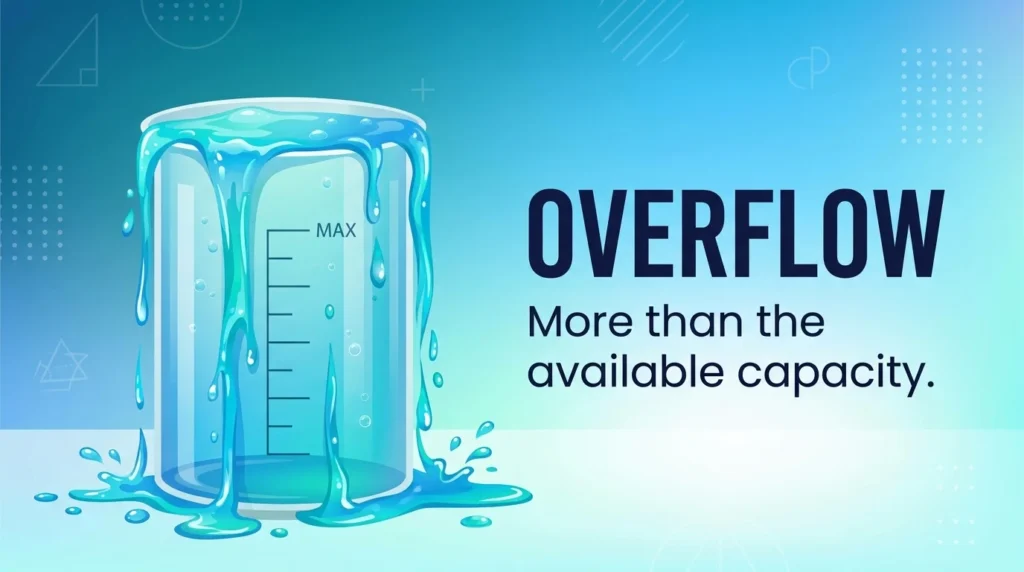
A synonym for overflow is a word or phrase that expresses the idea of something becoming too full and spilling, spreading, or extending beyond its limits. Common alternatives include spill over, brim over, flood, inundate, surge, and overrun, depending on context.
synonym for overflow becomes useful when a glass, river, room, or even a feeling becomes too full. Imagine rain filling a roadside drain until water spills onto the street.
The word overflow is common in everyday English because it describes liquids, crowds, information, emotions, and spaces. Its meaning changes slightly with each situation.
Learning a synonym for overflow helps students write more naturally. It also gives bloggers, content writers, and daily English users more precise vocabulary.
When you know several alternatives, you can avoid repeating overflow in essays, articles, emails, and conversations. The right synonym can also make your writing more vivid.
What Does “Overflow” Really Mean?
Overflow means to become so full that something spills, spreads, or extends beyond the available space or limit.
For example:
The glass overflowed with water.
Here, the water became greater than the glass could hold.
The word can also describe people or things. If a hall is overflowing with visitors, there are so many people that the available space cannot comfortably contain them.
It can describe emotions too. Someone may overflow with happiness, meaning they express a very strong amount of happiness.
Cambridge Dictionary similarly defines overflow as liquid flowing over the edge because there is too much, while also using it for places, people, objects, thoughts, and feelings that exceed available space or containment.
Part of Speech
Verb: to spill, spread, or extend beyond a limit.
Noun: an amount that cannot fit within a space or container.
Simple definition: To become too full and spread or spill beyond the available space.
Connotative Meaning
Connotation (the feeling or association a word carries beyond its basic dictionary meaning) can change how overflow feels in a sentence.
Positive Tone
When used with emotions, overflow can sound warm or joyful.
Her heart overflowed with gratitude.
Negative Tone
It can suggest an unwanted or difficult situation.
The drain overflowed after the heavy rain.
Neutral Tone
It can simply describe excess without a strong emotional judgment.
The tank overflowed when it became full.
Etymology of “Overflow”
The word overflow comes from Old English oferflōwan, formed from ofer meaning “over” and flōwan meaning “to flow.”
Old English: 450–1100
The early form oferflōwan referred to flowing over or beyond something.
Middle English: 1100–1500
The word developed through Middle English forms related to overflown and overflowen, retaining the idea of flowing beyond a boundary.
Modern English: 1500–Present
Modern English uses overflow for liquids, crowds, objects, emotions, information, and other things that exceed available space or limits.
Pronunciation
US: /ˌoʊ.vɚˈfloʊ/
UK: /ˌəʊ.vəˈfləʊ/
Syllables
o-ver-flow
Affixation Pattern of “Overflow”
Root: flow
Prefix: over-
Suffix: none
The prefix over- adds the idea of going beyond a normal boundary or limit.
Synonyms for Overflow
The best synonym depends on what is becoming too full and what happens afterward. A word that works for water may not work naturally for emotions, crowds, or information.
Spill (Verb) — US /spɪl/ | UK /spɪl/
Meaning: To accidentally let liquid or another substance escape from its container.
Tone/Register: Neutral, everyday
Example: The cup tipped and spilled water onto the table.
She spilled coffee on her notebook.

Spill Over (Phrasal Verb) — US /spɪl ˈoʊ.vɚ/ | UK /spɪl ˈəʊ.və/
Meaning: To spread beyond an original boundary or area.
Tone/Register: Neutral, conversational
Example: The crowd spilled over into the nearby street.
The discussion spilled over into the next meeting.
Brim Over (Phrasal Verb) — US /brɪm ˈoʊ.vɚ/ | UK /brɪm ˈəʊ.və/
Meaning: To become so full that something reaches or passes the edge.
Tone/Register: Neutral, descriptive
Example: The cup brimmed over with hot tea.
Her eyes brimmed over with tears of joy.
Flood (Verb) — US /flʌd/ | UK /flʌd/
Meaning: To cover an area with a large amount of water or another substance.
Tone/Register: Neutral, common
Example: Heavy rain flooded the lower streets.
Water flooded the basement overnight.
Inundate (Verb) — US /ˈɪn.ən.deɪt/ | UK /ˈɪn.ən.deɪt/
Meaning: To overwhelm an area or person with a very large amount of something.
Tone/Register: Formal, academic
Example: The storm inundated several coastal areas.
The office was inundated with emails.
Overrun (Verb) — US /ˌoʊ.vɚˈrʌn/ | UK /ˌəʊ.vəˈrʌn/
Meaning: To fill or spread through a place in excessive numbers.
Tone/Register: Neutral to negative
Example: Tourists overran the small town during the festival.
The garden was overrun with weeds.
Overflowing (Adjective) — US /ˌoʊ.vɚˈfloʊ.ɪŋ/ | UK /ˌəʊ.vəˈfləʊ.ɪŋ/
Meaning: Extremely full or containing more than can comfortably fit.
Tone/Register: Neutral, descriptive
Example: The bin was overflowing with paper.
The room was overflowing with guests.
Swell (Verb) — US /swel/ | UK /swel/
Meaning: To increase in size or volume, especially until something becomes very full.
Tone/Register: Neutral
Example: The river swelled after several days of rain.
The stream swelled beyond its usual width.
Surge (Verb) — US /sɝːdʒ/ | UK /sɜːdʒ/
Meaning: To rise or move suddenly and strongly in a large amount.
Tone/Register: Neutral, journalistic
Example: Water surged through the broken barrier.
Visitors surged into the stadium after the gates opened.
Pour Out (Phrasal Verb) — US /pɔːr aʊt/ | UK /pɔː aʊt/
Meaning: To flow or release in a large amount.
Tone/Register: Neutral, conversational
Example: Rainwater poured out of the blocked gutter.
People poured out of the theater after the show.
Gush (Verb) — US /ɡʌʃ/ | UK /ɡʌʃ/
Meaning: To flow out quickly and forcefully.
Tone/Register: Descriptive, informal
Example: Water gushed from the damaged pipe.
A stream of muddy water gushed across the road.
Spill Out (Phrasal Verb) — US /spɪl aʊt/ | UK /spɪl aʊt/
Meaning: To come or spread out beyond a container, room, or boundary.
Tone/Register: Neutral
Example: People spilled out of the concert hall.
Books spilled out of the open box.
Overflow With (Verb Phrase) — US /ˌoʊ.vɚˈfloʊ wɪð/ | UK /ˌəʊ.vəˈfləʊ wɪð/
Meaning: To contain a very large amount of something, especially an emotion or quality.
Tone/Register: Neutral, literary
Example: She overflowed with gratitude after the surprise.
The article overflows with useful examples.
Run Over (Phrasal Verb) — US /rʌn ˈoʊ.vɚ/ | UK /rʌn ˈəʊ.və/
Meaning: To flow beyond the edge or limit of a container or area.
Tone/Register: Informal, everyday
Example: The bath ran over while he was answering the phone.
The sauce ran over the edge of the pan.
Exceed (Verb) — US /ɪkˈsiːd/ | UK /ɪkˈsiːd/
Meaning: To go beyond an allowed, expected, or available amount.
Tone/Register: Formal, academic, professional
Example: The rainfall exceeded the monthly average.
The number of applicants exceeded the available places.
Surpass (Verb) — US /sɚˈpæs/ | UK /səˈpɑːs/
Meaning: To go beyond a particular amount, level, or expectation.
Tone/Register: Formal, academic
Example: Attendance surpassed the organizers’ expectations.
The demand surpassed the available supply.

Overload (Verb) — US /ˌoʊ.vɚˈloʊd/ | UK /ˌəʊ.vəˈləʊd/
Meaning: To give or place more of something on a person, system, or object than it can handle.
Tone/Register: Professional, technical
Example: Too many requests overloaded the server.
Don’t overload the small storage box.
The term is particularly useful for systems, workloads, electricity, and information.
Swamp (Verb) — US /swɑːmp/ | UK /swɒmp/
Meaning: To overwhelm someone or something with a very large amount.
Tone/Register: Informal to neutral
Example: The team was swamped with customer requests.
I was swamped with homework this week.
Saturate (Verb) — US /ˈsætʃ.ə.reɪt/ | UK /ˈsætʃ.ə.reɪt/
Meaning: To fill something completely so that it cannot absorb or contain much more.
Tone/Register: Academic, technical
Example: The soil became saturated after continuous rain.
The market is saturated with similar products.
Overflowing With (Phrase) — US /ˌoʊ.vɚˈfloʊ.ɪŋ wɪð/ | UK /ˌəʊ.vəˈfləʊ.ɪŋ wɪð/
Meaning: Having a very large amount of something.
Tone/Register: Neutral, expressive
Example: The speech was overflowing with optimism.
Her notebook was overflowing with ideas.
Abound (Verb) — US /əˈbaʊnd/ | UK /əˈbaʊnd/
Meaning: To exist in very large numbers or amounts.
Tone/Register: Formal, literary
Example: Freshwater plants abound in the wetland.
Opportunities abound for creative students.
Teem (Verb) — US /tiːm/ | UK /tiːm/
Meaning: To be filled with large numbers of people, animals, or things.
Tone/Register: Literary, descriptive
Example: The river teemed with fish.
The market teemed with shoppers before the holiday.
Crowd (Verb) — US /kraʊd/ | UK /kraʊd/
Meaning: To fill a place with more people or things than it can comfortably hold.
Tone/Register: Neutral, everyday
Example: Fans crowded the entrance before the match.
Boxes crowded the small storage room.
Fill Up (Phrasal Verb) — US /fɪl ʌp/ | UK /fɪl ʌp/
Meaning: To become completely full.
Tone/Register: Informal, everyday
Example: The water tank filled up quickly.
The parking lot filled up before noon.
Max Out (Phrasal Verb) — US /mæks aʊt/ | UK /mæks aʊt/
Meaning: To reach the highest available amount, capacity, or limit.
Tone/Register: Informal
Example: The stadium maxed out during the final.
My phone storage has maxed out.
Overflow Into (Phrasal Verb) — US /ˌoʊ.vɚˈfloʊ ˈɪn.tuː/ | UK /ˌəʊ.vəˈfləʊ ˈɪn.tuː/
Meaning: To extend beyond one area and enter another.
Tone/Register: Neutral, descriptive
Example: The crowd overflowed into the parking area.
The discussion overflowed into social media.
Overflow Onto (Phrasal Verb) — US /ˌoʊ.vɚˈfloʊ ˈɑːn.tuː/ | UK /ˌəʊ.vəˈfləʊ ˈɒn.tuː/
Meaning: To extend beyond a boundary and spread onto another surface or area.
Tone/Register: Neutral
Example: Rainwater overflowed onto the sidewalk.
The audience overflowed onto the lawn.
Runoff (Noun) — US /ˈrʌn.ɑːf/ | UK /ˈrʌn.ɒf/
Meaning: Water that flows away across land after rain or melting snow.
Tone/Register: Environmental, technical
Example: Heavy rainfall increased surface runoff.
The soil reduced water runoff after the storm.
Outpouring (Noun) — US /ˈaʊtˌpɔːr.ɪŋ/ | UK /ˈaʊtˌpɔː.rɪŋ/
Meaning: A sudden or abundant expression of feelings, support, or words.
Tone/Register: Neutral to formal
Example: The athlete received an outpouring of support.
There was an outpouring of sympathy after the announcement.
Excess (Noun) — US /ɪkˈses/ | UK /ɪkˈses/
Meaning: An amount that is greater than what is needed or allowed.
Tone/Register: Formal, academic
Example: Excess water drained from the field.
The report identified an excess of information.
Overflow (Noun) — US /ˈoʊ.vɚ.floʊ/ | UK /ˈəʊ.və.fləʊ/
Meaning: The extra amount that cannot fit within an available space or capacity.
Tone/Register: Neutral
Example: The tank has an overflow pipe.
The clinic opened another room for patient overflow.

Overfill (Verb)
Meaning: To fill something beyond its available capacity.
Example: The bucket overfilled during the heavy rain.
Overfill (Verb) — US /ˌoʊ.vɚˈfɪl/ | UK /ˌəʊ.vəˈfɪl/
Meaning: To fill something beyond its available capacity.
Tone/Register: Neutral, everyday
Example: The bucket overfilled during the heavy rain.
Be careful not to overfill the container.
Overspill (Verb/Noun) — US /ˈoʊ.vɚ.spɪl/ | UK /ˈəʊ.və.spɪl/
Meaning: To spread or extend beyond the intended area or boundary.
Tone/Register: Neutral, British English
Example: Rainwater overspilled onto the pavement.
The overspill from the river reached nearby fields.
Overabundance (Noun) — US /ˌoʊ.vɚ.əˈbʌn.dəns/ | UK /ˌəʊ.vər.əˈbʌn.dəns/
Meaning: An amount that is much greater than what is needed or useful.
Tone/Register: Formal, academic
Example: The garden produced an overabundance of tomatoes.
An overabundance of information can make a topic confusing.
Superabundance (Noun) — US /ˌsuː.pɚ.əˈbʌn.dəns/ | UK /ˌsuː.pər.əˈbʌn.dəns/
Meaning: An unusually large or excessive amount of something.
Tone/Register: Formal, literary
Example: The region has a superabundance of natural resources.
The forest provides a superabundance of plant species.
Profusion (Noun) — US /prəˈfjuː.ʒən/ | UK /prəˈfjuː.ʒən/
Meaning: A very large or plentiful amount of something.
Tone/Register: Formal, literary
Example: The garden was filled with a profusion of colorful flowers.
The report contains a profusion of useful examples.
Plethora (Noun) — US /ˈpleθ.ər.ə/ | UK /ˈpleθ.ər.ə/
Meaning: A very large number or amount of something.
Tone/Register: Formal, academic
Example: The website provides a plethora of vocabulary examples.
Students have a plethora of resources to explore.
Surfeit (Noun) — US /ˈsɝː.fɪt/ | UK /ˈsɜː.fɪt/
Meaning: An excessive amount of something, especially more than is desirable.
Tone/Register: Formal, literary
Example: The report contains a surfeit of unnecessary details.
A surfeit of information can make decisions harder.
Glut (Noun) — US /ɡlʌt/ | UK /ɡlʌt/
Meaning: An excessive supply of something, especially when there is more than people need.
Tone/Register: Business, economic, neutral
Example: The market faced a glut of fresh produce.
A glut of products caused demand to fall.
Deluge (Noun/Verb) — US /ˈdel.juːdʒ/ | UK /ˈdel.juːdʒ/
Meaning: A very large amount of something that arrives suddenly and overwhelms a person, place, or system.
Tone/Register: Formal, descriptive
Example: The company received a deluge of messages.
The storm brought a deluge of rain.
Torrent (Noun) — US /ˈtɔːr.ənt/ | UK /ˈtɒr.ənt/
Meaning: A powerful and continuous flow of liquid or a large amount of something expressed rapidly.
Tone/Register: Descriptive, literary
Example: A torrent of rain swept across the valley.
A torrent of comments appeared online after the announcement.
Stream (Verb) — US /striːm/ | UK /striːm/
Meaning: To move continuously and steadily in a large or noticeable flow.
Tone/Register: Neutral, everyday
Example: Fans streamed through the stadium gates.
People streamed into the hall before the event.
Cascade (Verb/Noun) — US /kæˈskeɪd/ | UK /kæˈskeɪd/
Meaning: To flow or fall rapidly in a large amount, often in stages.
Tone/Register: Descriptive, literary
Example: Water cascaded over the rocks after the storm.
Rain cascaded down the hillside.
Abundance (Noun) — US /əˈbʌn.dəns/ | UK /əˈbʌn.dəns/
Meaning: A large or plentiful quantity of something.
Tone/Register: Neutral, formal
Example: The region has an abundance of fresh water.
The forest provides an abundance of natural resources.
Plenty (Noun/Pronoun) — US /ˈplen.ti/ | UK /ˈplen.ti/
Meaning: A large or more-than-enough amount of something.
Tone/Register: Informal, everyday
Example: There was plenty of food for everyone.
We have plenty of time to finish the project.
Wealth (Noun) — US /welθ/ | UK /welθ/
Meaning: A large or valuable supply of something, especially knowledge, resources, or information.
Tone/Register: Formal, neutral
Example: The library contains a wealth of useful information.
The course provides a wealth of practical knowledge.
Bounty (Noun) — US /ˈbaʊn.ti/ | UK /ˈbaʊn.ti/
Meaning: A generous or plentiful supply of something, especially natural products or resources.
Tone/Register: Literary, positive
Example: The farmers celebrated the year’s rich bounty.
The harvest provided a bounty of fresh vegetables.
Copiousness (Noun) — US /ˈkoʊ.pi.əs.nəs/ | UK /ˈkəʊ.pi.əs.nəs/
Meaning: The quality of being present in large or abundant quantities.
Tone/Register: Formal, academic
Example: The copiousness of rainfall helped replenish the reservoir.
The writer’s copiousness of detail made the report comprehensive.
Multitude (Noun) — US /ˈmʌl.tə.tuːd/ | UK /ˈmʌl.tɪ.tjuːd/
Meaning: A very large number or great variety of people or things.
Tone/Register: Formal, literary
Example: A multitude of visitors attended the festival.
The article presents a multitude of possible explanations.
Accumulation (Noun) — US /əˌkjuː.mjəˈleɪ.ʃən/ | UK /əˌkjuː.mjəˈleɪ.ʃən/
Meaning: A gradual gathering of something until a large amount has collected.
Tone/Register: Neutral, academic
Example: The accumulation of rainwater caused problems near the road.
Dust accumulation can damage sensitive equipment.
Positive
When overflow describes positive emotions or abundance, these choices work well:
- Outpouring
- Overflowing with
- Abound
- Teem
- Brim over
These words can create a warm or expressive feeling.
Neutral
For everyday descriptions, use:
- Spill
- Spill over
- Spill out
- Flood
- Swell
- Surge
- Fill up
- Run over
- Exceed
- Crowd
These are useful for ordinary conversations and general writing.
Negative
When excessive quantity causes difficulty, consider:
- Overrun
- Overload
- Swamp
- Inundate
- Excess
These choices often suggest that there is more than someone or something can comfortably handle.
Playful or Informal
For casual speech, you can use:
- Max out
- Fill up
- Run over
- Swamp
Tone matters because the same basic idea can sound academic, conversational, dramatic, or emotional depending on your word choice.
“Overflow” vs. “Spill”
When something exceeds its usual capacity and spreads beyond its normal boundary, overflow is generally the more appropriate term.
Spill often suggests accidental release from a container.
The river overflowed its banks.
She spilled juice on the table.
Overflow vs. Flood
Overflow focuses on going beyond a boundary or capacity. Flood emphasizes covering an area with a large amount of water.
The sink overflowed.
The storm flooded the street.
Overflow vs. Overrun
Overflow can be neutral and can describe liquids, people, objects, or feelings. Overrun often suggests that a place has been occupied or filled excessively.
The hall overflowed with visitors.
Tourists overran the small village.
How “Overflow” Changes by Context
Daily Conversation
In everyday English, spill, spill over, fill up, and run over are often natural choices.
You might say:
The glass spilled.
or:
The bath ran over.
These expressions sound simple and conversational.
Writing or Blogging
Bloggers can choose more descriptive alternatives such as surge, swell, flood, outpouring, or spill over.
For example:
A surge of interest followed the announcement.
This sounds more specific than repeatedly using overflow.
Professional or Academic Tone
Formal writing often benefits from terms such as exceed, inundate, saturate, overload, and surpass.
For example:
The department was inundated with applications.
This is more formal than:
The department had too many applications.
Creative or Informal Use
Creative writing can use gush, brim over, teem, and outpouring to create stronger imagery.
Her words gushed out before she could stop.
These choices can make a sentence feel more vivid.
Common Mistakes & Native Usage
Mistake 1: Treating Every Synonym as Interchangeable
Not every synonym works in every sentence.
Inundate can describe a person receiving too many messages, while spill usually cannot.
Mistake 2: Using “Flood” for Every Type of Overflow
Flood strongly suggests water or overwhelming amounts. It may sound unnatural when the context simply involves a container becoming full.
Mistake 3: Confusing “Exceed” With Physical Overflow
Exceed means to go beyond a limit, but it does not necessarily mean something physically spills.
The cost exceeded the budget.
There is no physical overflow here.
Register Notes
Overflow, spill, and fill up are common in everyday speech.
Inundate, saturate, exceed, and surpass are more suitable for formal, academic, scientific, or professional contexts.
For related vocabulary, you can also explore other synonym articles on your site through one relevant internal link.
Real-Life Mini Scenarios Using “Overflow”
Workplace
A customer-service team may become swamped with requests during a busy period.
Social Situation
A concert venue may overflow with visitors when more people arrive than expected.
Media and Pop Culture
A celebrity announcement may trigger an outpouring of reactions online.
Writing and Storytelling
A writer may describe a river that surges beyond its banks to create a stronger visual image.
Why Synonyms for Overflow Matter
Using different words helps you communicate the exact kind of excess you mean.
If water moves beyond a riverbank, flood or surge may be better. If emails become too numerous, inundate or swamp may fit.
For emotions, brim over, overflow with, and outpouring can sound more natural and expressive.
This precision is especially valuable for students writing essays, bloggers creating readable content, and English learners building a stronger vocabulary.
Conclusion
Learning a synonym for overflow gives you more control over your English. Instead of repeating one word, you can choose language that clearly shows the amount, movement, or emotional effect.
Words such as spill, flood, surge, inundate, overrun, exceed, and outpouring each add a different shade of meaning. That makes your writing more precise and natural.
Strong synonym knowledge can improve essays, blog posts, emails, storytelling, and everyday conversations. It also helps you understand how native speakers choose words for different situations.
Keep practicing these alternatives in short sentences. Try using one in an email, essay, or daily conversation today, and gradually build a vocabulary that feels natural and confident.
Interactive Practice Quiz
Choose the best answer for each sentence.
1. The sink became too full, and water moved across the floor.
A. Exceed
B. Overflow
C. Abound
D. Surpass
2. The office received hundreds of emails after the announcement.
A. Inundated
B. Brimmed
C. Teemed
D. Spilled
3. Heavy rain caused the river to cover nearby streets.
A. Flood
B. Exceed
C. Crowd
D. Max out
4. The small village was filled with tourists.
A. Overrun
B. Gushed
C. Saturated
D. Poured
5. She received a large expression of public support.
A. Outpouring
B. Runoff
C. Spill
D. Overflow pipe
6. The river became wider after several days of rain.
A. Swelled
B. Crowded
C. Surpassed
D. Overloaded
7. The team had far more work than it could handle.
A. Teemed
B. Swamped
C. Brimmed
D. Spilled
8. The number of applications went beyond the available places.
A. Exceeded
B. Gushed
C. Flooded
D. Poured
9. The stadium became completely full before the match.
A. Maxed out
B. Inundated
C. Surged
D. Saturated
10. Water flowed quickly from the broken pipe.
A. Gushed
B. Surpassed
C. Overran
D. Abounded
11. The discussion continued into another area of the project.
A. Spilled over
B. Teemed
C. Flooded
D. Filled up
12. The soil could not absorb any more water.
A. Saturated
B. Crowded
C. Surged
D. Exceeded
Answer key: 1-B | 2-A | 3-A | 4-A | 5-A | 6-A | 7-B | 8-A | 9-A | 10-A | 11-A | 12-A
Reflection Task
Write one sentence using overflow, spill over, inundate, surge, or outpouring. Choose a situation from your own daily life.
Frequently Asked Questions
1. What is a good synonym for overflow in writing?
A good synonym depends on the context. Spill, spill over, flood, surge, exceed, and inundate are useful choices. For emotional writing, brim over, overflow with, and outpouring may sound more natural. Always choose the word that describes exactly what is becoming excessive and how it extends beyond its limit.
2. What is a synonym for overflow when talking about water?
For water, common alternatives include spill, flood, surge, gush, run over, spill over, and swell. The best option depends on the movement. Gush suggests fast, forceful flow, while flood suggests water covering an area. Swell focuses on water increasing in volume or level.
3. What is another word for overflow with people?
When a place contains too many people, you can use overrun, crowd, teem, or spill over. For example, “The stadium was overrun with fans” emphasizes a very large crowd. “People spilled over into the street” emphasizes people extending beyond the original area.
4. What is a formal synonym for overflow?
Inundate, exceed, surpass, saturate, and overload can work in formal contexts, but their meanings are not identical. Inundate is especially useful when someone or something receives an excessive amount. Exceed is better when an amount goes beyond a limit or expectation.
5. What is a synonym for overflow when describing emotions?
For emotions, natural choices include brim over, overflow with, and outpouring. For example, “She brimmed over with excitement” describes a strong emotional state. “An outpouring of gratitude” describes a powerful public or personal expression of feeling.
6. Is “spill over” the same as “overflow”?
They are closely related but not always identical. Overflow often focuses on becoming too full and extending beyond capacity. Spillover emphasizes something spreading from its original place or situation into another area. For example, water can overflow a tank, while a disagreement can spill over into another meeting.
7. What is the difference between overflow and inundate?
Overflow is broader and can describe physical liquids, people, places, objects, and emotions. Inundate often emphasizes being overwhelmed by a very large amount of something. It is common in formal writing, especially when discussing emails, applications, requests, information, or water.
External Learning Source
For a reliable dictionary definition, pronunciation, usage examples, and related vocabulary, see the Cambridge Dictionary entry for “overflow”. Cambridge confirms that overflow can describe liquids, crowded spaces, people, things, thoughts, and emotions.

Aqsa Rani is the founder and lead writer at VocaNeest.com, a trusted platform dedicated to helping people improve their English vocabulary and communication skills. She creates well-researched, accurate, and easy-to-understand content covering synonyms, antonyms, word meanings, idioms, phrases, and everyday vocabulary. Her goal is to make learning English simple, practical, and accessible for students, writers, professionals, and lifelong learners.
At VocaNeest.com, every article is carefully researched, fact-checked, and written with a strong focus on accuracy, clarity, and real-world usage. Content is regularly reviewed and updated to ensure it remains helpful, relevant, and aligned with modern language standards. Through reliable vocabulary guides and practical examples, Aqsa aims to help readers write with confidence, expand their vocabulary, and communicate more effectively.