
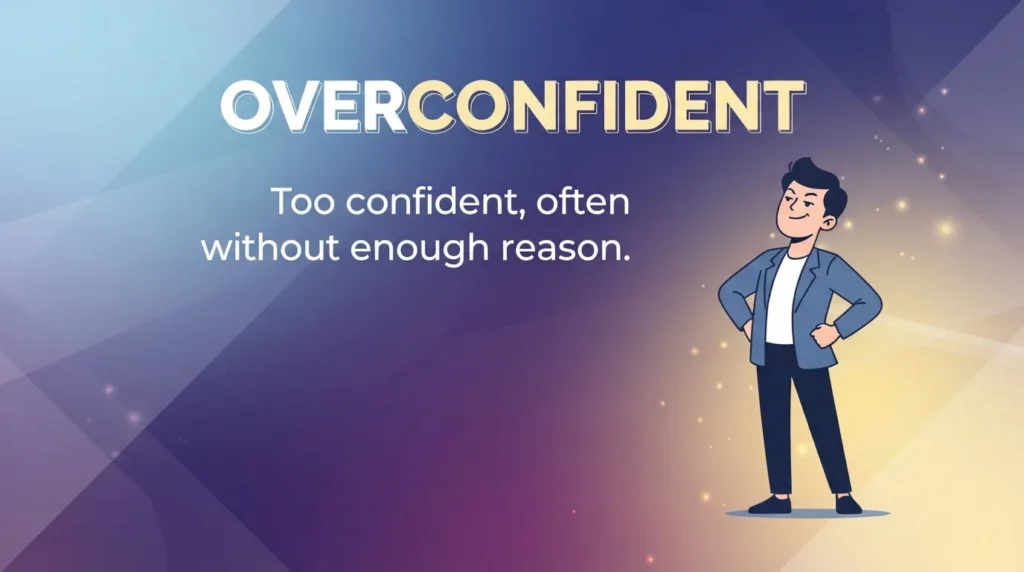
A synonym for overconfident is a word or phrase that describes someone who has too much confidence in their abilities, knowledge, success, or judgment. Common alternatives include arrogant, conceited, cocky, self-important, presumptuous, brash, cocksure, and overweening. The best choice depends on the tone and context.
A synonym for overconfident becomes useful when you want to describe excessive confidence without repeating the same word. Imagine a student who skips revision because they are certain they will get the highest marks.
That student may seem overconfident because their confidence goes beyond what the situation supports. A synonym can make the description more precise.
Learning a synonym for overconfident also helps you understand different shades of attitude. Words such as self-assured, cocky, and presumptuous do not carry exactly the same tone.
The word overconfident is common in everyday English, education, workplaces, writing, and conversations. Students, bloggers, content writers, and daily English users can all benefit from knowing its alternatives.
What Does “Overconfident” Really Mean?
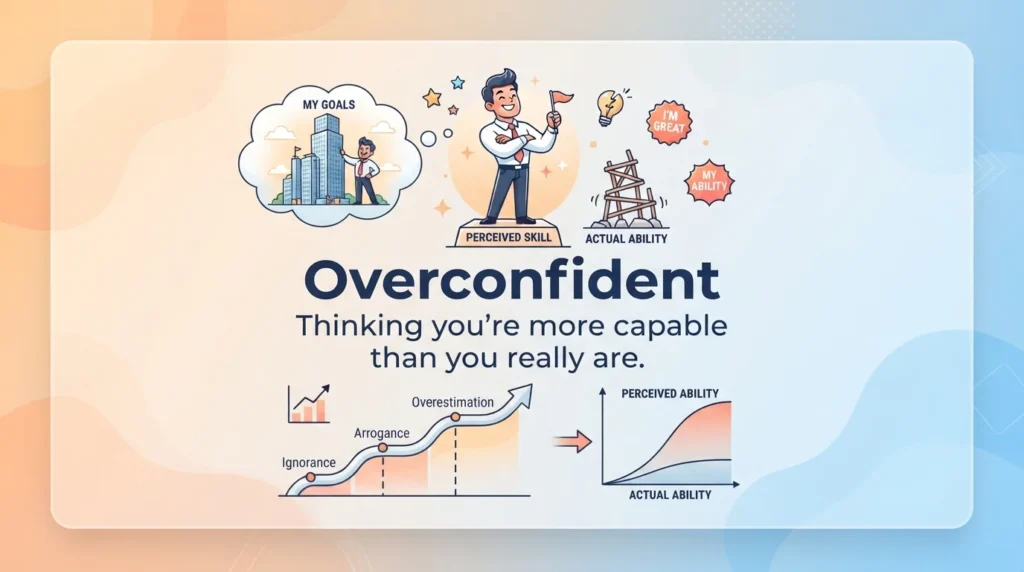
Overconfident is an adjective that means having or showing more confidence than is reasonable or appropriate.
Someone who is overconfident may believe they are more skilled, capable, intelligent, successful, or certain than the available evidence suggests.
For example:
He was overconfident about winning the competition.
This means he felt too certain that he would win.
Native speakers usually understand overconfident as a criticism. It suggests that confidence has gone beyond a sensible level.
The word can describe people, decisions, predictions, attitudes, performances, or expectations.
Part of Speech
Overconfident — adjective
Simple definition: Too confident in yourself, your abilities, or the likely success of something.
Connotative Meaning
Connotation (the feeling or association a word carries beyond its basic dictionary meaning) can change how a synonym sounds.
Positive Tone
Some related expressions can suggest strong self-belief without directly insulting someone.
Examples include:
- self-assured
- assured
- confident
- bold
- assertive
These are not exact replacements in every sentence because they can describe healthy confidence.
Negative Tone
Most close synonyms for overconfident have a negative or critical tone.
Examples include:
- arrogant
- conceited
- cocky
- presumptuous
- pompous
- egotistical
They suggest that someone’s confidence may be excessive or unpleasant.
Neutral Tone
Words such as overly confident, too sure of oneself, and overestimating oneself can describe excessive confidence more objectively.
Etymology of Overconfident
The word overconfident is formed from over- + confident.
The prefix over- is of Germanic origin and has long been used in English to express excess or an excessive degree.
Confident ultimately comes from Latin confidēre, meaning “to trust fully” or “to have confidence.” It entered English through French and developed into the modern adjective associated with certainty and self-assurance.
Old English: 450–1100
The exact modern word overconfident did not exist in Old English. However, Old English had Germanic vocabulary related to trust, belief, certainty, and excess.
The prefix over- has Germanic roots and was already productive in English.
Middle English: 1100–1500
English continued developing vocabulary connected with confidence and certainty through French and Latin influence after the Norman Conquest.
The modern idea of excessive confidence gradually became easier to express through combinations of existing words.
Modern English: 1500–Present
Modern English expanded the use of confident and productive prefixes such as over-. The compound overconfident came to describe confidence that goes beyond what is justified.
Today, it is widely used in everyday speech, journalism, education, business writing, and academic discussion.
Pronunciation of Overconfident
US: /ˌoʊ.vɚˈkɑːn.fə.dənt/
UK: /ˌəʊ.vəˈkɒn.fɪ.dənt/
Syllables
o-ver-con-fi-dent
Affixation Pattern
Root: confident
Prefix: over-
Suffix: -ent
The prefix over- adds the idea of excess. Therefore, overconfident literally communicates the idea of being confident to an excessive degree.
List of Synonyms
Not every synonym has exactly the same meaning. Some focus on excessive pride, while others emphasize excessive certainty, boldness, or self-belief.
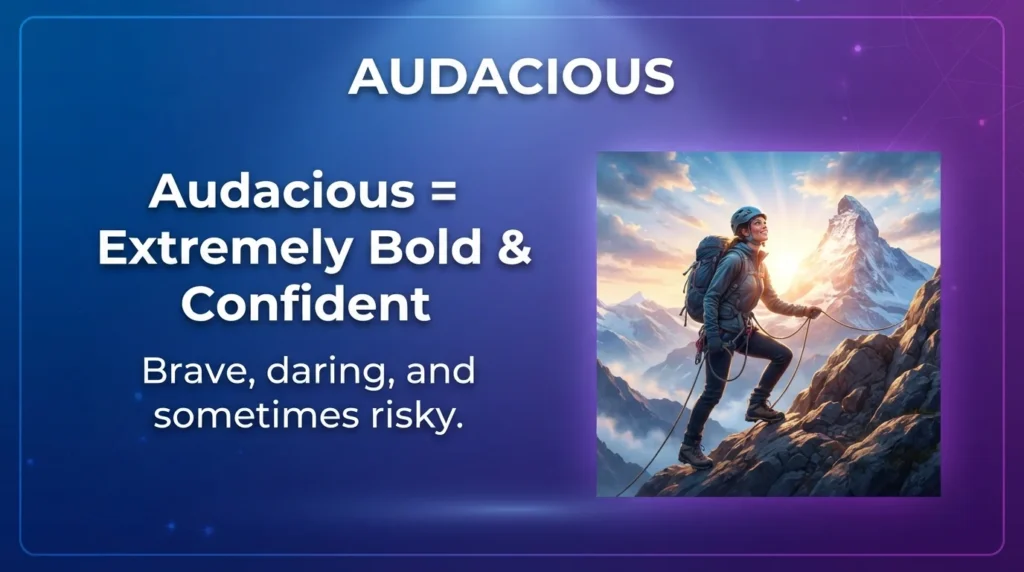
Audacious (Adjective)
US: /ɔːˈdeɪ.ʃəs/
UK: /ɔːˈdeɪ.ʃəs/
Meaning: Extremely bold and confident, sometimes without enough concern for risks.
Tone/Register: Formal to neutral.
Example:
His audacious prediction surprised the entire team.
She made an audacious claim without much evidence.
Bold (Adjective)
US: /boʊld/
UK: /bəʊld/
Meaning: Very confident and willing to take risks, sometimes excessively.
Tone/Register: Neutral; can be positive or negative.
Example:
He made a bold assumption about the project’s success.
Her bold approach impressed the audience.
Adventurous (Adjective)
US: /ədˈven.tʃɚ.əs/
UK: /ədˈven.tʃər.əs/
Meaning: Willing to take risks or try difficult things with strong confidence.
Tone/Register: Neutral to positive.
Example:
His adventurous approach sometimes overlooked potential problems.
She has an adventurous attitude toward new challenges.
Daring (Adjective)
US: /ˈder.ɪŋ/
UK: /ˈdeə.rɪŋ/
Meaning: Confident enough to attempt something difficult or risky.
Tone/Register: Neutral to positive.
Example:
The team made a daring prediction before the final.
His daring decision could either succeed or fail.
Bravado (Noun)
US: /brəˈvɑː.doʊ/
UK: /brəˈvɑː.dəʊ/
Meaning: A show of confidence or courage that may be exaggerated or insincere.
Tone/Register: Neutral to negative.
Example:
His bravado disappeared when the challenge became serious.
She used bravado to hide her uncertainty.
Swagger (Noun)
US: /ˈswæɡ.ɚ/
UK: /ˈswæɡ.ər/
Meaning: An exaggerated display of confidence or self-importance.
Tone/Register: Informal.
Example:
He walked into the room with obvious swagger.
Her swagger attracted attention immediately.
Blustering (Adjective)
US: /ˈblʌs.tɚ.ɪŋ/
UK: /ˈblʌs.tər.ɪŋ/
Meaning: Speaking or behaving with loud, forceful confidence that may lack substance.
Tone/Register: Neutral to negative.
Example:
The politician gave a blustering response to the question.
His blustering style did not convince the audience.
Overbearing (Adjective)
US: /ˌoʊ.vɚˈber.ɪŋ/
UK: /ˌəʊ.vəˈbeə.rɪŋ/
Meaning: Too forceful or controlling because of excessive confidence or authority.
Tone/Register: Neutral to negative.
Example:
His overbearing manner made teamwork difficult.
The manager became increasingly overbearing.
Domineering (Adjective)
US: /ˌdɑː.məˈnɪr.ɪŋ/
UK: /ˌdɒm.ɪˈnɪə.rɪŋ/
Meaning: Trying to control others in an overly confident and forceful way.
Tone/Register: Formal to neutral; negative.
Example:
Her domineering personality discouraged discussion.
He became domineering during group decisions.
Self-satisfied (Adjective)
US: /ˌselfˈsæt̬.ɪs.faɪd/
UK: /ˌselfˈsæt.ɪs.faɪd/
Meaning: Excessively pleased with yourself or your achievements.
Tone/Register: Neutral to negative.
Example:
The players became self-satisfied after several victories.
His self-satisfied expression annoyed his teammates.
Self-aggrandizing (Adjective)
US: /ˌself.əˈɡræn.də.zaɪz.ɪŋ/
UK: /ˌself.əˈɡræn.dɪ.zaɪ.zɪŋ/
Meaning: Trying to make yourself appear more important, successful, or impressive than you really are.
Tone/Register: Formal; negative.
Example:
The article contained several self-aggrandizing statements.
His self-aggrandizing behavior attracted criticism.
Vainglorious (Adjective)
US: /veɪnˈɡlɔːr.i.əs/
UK: /veɪnˈɡlɔː.ri.əs/
Meaning: Excessively proud of your own achievements or qualities.
Tone/Register: Formal or literary.
Example:
The novel portrays a vainglorious ruler.
His vainglorious speech impressed nobody.
Vaingloriousness (Noun)
US: /veɪnˈɡlɔːr.i.əs.nəs/
UK: /veɪnˈɡlɔː.ri.əs.nəs/
Meaning: Excessive pride in one’s achievements, abilities, or qualities.
Tone/Register: Formal; literary.
Example:
His vainglory prevented him from accepting criticism.
The story explores the dangers of vainglory.
Self-glorifying (Adjective)
US: /ˌselfˈɡlɔːr.ə.faɪ.ɪŋ/
UK: /ˌselfˈɡlɔː.rɪ.faɪ.ɪŋ/
Meaning: Making yourself appear unusually impressive or worthy of admiration.
Tone/Register: Formal to neutral; negative.
Example:
The speech sounded self-glorifying.
His self-glorifying comments weakened his argument.
Overproud (Adjective)
US: /ˌoʊ.vɚˈpraʊd/
UK: /ˌəʊ.vəˈpraʊd/
Meaning: Too proud of yourself, your abilities, or your achievements.
Tone/Register: Neutral; somewhat literary.
Example:
He became overproud after receiving the award.
An overproud attitude can make it difficult to accept criticism.
Proudful (Adjective)
Meaning: Showing excessive pride or an inflated sense of personal importance.
Tone/Register: Uncommon; literary.
Example:
The character is portrayed as proudful and stubborn.
His proudful attitude created tension within the group.

Self-opinionated (Adjective)
US: /ˌself.əˈpɪn.jə.neɪ.tɪd/
UK: /ˌself.əˈpɪn.jə.neɪ.tɪd/
Meaning: Having a very high opinion of your own ideas and opinions.
Tone/Register: Informal to neutral; negative.
Example:
The self-opinionated speaker rarely listened to others.
His self-opinionated manner frustrated the group.
Self-satisfiedly (Adverb)
US: /ˌselfˈsæt̬.ɪs.faɪd.li/
UK: /ˌselfˈsæt.ɪs.faɪd.li/
Meaning: In a way that shows excessive satisfaction with yourself or your achievements.
Tone/Register: Formal to neutral.
Example:
He smiled self-satisfiedly after winning the debate.
She spoke self-satisfiedly about her prediction.
Inflated (Adjective)
US: /ɪnˈfleɪ.t̬ɪd/
UK: /ɪnˈfleɪ.tɪd/
Meaning: Excessively high or exaggerated, especially when describing someone’s opinion of themselves.
Tone/Register: Neutral to formal.
Example:
He has an inflated opinion of his abilities.
The report revealed an inflated sense of confidence.
Grandiose (Adjective)
US: /ˈɡræn.di.oʊs/
UK: /ˈɡræn.di.əʊs/
Meaning: Having an exaggerated belief in your importance, abilities, or achievements.
Tone/Register: Formal; negative.
Example:
He made grandiose claims about his future success.
Her grandiose plans lacked realistic details.
Quick Note
These words are not all perfect one-for-one replacements for overconfident. Some focus more strongly on excessive pride, risk-taking, dominance, self-praise, or exaggerated self-belief.
For the closest alternatives, bold, audacious, overproud, inflated, self-opinionated, and grandiose can be useful depending on the sentence.
Arrogant (Adjective)
US: /ˈer.ə.ɡənt/
UK: /ˈær.ə.ɡənt/
Meaning: Believing that you are more important, capable, or knowledgeable than other people.
Tone/Register: Negative; common in everyday and professional English.
Example:
He sounded arrogant during the interview.
His arrogant attitude annoyed the other candidates.
Conceited (Adjective)
US: /kənˈsiː.tɪd/
UK: /kənˈsiː.tɪd/
Meaning: Having an excessively high opinion of yourself, especially your abilities or appearance.
Tone/Register: Negative; everyday English.
Example:
She became conceited after winning several awards.
His conceited comments made the conversation uncomfortable.
Cocky (Adjective)
US: /ˈkɑː.ki/
UK: /ˈkɒk.i/
Meaning: Too confident in a way that makes someone appear irritating or disrespectful.
Tone/Register: Informal; negative.
Example:
The young player sounded cocky before the match.
His cocky attitude disappeared after the difficult first round.
Cocksure (Adjective)
US: /ˈkɑːk.ʃʊr/
UK: /ˈkɒk.ʃɔːr/
Meaning: Extremely confident that you are right or will succeed.
Tone/Register: Informal; strongly negative or critical.
Example:
He was cocksure that nobody could beat him.
Her cocksure prediction turned out to be wrong.
Presumptuous (Adjective)
US: /prɪˈzʌmp.tʃu.əs/
UK: /prɪˈzʌmp.tʃu.əs/
Meaning: Showing too much confidence by assuming something without having the right evidence to do so.
Tone/Register: Formal; negative.
Example:
It was presumptuous to assume everyone would agree.
His presumptuous comment surprised the committee.
Brash (Adjective)
US: /bræʃ/
UK: /bræʃ/
Meaning: Very confident and direct in a way that can seem rude or careless.
Tone/Register: Informal to neutral; negative.
Example:
Her brash approach impressed some people but annoyed others.
He made a brash promise without checking the facts.
Pompous (Adjective)
US: /ˈpɑːm.pəs/
UK: /ˈpɒm.pəs/
Meaning: Behaving as if you are more important, intelligent, or impressive than others.
Tone/Register: Negative; common in descriptive writing.
Example:
The speaker sounded pompous during the discussion.
His pompous manner made a simple idea seem complicated.
Egotistical (Adjective)
US: /ˌiː.ɡoʊˈtɪs.tɪ.kəl/
UK: /ˌiː.ɡəʊˈtɪs.tɪ.kəl/
Meaning: Having an excessively high opinion of yourself.
Tone/Register: Formal to neutral; negative.
Example:
His egotistical behavior caused tension in the group.
She disliked his egotistical way of discussing success.
Self-important (Adjective)
US: /ˌself.ɪmˈpɔːr.tənt/
UK: /ˌself.ɪmˈpɔː.tənt/
Meaning: Acting as though you are more important than you really are.
Tone/Register: Neutral to negative; common in writing.
Example:
His self-important tone bothered his colleagues.
She came across as self-important during the meeting.
Overweening (Adjective)
US: /ˌoʊ.vɚˈwiː.nɪŋ/
UK: /ˌəʊ.vəˈwiː.nɪŋ/
Meaning: Excessively proud or confident in yourself.
Tone/Register: Formal; strongly negative.
Example:
His overweening confidence caused poor decisions.
The novel portrays an overweening leader.
Presumptive (Adjective)
US: /prɪˈzʌmp.tɪv/
UK: /prɪˈzʌmp.tɪv/
Meaning: Based on an assumption that may be too confident or not fully supported.
Tone/Register: Formal; academic and professional.
Example:
Her presumptive conclusion needed more evidence.
The report avoided presumptive claims.

Forward (Adjective)
US: /ˈfɔːr.wɚd/
UK: /ˈfɔː.wəd/
Meaning: Confident and bold in a way that may sometimes seem too direct.
Tone/Register: Formal or literary; context-dependent.
Example:
His forward manner surprised the new team.
She was unusually forward during the negotiation.
Immodest (Adjective)
US: /ɪˈmɑː.dɪst/
UK: /ɪˈmɒd.ɪst/
Meaning: Not modest because you openly display too much pride in yourself.
Tone/Register: Neutral to formal; negative.
Example:
It may sound immodest, but I am proud of the result.
His immodest remarks attracted criticism.
Boastful (Adjective)
US: /ˈboʊst.fəl/
UK: /ˈbəʊst.fəl/
Meaning: Frequently talking with too much pride about your achievements or abilities.
Tone/Register: Neutral; negative.
Example:
His boastful posts attracted attention online.
She avoided sounding boastful when discussing her success.
Swollen-headed (Adjective)
US: /ˌswoʊ.lənˈhedɪd/
UK: /ˌswəʊ.lənˈhedɪd/
Meaning: Too proud of yourself because you think you are especially successful or important.
Tone/Register: Informal.
Example:
Winning the prize made him a little swollen-headed.
Her friends joked that success had made her swollen-headed.
Full of Yourself (Phrase)
US: /fʊl əv jɚˈself/
UK: /fʊl əv jɔːˈself/
Meaning: Acting as though you are extremely important, talented, or impressive.
Tone/Register: Informal; conversational.
Example:
He is talented, but sometimes he is too full of himself.
She sounded full of herself during the interview.
Self-satisfied (Adjective)
US: /ˌselfˈsæt̬.ɪs.faɪd/
UK: /ˌselfˈsæt.ɪs.faɪd/
Meaning: Too pleased with yourself or your achievements, often without recognizing problems.
Tone/Register: Neutral to formal; negative.
Example:
The team became self-satisfied after several easy wins.
A self-satisfied attitude can prevent improvement.
Overassured (Adjective)
US: /ˌoʊ.vɚ.əˈʃʊrd/
UK: /ˌəʊ.vər.əˈʃʊəd/
Meaning: Too certain about your ability, judgment, or success.
Tone/Register: Formal; less common.
Example:
His overassured response ignored several risks.
The manager warned against becoming overassured.
Overbold (Adjective)
US: /ˌoʊ.vɚˈboʊld/
UK: /ˌəʊ.vəˈbəʊld/
Meaning: Too bold or confident, especially when caution would be sensible.
Tone/Register: Formal or literary.
Example:
The proposal was overbold for such a small budget.
His overbold prediction attracted criticism.
Overoptimistic (Adjective)
US: /ˌoʊ.vɚˌɑːp.təˈmɪs.tɪk/
UK: /ˌəʊ.vərˌɒp.tɪˈmɪs.tɪk/
Meaning: Too hopeful about a future result or situation.
Tone/Register: Neutral; professional and everyday use.
Example:
The original deadline was overoptimistic.
Her overoptimistic forecast ignored possible delays.
Self-assured (Adjective)
US: /ˌself.əˈʃʊrd/
UK: /ˌself.əˈʃʊəd/
Meaning: Confident in your abilities or decisions.
Tone/Register: Positive to neutral.
Example:
She gave a self-assured presentation.
His self-assured manner helped the team stay calm.
Note: Self-assured is not always negative, so it is not a perfect replacement for overconfident.
Assured (Adjective)
US: /əˈʃʊrd/
UK: /əˈʃʊəd/
Meaning: Confident and certain, sometimes to an excessive degree depending on context.
Tone/Register: Neutral to formal.
Example:
She sounded assured when answering questions.
His assured tone made the decision seem easy.
Overcertain (Adjective)
US: /ˌoʊ.vɚˈsɜːr.tən/
UK: /ˌəʊ.vəˈsɜː.tən/
Meaning: Too certain about something that may actually be uncertain.
Tone/Register: Formal; analytical.
Example:
The article makes an overconfident claim about the results.
Researchers should avoid being overconfident when evidence is limited.
Dogmatic (Adjective)
US: /dɔːɡˈmæt̬.ɪk/
UK: /dɒɡˈmæt.ɪk/
Meaning: Expressing opinions as if they are unquestionably correct.
Tone/Register: Formal; academic and professional.
Example:
His dogmatic approach discouraged open discussion.
The essay sounds too dogmatic in places.
Imperious (Adjective)
US: /ɪmˈpɪr.i.əs/
UK: /ɪmˈpɪə.ri.əs/
Meaning: Acting as though you have the authority to command or control others.
Tone/Register: Formal; negative.
Example:
Her imperious tone upset the staff.
He gave an imperious order without explaining it.
Haughty (Adjective)
US: /ˈhɑː.ti/
UK: /ˈhɔː.ti/
Meaning: Unfriendly and proud because you believe you are better than other people.
Tone/Register: Formal; negative.
Example:
His haughty attitude discouraged new team members.
She gave the impression of being haughty and distant.
Supercilious (Adjective)
US: /ˌsuː.pɚˈsɪl.i.əs/
UK: /ˌsuː.pəˈsɪl.i.əs/
Meaning: Behaving as though you are superior to other people.
Tone/Register: Formal; strongly negative.
Example:
His supercilious response offended the audience.
She disliked the manager’s supercilious manner.
Bumptious (Adjective)
US: /ˈbʌmp.ʃəs/
UK: /ˈbʌmp.ʃəs/
Meaning: Excessively confident and self-important in an annoying way.
Tone/Register: Informal to formal; uncommon but recognizable.
Example:
The bumptious speaker interrupted several people.
His bumptious behavior quickly became irritating.
Uppity (Adjective)
US: /ˈʌp.ə.t̬i/
UK: /ˈʌp.ɪ.ti/
Meaning: Acting as though you deserve more respect or importance than others think you do.
Tone/Register: Informal; potentially offensive depending on context.
Example:
The character is portrayed as uppity and demanding.
The informal word can sound insulting, so use it carefully.
Cheeky (Adjective)
US: /ˈtʃiː.ki/
UK: /ˈtʃiː.ki/
Meaning: Slightly rude or disrespectful in a playful or bold way.
Tone/Register: Informal; often British English.
Example:
The child gave a cheeky answer.
His cheeky confidence made everyone laugh.
Note: Cheeky is often playful rather than seriously arrogant.
Impudent (Adjective)
US: /ˈɪm.pjə.dənt/
UK: /ˈɪm.pjə.dənt/
Meaning: Showing a lack of respect through overly bold behavior or speech.
Tone/Register: Formal; negative.
Example:
The student gave an impudent reply to the teacher.
His impudent comment surprised everyone.
Swaggering (Adjective)
US: /ˈswæɡ.ər.ɪŋ/
UK: /ˈswæɡ.ər.ɪŋ/
Meaning: Showing exaggerated confidence through behavior, appearance, or movement.
Tone/Register: Descriptive; often negative.
Example:
The actor entered with a swaggering confidence.
His swaggering manner attracted attention.
Self-confident to a Fault (Phrase)
US: /ˌselfˈkɑːn.fə.dənt tə ə fɔːlt/
UK: /ˌselfˈkɒn.fɪ.dənt tə ə fɔːlt/
Meaning: So confident that the confidence becomes a weakness.
Tone/Register: Neutral; useful in thoughtful writing.
Example:
She is self-confident to a fault.
His confidence is useful, but sometimes it prevents careful planning.
Too Sure of Oneself (Phrase)
US: /tuː ʃʊr əv wʌnˈself/
UK: /tuː ʃɔːr əv wʌnˈself/
Meaning: Excessively certain about your own abilities or judgment.
Tone/Register: Neutral; everyday English.
Example:
He became too sure of himself after one successful project.
Don’t become too sure of yourself before checking the details.
Overestimating Oneself (Phrase)
US: /ˌoʊ.vɚˈes.tə.meɪ.tɪŋ wʌnˈself/
UK: /ˌəʊ.vərˈes.tɪ.meɪ.tɪŋ wʌnˈself/
Meaning: Thinking your abilities or importance are greater than they actually are.
Tone/Register: Neutral; academic and professional.
Example:
He was overestimating himself before the competition.
Overestimating yourself can lead to poor planning.
Synonyms for Overconfident by Tone
Positive or Mild
These words can describe confidence without strongly criticizing the person:
- self-assured
- assured
- bold
- assertive
- forward
Use them when the speaker may actually admire the person’s confidence.
Neutral
These expressions can describe excessive confidence more objectively:
- overoptimistic
- overcertain
- too sure of oneself
- overestimating oneself
- self-confident to a fault
These are useful in essays, reports, and analytical writing.
Negative
These choices clearly suggest a personality problem or unpleasant attitude:
- arrogant
- conceited
- cocky
- cocksure
- pompous
- egotistical
- presumptuous
- haughty
- supercilious
- self-important
Playful or Informal
Some alternatives can sound lighter or humorous:
- cheeky
- full of yourself
- swollen-headed
- cocky
Tone matters because replacing overconfident with arrogant can make a sentence much more critical.
“Overconfident” vs. Close Alternatives
How Overconfident Differs from Arrogant
Overconfident describes having more confidence in your abilities or importance than is reasonable.
Arrogant goes further and often suggests that someone believes they are superior to others.
He was overconfident about passing the exam.
He was arrogant toward his classmates.
Overconfident vs. Conceited
Conceited emphasizes an overly high opinion of yourself.
Overconfident can refer to a specific situation, prediction, or ability.
She was overconfident about winning.
She was conceited about her intelligence.
Overconfident vs. Cocky
Cocky is more informal and often describes confidence that feels irritating or disrespectful.
The player was overconfident before the match.
The player sounded cocky during the interview.
How “Overconfident” Changes by Context
Daily Conversation
In casual conversation, overconfident, cocky, full of yourself, and too sure of yourself are natural choices.
For example:
Don’t get too sure of yourself after one good result.
The informal alternatives make everyday speech sound more natural.
Writing and Blogging
Bloggers can use overconfident, conceited, arrogant, or overoptimistic, depending on the intended meaning.
For example:
Overconfident predictions can make an article sound unreliable.
The word is especially useful when discussing behavior, decisions, predictions, or expectations.
Professional or Academic English
Formal alternatives include presumptuous, overconfident, overoptimistic, and self-assured.
For example:
The researchers avoided making overcertain claims.
These choices can make analytical writing more precise.
Creative or Informal Use
Storytelling often benefits from vivid words such as cocky, cocksure, swaggering, pompous, and full of himself.
These words help readers understand a character’s personality quickly.
Common Mistakes Learners Make
One common mistake is treating every confidence-related word as a direct synonym.
Confident and overconfident are not interchangeable.
She is confident about the presentation.
This is normally positive.
She is overconfident about the presentation.
This suggests that her confidence may be excessive.
Another mistake is using arrogant when you only mean someone is very confident. Arrogant usually carries a stronger criticism and can imply superiority.
Learners should also remember that cocky is informal. It works well in conversation but may not be the best choice for a formal academic essay.
Register Notes
For positive or neutral descriptions, self-assured is often the most suitable choice.
When expressing a stronger negative judgment, arrogant or conceited works better.
For specific decisions, claims, or expectations, consider presumptuous, overconfident, or overoptimistic.
For more vocabulary practice, you can internally link this article to another vocabulary guide about confidence and personality adjectives.
Real-Life Mini Scenarios
Workplace
A new employee confidently predicts that a difficult project will finish in two days.
A manager might describe the prediction as overconfident or overoptimistic.
Social Situation
Someone constantly talks about being smarter than everyone else.
Words such as arrogant, conceited, or self-important fit better.
Media and Pop Culture
A fictional character walks into every challenge believing they cannot lose.
A writer might call the character cocky, cocksure, or swaggering.
Writing and Storytelling
A narrator may want to show a character’s personality without directly saying “he was overconfident.”
For example, pompous, haughty, or supercilious can reveal a stronger sense of superiority.
How to Choose the Right Synonym
Ask yourself what exactly you want to criticize.
When excessive confidence is the main issue, choose overconfident or overassured.
For someone who believes they are better than others, arrogant, haughty, or supercilious may be more appropriate.
To describe someone who feels excessively proud of themselves, use conceited or self-important.
When a person is extremely certain about their success, cocksure or too sure of oneself fits well.
For someone who is unrealistically hopeful about an outcome, overoptimistic is a suitable choice.
If the behavior seems bold, confident, and slightly rude, consider brash or impudent.
This small distinction can make your English sound much more natural.
Interactive Practice Quiz
Choose the best word or phrase for each situation.
1.
Someone believes they will definitely win despite having done almost no preparation.
A. modest
B. overconfident
C. uncertain
D. hesitant
2.
A person constantly talks about how talented they are.
A. conceited
B. cautious
C. uncertain
D. reserved
3.
A student gives a very confident answer but has no evidence.
A. overconfident
B. humble
C. hesitant
D. thoughtful
4.
A manager expects a complicated project to finish far earlier than realistically possible.
A. overoptimistic
B. modest
C. timid
D. uncertain
5.
Someone behaves as though they are more important than everyone else.
A. arrogant
B. shy
C. careful
D. nervous
6.
A young athlete speaks with irritating confidence before a match.
A. cocky
B. modest
C. cautious
D. uncertain
7.
A person assumes everyone will accept their decision without asking them.
A. presumptuous
B. humble
C. reserved
D. uncertain
8.
A character acts as though they are superior to other people.
A. haughty
B. cheerful
C. nervous
D. cautious
9.
A formal report makes a claim with far more certainty than the evidence allows.
A. overconfident
B. playful
C. modest
D. doubtful
10.
Someone is confident in a way that is friendly and positive rather than arrogant.
A. self-assured
B. pompous
C. conceited
D. haughty
Answer Key: 1-B | 2-A | 3-A | 4-A | 5-A | 6-A | 7-A | 8-A | 9-A | 10-A |
Reflection Task
Write one sentence using a synonym for overconfident. Then rewrite the sentence using a different synonym and notice how the tone changes.
External Resources
For more detailed information about the meaning, pronunciation, and usage of overconfident, you can also explore the Cambridge Dictionary. It provides reliable definitions, pronunciation, and examples to help you understand the word in different contexts.
Frequently Asked Questions
1. What is a good synonym for overconfident in an essay?
Arrogant, presumptuous, conceited, overconfident, and overoptimistic can work in essays, depending on meaning. If you are discussing a person’s attitude, arrogant or conceited may fit. If you are discussing an unsupported claim or prediction, overconfident or overoptimistic may be more precise.
2. What is a polite way to say someone is overconfident?
A softer expression is too sure of themselves or very self-assured. You can also describe the specific behavior rather than criticizing the person’s personality. For example, “She may be more confident than the evidence supports” sounds more diplomatic than simply calling her arrogant.
3. What is the difference between confident and overconfident?
Confident usually means having reasonable trust in your abilities or judgment. Overconfident means having more confidence than the situation justifies. Confidence can help someone perform well, while overconfidence may cause them to ignore risks, preparation, evidence, or advice.
4. Is cocky a synonym for overconfident?
Yes, cocky can be a synonym for overconfident when someone displays excessive confidence in an irritating or disrespectful way. However, cocky is informal. It is common in conversations and casual writing but is usually less suitable for formal academic work.
5. What is a formal synonym for overconfident?
Useful formal alternatives include presumptuous, overconfident, overweening, self-important, supercilious, and overoptimistic. The best choice depends on what is excessive. Overcertain describes excessive certainty, while presumptuous often describes unreasonable assumptions.
6. Can arrogant and overconfident be used interchangeably?
Sometimes, but they are not exact equivalents. Overconfident focuses mainly on excessive confidence. Arrogant usually suggests that a person considers themselves superior to others. Someone can be overconfident without treating other people as inferior.
7. What is the best synonym for overconfident in professional English?
The safest choice depends on the situation. Overoptimistic works well for unrealistic expectations, while overconfident works for unsupported claims. Presumptuous is useful when someone makes an unjustified assumption. These are often more precise than informal words such as cocky.
Conclusion
Learning a synonym for overconfident gives you more control over tone. You can choose a mild, neutral, formal, playful, or strongly critical word.
Words such as arrogant, conceited, cocky, presumptuous, overoptimistic, and self-assured each show a different shade of confidence.
For students and writers, these distinctions make essays and articles more precise. For daily English users, they make conversations more natural and expressive.
Try using one new synonym in an email, essay, story, or daily conversation today. Small vocabulary choices can make your English clearer, richer, and more confident.

Aqsa Rani is the founder and lead writer at VocaNeest.com, a trusted platform dedicated to helping people improve their English vocabulary and communication skills. She creates well-researched, accurate, and easy-to-understand content covering synonyms, antonyms, word meanings, idioms, phrases, and everyday vocabulary. Her goal is to make learning English simple, practical, and accessible for students, writers, professionals, and lifelong learners.
At VocaNeest.com, every article is carefully researched, fact-checked, and written with a strong focus on accuracy, clarity, and real-world usage. Content is regularly reviewed and updated to ensure it remains helpful, relevant, and aligned with modern language standards. Through reliable vocabulary guides and practical examples, Aqsa aims to help readers write with confidence, expand their vocabulary, and communicate more effectively.