

A synonym for paint depends on what you mean: coat, cover, color, decorate, daub, brush, or illustrate may work in specific contexts. For artistic work, color or depict may fit, while coat suits applying a layer to a surface.
Imagine describing a freshly painted bedroom. You could say someone painted the walls, coated them with a new finish, or colored them a soft blue. Each expression creates a slightly different picture.
The word paint appears in everyday conversation, art, home improvement, and creative writing. Learning related words helps you describe actions and artistic techniques more precisely.
If you are a student, blogger, content writer, or everyday English learner, exploring synonyms can make your vocabulary more flexible. The right alternative also helps you avoid repeating the same word.
This guide explores useful alternatives to paint, explains their meanings and pronunciations, and shows you how to choose the right word for different situations.
What Does “Paint” Really Mean?
Paint can function as both a noun and a verb.
- As a noun: Paint is a colored liquid, paste, or similar substance applied to a surface to decorate or protect it.
- As a verb: To paint means to apply paint to something or create a picture using colors and artistic materials.
Native English speakers use paint when discussing artwork, decorating rooms, protecting surfaces, or describing images created with artistic skill.
For example, “She painted a landscape” describes creating an artwork. “They painted the fence” describes applying a coating to a physical surface.
The word is generally neutral. Its emotional effect depends on the surrounding sentence. Painting can suggest creativity, renewal, careful work, or even an attempt to hide an unpleasant appearance.
Connotative Meaning of Paint
(Connotation is the feeling, association, or emotional suggestion that a word carries beyond its basic definition.)
- Positive tone: Paint can suggest creativity, beauty, transformation, and self-expression.
- Negative tone: In expressions such as “paint a misleading picture,” it can suggest dishonesty or distortion.
- Neutral tone: In instructions such as “paint the door white,” it simply describes an action.
The context determines whether the word sounds artistic, practical, critical, or imaginative.
Etymology of Paint
The English word paint developed through Anglo-French and Old French forms related to the Latin word pingere, meaning “to paint” or “to depict.” The Latin past participle pictus also influenced related words such as picture and pictorial.
Historical development
- Old English (450–1100): The modern word paint was not commonly established in its present form. English used other words and expressions to describe coloring and decorating.
- Middle English (1100–1500): Forms related to Anglo-French and Old French peint and peindre entered English, helping establish paint and its artistic meaning.
- Modern English (1500–present): The word expanded across art, decoration, construction, and figurative language. Expressions such as “paint a picture” also developed metaphorical meanings.
Pronunciation (US and UK – IPA)
- US: /peɪnt/
- UK: /peɪnt/
Syllables: paint (one syllable)
Affixation pattern
- Root: paint
- Prefix: None
- Suffix: None in the base word
Related forms include painter, painting, painted, and paintable. These forms add suffixes to the base word and serve different grammatical purposes.
Synonyms List
Not every alternative to paint works in every sentence. Some words describe applying a colored substance, while others refer to creating artwork or describing something figuratively.
The following alternatives are organized by their closest practical meanings. Pronunciations use IPA, with US and UK forms shown separately.
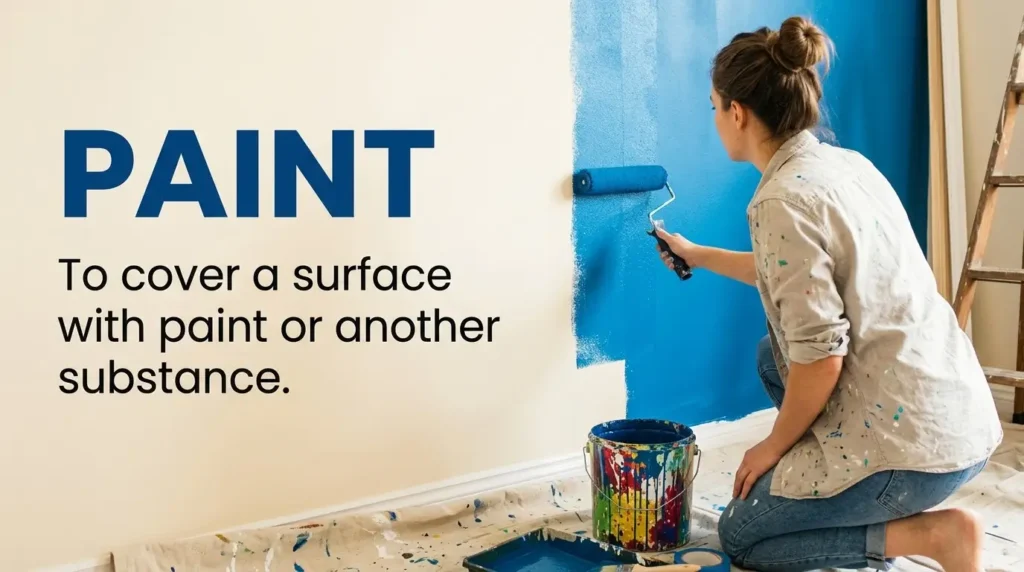
Coat (Verb) — US: /koʊt/ | UK: /kəʊt/
Meaning: To cover a surface with a layer of paint or another substance.
Tone/Register: Neutral, practical, and professional.
Example:
- We coated the wooden table with white paint.
- She coated the garden fence before winter.
Color (Verb) — US: /ˈkʌl.ɚ/ | UK: /ˈkʌl.ə/
Meaning: To add color to a drawing, picture, or surface.
Tone/Register: Neutral, creative, and informal.
Example:
- The children colored the pictures in their books.
- He colored the background with shades of green.
Colour (Verb) — US: /ˈkʌl.ɚ/ | UK: /ˈkʌl.ə/
Meaning: The British spelling of color, referring to adding or changing color.
Tone/Register: Neutral, especially in British English.
Example:
- She coloured the sketch with soft pastels.
- The artist coloured the design in warm tones.
Decorate (Verb) — US: /ˈdɛk.əˌreɪt/ | UK: /ˈdek.ə.reɪt/
Meaning: To make something more attractive, sometimes by applying paint.
Tone/Register: Neutral, domestic, and creative.
Example:
- They decorated the bedroom with pale green walls.
- We decorated the classroom for the school event.
Brush (Verb) — US: /brʌʃ/ | UK: /brʌʃ/
Meaning: To apply paint using a brush, usually with controlled strokes.
Tone/Register: Practical and descriptive.
Example:
- She brushed blue paint across the wooden panel.
- He brushed another layer onto the frame.
Daub (Verb) — US: /dɔːb/ | UK: /dɔːb/
Meaning: To spread or apply paint in rough, uneven, or careless marks.
Tone/Register: Informal, expressive, and sometimes negative.
Example:
- The toddler daubed paint across the paper.
- Someone daubed bright colors onto the old wall.
Depict (Verb) — US: /dɪˈpɪkt/ | UK: /dɪˈpɪkt/
Meaning: To represent a person, place, or scene in an artwork.
Tone/Register: Formal, artistic, and academic.
Example:
- The mural depicts life in a coastal village.
- Her painting depicts a quiet mountain landscape.
Illustrate (Verb) — US: /ˈɪl.əˌstreɪt/ | UK: /ˈɪl.ə.streɪt/
Meaning: To explain or represent something using pictures, drawings, or visual details.
Tone/Register: Educational, professional, and creative.
Example:
- The artist illustrated the story with colorful scenes.
- She illustrated the book using watercolor paintings.
Render (Verb) — US: /ˈrɛn.dɚ/ | UK: /ˈren.də/
Meaning: To represent a subject visually through artistic techniques, color, and detail.
Tone/Register: Formal, artistic, and technical.
Example:
- The painter rendered the clouds in delicate shades of gray.
- He rendered the old building with remarkable detail.
Illustrate With Color (Verb Phrase)
Meaning: To explain or represent an idea visually by adding color to an image or drawing.
Tone/Register: Educational and descriptive.
Example:
- The teacher illustrated the diagram with color.
- She illustrated each stage of the process with colored drawings.
Tint (Verb) — US: /tɪnt/ | UK: /tɪnt/
Meaning: To give something a slight or subtle shade of color.
Tone/Register: Neutral, artistic, and technical.
Example:
- She tinted the white paint with a little blue.
- The artist tinted the background with soft pink.
Stain (Verb) — US: /steɪn/ | UK: /steɪn/
Meaning: To change the color of a material by applying a substance that penetrates its surface.
Tone/Register: Practical and technical.
Example:
- They stained the wooden shelves a darker brown.
- He stained the deck to bring out the wood grain.
Note: Stain is not a direct substitute for paint in every situation. It is especially suitable for wood and other materials that absorb coloring substances.
Dye (Verb) — US: /daɪ/ | UK: /daɪ/
Meaning: To change the color of a material using a coloring substance.
Tone/Register: Neutral and technical.
Example:
- She dyed the fabric a deep purple.
- The workshop dyed the cotton before making the bags.
Note: Dye is commonly used for fabrics, hair, and fibers rather than ordinary painted walls.
Pigment (Verb) — US: /ˈpɪɡ.mənt/ | UK: /ˈpɪɡ.mənt/
Meaning: To add pigment or coloring matter to a substance.
Tone/Register: Scientific, technical, and artistic.
Example:
- The manufacturer pigmented the mixture with natural minerals.
- The artist pigmented the medium to achieve a richer shade.
Enamel (Verb) — US: /ɪˈnæm.əl/ | UK: /ɪˈnæm.əl/
Meaning: To coat a surface with enamel paint or a similar hard, glossy finish.
Tone/Register: Technical and practical.
Example:
- They enameled the metal cabinet for a smooth finish.
- The craftsperson enameled the decorative panel.
Whitewash (Verb) — US: /ˈwaɪt.wɑːʃ/ | UK: /ˈwaɪt.wɒʃ/
Meaning: To cover a surface with whitewash, traditionally a mixture used to whiten walls.
Tone/Register: Practical and traditional; figurative use can be critical.
Example:
- The workers whitewashed the garden wall.
- The report was criticized for trying to whitewash the problem.
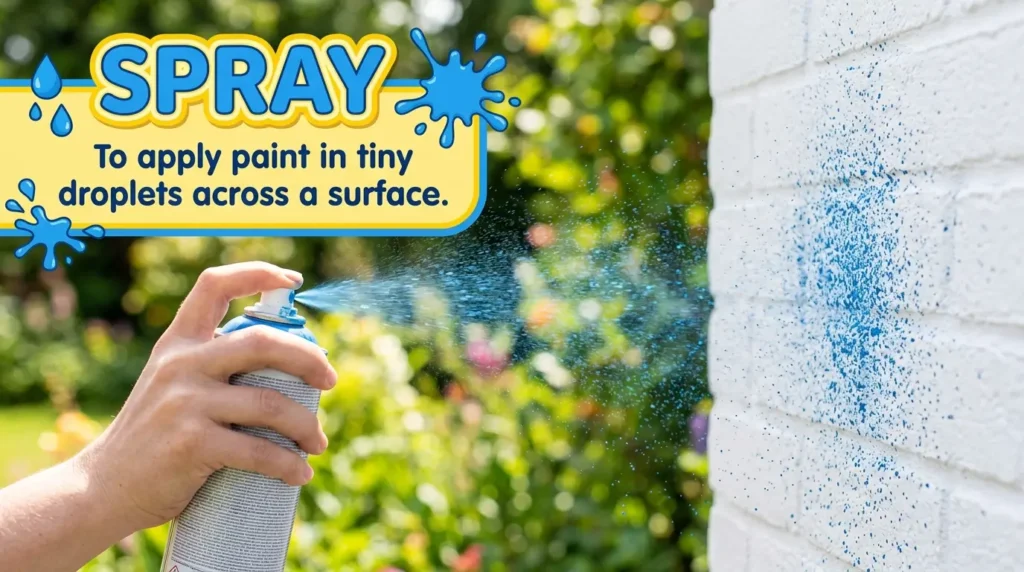
Spray (Verb) — US: /spreɪ/ | UK: /spreɪ/
Meaning: To apply paint or another substance in tiny droplets across a surface.
Tone/Register: Neutral, practical, and technical.
Example:
- He sprayed the chair with an even coat of paint.
- The artist sprayed color across the canvas.
Stipple (Verb) — US: /ˈstɪp.əl/ | UK: /ˈstɪp.əl/
Meaning: To apply paint in small dots or short marks to create texture.
Tone/Register: Artistic and technical.
Example:
- She stippled the background to create a textured effect.
- The painter stippled the leaves with tiny green marks.
Smear (Verb) — US: /smɪr/ | UK: /smɪə/
Meaning: To spread paint across a surface in a messy or uneven way.
Tone/Register: Informal and often negative.
Example:
- The child smeared orange paint across the page.
- Wet paint smeared when he touched the canvas.
Splash (Verb) — US: /splæʃ/ | UK: /splæʃ/
Meaning: To scatter or throw liquid paint onto a surface, often producing bold, irregular marks.
Tone/Register: Informal, energetic, and artistic.
Example:
- The artist splashed yellow paint across the canvas.
- She splashed color onto the paper to create an abstract design.
Dab (Verb) — US: /dæb/ | UK: /dæb/
Meaning: To apply small amounts of paint with light, repeated touches.
Tone/Register: Neutral and descriptive.
Example:
- He dabbed white paint onto the clouds.
- She dabbed gold onto the edges of the design.
Swab (Verb) — US: /swɑːb/ | UK: /swɒb/
Meaning: To spread or wipe a substance across a surface using an absorbent material.
Tone/Register: Technical and descriptive; not a general substitute for painting.
Example:
- The technician swabbed the sample with a colored solution.
- She swabbed a thin layer of coating across the surface.
Glaze (Verb) — US: /ɡleɪz/ | UK: /ɡleɪz/
Meaning: To apply a thin, often translucent layer that adds depth, color, or shine.
Tone/Register: Artistic, decorative, and technical.
Example:
- The painter glazed the portrait with a warm transparent layer.
- She glazed the ceramic bowl to give it a glossy finish.
Illustrate Pictorially (Verb Phrase)
Meaning: To communicate an idea through a visual representation rather than words alone.
Tone/Register: Formal and academic.
Example:
- The textbook illustrates the historical event pictorially.
- The designer illustrated the concept through a series of images.
Sketch (Verb) — US: /skɛtʃ/ | UK: /skɛtʃ/
Meaning: To create a quick or rough drawing that outlines a subject.
Tone/Register: Neutral and artistic.
Example:
- She sketched the garden before painting the final scene.
- He sketched the house in his notebook.
Note: Sketching usually involves drawing rather than applying paint, so it is an alternative only when discussing the broader process of creating artwork.
Illustrate in Watercolor (Verb Phrase)
Meaning: To create a visual representation using watercolor paints.
Tone/Register: Artistic and descriptive.
Example:
- She illustrated the flowers in watercolor.
- The book illustrates local birds in delicate watercolor scenes.
Airbrush (Verb) — US: /ˈer.brʌʃ/ | UK: /ˈeə.brʌʃ/
Meaning: To apply paint or color using a device that sprays a fine mist.
Tone/Register: Technical, artistic, and professional.
Example:
- The artist airbrushed soft shadows onto the illustration.
- He airbrushed the model of the car with metallic color.
Retouch (Verb) — US: /ˌriːˈtʌtʃ/ | UK: /ˌriːˈtʌtʃ/
Meaning: To make small changes to an image or painted surface to improve its appearance.
Tone/Register: Professional and artistic.
Example:
- The restorer retouched the faded areas of the painting.
- She retouched the illustration before submitting it.
Embellish (Verb) — US: /ɪmˈbɛl.ɪʃ/ | UK: /ɪmˈbel.ɪʃ/
Meaning: To add decorative details that make an object or image more attractive.
Tone/Register: Creative, descriptive, and sometimes critical.
Example:
- The artist embellished the border with delicate painted flowers.
- She embellished the plain design with colorful details.
Note: Embellish means to decorate or enhance. It does not necessarily mean to apply paint.
Illustrate Artistically (Verb Phrase)
Meaning: To express a subject or idea through artistic imagery and visual techniques.
Tone/Register: Creative and descriptive.
Example:
- The designer illustrated the poem artistically.
- She illustrated the story through expressive colors and shapes.
Paint Over (Phrasal Verb)
Meaning: To cover an existing painted surface or image with another layer of paint.
Tone/Register: Neutral and practical.
Example:
- They painted over the faded wall with fresh white paint.
- She painted over the old design before adding a new one.
Color In (Phrasal Verb)
Meaning: To fill the outlined areas of a drawing with color.
Tone/Register: Informal, educational, and creative.
Example:
- The students colored in their animal drawings.
- He colored in the shapes with bright markers.
Brush On (Phrasal Verb)
Meaning: To apply paint or another liquid using a brush.
Tone/Register: Neutral and practical.
Example:
- Brush on a thin layer and let it dry.
- She brushed on the final coat before lunch.
Lay On (Phrasal Verb)
Meaning: To apply a layer of paint, sometimes generously or heavily.
Tone/Register: Informal, practical, and artistic.
Example:
- The artist laid on thick strokes of blue.
- He laid on another coat to cover the uneven patches.
These expressions offer a broad vocabulary for describing painting. Some are close substitutes, while others refer to specific methods or related artistic activities.
Apply (Verb) — US: /əˈplaɪ/ | UK: /əˈplaɪ/
Meaning: To put paint or another substance onto a surface.
Tone/Register: Neutral, practical, and professional.
Example:
- Apply the first layer evenly across the wooden door.
- She applied fresh paint to the window frame.
Brushstroke (Verb) — US: /ˈbrʌʃˌstroʊk/ | UK: /ˈbrʌʃˌstrəʊk/
Meaning: To create or mark a surface with a deliberate stroke of a paintbrush.
Tone/Register: Artistic and descriptive.
Example:
- The artist brushstroked fine details into the landscape.
- She brushstroked the petals with delicate shades of pink.
Fresco (Verb) — US: /ˈfres.koʊ/ | UK: /ˈfres.kəʊ/
Meaning: To paint a mural on fresh, wet plaster, allowing the pigment to become part of the surface.
Tone/Register: Artistic, historical, and specialized.
Example:
- The artist frescoed the chapel walls with religious scenes.
- Students studied how Renaissance painters frescoed large ceilings.
Portray (Verb) — US: /pɔːrˈtreɪ/ | UK: /pɔːˈtreɪ/
Meaning: To represent a person, scene, or idea through an artistic image.
Tone/Register: Formal, artistic, and descriptive.
Example:
- The canvas portrays a family enjoying a summer afternoon.
- Her artwork portrays the beauty of rural life.
Picture (Verb) — US: /ˈpɪk.tʃɚ/ | UK: /ˈpɪk.tʃə/
Meaning: To represent something in an image or form a mental image of it.
Tone/Register: Neutral and descriptive.
Example:
- The artist pictured a peaceful village beside the river.
- The illustration pictures children playing beneath tall trees.
Saturate (Verb) — US: /ˈsætʃ.əˌreɪt/ | UK: /ˈsætʃ.ə.reɪt/
Meaning: To make a color or surface intensely rich by adding strong color or substantial coverage.
Tone/Register: Technical, artistic, and descriptive.
Example:
- The artist saturated the background with deep blue.
- She saturated the canvas with vivid shades of orange.
Impasto (Verb) — US: /ɪmˈpæs.toʊ/ | UK: /ɪmˈpæs.təʊ/
Meaning: To apply paint thickly so that visible brush marks and raised textures remain.
Tone/Register: Specialized, artistic, and technical.
Example:
- The painter impastoed the canvas to create a textured sky.
- He impastoed the flowers with thick strokes of yellow.
Muralize (Verb) — US: /ˈmjʊr.əˌlaɪz/ | UK: /ˈmjʊə.rə.laɪz/
Meaning: To decorate or transform a wall or space by creating a mural.
Tone/Register: Creative and specialized.
Example:
- Local artists muralized the community center walls.
- The team muralized the hallway with scenes from local history.
Colorize (Verb) — US: /ˈkʌl.əˌraɪz/ | UK: /ˈkʌl.ə.raɪz/
Meaning: To add color to an image or previously monochrome visual material.
Tone/Register: Technical, creative, and media-related.
Example:
- The editor colorized the old black-and-white photograph.
- The studio colorized historical footage for the documentary.
Overpaint (Verb) — US: /ˌoʊ.vɚˈpeɪnt/ | UK: /ˌəʊ.vəˈpeɪnt/
Meaning: To paint over an existing image or layer, often to modify or conceal it.
Tone/Register: Artistic and technical.
Example:
- The artist overpainted the background to correct its colors.
- She overpainted the earlier sketch with a brighter design.
Underpaint (Verb) — US: /ˌʌn.dɚˈpeɪnt/ | UK: /ˌʌn.dəˈpeɪnt/
Meaning: To apply an initial layer of paint beneath the main colors and details of an artwork.
Tone/Register: Artistic and technical.
Example:
- The painter underpainted the portrait with earthy tones.
- She underpainted the canvas before adding the final details.
Gild (Verb) — US: /ɡɪld/ | UK: /ɡɪld/
Meaning: To cover or decorate an object with a thin layer of gold or a gold-colored material.
Tone/Register: Decorative, formal, and artistic.
Example:
- The restorer gilded the frame to match its original appearance.
- The artist gilded the decorative details around the painting.
Lacquer (Verb) — US: /ˈlæk.ɚ/ | UK: /ˈlæk.ə/
Meaning: To coat a surface with lacquer to create a smooth, protective, or glossy finish.
Tone/Register: Technical and practical.
Example:
- The craftsperson lacquered the cabinet for a polished finish.
- He lacquered the wooden ornament to protect its surface.
Varnish (Verb) — US: /ˈvɑːr.nɪʃ/ | UK: /ˈvɑː.nɪʃ/
Meaning: To apply a transparent protective finish to a surface, including a finished painting.
Tone/Register: Practical, artistic, and technical.
Example:
- The artist varnished the finished canvas to protect it.
- She varnished the wooden frame to enhance its finish.
Imprint (Verb) — US: /ɪmˈprɪnt/ | UK: /ɪmˈprɪnt/
Meaning: To leave a visible mark or design on a surface by pressing or transferring a pattern.
Tone/Register: Technical, creative, and descriptive.
Example:
- The artist imprinted a decorative pattern onto the prepared surface.
- The workshop imprinted colored designs on handmade paper.
Stencil (Verb) — US: /ˈsten.səl/ | UK: /ˈsten.səl/
Meaning: To apply a design to a surface by placing paint over a cutout pattern.
Tone/Register: Practical, decorative, and creative.
Example:
- She stenciled white flowers onto the bedroom wall.
- The designer stenciled geometric shapes around the border.
Fleck (Verb) — US: /flɛk/ | UK: /flɛk/
Meaning: To mark or cover something with small spots or specks of color.
Tone/Register: Descriptive, artistic, and neutral.
Example:
- The artist flecked the blue canvas with tiny white marks.
- She flecked the pottery design with gold-colored details.
Mottle (Verb) — US: /ˈmɑː.t̬əl/ | UK: /ˈmɒt.əl/
Meaning: To mark a surface with irregular patches or spots of different colors.
Tone/Register: Descriptive, artistic, and technical.
Example:
- The painter mottled the background with brown and green.
- He mottled the surface to imitate the appearance of natural stone.
Distemper (Verb) — US: /dɪˈstɛm.pɚ/ | UK: /dɪˈstɛm.pə/
Meaning: To paint a surface using distemper, a traditional water-based paint made with pigments and a binding medium.
Tone/Register: Traditional, technical, and historical.
Example:
- The restorer distempered the interior wall using a traditional finish.
- The historic room was distempered to preserve its original appearance.
Limewash (Verb) — US: /ˈlaɪm.wɑːʃ/ | UK: /ˈlaɪm.wɒʃ/
Meaning: To coat a surface with limewash, a traditional finish made primarily from lime and water.
Tone/Register: Practical, traditional, and architectural.
Example:
- The builders limewashed the exterior walls of the cottage.
- She limewashed the brick surface to create a soft, matte finish.
Synonyms for Paint by Tone
Choosing the right synonym depends on your audience and the feeling you want to communicate. A technical report needs different vocabulary from a children’s story or an art review.
Positive synonyms
These words emphasize creativity, improvement, or visual appeal.
- Decorate: Highlights making something attractive.
- Depict: Emphasizes artistic representation.
- Illustrate: Suggests explaining or presenting an idea visually.
- Glaze: Often suggests a refined finish or artistic depth.
- Embellish: Emphasizes adding attractive details.
- Tint: Suggests adding a subtle shade.
Neutral synonyms
These words describe a practical action without a strong emotional judgment.
- Coat: Applying a layer to a surface.
- Brush: Applying a substance with a brush.
- Color: Adding or changing color.
- Spray: Applying paint in droplets.
- Stain: Changing the color of a material.
- Dye: Coloring fabric or another suitable material.
- Airbrush: Applying color through a fine spray.
Negative or critical synonyms
These words can imply messiness, carelessness, or misleading presentation.
- Daub: Suggests rough or careless application.
- Smear: Suggests spreading paint messily.
- Whitewash: Can suggest concealing faults in figurative use.
- Embellish: May imply exaggeration when used to describe a story.
These words are not inherently negative in every context. Their effect depends on how they are used.
Playful and informal alternatives
These expressions are useful in casual conversation and creative descriptions.
- Splash: Suggests energetic, spontaneous application.
- Dab: Describes small, light touches.
- Color in: Commonly used for filling drawings.
- Paint over: Describes covering an existing surface.
- Brush on: Describes applying a layer with a brush.
“Paint” vs. Close Alternatives
Some words appear interchangeable but describe different actions. Understanding these distinctions helps you avoid awkward sentences.
| Word | Main difference | Best context |
|---|---|---|
| Paint | General term for applying paint or creating artwork | Walls, canvases, furniture |
| Coat | Emphasizes covering a surface with a layer | Furniture, fences, protective finishes |
| Color | Emphasizes adding or changing color | Drawings, illustrations, designs |
| Depict | Emphasizes representing a subject visually | Art criticism, literature, descriptions |
| Stain | Emphasizes coloring a material by penetration | Wood, fabrics, suitable materials |
| Decorate | Emphasizes improving appearance | Rooms, objects, celebrations |
Quick comparison:
- “She painted the door” describes applying paint.
- “She coated the door” emphasizes covering its surface.
- “She decorated the door” focuses on improving its appearance.
- “She depicted the door” would usually mean representing it in an image, not physically painting the door.
The central lesson is simple: choose a synonym according to the action you want the reader to imagine.
How “Paint” Changes by Context
Daily conversation
In everyday English, paint, color, coat, and decorate are among the most useful choices.
You might say, “We painted the kitchen,” or “We decorated the kitchen with a fresh color scheme.” The second sentence focuses more broadly on the room’s appearance.
Writing and blogging
Writers can use words such as depict, illustrate, render, and portray when discussing artwork, stories, or visual communication.
For example, a gardening blogger might write, “The illustration depicts the stages of seed growth.” This is more precise than saying the illustration paints the stages.
Professional and academic English
Professional writing benefits from precise vocabulary.
Use coat when discussing surface coverage, stain when discussing certain wood treatments, and pigment when explaining coloring materials. In art history, depict and render can describe how an artist represents a subject.
Creative and informal English
Words such as splash, dab, daub, and smear help describe the movement and texture of paint.
For example, “She splashed orange across the canvas” creates a more energetic image than “She painted the canvas orange.”
Common Mistakes Learners Make
Using every synonym in the same way
Not all alternatives can replace paint without changing the meaning. You can paint a wall, but depict a wall usually means representing it in a picture.
Confusing paint with dye
Paint generally forms a coating on a surface. Dye typically colors a material through absorption or chemical interaction. The distinction matters in technical and practical writing.
Using formal words in casual conversations
Words such as render, depict, and pigment may sound overly technical in a simple conversation about decorating a bedroom.
Using negative words unintentionally
Daub and smear can suggest a messy result. If you want to praise someone’s careful work, apply, brush, or render may be more suitable.
Repeating the same word too often
Writers sometimes repeat paint in every sentence. However, replacing it with an inaccurate synonym can make the writing less clear.
Instead, alternate between paint, coating, artwork, color, and other context-appropriate expressions.
Register notes
- Formal writing: Prefer depict, render, or illustrate when discussing visual representation.
- Informal speech: Use paint, color in, brush on, and paint over.
- Technical writing: Choose coat, stain, pigment, or airbrush when the specific process matters.
- Creative writing: Use expressive verbs such as splash, dab, and glaze when they accurately describe the action.
For related vocabulary, you can also explore an article about synonyms for color on your vocabulary website.
Real-Life Mini Scenarios Using Paint Synonyms
Workplace
A maintenance worker may coat a metal railing to protect it. An interior designer may decorate an office to make it feel more welcoming.
Social situations
A parent might ask a child to color in a picture. A friend helping with a home project might offer to brush on another layer of paint.
Media and pop culture
An art reviewer may explain how a filmmaker’s promotional artwork depicts a fictional world. A photographer may retouch an image before publication.
Writing and storytelling
A novelist may describe an artist who splashes paint across a canvas in a moment of inspiration. Another character might carefully dab small details into a miniature landscape.
These scenarios show that strong vocabulary is not about replacing every familiar word. It is about choosing an expression that conveys the intended action, mood, and detail.
External Link Source
For reliable information about the history and meaning of paint, link to the Merriam-Webster Dictionary. Its dictionary entry can help readers explore definitions, word history, and related forms.
Interactive Practice Quiz
Choose the most appropriate answer for each situation. Check the answer key after completing all questions.
Which word means to apply a substance roughly or in an uneven way?
A. Enamel
B. Daub
C. Render
D. Gild
Which word means to cover a surface with a layer of paint or another substance?
A. Sketch
B. Coat
C. Outline
D. Depict
Which word means to add color to a black-and-white photograph or film?
A. Whitewash
B. Sketch
C. Colorize
D. Mottle
Which term describes artwork painted directly onto a wall or ceiling?
A. Pigment
B. Sketch
C. Mural
D. Stencil
Which word means to color or mark a surface using small dots?
A. Glaze
B. Stipple
C. Gild
D. Lacquer
Which words can describe applying paint or a coating to a surface? Select all that apply.
A. Coat
B. Varnish
C. Brush on
D. Sketch
The word “tint” can mean to give something a slight shade or color.
True
False
Which word means to cover a surface with a clear or colored protective finish?
A. Portray
B. Lacquer
C. Depict
D. Illustrate
Which verb means to represent a person, place, or scene in an artwork?
A. Saturate
B. Whitewash
C. Limewash
D. Portray
“Pigment” is the name for the complete artwork painted on a wall.
True
False
Answer key
1. Coat | 2. Color in | 3. Depict | 4. Stain | 5. Stipple | 6. Smear | 7. Airbrush | 8. Glaze | 9. Whitewash | 10. Sketch
Frequently Asked Questions
1. What is the closest synonym for paint in everyday English?
The closest synonym depends on how you use the word. Coat works when applying a layer to a surface, while color fits adding color to a drawing. If you mean creating a picture, depict or illustrate may be more accurate. For ordinary decorating tasks, paint remains the clearest and most natural choice.
2. What is another word for painting a wall?
Useful alternatives include coating, covering, and decorating. For example, “They coated the wall with white paint” emphasizes the applied layer. “They decorated the room” focuses on the overall appearance. The best choice depends on whether you want to describe the physical action or the final decorative result.
3. What is a formal synonym for paint in art and literature?
Depict, render, and illustrate are useful formal alternatives when describing visual representation. An art historian might explain how a painter depicts historical events or renders facial expressions. These verbs do not usually mean applying paint to a physical surface, so use them when discussing the subject or appearance of an artwork.
4. What is the difference between paint, pigment, and color?
Paint is a substance applied to a surface, often containing pigments and a binding medium. Pigment is the coloring material that gives paint its color. Color describes the visual quality itself. Understanding these distinctions helps students, artists, and science writers explain how paints work without confusing the material with its appearance.
5. Which synonym for paint is best for creative writing?
Words such as splash, dab, glaze, and render can make creative writing more descriptive. Splash suggests energetic movement, while dab describes small touches. Glaze refers to a thin layer, and render emphasizes artistic representation. Select the verb that matches the scene rather than choosing an alternative simply to avoid repetition.
6. Can decorate be used instead of paint?
Sometimes, but the meanings are different. Paint describes applying paint or creating an artwork, whereas decorate means making something more attractive. Painting may be one way to decorate a room, but decorating can also involve furniture, lighting, and other details. Use decorate when the overall improvement matters more than the painting process.
7. What is the best synonym for paint in a technical report?
Coat, stain, pigment, and airbrush can be appropriate when describing specific materials or techniques. For instance, coat emphasizes surface coverage, while pigment refers to coloring material. Choose the word that accurately describes the process. In technical writing, precision is more important than replacing a repeated word with an approximate synonym.
8. How can I improve my vocabulary using synonyms for paint?
Start by learning three or four alternatives and writing your own examples. Compare how each word changes the meaning of a sentence. Then practice using the words in essays, emails, captions, and everyday conversations. Reading art descriptions and instructional texts can also help you recognize natural usage and understand when a synonym is appropriate.
Conclusion
Learning a synonym for paint helps you describe artwork, decorating tasks, and creative ideas more precisely. Words such as coat, color, and depict each communicate a different meaning.
A wider vocabulary makes essays, blog posts, and everyday conversations more engaging. It also helps you express details that a familiar word may not fully capture.
Remember that context matters. A word that works beautifully in an art review may sound unusual in a simple conversation about painting a bedroom.
Start practicing today. Choose three synonyms, write your own sentences, and use them in your next email, essay, or daily conversation to build confidence.

Aqsa Rani is the founder and lead writer at VocaNeest.com, a trusted platform dedicated to helping people improve their English vocabulary and communication skills. She creates well-researched, accurate, and easy-to-understand content covering synonyms, antonyms, word meanings, idioms, phrases, and everyday vocabulary. Her goal is to make learning English simple, practical, and accessible for students, writers, professionals, and lifelong learners.
At VocaNeest.com, every article is carefully researched, fact-checked, and written with a strong focus on accuracy, clarity, and real-world usage. Content is regularly reviewed and updated to ensure it remains helpful, relevant, and aligned with modern language standards. Through reliable vocabulary guides and practical examples, Aqsa aims to help readers write with confidence, expand their vocabulary, and communicate more effectively.


Pingback: 🔍Synonyms for Very Little: 50 Words and Phrases Explained
Pingback: 🙄Synonym for Unpleasant: 45 Best Words for 2026
Pingback: 🌤️Synonyms for Humidity:45 Best Meanings,Tone & Examples(2026)
Pingback: 🌤️Synonyms for Humidity:45 Best Meanings,Tone & Examples(2026)
Pingback: 🎵Synonym for upbeat: 50 Best Cheerful Words to Master in (2026)
Pingback: Synonym for Trashy: 41+ Vivid Words to Use in (2026)