

Finding a reliable synonym for uneven helps writers describe bumpy roads and irregular textures with absolute clarity. Whether you draft a building report or outline a rocky trail, selecting the right adjective transforms your sentence. This guide explores top alternatives, meanings, and practical uses to elevate your vocabulary.
Every writer wants to secure fresh descriptive depth when crafting compelling stories or professional reports. A well-chosen synonym for uneven breathes life into your writing by adding precision, nuance, and visual clarity. Let us explore how expanding your vocabulary elevates everyday communication across all platforms.
Mastering a synonym for uneven empowers students, bloggers, and content creators to communicate physical irregularities and inconsistent patterns more effectively.
Delving into these linguistic alternatives allows you to refine your personal voice and adapt your tone to any audience. Whether you are drafting a formal engineering paper or a casual blog post, having the right words at your disposal makes all the difference.
What Does “Uneven” Really Mean?
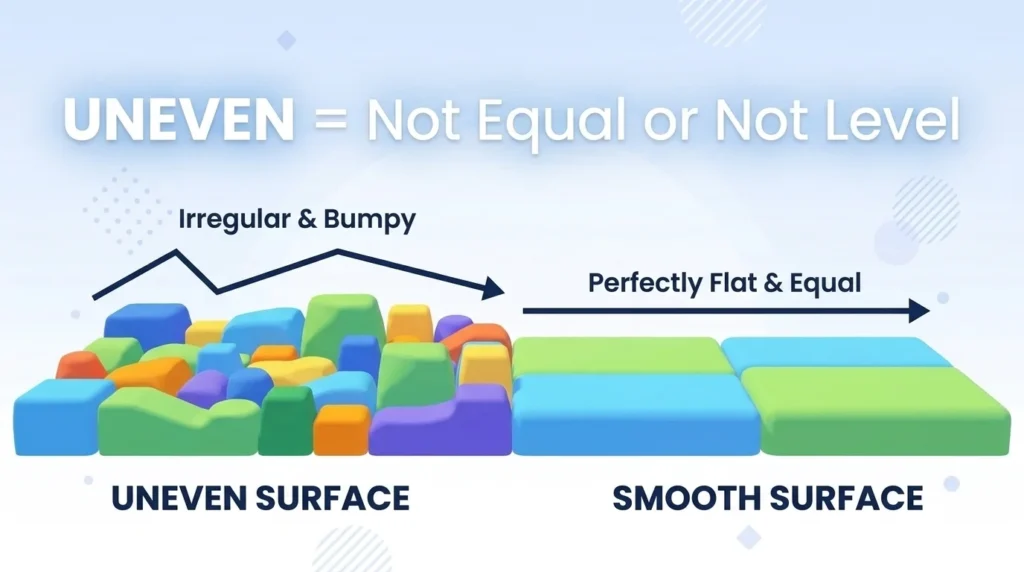
Uneven literally means not level, smooth, or flat, but it is frequently used metaphorically to describe inconsistent performance, irregular distribution, or unequal matching between opponents.
The emotional tone of the word is typically descriptive, analytical, or observational, carrying a sense of imbalance or lack of uniformity. Native speakers use it when talking about flooring, athletic scores, economic growth, or erratic daily schedules.
As an adjective, it modifies nouns by highlighting a lack of smoothness, regularity, or balance.
🧠 Connotative Meaning
- Positive tone: Describing organic landscapes, unique handmade textures, or charmingly rustic architecture. (Connotation refers to the emotional or cultural association attached to a word beyond its literal definition.)
- Negative tone: Criticizing poor construction quality, inconsistent work performance, or unfair competitive advantages.
- Neutral tone: Reporting scientific measurement variances, statistical data discrepancies, or topographical surface variations.
Etymology
Uneven originates from Middle English, combining the native English negative prefix un- (meaning “not”) and the adjective even (derived from Old English efen, meaning flat, level, or equal).
- Old English (450–1100): The root word efen referred strictly to flat ground or equal quantities.
- Middle English (1100–1500): The prefix was attached to form unene, evolving to describe objects that lacked a level surface or balanced proportion.
- Modern English (1500–Present): The spelling settled into uneven, expanding rapidly from physical terrain descriptions to abstract concepts like inconsistent quality or erratic human behavior.
Pronunciation (US & UK – IPA)
- US: /ʌnˈiːvən/
- UK: /ʌnˈiːvən/
Syllables
- un-ev-en
Affixation Pattern
- Root: even (Adjective)
- Prefix: un- (Negation or opposite)
- Suffix: None
Synonyms List
Bumpy (Adjective) — US: /ˈbʌm.pi/ | UK: /ˈbʌm.pi/
Meaning: Having a surface covered with small rises or protuberances.
Tone/Register: Informal / Descriptive
Example 1: The old country road was extremely bumpy after the heavy rainstorm.
Example 2: Passengers felt a few bumpy moments during the turbulent flight.
Rough (Adjective) — US: /rʌf/ | UK: /rʌf/
Meaning: Having an irregular, uneven, or unsmooth surface lacking uniformity.
Tone/Register: General / Standard
Example 1: Workers sanded the rough wooden plank until it felt completely smooth.
Example 2: The hikers struggled to walk across the rough terrain in the dark.
Lumpy (Adjective) — US: /ˈlʌm.pi/ | UK: /ˈlʌm.pi/
Meaning: Full of or covered in small, solid lumps or irregular clumps.
Tone/Register: Casual / Conversational
Example 1: The mashed potatoes turned out unpleasantly lumpy after quick stirring.
Example 2: He tossed and turned all night on the lumpy guest bed.
Irregular (Adjective) — US: /ɪˈrɛɡ.jə.lər/ | UK: /ɪˈrɛɡ.jə.lə/
Meaning: Not conforming to a regular pattern, shape, or uniform standard.
Tone/Register: Formal / Technical
Example 1: The tailor measured the irregular hemline carefully before cutting.
Example 2: Doctors monitored her irregular heartbeat using specialized clinical equipment.
Jagged (Adjective) — US: /ˈdʒæɡ.ɪd/ | UK: /ˈdʒæɡ.ɪd/
Meaning: Having a sharp, rough, or deeply notched edge or surface.
Tone/Register: Descriptive / Vivid
Example 1: Sharp, jagged rocks lined the base of the steep ocean cliff.
Example 2: A jagged piece of metal tore through the old bicycle tire.

Rocky (Adjective) — US: /ˈrɑː.ki/ | UK: /ˈrɒk.i/
Meaning: Consisting of or full of stones and solid rock formations.
Tone/Register: Descriptive / Standard
Example 1: Gardeners had to clear away rocky soil before planting vegetables.
Example 2: Their marriage went through a rocky phase during the relocation.
Patchy (Adjective) — US: /ˈpætʃ.i/ | UK: /ˈpætʃ.i/
Meaning: Existing in small, isolated areas rather than forming a smooth or uniform whole.
Tone/Register: Conversational / General
Example 1: Dense fog caused patchy visibility along the coastal highway.
Example 2: The lawn looked patchy after surviving the hot summer drought.
Inconsistent (Adjective) — US: /ˌɪnkənˈsɪs.tənt/ | UK: /ˌɪnkənˈsɪs.tənt/
Meaning: Not staying the same in quality, behavior, or performance over time.
Tone/Register: Professional / Formal
Example 1: The restaurant received poor reviews due to inconsistent food quality.
Example 2: His inconsistent pitching cost the team a crucial playoff game.
Erratic (Adjective) — US: /ɪˈræt.ɪk/ | UK: /ɪˈræt.ɪk/
Meaning: Unpredictable, wandering, or lacking consistency in movement or behavior.
Tone/Register: Academic / Formal
Example 1: Stock market prices showed erratic movement throughout the tense trading session.
Example 2: The stray dog exhibited erratic behavior near the crowded park.
Variable (Adjective) — US: /ˈvɛr.i.ə.bəl/ | UK: /ˈvɛə.ri.ə.bəl/
Meaning: Prone to changing frequently or exhibiting multiple possible states.
Tone/Register: Technical / Scientific
Example 1: Spring weather in the valley remains highly variable from day to day.
Example 2: Researchers noted variable responses to the new educational program.
Unbalanced (Adjective) — US: /ʌnˈbæl.ənst/ | UK: /ʌnˈbæl.ənst/
Meaning: Lacking proper balance, equality, or proportional distribution of weight or force.
Tone/Register: General / Standard
Example 1: The overloaded washing machine shook violently because the load was unbalanced.
Example 2: An unbalanced diet can lead to low energy and poor health.
Asymmetrical (Adjective) — US: /ˌeɪ.sɪˈmɛt.rɪ.kəl/ | UK: /ˌeɪ.sɪˈmɛt.rɪ.kəl/
Meaning: Having two sides or halves that do not match in shape, size, or arrangement.
Tone/Register: Formal / Artistic
Example 1: The modern building featured an asymmetrical glass facade.
Example 2: She preferred an asymmetrical haircut for a bold, artistic look.
Lopsided (Adjective) — US: /ˈlɑːpˌsaɪ.dɪd/ | UK: /ˈlɒpˌsaɪ.dɪd/
Meaning: Heavier, larger, or higher on one side than on the other.
Tone/Register: Informal / Descriptive
Example 1: The painting hanging on the office wall looked crooked and lopsided.
Example 2: The basketball game ended with a lopsided score of ninety to forty.
Disproportionate (Adjective) — US: /ˌdɪsprəˈpɔːr.ʃən.ət/ | UK: /ˌdɪsprəˈpɔː.ʃən.ət/
Meaning: Too large or too small in comparison with something else.
Tone/Register: Formal / Academic
Example 1: Rent takes up a disproportionate amount of his monthly income.
Example 2: Critics pointed out a disproportionate allocation of funds to marketing.
Flawed (Adjective) — US: /flɔːd/ | UK: /flɔːd/
Meaning: Having faults, imperfections, or internal structural weaknesses.
Tone/Register: Standard / Critical
Example 1: The initial research study relied on flawed methodology and small samples.
Example 2: Developers realized the software code was fundamentally flawed.
Patchy (Adjective) — US: /ˈpætʃ.i/ | UK: /ˈpætʃ.i/
Meaning: Existing in small, isolated areas rather than forming a smooth or uniform whole.
Tone/Register: Conversational / General
Example 1: Dense fog caused patchy visibility along the coastal highway.
Example 2: The lawn looked patchy after surviving the hot summer drought.
Inconsistent (Adjective) — US: /ˌɪnkənˈsɪs.tənt/ | UK: /ˌɪnkənˈsɪs.tənt/
Meaning: Not staying the same in quality, behavior, or performance over time.
Tone/Register: Professional / Formal
Example 1: The restaurant received poor reviews due to inconsistent food quality.
Example 2: His inconsistent pitching cost the team a crucial playoff game.
Erratic (Adjective) — US: /ɪˈræt.ɪk/ | UK: /ɪˈræt.ɪk/
Meaning: Unpredictable, wandering, or lacking consistency in movement or behavior.
Tone/Register: Academic / Formal
Example 1: Stock market prices showed erratic movement throughout the tense trading session.
Example 2: The stray dog exhibited erratic behavior near the crowded park.

Variable (Adjective) — US: /ˈvɛr.i.ə.bəl/ | UK: /ˈvɛə.ri.ə.bəl/
Meaning: Prone to changing frequently or exhibiting multiple possible states.
Tone/Register: Technical / Scientific
Example 1: Spring weather in the valley remains highly variable from day to day.
Example 2: Researchers noted variable responses to the new educational program.
Unbalanced (Adjective) — US: /ʌnˈbæl.ənst/ | UK: /ʌnˈbæl.ənst/
Meaning: Lacking proper balance, equality, or proportional distribution of weight or force.
Tone/Register: General / Standard
Example 1: The overloaded washing machine shook violently because the load was unbalanced.
Example 2: An unbalanced diet can lead to low energy and poor health.
Asymmetrical (Adjective) — US: /ˌeɪ.sɪˈmɛt.rɪ.kəl/ | UK: /ˌeɪ.sɪˈmɛt.rɪ.kəl/
Meaning: Having two sides or halves that do not match in shape, size, or arrangement.
Tone/Register: Formal / Artistic
Example 1: The modern building featured an asymmetrical glass facade.
Example 2: She preferred an asymmetrical haircut for a bold, artistic look.
Lopsided (Adjective) — US: /ˈlɑːpˌsaɪ.dɪd/ | UK: /ˈlɒpˌsaɪ.dɪd/
Meaning: Heavier, larger, or higher on one side than on the other.
Tone/Register: Informal / Descriptive
Example 1: The painting hanging on the office wall looked crooked and lopsided.
Example 2: The basketball game ended with a lopsided score of ninety to forty.
Disproportionate (Adjective) — US: /ˌdɪsprəˈpɔːr.ʃən.ət/ | UK: /ˌdɪsprəˈpɔː.ʃən.ət/
Meaning: Too large or too small in comparison with something else.
Tone/Register: Formal / Academic
Example 1: Rent takes up a disproportionate amount of his monthly income.
Example 2: Critics pointed out a disproportionate allocation of funds to marketing.
Flawed (Adjective) — US: /flɔːd/ | UK: /flɔːd/
Meaning: Having faults, imperfections, or internal structural weaknesses.
Tone/Register: Standard / Critical
Example 1: The initial research study relied on flawed methodology and small samples.
Example 2: Developers realized the software code was fundamentally flawed.
Patchwork (Adjective) — US: /ˈpætʃ.wɝːk/ | UK: /ˈpætʃ.wɜːk/
Meaning: Composed of mismatched or disconnected parts cobbled together without uniformity.
Tone/Register: Descriptive / Literary
Example 1: The old town displayed a patchwork architecture of various eras.
Example 2: Farmers managed a patchwork system of irrigated crop fields.
Uncalibrated (Adjective) — US: /ʌnˈkæl.əˌbreɪ.tɪd/ | UK: /ʌnˈkæl.ɪˌbreɪ.tɪd/
Meaning: Lacking precise adjustment, standardization, or measurement accuracy.
Tone/Register: Technical / Scientific
Example 1: The uncalibrated sensors recorded wildly fluctuating temperature data.
Example 2: Technicians tested the uncalibrated instruments before the launch sequence.
Jagged-edged (Adjective) — US: /ˈdʒæɡ.ɪd.ɛdʒd/ | UK: /ˈdʒæɡ.ɪd.ɛdʒd/
Meaning: Finished with sharp, uneven breaks or serrated projections along the border.
Tone/Register: Vivid / Descriptive
Example 1: Waves crashed against the jagged-edged barrier of dark basalt rock.
Example 2: She carefully discarded the jagged-edged piece of broken ceramic.
Undistributed (Adjective) — US: /ˌʌn.dɪsˈtrɪb.juː.tɪd/ | UK: /ˌʌn.dɪsˈtrɪb.juː.tɪd/
Meaning: Spread or allocated unevenly rather than shared equally across a group.
Tone/Register: Academic / Economic
Example 1: Auditors found large pools of undistributed funds sitting in subsidiary accounts.
Example 2: Undistributed supplies remained piled high inside the central warehouse.
Patch-worked (Adjective) — US: /ˈpætʃ.wɝːkt/ | UK: /ˈpætʃ.wɜːkt/
Meaning: Assembled from diverse, irregular pieces that lack a smooth, cohesive finish.
Tone/Register: Descriptive / Conversational
Example 1: The roof featured a patch-worked collection of mismatched metal sheets.
Example 2: He navigated the patch-worked trail of asphalt patches on his bicycle.

SYNONYMS BY TONE
Understanding tone ensures you pick the right word for architectural reports, creative writing, or casual conversations. Choosing words that match your intended context prevents confusion and strengthens your message.
Positive:
Asymmetrical, Variable, Rough (when describing natural rustic textures)
Neutral:
Bumpy, Lumpy, Rocky, Patchy, Lopsided
Negative:
Flawed, Inconsistent, Erratic, Unbalanced, Disproportionate
Playful/Informal:
Bumpy, Lumpy, Lopsided
MINI COMPARISON
Uneven vs Irregular vs Lopsided
- Meaning difference: Uneven denotes a lack of a flat or uniform level. Irregular indicates a failure to follow a standard pattern or consistent shape. Lopsided specifically means heavier or lower on one side than the other.
- Tone difference: Uneven is casual and descriptive. Irregular feels technical and formal. Lopsided carries a distinct visual and informal tone.
- When to use each: Use uneven for sidewalks or textures. Use irregular for heartbeats or schedules. Use lopsided for scorelines or tilted pictures.
CONTEXT‑BASED USAGE
How “Uneven” Changes by Context
In daily conversation, speakers use casual terms like bumpy or lopsided to talk about physical objects or driving paths.
When writing blog posts or articles, creators prefer vivid words like patchy or rough to keep readers engaged.
In professional or academic settings, researchers rely on formal vocabulary such as irregular, inconsistent, or disproportionate to maintain scholarly authority and precision.
COMMON MISTAKES & NATIVE USAGE
Common Mistakes Learners Make
- Misuse scenarios: Using erratic for a physically bumpy road instead of an erratic driving pattern.
- Confusing tone: Using harsh words like flawed when describing a naturally uneven handmade ceramic bowl.
- Overuse warnings: Repeating uneven in every paragraph instead of varying synonyms.
Register Notes
Formal writing demands precise adjectives like disproportionate or irregular, whereas casual speech naturally welcomes friendly words like bumpy or lopsided. Choosing the appropriate register ensures your message resonates well with your audience.
REAL‑LIFE MINI SCENARIOS
Real‑Life Examples Using “Uneven”
- Workplace: The team noticed an uneven distribution of tasks across the project departments.
- Social situations: Walking down the cobbled street proved difficult due to the uneven pavement.
- Media / pop culture: Film critics described the new anthology movie as having an uneven narrative pace.
- Writing or storytelling: The author described the protagonist’s uneven journey through grief with remarkable grace.
CONCLUSION
Mastering vocabulary and discovering a precise synonym for uneven enhances your writing, blogging, and daily speaking skills. Exploring diverse words allows you to communicate physical texture and abstract inconsistency with confidence and style.
Practicing these terms in your daily emails, essays, and conversations transforms your language abilities. Start experimenting with these creative alternatives today and watch your writing come alive.
INTERACTIVE PRACTICE QUIZ
- Which synonym best describes a road surface full of small bumps?
- A) Flawed
- B) Bumpy
- C) Asymmetrical
- D) Disproportionate
- Which formal term describes data that does not follow a standard pattern?
- A) Lopsided
- B) Irregular
- C) Lumpy
- D) Bumpy
- What tone does the word “erratic” typically carry when describing behavior?
- A) Playful
- B) Formal / Negative
- C) Casual
- D) Humorous
- Which term is best used when describing a picture hanging crookedly on a wall?
- A) Variable
- B) Lopsided
- C) Disproportionate
- D) Irregular
- What prefix is attached to “even” to form the base adjective?
- A) Re-
- B) Un-
- C) Dis-
- D) Mis-
- Which synonym is most appropriate for describing inconsistent food quality at a restaurant?
- A) Lumpy
- B) Inconsistent
- C) Rocky
- D) Jagged
- Which word implies having sharp, rough edges?
- A) Jagged
- B) Patchy
- C) Smooth
- D) Flat
- Which term describes weather conditions that change frequently?
- A) Variable
- B) Lopsided
- C) Flawed
- D) Bumpy
- What is the primary register of the casual word “lumpy”?
- A) Academic
- B) Informal
- C) Literary
- D) Legal
Answer Key: 1-B | 2-B | 3-B | 4-B | 5-B | 6-B | 7-A | 8-A | 9-B
FREQUENTLY ASKED QUESTIONS
What is the best synonym for uneven in formal writing?
Words like irregular, inconsistent, and disproportionate offer formal alternatives depending on whether you are discussing physical patterns, performance, or resource allocation.
Can uneven be used for abstract concepts?
Yes, native speakers frequently use it metaphorically to describe inconsistent work quality, unpredictable moods, or unbalanced economic growth.
How do uneven and irregular differ?
Uneven usually implies a lack of a level plane or flat surface, while irregular broadly means failing to conform to a standard pattern or uniform rule.
Is uneven considered a formal word?
It sits comfortably in standard professional and conversational English, making it suitable for both casual descriptions and technical reports.
What adjectives mean the same as uneven?
Common descriptive alternatives include bumpy, rough, lopsided, patchy, and unbalanced, which fit various everyday contexts.

Esha loves exploring English words and finding simple ways to explain them. She writes about synonyms, vocabulary, word meanings, and everyday language in a clear and friendly style. Through vocaneest.com, Esha shares useful tips and easy-to-follow language guides for students, writers, and anyone looking to improve their English. Her goal is simple: to help readers choose better words, express their ideas clearly, and feel more confident when writing or communicating.