

Synonym for occupation searches usually start when you want to describe a person’s regular job, trade, or professional field with greater precision.
Imagine filling out a formal application form, pausing at a blank field, and wondering whether to write down job, career, or trade.
For example, a software developer completing an official visa form might state that their primary occupation is engineering. Finding the right synonym for occupation makes your writing far more engaging, dynamic, and polished for any audience.
Learning semantic variations for a synonym for occupation keeps your communication natural and precise. Consequently, expanding your vocabulary strengthens your writing across academic essays, professional resumes, and daily workplace dialogue.
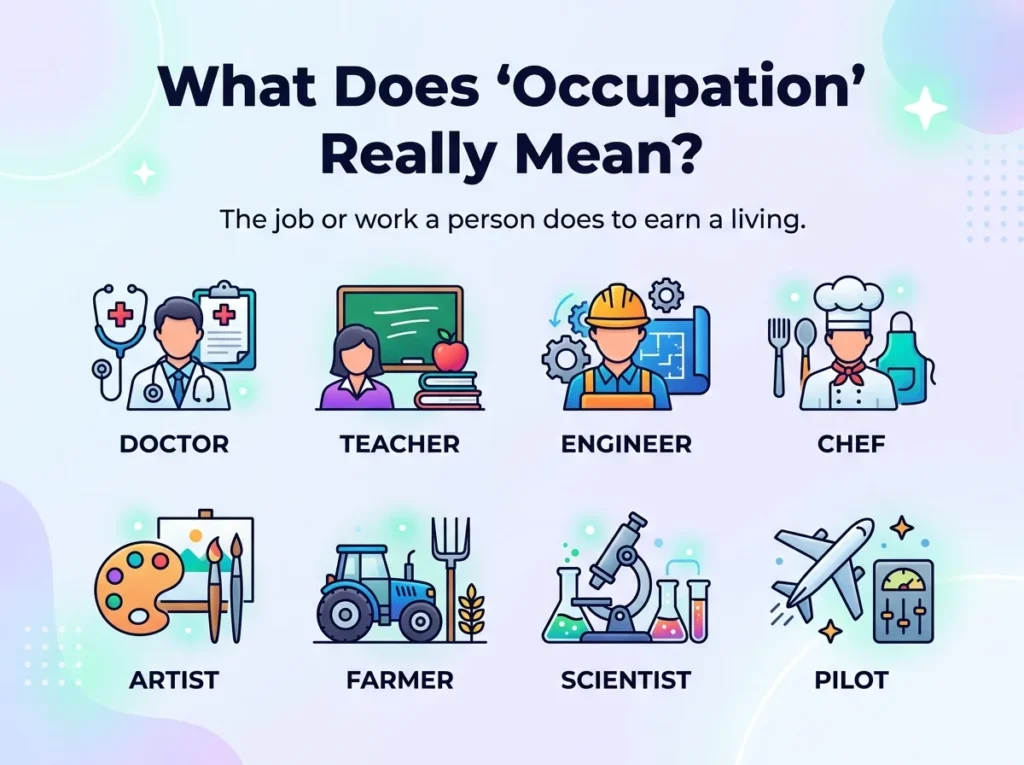
What Does “Occupation” Really Mean?
An occupation is a person’s principal work or business, especially as a means of earning a living. In addition, native speakers use it to describe an activity that takes up someone’s time or the act of inhabiting a physical space.
The word carries a neutral to formal tone depending on whether it appears on an official form, in legal papers, or during casual talk. Furthermore, it appears continuously in census reports, job applications, economic studies, and human resource documents.
As a Part of Speech, “occupation” functions primarily as a noun (/ˌɑː.kjəˈpeɪ.ʃən/).
- Simple Definition: A person’s job, regular trade, or principal activity used to earn a living.
Connotative Meaning
(Connotation is the emotional feeling or cultural association that a word carries beyond its strict dictionary definition.)
- Positive tone: Moderately positive when linked with a fulfilling career, passion project, or respectable professional calling.
- Negative tone: Can feel clinical or detached on bureaucratic forms; military contexts (“foreign occupation”) carry strong negative weight.
- Neutral tone: Predominantly neutral in standard English because it simply states the regular work or activity a person performs.
Etymology
The word has a rich history originating from classical Latin before entering the English language.
- Origin: Derived from Latin occupātiō (a taking possession, business), coming from occupāre (to seize, take up, or hold).
- Old English (450–1100): Early Anglo-Saxon speakers relied instead on native West Germanic terms like cræft (craft/trade) or weorc (work).
- Middle English (1100–1500): Adopted during the 14th century via Anglo-Norman French occupation, referring to employment, business, or holding property.
- Modern English (1500–Present): Settled as a standard formal noun used widely across employment forms, sociology, and military strategy.
Pronunciation & Syllables
- US: /ˌɑː.kjəˈpeɪ.ʃən/
- UK: /ˌɒk.jəˈpeɪ.ʃən/
Syllable Breakdown: oc-cu-pa-tion (4 Syllables)
Affixation Pattern:
- Root: occupy (from Latin occupāre, meaning to hold or take up)
- Prefix: None
- Suffix: -ation (noun suffix indicating an action, state, or process)
List of Synonyms
Profession (Noun) — US: /prəˈfeʃ.ən/ | UK: /prəˈfeʃ.ən/
- Meaning: A paid occupation that requires prolonged training, formal qualifications, and specialized knowledge.
- Tone/Register: Formal / Professional
- Example 1: Medicine is a demanding profession that requires years of rigorous study.
- Example 2: Consequently, many young graduates aim to enter the legal profession.
Vocation (Noun) — US: /voʊˈkeɪ.ʃən/ | UK: /vəʊˈkeɪ.ʃən/
- Meaning: A strong feeling of suitability for a particular career, often regarded as a noble calling.
- Tone/Register: Formal / Philosophical
- Example 1: Nursing was not just a job for Maria, but a true lifelong vocation.
- Example 2: Therefore, artists often feel a deep vocation to create work despite financial uncertainty.
Calling (Noun) — US: /ˈkɑː.lɪŋ/ | UK: /ˈkɔː.lɪŋ/
- Meaning: A strong impulse or divine summons to follow a particular career or meaningful life work.
- Tone/Register: Warm / Expressive
- Example 1: Teaching young children was a natural calling that brought her immense joy every day.
- Example 2: In addition, he felt a powerful calling to join humanitarian relief efforts abroad.
Trade (Noun) — US: /treɪd/ | UK: /treɪd/
- Meaning: A skilled manual job or practical craft requiring specialized training and physical expertise.
- Tone/Register: Practical / General
- Example 1: Learning a skilled trade like carpentry can lead to a stable and lucrative career.
- Example 2: Furthermore, his father taught him the plumbing trade during summer vacations.
Craft (Noun) — US: /kræft/ | UK: /krɑːft/
- Meaning: An activity or job involving skill in making things by hand or applying refined technique.
- Tone/Register: Creative / Respectful
- Example 1: The veteran potter spent decades mastering the traditional craft of ceramics.
- Example 2: Consequently, writers must dedicate hours every day to honing their storytelling craft.

Career (Noun) — US: /kəˈrɪr/ | UK: /kəˈrɪə/
- Meaning: An undertaking pursued over a significant period of a person’s life with opportunities for progress.
- Tone/Register: Universal / Business
- Example 1: She built a long and successful career in digital marketing across three major agencies.
- Example 2: Thus, ongoing professional development helps advance your career trajectory effectively.
Employment (Noun) — US: /ɪmˈploɪ.mənt/ | UK: /ɪmˈploɪ.mənt/
- Meaning: The state of having paid work or the specific work in which a person is engaged.
- Tone/Register: Official / Economic
- Example 1: The local manufacturing plant provides steady employment for hundreds of town residents.
- Example 2: Meanwhile, regional economic policies aim to boost long-term youth employment.
Line of Work (Noun Phrase) — US: /laɪn ʌv wɝːk/ | UK: /laɪn ɒv wɜːk/
- Meaning: The principal type of job, business, or industry in which a person regularly works.
- Tone/Register: Conversational / Business
- Example 1: What line of work are you in these days after finishing university?
- Example 2: As a result, cybersecurity has become a highly secure line of work in recent years.
Livelihood (Noun) — US: /ˈlaɪv.li.hʊd/ | UK: /ˈlaɪv.li.hʊd/
- Meaning: The means of securing the necessities of life, such as food, shelter, and income.
- Tone/Register: Expressive / Economic
- Example 1: Local fishermen depend entirely on clean ocean waters for their daily livelihood.
- Example 2: Therefore, severe drought threatened the livelihood of farming families across the region.
Business (Noun) — US: /ˈbɪz.nɪs/ | UK: /ˈbɪz.nɪs/
- Meaning: A person’s regular trade, commercial activity, or professional field of operation.
- Tone/Register: Universal / Direct
- Example 1: He decided to start his own consulting business after ten years in corporate sales.
- Example 2: In addition, small family business owners work hard to serve local communities.
Pursuit (Noun) — US: /pɚˈsuːt/ | UK: /pəˈsjuːt/
- Meaning: An activity, passion, or field of interest that takes up time and effort over time.
- Tone/Register: Elegant / Literary
- Example 1: Scientific research was his primary intellectual pursuit throughout his long academic life.
- Example 2: Consequently, outdoor recreational pursuits became very popular over the summer months.
Undertaking (Noun) — US: /ˌʌn.dɚˈteɪ.kɪŋ/ | UK: /ˌʌn.dəˈteɪ.kɪŋ/
- Meaning: A formal task, major project, or business enterprise that someone assumes responsibility for.
- Tone/Register: Formal / Academic
- Example 1: Launching a global charity foundation is a massive undertaking requiring heavy funding.
- Example 2: Thus, the team approached the engineering undertaking with meticulous planning.
Activity (Noun) — US: /ækˈtɪv.ə.t̬i/ | UK: /ækˈtɪv.ə.ti/
- Meaning: A condition or task that a person does, especially for interest, duty, or routine focus.
- Tone/Register: General / Casual
- Example 1: Reading financial newspapers is his favorite morning activity before heading to the office.
- Example 2: Furthermore, physical activity helps office workers stay healthy during long workdays.
Field (Noun) — US: /fiːld/ | UK: /fiːld/
- Meaning: A particular branch of study, sphere of professional activity, or specialized area of work.
- Tone/Register: Academic / Professional
- Example 1: Dr. Aris is a renowned expert in the field of artificial intelligence research.
- Example 2: As a result, entering a growing field offers excellent job security for new graduates.
Post (Noun) — US: /poʊst/ | UK: /pəʊst/
- Meaning: An official job or position of employment, especially within corporate or public organizations.
- Tone/Register: Formal / Official
- Example 1: She accepted a high-level diplomatic post at the embassy in Geneva last month.
- Example 2: Therefore, the board appointed a new manager to fill the vacant administrative post.

Position (Noun) — US: /pəˈzɪʃ.ən/ | UK: /pəˈzɪʃ.ən/
- Meaning: An official role, job title, or rank held by an employee within a firm or institution.
- Tone/Register: Corporate / Standard
- Example 1: He applied for the open position of senior project manager at the tech firm.
- Example 2: In addition, internal candidates secured several leadership positions this quarter.
Job (Noun) — US: /dʒɑːb/ | UK: /dʒɒb/
- Meaning: A paid position of regular employment performed by an individual daily.
- Tone/Register: Conversational / Everyday
- Example 1: Finding a flexible job after graduation helped him pay off his student loans quickly.
- Example 2: Consequently, taking pride in your daily job makes your work experience far more rewarding.
Role (Noun) — US: /roʊl/ | UK: /rəʊl/
- Meaning: The specific duty, function, or position that an employee performs within a team structure.
- Tone/Register: Corporate / Modern
- Example 1: Her primary role in the company involves coordinating client relations across regions.
- Example 2: Thus, clear team communication ensures everyone understands their assigned role.
Gig (Noun) — US: /ɡɪɡ/ | UK: /ɡɪɡ/
- Meaning: A temporary, freelance, or short-term task or job, often in modern flexible work setups.
- Tone/Register: Informal / Modern Slang
- Example 1: He picked up a weekend guitar gig at a local venue to make extra income.
- Example 2: Furthermore, many graphic designers thrive in the modern gig economy.
Enterprise (Noun) — US: /ˈen.t̬ɚ.praɪz/ | UK: /ˈen.tə.praɪz/
- Meaning: A bold, difficult, or important business organization or industrious venture.
- Tone/Register: Corporate / Strategic
- Example 1: The international tech enterprise expanded operations across three new continents.
- Example 2: As a result, local governments encourage private enterprise to spur economic growth.
Industry (Noun) — US: /ˈɪn.də.stri/ | UK: /ˈɪn.də.stri/
- Meaning: Economic activity concerned with the processing of raw materials and manufacture of goods.
- Tone/Register: Economic / Macro
- Example 1: The automotive industry underwent massive changes with the rise of electric vehicles.
- Example 2: Therefore, working in a fast-paced industry requires continuous learning.
Metier (Noun) — US: /ˈmeɪ.tjeɪ/ | UK: /ˈmeɪ.tieɪ/
- Meaning: An occupation, trade, or field of activity in which one excels or feels particularly suited.
- Tone/Register: Literary / Refined
- Example 1: High-fashion photography was clearly her true metier from an early age.
- Example 2: In addition, he discovered that investigative journalism was his genuine metier.
Appointment (Noun) — US: /əˈpoɪnt.mənt/ | UK: /əˈpoɪnt.mənt/
- Meaning: An official selection or job assignment to a position, responsibility, or public office.
- Tone/Register: Legal / Official
- Example 1: The professor celebrated her official appointment as department chair this morning.
- Example 2: Consequently, public news outlets announced the ambassador’s new diplomatic appointment.
Function (Noun) — US: /ˈfʌŋk.ʃən/ | UK: /ˈfʌŋk.ʃən/
- Meaning: The special purpose, duty, or professional work performed by a person or organizational unit.
- Tone/Register: Analytical / Business
- Example 1: The accounting division performs a vital financial control function within the company.
- Example 2: Thus, every employee’s function contributes to the overall success of the project.
Work (Noun) — US: /wɝːk/ | UK: /wɜːk/
- Meaning: Activity involving mental or physical effort done to achieve a purpose or result.
- Tone/Register: Universal / Direct
- Example 1: She enjoys her daily work as a high school counselor assisting ambitious students.
- Example 2: Meanwhile, balance between daily work and personal life remains essential for health.
Specialty (Noun) — US: /ˈspeʃ.əl.ti/ | UK: /ˈspeʃ.əl.ti/
- Meaning: A specific branch of study, trade, or professional work in which someone has expert knowledge and skill.
- Tone/Register: Professional / Academic
- Example 1: Pediatric cardiology became her primary specialty after completing medical residency.
- Example 2: In addition, the firm’s specialty includes commercial real estate litigation.
Breadwinner Role (Noun Phrase) — US: /ˈbredˌwɪn.ɚ roʊl/ | UK: /ˈbredˌwɪn.ər rəʊl/
- Meaning: The primary income-earning work that provides financial support for a household.
- Tone/Register: Sociological / Everyday
- Example 1: Taking on the breadwinner role motivated him to pursue higher-paying corporate contracts.
- Example 2: Consequently, dual-income households share the breadwinner role more evenly today.
Walk of Life (Noun Phrase) — US: /wɑːk ʌv laɪf/ | UK: /wɔːk ɒv laɪf/
- Meaning: An individual’s specific professional background, social position, or daily economic activity.
- Tone/Register: Human Interest / General
- Example 1: Volunteers from every walk of life joined the community food drive on Sunday.
- Example 2: Thus, the survey gathered perspectives from workers from every walk of life.
Lineage Craft (Noun Phrase) — US: /ˈlɪn.i.ɪdʒ kræft/ | UK: /ˈlɪn.i.ɪdʒ krɑːft/
- Meaning: A traditional trade or technical skill passed down through generations within a family.
- Tone/Register: Cultural / Historical
- Example 1: Hand-weaving silk rugs remains a prized lineage craft in the historic valley.
- Example 2: Furthermore, he preserved his family’s lineage craft of custom watchmaking.
Lifework (Noun) — US: /ˈlaɪf.wɝːk/ | UK: /ˈlaɪf.wɜːk/
- Meaning: The overall body of professional or creative work to which a person devotes their entire living years.
- Tone/Register: Reflective / Formal
- Example 1: Writing the multi-volume encyclopedia served as the historian’s monumental lifework.
- Example 2: Therefore, protecting rainforest ecosystems became the biologist’s ultimate life’s work.
Area of Expertise (Noun Phrase) — US: /ˈer.i.ə ʌv ˌek.spɚˈtiːz/ | UK: /ˈeə.ri.ə ɒv ˌek.spɜːˈtiːz/
- Meaning: The specific subject field or technical domain in which a worker possesses advanced skills.
- Tone/Register: Corporate / Official
- Example 1: Cloud security architecture remains his primary area of expertise.
- Example 2: Consequently, the committee invited specialists based on their area of expertise.
Assignment (Noun) — US: /əˈsaɪn.mənt/ | UK: /əˈsaɪn.mənt/
- Meaning: A specific task, duty, or temporary professional role given to an employee within an organization.
- Tone/Register: Workplace / Operational
- Example 1: She accepted a two-year overseas assignment to manage the company’s Tokyo branch.
- Example 2: In addition, officers received their daily patrol assignments before sunrise.
Stint (Noun) — US: /stɪnt/ | UK: /stɪnt/
- Meaning: A fixed, limited, or specific period of work spent doing a particular job or duty.
- Tone/Register: Conversational / Narrative
- Example 1: After a brief stint as a high school teacher, he transitioned into journalism.
- Example 2: Meanwhile, her successful stint in sales earned her a spot in executive leadership.
Commission (Noun) — US: /kəˈmɪʃ.ən/ | UK: /kəˈmɪʃ.ən/
- Meaning: An official duty, project, or military rank assigned to an individual to perform for pay.
- Tone/Register: Formal / Military / Artistic
- Example 1: The sculptor received a government commission to design the public memorial.
- Example 2: Thus, earning his officer’s commission marked the start of a long military career.
Domain (Noun) — US: /doʊˈmeɪn/ | UK: /dəʊˈmeɪn/
- Meaning: A specified sphere of activity, knowledge, or professional responsibility.
- Tone/Register: Academic / Corporate
- Example 1: Financial forecasting falls entirely within the chief financial officer’s domain.
- Example 2: As a result, digital media transformed the traditional domain of print publishing.
Posting (Noun) — US: /ˈpoʊ.stɪŋ/ | UK: /ˈpəʊ.stɪŋ/
- Meaning: An official job assignment to a specific location, station, or diplomatic office.
- Tone/Register: Official / Government
- Example 1: His diplomatic posting in South America lasted for nearly four years.
- Example 2: Therefore, border patrol personnel receive new field postings every few seasons.
Functionality (Noun) — US: /ˌfʌŋk.ʃəˈnæl.ə.t̬i/ | UK: /ˌfʌŋk.ʃəˈnæl.ə.ti/
- Meaning: The operational role, purpose, or specialized work performed by an individual or department.
- Tone/Register: Administrative / Technical
- Example 1: Logistics management represents a crucial functionality within global retail supply chains.
- Example 2: Consequently, cross-training employees improves overall departmental functionality.
Practice (Noun) — US: /ˈpræk.tɪs/ | UK: /ˈpræk.tɪs/
- Meaning: The professional business or work of a licensed specialist, such as a doctor, dentist, or lawyer.
- Tone/Register: Professional / Medical / Legal
- Example 1: Dr. Vance opened a private dental practice in the downtown commercial district.
- Example 2: In addition, the partners built a thriving corporate law practice over two decades.
Line of Duty (Noun Phrase) — US: /laɪn ʌv ˈduː.t̬i/ | UK: /laɪn ɒv ˈdjuː.ti/
- Meaning: The formal responsibilities and daily actions required by an official job, especially in public service.
- Tone/Register: Official / Legal
- Example 1: First responders demonstrate immense courage while performing their regular line of duty.
- Example 2: Therefore, officers receive full insurance coverage for actions taken in the line of duty.
Agency (Noun) — US: /ˈeɪ.dʒən.si/ | UK: /ˈeɪ.dʒən.si/
- Meaning: The specialized professional capacity, business body, or active power through which work is executed.
- Tone/Register: Business / Institutional
- Example 1: She ran a boutique advertising agency that created viral digital marketing campaigns.
- Example 2: As a result, government agencies hired environmental consultants for land assessments.
Avocation (Noun) — US: /ˌæv.əˈkeɪ.ʃən/ | UK: /ˌæv.əˈkeɪ.ʃən/
- Meaning: A secondary activity or minor work pursued alongside one’s main job, often out of personal interest.
- Tone/Register: Formal / Literary
- Example 1: While accounting was his day job, restoring antique cars served as his favorite avocation.
- Example 2: Furthermore, her artistic avocation eventually evolved into a full-time design firm.
Capacity (Noun) — US: /kəˈpæs.ə.t̬i/ | UK: /kəˈpæs.ə.ti/
- Meaning: The specific role, position, or function in which an individual acts during official work.
- Tone/Register: Formal / Legal
- Example 1: She attended the international summit in her official capacity as environmental minister.
- Example 2: Thus, acting in an advisory capacity allowed the retired executive to mentor young leaders.
Charge (Noun) — US: /tʃɑːrdʒ/ | UK: /tʃɑːdʒ/
- Meaning: A specific responsibility, duty, or group of tasks entrusted to an individual’s care.
- Tone/Register: Authoritative / Management
- Example 1: Overseeing clinical safety procedures remained the senior surgeon’s primary charge.
- Example 2: Consequently, the head ranger took charge of wildlife protection across the park.
Departmental Role (Noun Phrase) — US: /ˌdiː.pɑːrtˈmen.t̬əl roʊl/ | UK: /ˌdiː.pɑːtˈmen.təl rəʊl/
- Meaning: The designated work duties assigned to an employee within a specific organizational division.
- Tone/Register: Corporate / Standard
- Example 1: His departmental role focuses on auditing software security systems quarterly.
- Example 2: In addition, clear job descriptions ensure everyone understands their departmental role.
Tenure Track (Noun) — US: /ˈten.jɚ træk/ | UK: /ˈten.jər træk/
- Meaning: An academic career path leading toward a permanent teaching and research appointment at a university.
- Tone/Register: Academic / Higher Education
- Example 1: Securing a tenure track position allows young professors to build long-term research labs.
- Example 2: Therefore, published peer-reviewed papers remain critical for success on the tenure track.

Synonyms by Tone
Choosing the right tone ensures your vocabulary fits the situation naturally. Using formal terms in casual texting sounds unnatural, while using informal slang in research papers lowers authority.
Positive / Passion-Driven:
Vocation, Calling, Craft, Metier, Pursuit (highlights deep dedication, skill, and personal fulfillment).
Neutral / Objective:
Occupation, Job, Work, Field, Position, Role (focuses purely on daily duties, structure, and employment).
Formal / Legal / Economic:
Profession, Employment, Livelihood, Post, Appointment, Enterprise (ideal for forms, census data, and official papers).
Playful / Informal:
Gig, Line of Work, Business (perfect for casual dialogue, social media, and networking chats).
Mini Comparison: “Occupation” vs. Close Alternatives
| Word | Specific Focus | Best Context |
| Occupation | A general term for a person’s work or business, often used on official forms. | Job forms, government census, legal papers, formal surveys. |
| Profession | Work requiring advanced education, degrees, and specialized training. | Medical practice, law, engineering, academic fields. |
| Vocation | A career chosen out of deep passion, personal dedication, or moral calling. | Teaching, nursing, ministry, art, social service work. |
How “Occupation” Changes by Context
When speaking casually, native speakers rarely ask, “What is your occupation?” Instead, they naturally say, “What line of work are you in?” or “What do you do for a living?”
For writing and blogging, using vivid terms such as vocation, craft, or livelihood can keep readers engaged while making paragraphs smooth and easy to read on mobile screens.
Within professional or academic contexts, precise vocabulary like profession, appointment, or employment can add clarity and credibility to corporate reports and research essays.
Through creative storytelling, expressive words such as calling, metier, or undertaking can bring emotional depth and richer detail to characters’ backgrounds.
Common Mistakes Learners Make
- Using “Occupation” in Casual Greetings: Asking “What is your occupation?” during a casual party sounds unnaturally stiff and robotic.
- Confusing “Profession” with any Job: Calling every job a profession is inaccurate; a profession requires advanced training and formal credentials.
- Tone Mismatch: Avoid using gig on formal resumes, as casual workplace slang undermines professional credibility.
(For additional vocabulary insights, explore our academic writing guides to refine your everyday sentence flow.)
Real-Life Mini Scenarios
- Workplace: The HR officer recorded each candidate’s previous profession on the interview evaluation forms.
- Social Situations: During dinner, he casually asked his guest what line of work she pursued in the city.
- Media / Pop Culture: The documentary highlighted how coastal storms ruined the local fishermen’s livelihood.
- Writing or Storytelling: The old watchmaker dedicated his entire life to honing his intricate mechanical craft.
Conclusion
Learning synonyms enriches your writing and helps you express subtle thoughts clearly. Expanding your vocabulary ensures your message stays fresh across all communication mediums.
Mastering words like profession, vocation, and trade gives your prose precision and confidence. Furthermore, choosing the right word ensures your writing connects deeply with readers.
Try practicing these new words today in your journal, email drafts, or essay writing. Developing consistent vocabulary habits builds strong, lifelong communication skills.
Interactive Practice Quiz
1. Which synonym fits best when filling out an official government census form?
a) Gig
b) Occupation
c) Calling
d) Pursuit
2. If someone feels a deep moral drive to help sick children as a nurse, it is their:
a) Gig
b) Vocation
c) Post
d) Line of work
3. What word best describes specialized work requiring law degrees or medical licenses?
a) Gig
b) Profession
c) Activity
d) Undertaking
4. When asking someone casually about their job during a party, you ask about their:
a) Metier
b) Line of work
c) Appointment
d) Undertaking
5. Which casual term fits best when describing a freelance graphic design task?
a) Appointment
b) Gig
c) Profession
d) Livelihood
6. What term works best for practical manual work like electrical wiring or carpentry?
a) Metier
b) Trade
c) Appointment
d) Calling
7. If a storm destroys a farmer’s income source, it threatens their:
a) Gig
b) Livelihood
c) Appointment
d) Pursuit
8. Which word describes a specific job title or rank within a company hierarchy?
a) Craft
b) Position
c) Calling
d) Vocation
9. What elegant word describes an area of study where someone naturally excels?
a) Metier
b) Gig
c) Post
d) Job
10. Which word fits best when a professor receives an official leadership post at university?
a) Gig
b) Appointment
c) Trade
d) Craft
11. What word describes a long-term professional journey with room for advancement?
a) Gig
b) Career
c) Post
d) Activity
12. Which word best describes someone’s creative skill in making handcrafted furniture?
a) Gig
b) Craft
c) Post
d) Appointment
Application Task: Write one original sentence using vocation or profession to describe your current career goals.
Answer Key: 1-b, 2-b, 3-b, 4-b, 5-b, 6-b, 7-b, 8-b, 9-a, 10-b, 11-b, 12-b
Frequently Asked Questions
1. What is the most common synonym for occupation in everyday English?
The most common everyday alternative is “job” or “work.” In casual conversation, native speakers almost always ask “What is your job?” or “What do you do?” rather than using “occupation.”
2. Is “profession” identical in meaning to “occupation”?
While closely related, a “profession” specifically refers to a job that requires advanced education, specialized training, and formal credentials, such as law, medicine, or architecture, whereas “occupation” covers any work done to earn a living.
3. When should I use “vocation” instead of “occupation”?
Use “vocation” when describing work that someone feels deeply drawn to perform out of passion, duty, or a sense of purpose, such as teaching, social work, ministry, or artistic pursuits.
4. Why does “occupation” appear on official forms?
Official forms use “occupation” because it is a neutral, standardized, and formal term that accurately encompasses all forms of employment, self-employment, trades, and professional fields without bias.
5. What is the best modern business alternative for occupation?
In corporate environments and on digital profile platforms, terms like “profession,” “career field,” “current role,” or “position” are preferred because they highlight experience and specific job responsibilities.

Esha loves exploring English words and finding simple ways to explain them. She writes about synonyms, vocabulary, word meanings, and everyday language in a clear and friendly style. Through vocaneest.com, Esha shares useful tips and easy-to-follow language guides for students, writers, and anyone looking to improve their English. Her goal is simple: to help readers choose better words, express their ideas clearly, and feel more confident when writing or communicating.