
Synonym for loan searches usually start when you want to describe borrowed money, financial credit, or temporary assistance with greater clarity.
Imagine sitting down with a financial advisor, reviewing a housing contract, and trying to express a borrowing arrangement without repeating the same term over and over.
For example, a prospective home buyer applying for a property mortgage might ask whether a personal advance or institutional credit fits their budget better. Finding the right synonym for loan makes your financial reports, essays, and business emails sound far more articulate and polished.
Consequently, mastering varied terms for a synonym for loan ensures your financial communication remains professional, precise, and visually engaging. Furthermore, expanding your vocabulary strengthens your writing across college assignments, corporate pitches, and daily workplace correspondence.
What Does “Loan” Really Mean?
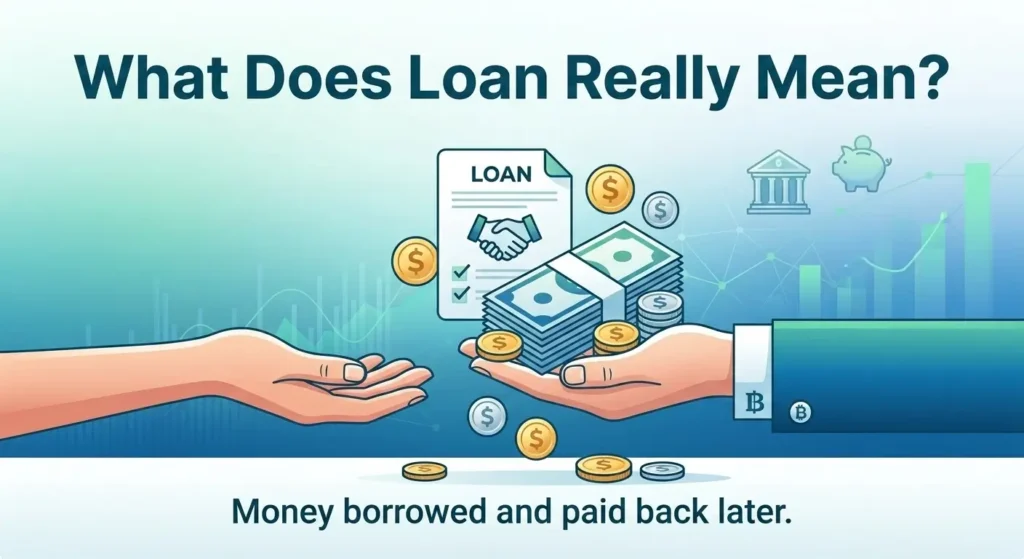
A loan is a sum of money or property that is borrowed and expected to be paid back, typically with accumulated interest over time. Additionally, native English speakers use it as a verb to describe the physical act of lending something to another party.
The word carries a neutral, matter-of-fact financial tone in standard conversation. However, it appears continuously in banking agreements, legal contracts, economic articles, and personal budget planning.
As a Part of Speech, “loan” functions primarily as a noun (/loʊn/) and as a verb (/loʊn/).
- Simple Definition: Money or property borrowed by a person or organization that must be returned, usually with interest.
Connotative Meaning
(Connotation is the emotional feeling or cultural association that a word carries beyond its strict dictionary definition.)
- Positive tone: Moderately positive when associated with financial growth, investment opportunity, educational funding, or business expansion.
- Negative tone: Can feel burdensome or stressful when linked with high debt, financial struggles, or heavy interest rates.
- Neutral tone: Predominantly neutral in general finance because it simply describes a standard transactional borrowing agreement.
Etymology
The word has a fascinating linguistic history originating from ancient Germanic roots before entering English.
- Origin: Derived from Proto-Germanic *laihnwaz (something lent) and Old Norse lán, meaning a gift or a loan.
- Old English (450–1100): Existed as læn (a grant, temporary gift, or lease), closely tied to early Germanic property arrangements.
- Middle English (1100–1500): Shifted into lone or lane under Scandinavian influence, specifying borrowed money with expectation of return.
- Modern English (1500–Present): Settled into its standard spelling as a core noun and verb across commercial banking and daily speech.
Pronunciation & Syllables
- US: /loʊn/
- UK: /ləʊn/
Syllable Breakdown: loan (1 Syllable)
Affixation Pattern:
- Root: loan (base word)
- Prefix: None
- Suffix: None
List of Synonyms
Advance (Noun) — US: /ədˈvæns/ | UK: /ədˈvɑːns/
- Meaning: A sum of money paid before the usual or agreed payment time, often deducted from future earnings.
- Tone/Register: Business / Professional
- Example 1: The publisher offered the novel author a substantial cash advance upon signing the contract.
- Example 2: Consequently, she requested an emergency salary advance to cover unexpected medical bills.
Credit (Noun) — US: /ˈkred.ɪt/ | UK: /ˈkred.ɪt/
- Meaning: An arrangement allowing a customer to receive goods or money before payment, based on trust and repayment ability.
- Tone/Register: Commercial / Financial
- Example 1: The local bank extended a high credit line to help the startup purchase inventory.
- Example 2: Therefore, maintaining a clean payment history improves your overall business credit score.
Mortgage (Noun) — US: /ˈmɔːr.ɡɪdʒ/ | UK: /ˈmɔː.ɡɪdʒ/
- Meaning: A legal borrowing agreement where a lender holds title to real estate property until the debt is fully cleared.
- Tone/Register: Legal / Real Estate
- Example 1: The young couple secured a thirty-year fixed mortgage to purchase their first suburban home.
- Example 2: In addition, low interest rates made refinancing their existing mortgage very appealing.
Financing (Noun) — US: /fəˈnæn.sɪŋ/ | UK: /ˈfaɪ.næns.ɪŋ/
- Meaning: The process or funding provided by a financial institution to support a major purchase or enterprise.
- Tone/Register: Corporate / Executive
- Example 1: The automotive dealership offered flexible financing options for new electric vehicle buyers.
- Example 2: Thus, securing venture capital financing allowed the tech firm to build its software platform.
Allowance (Noun) — US: /əˈlaʊ.əns/ | UK: /əˈlaʊ.əns/
- Meaning: An amount of money given regularly for a specific purpose or as personal spending funds.
- Tone/Register: Familial / Administrative
- Example 1: Parents often give children a modest weekly allowance to teach basic budgeting skills.
- Example 2: Meanwhile, the university provided a monthly travel allowance for overseas research fellows.

Subsidy (Noun) — US: /ˈsʌb.sə.di/ | UK: /ˈsʌb.sɪ.di/
- Meaning: Direct financial assistance granted by a government or public body to support an industry or social cause.
- Tone/Register: Governmental / Economic
- Example 1: Government agricultural subsidies helped local farmers withstand severe seasonal weather conditions.
- Example 2: As a result, green energy subsidies lowered the installation costs of home solar panels.
Grant (Noun) — US: /ɡrænt/ | UK: /ɡrɑːnt/
- Meaning: A quantity of money given by a government or organization for a specific project that does not require repayment.
- Tone/Register: Academic / Official
- Example 1: The research laboratory received a national science grant to study renewable battery technology.
- Example 2: Therefore, ambitious students applied for private academic grants to fund their studies abroad.
Accommodation (Noun) — US: /əˌkɑː.məˈdeɪ.ʃən/ | UK: /əˌkɒm.əˈdeɪ.ʃən/
- Meaning: A temporary financial favor or short-term loan extended by a bank or commercial partner.
- Tone/Register: Formal Banking / UK Finance
- Example 1: The commercial bank extended a temporary financial accommodation to resolve short-term cash flow issues.
- Example 2: Furthermore, the firm relied on short-term bank accommodations during peak inventory seasons.
Line of Credit (Noun Phrase) — US: /laɪn ʌv ˈkred.ɪt/ | UK: /laɪn ɒv ˈkred.ɪt/
- Meaning: A preset borrowing limit extended by a bank that a customer can draw from as needed.
- Tone/Register: Commercial Banking / Business
- Example 1: The business owner tapped into her corporate line of credit to pay workers during slow quarters.
- Example 2: Consequently, having a flexible line of credit provided crucial peace of mind.
Funding (Noun) — US: /ˈfʌn.dɪŋ/ | UK: /ˈfʌn.dɪŋ/
- Meaning: Financial resources provided for a specific purpose, project, or organizational operation.
- Tone/Register: Universal / Professional
- Example 1: The non-profit organization secured international funding to build clean water wells.
- Example 2: In addition, early startup funding helped the engineers develop their working prototype.
Investment (Noun) — US: /ɪnˈvest.mənt/ | UK: /ɪnˈvest.mənt/
- Meaning: Money committed with the expectation of generating future income, capital growth, or strategic value.
- Tone/Register: Financial / Growth
- Example 1: Angel investors provided strategic capital investment to accelerate the company’s growth.
- Example 2: Thus, upgrading machinery proved to be a profitable long-term investment for the factory.
Microloan (Noun) — US: /ˈmaɪ.kroʊ.loʊn/ | UK: /ˈmaɪ.krəʊ.ləʊn/
- Meaning: A small, short-term loan extended primarily to low-income entrepreneurs or small startup businesses.
- Tone/Register: Social Enterprise / Economic
- Example 1: A modest community microloan allowed the artisan to buy sewing equipment and start a shop.
- Example 2: Furthermore, microloan initiatives empowered small business owners across rural regions.
Overdraft (Noun) — US: /ˈoʊ.vɚ.dræft/ | UK: /ˈəʊ.və.drɑːft/
- Meaning: A temporary deficit in a bank account caused by drawing more money than the account holds, functioning as a short-term debt.
- Tone/Register: Retail Banking / Everyday
- Example 1: The bank charged a small service fee when his account went into a temporary overdraft.
- Example 2: Consequently, arranging an authorized overdraft protected her business from bounced checks.
Debenture (Noun) — US: /dɪˈben.tʃɚ/ | UK: /dɪˈben.tʃər/
- Meaning: A long-term corporate bond or loan certificate issued by a company to raise capital, backed by reputation rather than assets.
- Tone/Register: Corporate Law / Financial
- Example 1: The multinational corporation issued convertible debentures to fund its overseas expansion.
- Example 2: Therefore, institutional investors purchased company debentures for reliable annual returns.
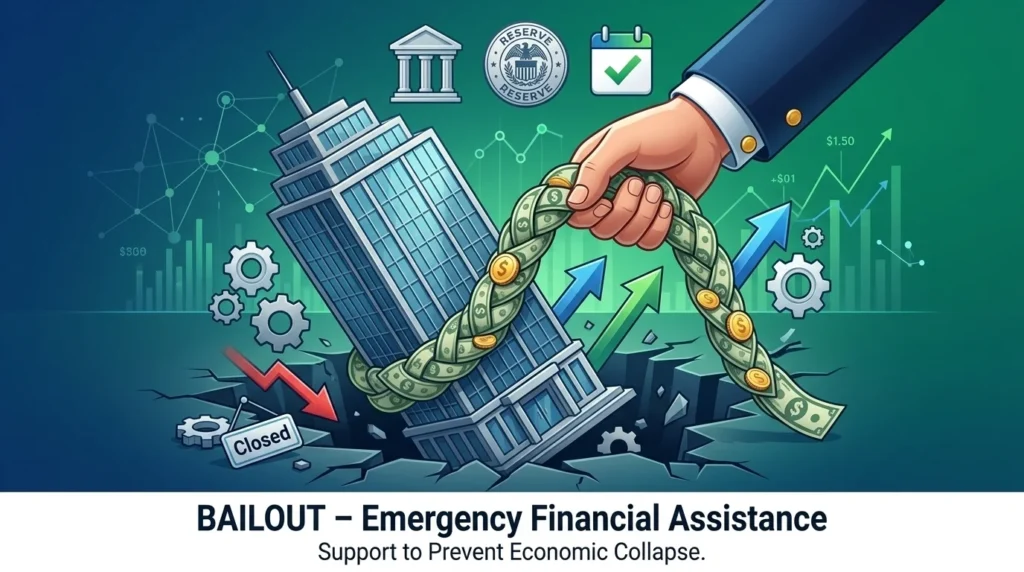
Bailout (Noun) — US: /ˈbeɪl.aʊt/ | UK: /ˈbeɪl.aʊt/
- Meaning: An act of giving emergency financial assistance to a company, country, or economy to prevent total collapse.
- Tone/Register: News / Macroeconomic
- Example 1: The government approved a multi-billion-dollar financial bailout to support struggling commercial airlines.
- Example 2: As a result, public debates arose regarding the fairness of corporate bailouts.
IOU (Noun Phrase) — US: /ˌaɪ.oʊˈjuː/ | UK: /ˌaɪ.əʊˈjuː/
- Meaning: An informal written document acknowledging a debt owed to another person.
- Tone/Register: Informal / Casual
- Example 1: He wrote a quick IOU on a paper napkin after borrowing lunch money from his friend.
- Example 2: Meanwhile, she kept a folder of informal IOUs from her roommates for shared house bills.
Debt (Noun) — US: /det/ | UK: /det/
- Meaning: A sum of money or obligation that is owed or due to be paid to someone else.
- Tone/Register: Universal / Direct
- Example 1: Working double shifts helped him clear his personal credit card debt in under a year.
- Example 2: In addition, responsible budgeting prevents consumers from falling into heavy debt.
Lease (Noun) — US: /liːs/ | UK: /liːs/
- Meaning: A contractual arrangement calling for the user to pay the owner for the temporary use of property or equipment.
- Tone/Register: Legal / Commercial
- Example 1: The medical clinic signed a ten-year commercial lease for modern office space downtown.
- Example 2: Consequently, leasing corporate vehicles reduced upfront capital expenditure for the firm.
Subvention (Noun) — US: /səbˈven.ʃən/ | UK: /səbˈven.ʃən/
- Meaning: A grant or financial aid provided by a government or authority to support an institution or cause.
- Tone/Register: Formal / High Academic
- Example 1: The state research institute relied on an annual government subvention to operate.
- Example 2: Thus, subvention funds kept public museum admission fees affordable for local families.
Stipend (Noun) — US: /ˈstaɪ.pend/ | UK: /ˈstaɪ.pend/
- Meaning: A fixed, regular sum paid as a salary or allowance to cover living expenses for students, interns, or clergy.
- Tone/Register: Academic / Institutional
- Example 1: Graduate teaching assistants receive a modest living stipend while completing their doctoral degrees.
- Example 2: Furthermore, the summer internship program offered a daily food and transportation stipend.
Trust (Noun) — US: /trʌst/ | UK: /trʌst/
- Meaning: A financial arrangement where one party holds property or funds for the benefit of another.
- Tone/Register: Legal / Estate
- Example 1: Her grandparents set up a college trust fund that matured on her eighteenth birthday.
- Example 2: Therefore, placing family assets in a secure trust protected them for future generations.
Assistance (Noun) — US: /əˈsɪs.təns/ | UK: /əˈsɪs.təns/
- Meaning: Financial aid or support provided to help someone overcome a temporary emergency or hardship.
- Tone/Register: Supportive / Formal
- Example 1: Emergency financial assistance was dispatched immediately to flood victims in the valley.
- Example 2: In addition, non-profit groups offer food and rental assistance to families in need.
Backing (Noun) — US: /ˈbæk.ɪŋ/ | UK: /ˈbæk.ɪŋ/
- Meaning: Financial or moral support provided by an investor, institution, or sponsor to back a project.
- Tone/Register: Business / Creative
- Example 1: With strong institutional financial backing, the young inventor launched her clean energy product.
- Example 2: As a result, the independent film project secured financial backing from private donors.
Endowment (Noun) — US: /ɪnˈdaʊ.mənt/ | UK: /ɪnˈdaʊ.mənt/
- Meaning: An income or property donated to an institution like a university or hospital to yield ongoing financial support.
- Tone/Register: Institutional / Philanthropic
- Example 1: The prestigious university used its substantial financial endowment to fund full student scholarships.
- Example 2: Consequently, alumni donations expanded the hospital’s research endowment fund.
Lending (Noun) — US: /ˈlen.dɪŋ/ | UK: /ˈlen.dɪŋ/
- Meaning: The commercial practice or business of allowing people to borrow money in exchange for interest.
- Tone/Register: Financial Sector / General
- Example 1: Central bank policy adjustments heavily influence commercial bank lending rates nationwide.
- Example 2: Thus, peer-to-peer online lending platforms gained significant popularity among young borrowers.
Stipulation Bond (Noun Phrase) — US: /ˌstɪp.jəˈleɪ.ʃən bɑːnd/ | UK: /ˌstɪp.jəˈleɪ.ʃən bɒnd/
- Meaning: A legally binding financial commitment or collateral security posted to guarantee fulfillment of a deferred obligation.
- Tone/Register: Legal / Contractual
- Example 1: The developer posted a stipulation bond to secure local government approval for the construction project.
- Example 2: Consequently, the court required a financial stipulation bond before releasing the impounded commercial assets.
Debtor Obligation (Noun Phrase) — US: /ˈdet.ɚ ˌɑː.bləˈɡeɪ.ʃən/ | UK: /ˈdet.ər ˌɒb.lɪˈɡeɪ.ʃən/
- Meaning: The formal financial duty or borrowed balance that an individual or company is legally required to repay.
- Tone/Register: Corporate / Accounting
- Example 1: Restructuring their debtor obligation allowed the manufacturing company to avoid bankruptcy proceedings.
- Example 2: Therefore, the audit revealed a massive debtor obligation owed to foreign suppliers.
Floating Charge (Noun Phrase) — US: /ˈfloʊ.t̬ɪŋ tʃɑːrdʒ/ | UK: /ˈfləʊ.tɪŋ tʃɑːdʒ/
- Meaning: A flexible security interest created over a class of changing business assets used to secure commercial financing.
- Tone/Register: Commercial Banking / Legal
- Example 1: The lender secured the business advance against the firm’s inventory using a floating charge.
- Example 2: In addition, the bank registered a floating charge to protect its investment across company operations.
Note of Hand (Noun Phrase) — US: /noʊt ʌv hænd/ | UK: /nəʊt ɒv hænd/
- Meaning: A signed written document containing a promise to pay a specified sum of money to a named person.
- Tone/Register: Traditional / Financial
- Example 1: He secured the short-term personal credit by signing a simple note of hand with the lender.
- Example 2: Thus, the merchant held a binding note of hand for the delivered agricultural goods.
Subordinated Debt (Noun Phrase) — US: /səˈbɔːr.də.neɪ.t̬ɪd det/ | UK: /səˈbɔː.dɪ.neɪ.tɪd det/
- Meaning: A junior loan or secondary credit agreement that ranks below primary debts in repayment priority during liquidation.
- Tone/Register: High Finance / Investment
- Example 1: Issuing subordinated debt enabled the tech firm to raise capital without diluting current shareholder equity.
- Example 2: As a result, institutional investors demanded higher-yield interest on the subordinated debt investment.
Capital Injection (Noun Phrase) — US: /ˈkæp.ə.t̬əl ɪnˈdʒek.ʃən/ | UK: /ˈkæp.ɪ.təl ɪnˈdʒek.ʃən/
- Meaning: An infusion of money provided to a business or project to improve liquidity or fund expansion efforts.
- Tone/Register: Business / Executive
- Example 1: The emergency capital injection saved the startup from liquidating its core intellectual assets.
- Example 2: Furthermore, venture partners authorized an additional capital injection following quarterly performance metrics.
Drawdown (Noun) — US: /ˈdrɑː.daʊn/ | UK: /ˈdrɔː.daʊn/
- Meaning: The actual disbursement or release of money from a previously approved borrowing facility or credit line.
- Tone/Register: Banking / Operations
- Example 1: The construction project processed its first drawdown to pay site clearing contractors.
- Example 2: Consequently, the CFO scheduled a second drawdown from their revolving credit facility.
Mezzanine Financing (Noun Phrase) — US: /ˈmet.sə.niːn fəˈnæn.sɪŋ/ | UK: /ˈmet.zə.niːn faɪˈnæns.ɪŋ/
- Meaning: A hybrid debt and equity financing structure that gives the lender the right to convert debt into stock.
- Tone/Register: Corporate Finance / Venture Capital
- Example 1: The acquisition was funded primarily through mezzanine financing provided by private equity funds.
- Example 2: Thus, mezzanine financing bridged the funding gap before the company went public.
Commercial Paper (Noun Phrase) — US: /kəˈmɝː.ʃəl ˈpeɪ.pɚ/ | UK: /kəˈmɜː.ʃəl ˈpeɪ.pər/
- Meaning: An unsecured, short-term debt instrument issued by corporations to finance immediate operational liabilities.
- Tone/Register: Macroeconomics / Corporate
- Example 1: Major corporations issue commercial paper to cover weekly payroll and inventory costs.
- Example 2: In addition, central banks bought commercial paper to keep institutional credit markets liquid.
Cash Cushion (Noun Phrase) — US: /kæʃ ˈkʊʃ.ən/ | UK: /kæʃ ˈkʊʃ.ən/
- Meaning: A reserve sum of money kept available to absorb unexpected expenses or financial shortfalls.
- Tone/Register: Conversational / Personal Finance
- Example 1: Keeping a modest cash cushion prevented the family from relying on high-interest credit cards.
- Example 2: Meanwhile, small businesses maintain a cash cushion to survive seasonal revenue dips.
Letter of Credit (Noun Phrase) — US: /ˈlet̬.ɚ ʌv ˈkred.ɪt/ | UK: /ˈlet.ər ɒv ˈkred.ɪt/
- Meaning: An official document issued by a bank guaranteeing that a buyer’s payment to a seller will be received on time.
- Tone/Register: International Trade / Banking
- Example 1: The overseas exporter refused to ship the electronics without a confirmed letter of credit.
- Example 2: Therefore, obtaining a letter of credit reduced cross-border payment risks for both trading partners.
Microcredit (Noun) — US: /ˈmaɪ.kroʊˌkred.ɪt/ | UK: /ˈmaɪ.krəʊˌkred.ɪt/
- Meaning: Very small sums of money lent at low interest to impoverished entrepreneurs to encourage self-employment.
- Tone/Register: Socioeconomic / Development
- Example 1: Microcredit programs enabled rural women to purchase livestock and establish local dairy businesses.
- Example 2: As a result, community-based microcredit initiatives lowered regional poverty rates over a decade.
Promissory Note (Noun Phrase) — US: /ˈprɑː.mə.sɔː.ri noʊt/ | UK: /ˈprɒm.ɪ.sər.i nəʊt/
- Meaning: A signed legal paper containing a written promise to pay a stated sum to a specified person at a set date.
- Tone/Register: Formal Legal / Financial
- Example 1: Before receiving the private funds, the borrower executed a legally binding promissory note.
- Example 2: Consequently, the real estate investor held several promissory notes earning monthly fixed returns.
Bridge Facility (Noun Phrase) — US: /brɪdʒ fəˈsɪl.ə.t̬i/ | UK: /brɪdʒ fəˈsɪl.ə.ti/
- Meaning: Short-term temporary financing used to cover expenses until a long-term arrangement or funding is secured.
- Tone/Register: Commercial / Corporate Banking
- Example 1: The bank granted a bridge facility to cover property purchasing expenses while the mortgage was being processed.
- Example 2: Thus, the company relied on a bridge facility to maintain payroll during corporate restructuring.
Subvention Grant (Noun Phrase) — US: /səbˈven.ʃən ɡrænt/ | UK: /səbˈven.ʃən ɡrɑːnt/
- Meaning: Financial support or yield relief provided by an authority or manufacturer to lower borrowing interest rates.
- Tone/Register: Administrative / Industrial
- Example 1: The automotive manufacturer introduced a subvention grant to offer zero percent interest financing.
- Example 2: Furthermore, the agricultural sector benefited from a government subvention grant on tractor purchases.
Call Money (Noun Phrase) — US: /kɑːl ˈmʌn.i/ | UK: /kɔːl ˈmʌn.i/
- Meaning: Short-term, interest-bearing loans extended between banking institutions that are payable immediately upon demand.
- Tone/Register: Institutional Banking / Markets
- Example 1: Commercial banks access call money markets daily to satisfy reserve requirements.
- Example 2: In addition, fluctuations in call money rates signaled changing liquidity across the financial sector.
Chattel Mortgage (Noun Phrase) — US: /ˈtʃæt̬.əl ˈmɔːr.ɡɪdʒ/ | UK: /ˈtʃæt.əl ˈmɔː.ɡɪdʒ/
- Meaning: A legal loan arrangement where movable personal property acts as security collateral for the debt.
- Tone/Register: Real Estate / Commercial Law
- Example 1: The farmer secured a chattel mortgage using his heavy machinery equipment as loan collateral.
- Example 2: Therefore, failure to meet payments resulted in the repossession of assets under the chattel mortgage.
Syndicated Credit (Noun Phrase) — US: /ˈsɪn.də.keɪ.t̬ɪd ˈkred.ɪt/
- Meaning: A large financing package provided by a group of financial institutions collaborating to spread risk.
- Tone/Register: Investment Banking / Corporate
- Example 1: International lenders joined together to structure a multi-billion-dollar syndicated credit for the oil pipeline.
- Example 2: Consequently, syndicated credit agreements help banks manage risk on massive infrastructure projects.
Refinance Arrangement (Noun Phrase) — US: /ˌriː.fəˈnæns əˈreɪndʒ.mənt/
- Meaning: The replacement of an existing debt obligation with a new borrowing contract carrying different payment terms.
- Tone/Register: Personal / Retail Finance
- Example 1: Lowering interest rates prompted thousands of homeowners to complete a mortgage refinance arrangement.
- Example 2: Thus, securing a new refinance arrangement significantly lowered his monthly debt servicing costs.
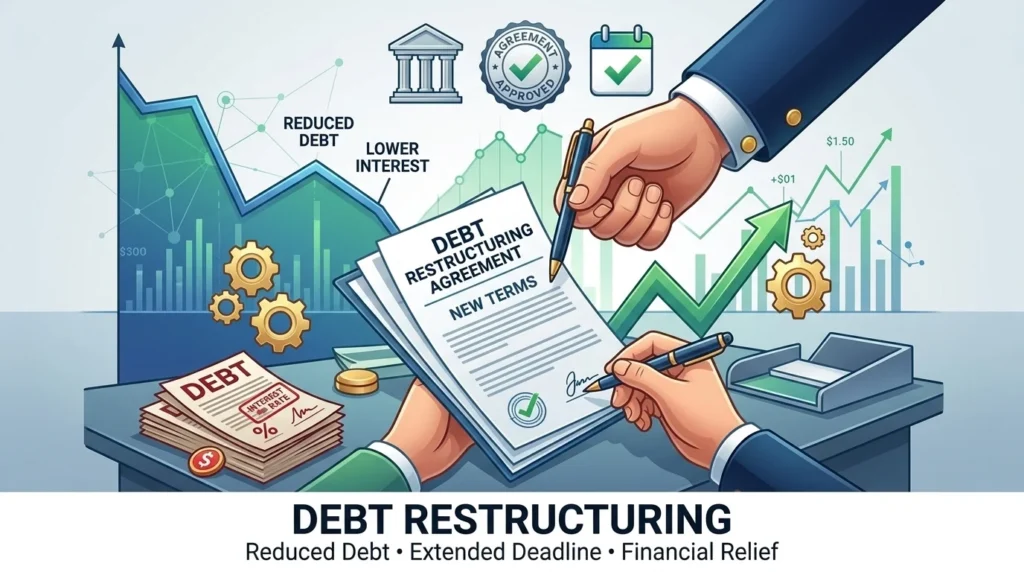
Debtor Relief (Noun Phrase) — US: /ˈdet.ɚ rɪˈliːf/ | UK: /ˈdet.ər rɪˈliːf/
- Meaning: Formal debt reduction, deadline extension, or financial restructuring granted to help a borrower overcome distress.
- Tone/Register: Governmental / Legal
- Example 1: Parliament enacted targeted debtor relief measures to support citizens affected by natural disaster damage.
- Example 2: As a result, the national bank offered temporary debtor relief to small businesses facing liquidity constraints.
Synonyms by Tone
Choosing the right tone ensures your vocabulary fits the situation naturally. Using formal terms in casual texting sounds unnatural, while using informal slang in research papers lowers authority.
Positive / Gift / Support:
Grant, Subsidy, Stipend, Endowment, Assistance (highlights money that helps without burdening the borrower).
Neutral / Objective:
Loan, Credit, Financing, Lease, Funding, Line of Credit (focuses purely on commercial transactions).
Formal / Legal / Corporate:
Debenture, Accommodation, Subvention, Mortgage, Bailout (ideal for legal contracts, reports, and macroeconomics).
Playful / Informal:
IOU, Advance, Overdraft (perfect for personal chats, casual notes, and everyday finances).
Mini Comparison: “Loan” vs. Close Alternatives
| Word | Specific Focus | Best Context |
| Loan | Standard money borrowed that must be paid back, almost always with interest. | Personal bank debts, car purchases, student debt, general borrowing. |
| Grant | Funds given for research, education, or public causes that require no repayment. | University research, non-profit funding, government art projects. |
| Mortgage | A specific long-term debt used exclusively to buy real estate, backed by property. | Buying houses, commercial real estate, land acquisition. |
How “Loan” Changes by Context
When speaking casually, native speakers often mention getting an advance from an employer or asking a friend for a quick favor instead of discussing formal arrangements.
For blogs and general writing, lively terms such as financing, credit, or grant can make the content more engaging while keeping it clear and mobile-friendly.
Within professional or academic contexts, specialized vocabulary like debenture, subvention, or accommodation adds precision and credibility to reports and research papers.
In creative writing, expressive words such as bailout, IOU, or backing can bring urgency, conflict, and emotional depth to storytelling.
Common Mistakes Learners Make
- Confusing “Loan” and “Lend”: Loan is primarily a noun (the money itself), whereas lend is the verb (“Please lend me $10”).
- Calling a “Grant” a “Loan”: Calling a grant a loan is incorrect; grants are free funding that do not require repayment.
- Tone Mismatch: Avoid writing IOU on formal corporate balance sheets, as informal notes lower professional credibility.
(For additional vocabulary insights, explore our financial writing guides to refine your everyday sentence flow.)
Real-Life Mini Scenarios
- Workplace: The HR department processed an emergency salary advance for the employee after his house repair emergency.
- Social Situations: After realizing he forgot his wallet at dinner, Mark handed his co-worker a written IOU.
- Media / Pop Culture: Financial news outlets analyzed whether the international banking bailout would stabilize global markets.
- Writing or Storytelling: The main character secured private financial backing just hours before her laboratory lost power.
Conclusion
Learning synonyms enriches your writing and helps you express subtle financial concepts clearly. Expanding your vocabulary ensures your message stays fresh across all communication mediums.
Mastering words like advance, credit, and mortgage adds precision and confidence to your prose. Choosing the right word also helps your writing connect deeply with readers.
Try practicing these new words today in your journal, email drafts, or essay writing. Developing consistent vocabulary habits builds strong, lifelong communication skills.
Interactive Practice Quiz
1. Which synonym fits best when describing borrowed money specifically used to buy a house?
a) IOU
b) Mortgage
c) Stipend
d) Subsidy
2. Funds given to a university scientist for research that do NOT need to be paid back are called a:
a) Loan
b) Grant
c) Overdraft
d) Debenture
3. What word best describes money given early to an author before their book is published?
a) Bailout
b) Advance
c) Subvention
d) Trust
4. When a bank permits an account holder to spend slightly more than their account balance, it is an:
a) Overdraft
b) Endowment
c) Subvention
d) IOU
5. Which term best fits an informal handwritten debt note passed between close friends?
a) Debenture
b) IOU
c) Mortgage
d) Subsidy
6. What term works best for emergency government money given to prevent a big company collapse?
a) Stipend
b) Bailout
c) Endowment
d) Lease
7. If a graduate teaching assistant receives living funds while studying, they receive a:
a) Overdraft
b) Stipend
c) Mortgage
d) Debenture
8. Which word describes financial aid given by governments to lower solar panel costs for citizens?
a) Subsidy
b) IOU
c) Overdraft
d) Mortgage
9. What corporate bond certificate is issued by major firms to raise long-term capital?
a) IOU
b) Debenture
c) Stipend
d) Allowance
10. Which word fits best when a business draws funds up to a preset bank limit as needed?
a) Line of Credit
b) Subvention
c) IOU
d) Grant
Answer Key: 1-b, 2-b, 3-b, 4-a, 5-b, 6-b, 7-b, 8-a, 9-b, 10-a,
Frequently Asked Questions
1. What is the most common synonym for loan in everyday banking?
The most common everyday alternative in banking is “credit” or “financing.” Customers frequently ask for credit lines, personal financing, or bank advances when borrowing funds for daily or major expenses.
2. What is the key difference between a loan and a grant?
A loan consists of borrowed money that must be repaid over time, almost always with added interest. In contrast, a grant is financial aid given for education, research, or public projects that requires no repayment.
3. Can “loan” be used as both a noun and a verb?
Yes. “Loan” functions as a noun (“She took out a loan”) and as a verb (“Can you loan me a book?”), though many formal writers prefer using “lend” as the primary verb form.
4. What is the difference between a mortgage and a personal loan?
A mortgage is a specialized long-term loan tied specifically to real estate property as collateral. A personal loan is generally shorter in duration, smaller in size, and often unsecured by physical property.
5. What is the best academic synonym for loan?
In academic and economic contexts, excellent terms include “credit facility,” “financial accommodation,” “debt financing,” or “subvention,” depending on whether the funds are commercial debt or institutional assistance.

Esha loves exploring English words and finding simple ways to explain them. She writes about synonyms, vocabulary, word meanings, and everyday language in a clear and friendly style. Through vocaneest.com, Esha shares useful tips and easy-to-follow language guides for students, writers, and anyone looking to improve their English. Her goal is simple: to help readers choose better words, express their ideas clearly, and feel more confident when writing or communicating.


Pingback: ⚖️Synonym for Mistreatment: 45 Expert Terms & Definitions(2026)