
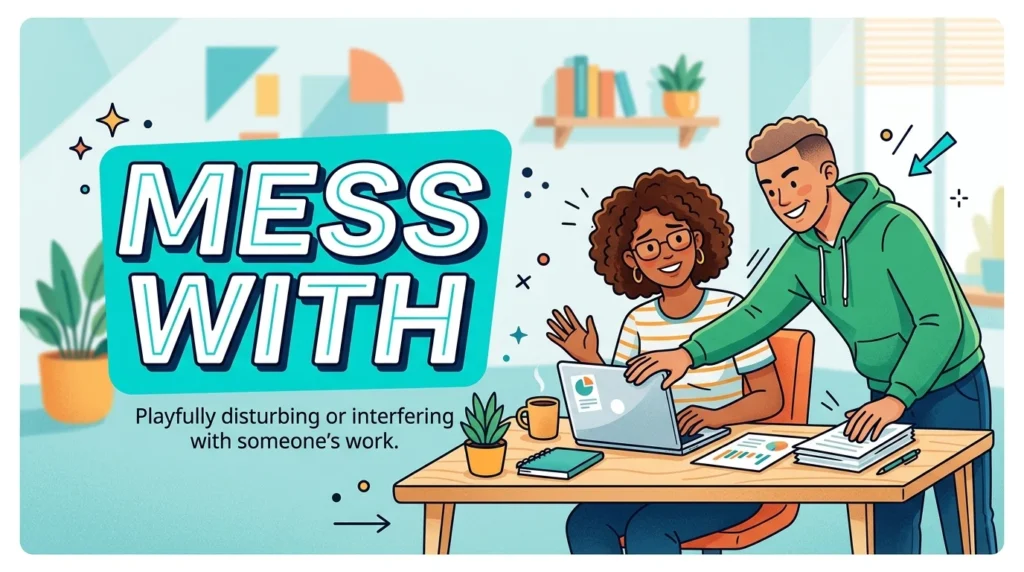
Synonym for mess with phrases help writers describe situations where someone interferes, tampers, or interacts casually with something delicate.
Imagine trying to warn a friend not to adjust a sensitive machine’s settings panel, but you keep repeating the exact same informal phrasal verb over and over.
Learning the right synonym for mess with helps you express interference or tinkering clearly. Consequently, your daily writing and storytelling become far more precise and engaging.
Finding a natural synonym for mess with improves vocabulary for students, bloggers, and writers. Mastering these options helps you articulate actions effortlessly today.
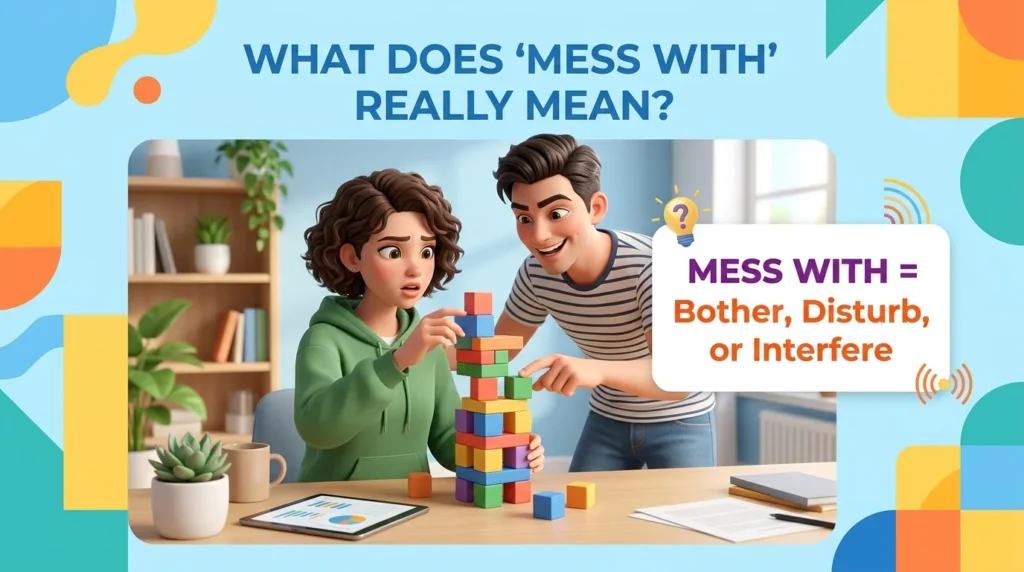
What Does “Mess With” Really Mean?
The phrase mess with refers to interfering with, tampering with, or engaging in casual, often risky interaction with a person or object. It highlights an act of disruption or unauthorized handling.
Native speakers view the term as a common phrasal verb. It appears frequently in casual conversation, fiction dialogue, and everyday safety warnings.
- Part of Speech: Phrasal Verb (Verb + Preposition)
- Simple Definition: To interfere with, tamper with, or annoy someone or something without permission.
Connotative Meaning
(Connotation is the emotional feeling or cultural association that a word carries beyond its literal dictionary definition.)
- Positive tone: Can occasionally suggest playful banter or lighthearted tinkering when used playfully among friends.
- Negative tone: Strongly implies unauthorized interference, disruption, troublemaking, or causing deliberate irritation.
- Neutral tone: Describes physical adjustment or handling of mechanical items without strong emotional weight.
Etymology
The term combines the noun-derived verb mess (from Old French mes, meaning a portion of food) with the preposition with. Over time, it evolved to mean mixing things up or meddling.
- Old English (450–1100): The exact phrasal combination did not exist, though native Germanic roots expressed interference through words like derian (to harm).
- Middle English (1100–1500): The noun mes entered from French, relating to portions, which later shifted to mean a state of confusion or untidiness.
- Modern English (1500–Present): The verb mess developed meanings associated with tampering or meddling, leading to the modern phrasal verb mess with.
Pronunciation (US & UK – IPA)
- US: /ˈmɛs wɪð/
- UK: /ˈmɛs wɪð/
Syllables & Structure
- Syllables: mess with (2 parts)
- Root: mess (verb/noun)
- Prefix: None
- Suffix: None (Prepositional particle attached)
Synonyms List
Tamper (Verb) — US: /ˈtæm.pɚ/ | UK: /ˈtæm.pər/
- Meaning: To interfere with something in order to cause damage or make unauthorized changes.
- Tone/Register: Formal / Legal
- Example 1: Someone tried to tamper with the electrical box during the storm.
- Example 2: Never tamper with security settings on office computers.
Interfere (Verb) — US: /ˌɪn.tɚˈfɪr/ | UK: /ˌɪn.təˈfɪə/
- Meaning: To take part in something so as to prevent or alter a result.
- Tone/Register: General / Formal
- Example 1: He tried not to interfere in family decisions.
- Example 2: Unnecessary rules can interfere with daily productivity.
Meddle (Verb) — US: /ˈmɛd.əl/ | UK: /ˈmɛd.əl/
- Meaning: To busy oneself unduly in other people’s affairs or matters.
- Tone/Register: Conversational / Disapproving
- Example 1: She told her neighbors not to meddle in her personal business.
- Example 2: It is unwise to meddle in things you do not fully understand.
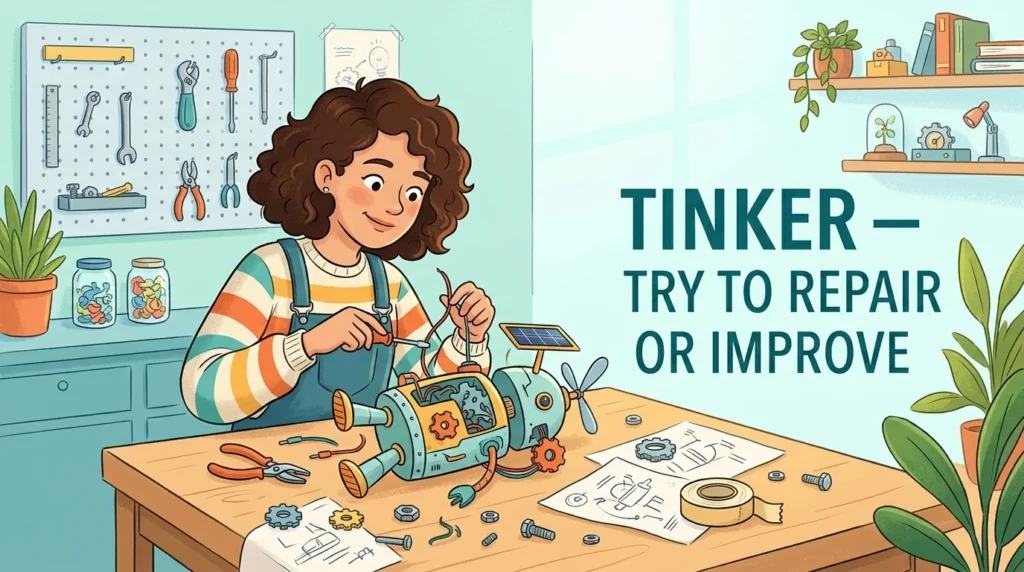
Tinker (Verb) — US: /ˈtɪŋ.kɚ/ | UK: /ˈtɪŋ.kər/
- Meaning: To attempt to repair or improve something in a casual or experimental way.
- Tone/Register: Conversational / Descriptive
- Example 1: He loves to tinker with old bicycles in his garage.
- Example 2: She spent the afternoon tinkering with her blog code.
Intervene (Verb) — US: /ˌɪn.tɚˈviːn/ | UK: /ˌɪn.təˈviːn/
- Meaning: To come between so as to prevent or alter a course of events.
- Tone/Register: Formal / Professional
- Example 1: Teachers had to intervene when the argument escalated.
- Example 2: Managers must intervene to resolve workplace disputes.
Provoke (Verb) — US: /prəˈvoʊk/ | UK: /prəˈvəʊk/
- Meaning: To stimulate or give rise to a reaction or emotion in someone.
- Tone/Register: Formal / Academic
- Example 1: Do not provoke the stray dog resting near the fence.
- Example 2: His harsh comments provoked an angry response from the crowd.
Harass (Verb) — US: /həˈræs/ | UK: /ˈhær.əs/
- Meaning: To subject someone to aggressive pressure or intimidation.
- Tone/Register: Professional / Legal
- Example 1: Company policies strictly prohibit employees from harassing coworkers.
- Example 2: Online trolls often try to harass independent creators.
Pester (Verb) — US: /ˈpɛs.tɚ/ | UK: /ˈpɛs.tər/
- Meaning: To trouble or annoy someone with frequent, persistent requests or actions.
- Tone/Register: Conversational / Informal
- Example 1: The puppy began to pester its owner for a walk.
- Example 2: Children often pester parents for toys while shopping.
Agitate (Verb) — US: /ˈædʒ.əˌteɪt/ | UK: /ˈædʒ.ɪˌteɪt/
- Meaning: To make someone troubled or nervous; to stir up public discussion.
- Tone/Register: Formal / Academic
- Example 1: Strong winds can agitate the surface of the quiet lake.
- Example 2: Activists gathered to agitate for better public transit policies.
Disturb (Verb) — US: /dɪˈstɜːrb/ | UK: /dɪˈstɜːb/
- Meaning: To interfere with the normal arrangement, functioning, or peace of something.
- Tone/Register: General / Conversational
- Example 1: Please do not disturb the papers on my desk.
- Example 2: Loud noises can disturb wildlife in the nature reserve.
Annoy (Verb) — US: /əˈnɔɪ/ | UK: /əˈnɔɪ/
- Meaning: To cause irritation or slight anger to someone through repetitive actions.
- Tone/Register: Conversational / Everyday
- Example 1: Dripping faucets can annoy people trying to sleep.
- Example 2: He likes to tease his sister just to annoy her.
Bog down (Verb) — US: /bɑːɡ daʊn/ | UK: /bɒɡ daʊn/
- Meaning: To cause something or someone to become stuck or delayed in details.
- Tone/Register: Professional / Idiomatic
- Example 1: Do not let minor administrative tasks bog down your project.
- Example 2: Negotiations can bog down over minor contract clauses.
Inconvenience (Verb) — US: /ˌɪn.kənˈviː.ni.əns/ | UK: /ˌɪn.kənˈviː.ni.əns/
- Meaning: To cause trouble or difficulty to someone.
- Tone/Register: Formal / Polite
- Example 1: Road construction might inconvenience drivers during peak hours.
- Example 2: She apologized if her late arrival would inconvenience the host.
Monkey with (Verb) — US: /ˈmʌŋ.ki wɪð/ | UK: /ˈmʌŋ.ki wɪð/
- Meaning: To tamper or tinker with something without proper understanding.
- Tone/Register: Informal / Conversational
- Example 1: Do not monkey with the thermostat settings in the hallway.
- Example 2: He managed to fix the watch after monkeying with the gears.
Fool with (Verb) — US: /fuːl wɪð/ | UK: /fuːl wɪð/
- Meaning: To handle or play with something carelessly or idly.
- Tone/Register: Informal / Conversational
- Example 1: Stop trying to fool with the television remote buttons.
- Example 2: Kids love to play with water balloons in the summer.
Toy with (Verb) — US: /tɔɪ wɪð/ | UK: /tɔɪ wɪð/
- Meaning: To consider an idea casually, or handle something idly without serious intent.
- Tone/Register: Literary / Conversational
- Example 1: She began to toy with her food during the dull meeting.
- Example 2: He started to toy with the idea of starting a new business.
Fiddle with (Verb) — US: /ˈfɪd.əl wɪð/ | UK: /ˈfɪd.əl wɪð/
- Meaning: To touch or adjust something nervously or continuously with one’s hands.
- Tone/Register: Conversational / Informal
- Example 1: He tended to fiddle with his keys whenever he felt nervous.
- Example 2: She adjusted her glasses while continuing to fiddle with the settings.
Play with (Verb) — US: /pleɪ wɪð/ | UK: /pleɪ wɪð/
- Meaning: To engage in recreation or handle something casually for amusement.
- Tone/Register: Everyday / Conversational
- Example 1: Kittens love to play with balls of yarn on the carpet.
- Example 2: The artist liked to play with bold color combinations.
Hack (Verb) — US: /hæk/ | UK: /hæk/
- Meaning: To gain unauthorized access to computer data or systems.
- Tone/Register: Technical / Informal
- Example 1: Experts worked quickly to secure servers after hackers breached them.
- Example 2: He learned how to hack basic software scripts in college.
Intrusion (Variant) -> Trespass (Verb) — US: /ˈtrɛs.pæs/ | UK: /ˈtrɛs.pæs/
- Meaning: To enter someone’s land or property without permission.
- Tone/Register: Legal / Formal
- Example 1: Signs warned visitors not to trespass on private ranch property.
- Example 2: Hikers faced fines if they chose to trespass past marked boundaries.
Butt in (Verb) — US: /bʌt ɪn/ | UK: /bʌt ɪn/
- Meaning: To interrupt a conversation or activity rudely.
- Tone/Register: Informal / Conversational
- Example 1: It is impolite to butt in while colleagues are talking.
- Example 2: He always tries to butt in during group brainstorming sessions.
Disturb (Variant) -> Discommode (Verb) — US: /ˌdɪs.kəˈmoʊd/ | UK: /ˌdɪs.kəˈməʊd/
- Meaning: To cause inconvenience or discomfort to someone.
- Tone/Register: Formal / Archaic
- Example 1: The host hoped the late-night noise did not discommode guests.
- Example 2: Staff worked quietly to avoid any effort that might discommode patrons.
Tamper (Variant) -> Corrupt (Verb) — US: /kəˈrʌpt/ | UK: /kəˈrʌpt/
- Meaning: To cause damage to the integrity and purity of digital file systems.
- Tone/Register: Formal / Technical
- Example 1: Malware can corrupt important database records overnight.
- Example 2: Officials investigated claims that bad actors tried to corrupt files.

Infringe (Verb) — US: /ɪnˈfrɪndʒ/ | UK: /ɪnˈfrɪndʒ/
- Meaning: To actively break the terms of a law, agreement, or copyright.
- Tone/Register: Legal / Formal
- Example 1: Copyright laws protect creators if other websites infringe on their work.
- Example 2: The new policy must not infringe upon personal privacy rights.
Disrupt (Verb) — US: /dɪsˈrʌpt/ | UK: /dɪsˈrʌpt/
- Meaning: To interrupt an event, activity, or process by causing a disturbance.
- Tone/Register: Professional / General
- Example 1: A sudden power surge can disrupt manufacturing operations.
- Example 2: Heavy traffic threatened to disrupt our travel schedule.
Bodger (Variant) -> Bungle (Verb) — US: /ˈbʌŋ.ɡəl/ | UK: /ˈbʌŋ.ɡəl/
- Meaning: To carry out a task clumsily or carelessly, resulting in a messed-up outcome.
- Tone/Register: Conversational / Informal
- Example 1: He tried to fix the plumbing himself but ended up bungling the whole job.
- Example 2: Do not rush the paperwork or you might bungle the details.
Botch (Verb) — US: /bɑːtʃ/ | UK: /bɒtʃ/
- Meaning: To ruin something through poor or clumsy handling.
- Tone/Register: Conversational / Expressive
- Example 1: The contractor managed to botch the kitchen renovation entirely.
- Example 2: She worried she would botch her speech during the ceremony.
Mismanage (Verb) — US: /ˌmɪsˈmæn.ɪdʒ/ | UK: /ˌmɪsˈmæn.ɪdʒ/
- Meaning: To manage something badly, carelessly, or incompetently.
- Tone/Register: Professional / Formal
- Example 1: The director tended to mismanage departmental funds during the fiscal year.
- Example 2: Poor leadership can mismanage even the strongest business strategy.
Malpractice (Variant) -> Blunder (Verb) — US: /ˈblʌn.dɚ/ | UK: /ˈblʌn.ْدər/
- Meaning: To make a or careless mistake through clumsy action.
- Tone/Register: Conversational / Literary
- Example 1: It is easy to blunder when you rush through critical instructions.
- Example 2: The team tried to ensure they did not blunder during negotiations.
Mishandle (Verb) — US: /ˌmɪsˈhæn.dəl/ | UK: /ˌmɪsˈhæn.dəl/
- Meaning: To manage or deal with something inefficiently or improperly.
- Tone/Register: Professional / Formal
- Example 1: Couriers must not mishandle fragile packages during delivery.
- Example 2: Public relations teams scrambled after officials chose to mishandle the crisis.
Derange (Verb) — US: /dɪˈreɪndʒ/ | UK: /dɪˈreɪndʒ/
- Meaning: To throw into disorder or cause mental confusion.
- Tone/Register: Formal / Literary
- Example 1: Severe stress can derange normal sleep patterns.
- Example 2: The storm managed to derange the city’s transport schedule.
Disarrange (Verb) — US: /ˌdɪs.əˈreɪndʒ/ | UK: /ˌdɪs.əˈreɪndʒ/
- Meaning: To disturb the arrangement or order of something; to make untidy.
- Tone/Register: Formal / Descriptive
- Example 1: Strong wind gusts began to disarrange the papers on the porch table.
- Example 2: Please do not disarrange the cataloged archive boxes.
Rumple (Verb) — US: /ˈrʌm.pəl/ | UK: /ˈrʌm.pəl/
- Meaning: To give something a creased, ruffled, or untidy appearance by handling.
- Tone/Register: Conversational / Descriptive
- Example 1: Sitting on the sofa all afternoon will rumple your new suit.
- Example 2: He began to rumple his notes out of sheer frustration.
Ruffle (Verb) — US: /ˈrʌf.əl/ | UK: /ˈrʌf.əl/
- Meaning: To disturb the smoothness or order of something surface-wise.
- Tone/Register: General / Conversational
- Example 1: A sudden breeze began to ruffle the calm surface of the lake.
- Example 2: Do not let minor setbacks ruffle your professional composure.
Disorganize (Verb) — US: /dɪsˈɔːr.ɡə.naɪz/ | UK: /dɪsˈɔː.ɡə.naɪz/
- Meaning: To disrupt the systematic order or function of an organization or plan.
- Tone/Register: Professional / Formal
- Example 1: Last-minute changes threatened to disorganize the entire event schedule.
- Example 2: Poor communication can quickly disorganize group project efforts.
Derail (Verb) — US: /dɪˈreɪl/ | UK: /dɪˈreɪl/
- Meaning: To cause a process, train, or plan to fail or veer off its course.
- Tone/Register: Professional / Idiomatic
- Example 1: Unexpected budget cuts could derail the new infrastructure project.
- Example 2: Do not let temporary obstacles derail your long-term goals.
Sabotage (Verb) — US: /ˈsæb.əˌtɑːʒ/ | UK: /ˈsæb.əˌtɑːʒ/
- Meaning: To deliberately destroy, damage, or obstruct something willfully.
- Tone/Register: Formal / Professional
- Example 1: Rivals tried to sabotage the company’s product launch event.
- Example 2: Employees must protect secure systems from intentional sabotage.
Vandalize (Verb) — US: /ˈvæn.də.laɪz/ | UK: /ˈvæn.də.laɪz/
- Meaning: To deliberately damage or destroy public or private property.
- Tone/Register: Formal / Legal
- Example 1: Police increased patrols after vandals tried to vandalize the community center.
- Example 2: Strict laws punish individuals who vandalize historical monuments.
Deface (Verb) — US: /dɪˈfeɪs/ | UK: /dɪˈfeɪs/
- Meaning: To spoil the surface or appearance of something by drawing or writing on it.
- Tone/Register: Formal / Legal
- Example 1: It is illegal to deface public street signs and property walls.
- Example 2: Library books should not be marked or defaced by readers.
Mar (Verb) — US: /mɑːr/ | UK: /mɑː/
- Meaning: To impair the quality or appearance of something; to spoil or disfigure.
- Tone/Register: Literary / Formal
- Example 1: A scratch on the wooden tabletop began to mar its antique finish.
- Example 2: Bad weather threatened to mar their weekend camping trip.
Blemish (Verb) — US: /ˈblɛm.ɪʃ/ | UK: /ˈblɛm.ɪʃ/
- Meaning: To spoil the perfection of something; to create a flaw or mark.
- Tone/Register: Literary / Formal
- Example 1: A single scandal can blemish a lifetime of public service.
- Example 2: Avoid careless mistakes that might blemish your academic record.
Taint (Verb) — US: /teɪnt/ | UK: /teɪnt/
- Meaning: To contaminate or pollute something; to affect with a bad or offensive quality.
- Tone/Register: Formal / Scientific
- Example 1: Industrial runoff threatened to taint the local drinking water supply.
- Example 2: Unverified rumors tried to taint the reputation of the organization.
Contaminate (Verb) — US: /kənˈtæm.əˌneɪt/ | UK: /kənˈtæm.ɪ.neɪt/
- Meaning: To make something impure by exposure to or addition of poisonous substances.
- Tone/Register: Formal / Scientific
- Example 1: Laboratory workers took precautions not to contaminate the samples.
- Example 2: Spilled chemicals could contaminate the surrounding soil beds.
Pollute (Verb) — US: /pəˈluːt/ | UK: /pəˈluːt/
- Meaning: To contaminate water, air, or soil with harmful or poisonous substances.
- Tone/Register: Formal / Environmental
- Example 1: Factories must reduce emissions to prevent air pollution in cities.
- Example 2: Plastic waste continues to pollute oceans around the globe.
Injure (Verb) — US: /ˈɪn.dʒɚ/ | UK: /ˈɪn.dʒər/
- Meaning: To do physical harm or damage to a person or animal’s body.
- Tone/Register: General / Medical
- Example 1: The heavy box fell and managed to injure his foot.
- Example 2: Athletes train carefully to avoid strains that might injure muscles.
Harm (Verb) — US: /hɑːrm/ | UK: /hɑːm/
- Meaning: To cause physical or psychological injury or damage.
- Tone/Register: General / Everyday
- Example 1: Careless driving can harm pedestrians on busy streets.
- Example 2: Harsh criticism can sometimes harm a child’s self-esteem.
Impair (Verb) — US: /ɪmˈpɛr/ | UK: /ɪmˈpɛə/
- Meaning: To weaken or damage something, especially a faculty or function.
- Tone/Register: Formal / Medical
- Example 1: Lack of quality sleep can impair cognitive performance during tests.
- Example 2: Loud noises may impair hearing over prolonged exposure periods.
Compromise (Verb) — US: /ˈkɑːm.prəˌmaɪz/ | UK: /ˈkɒm.prə.maɪz/
- Meaning: To accept standards that are lower than desirable, or expose to risk.
- Tone/Register: Professional / Formal
- Example 1: Weak passwords can compromise network security across the firm.
- Example 2: Investigators worked to ensure evidence integrity remained uncompromised.
Jeopardize (Verb) — US: /ˈdʒɛp.ɚˌdaɪz/ | UK: /ˈdʒɛp.ə.daɪz/
- Meaning: To put someone or something into a situation where there is a risk of loss.
- Tone/Register: Professional / Formal
- Example 1: Poor preparation could jeopardize your chances of passing the exam.
- Example 2: Unchecked spending will jeopardize the company’s financial future.
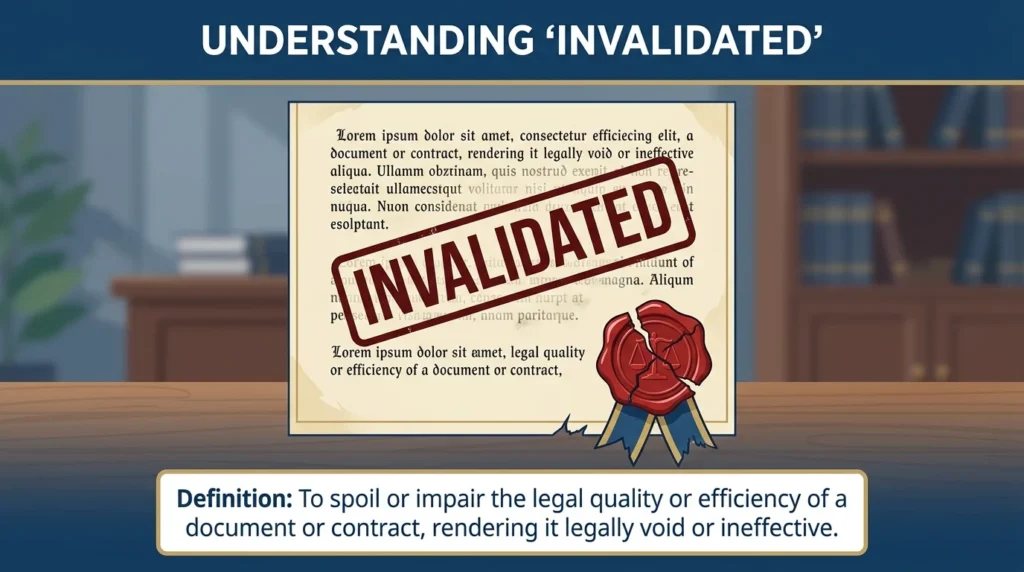
Vitiate (Verb) — US: /ˈvɪʃ.i.eɪt/ | UK: /ˈvɪʃ.i.eɪt/
- Meaning: To spoil or impair the legal quality or efficiency of something.
- Tone/Register: Legal / Formal
- Example 1: Errors in the contract documentation can vitiate the entire agreement.
- Example 2: Fraudulent practices vitiate the fairness of the election process.
Synonyms by Tone
Understanding tone ensures you pick the exact right word for every situation. Consequently, your writing sounds far more natural and appropriate.
Positive Tone
- Tinker: Suggests creative, harmless experimentation with tools or code.
- Play with: Implies lighthearted recreation or artistic exploration.
Neutral Tone
- Interfere: Objective description of getting involved in processes.
- Adjust: Describes altering settings or physical items calmly.
- Disturb: Refers to changing a peaceful state without malice.
Negative Tone
- Tamper: Implies malicious or unauthorized structural alteration.
- Meddle: Expresses annoying, unwelcome nosiness in private matters.
- Harass: Serious term for persistent aggressive intimidation.
Playful / Informal Tone
- Monkey with: Casual expression for tinkering with machinery.
- Fiddle with: Describes nervous or idle hand movements.
Mini Comparison
Mess With vs. Tamper vs. Tinker
| Feature | Mess With | Tamper | Tinker |
| Primary Meaning | Casual or unauthorized interference with people or things. | Malicious or illegal alteration of physical or digital items. | Experimental, casual repairing or adjusting of equipment. |
| Tone | Informal, conversational, caution-oriented. | Formal, legal, serious. | Casual, hobbyist, creative. |
| Best Context | Warnings to children, casual dialogues, general talk. | Security breaches, evidence handling, equipment safety. | Garage hobbies, coding adjustments, mechanical fixes. |
Context-Based Usage
Daily Conversation
In everyday speech, people prefer simple phrasal verbs. Consequently, words like fiddle with, fool with, or mess with sound completely natural when chatting with friends.
Writing or Blogging
Bloggers often need clear action verbs to keep readers engaged. Therefore, replacing repetitive phrases with tinker, interfere, or disrupt makes articles professional.
Professional or Academic Tone
Formal reports and academic papers demand legal and technical precision. As a result, researchers use exact terms like tamper, infringe, or intervene.
Common Mistakes & Native Usage
Common Mistakes Learners Make
- Confusing Mess With with Tinker: A common error is using tinker when describing malicious interference; tinker implies positive experimentation, whereas mess with is often negative.
- Overusing Tamper: Using tamper in casual social chats sounds overly dramatic. Reserve it for security, legal, or equipment contexts.
- Misusing Meddle: Meddle applies strictly to getting involved in other people’s personal private affairs.
Register Notes
In spoken English, native speakers frequently use fiddle with or mess with. In formal written essays or legal documents, terms like tamper, infringe, or intervene elevate your prose significantly.
For further vocabulary growth, exploring related safety description terms adds great depth to your communications.
Real-Life Mini Scenarios
- Workplace: “Engineers warned staff not to tamper with the server room wiring.”
- Social Situations: “Please do not meddle in matters that do not concern you.”
- Media / Pop Culture: “Cybersecurity experts stopped hackers trying to corrupt mainframe files.”
- Writing or Storytelling: “He loved to tinker with broken vintage clocks on rainy afternoons.”
Conclusion
Learning a rich synonym for mess with boosts your communication power instantly. Mastering these varied options enables you to describe interference clearly in any setting today.
Exploring these expressive words helps you replace repetitive, dull phrasing. Consequently, your everyday writing naturally becomes far more precise, engaging, and professional over time.
We encourage you to practice these new verbs across your routine communications. Continuous daily practice builds lasting vocabulary confidence across all areas of your life.
Start using your favorite choice in your next email or essay! Share this free guide with friends to keep expanding your language skills together.
Interactive Practice Quiz
Which formal term describes unauthorized alterations made to secure physical evidence or machinery?
A) Tamper
B) Tinker
C) Play
D) Joke
A hobbyist casually adjusting small gears in an old clock is best described as _____.
A) tinkering
B) hacking
C) harassing
D) trespassing
Getting involved in other people’s private personal business without invitation is called _____.
A) meddling
B) studying
C) relaxing
D) resting
Which professional term refers to stepping into a conflict to prevent a negative outcome?
A) Intervene
B) Ignore
C) Leave
D) Sleep
Nervously touching or turning keys in your pocket while waiting is known as _____.
A) fiddling
B) building
C) painting
D) writing
What is the primary difference between tinker and tamper?
A) Tinker implies harmless, experimental fixing; tamper implies malicious or unauthorized alteration
B) Tinker means sleeping; tamper means running
C) Both words mean legal compliance
D) Tamper is always positive
Which casual phrasal verb means handling or adjusting television remote buttons idly?
A) Fool with
B) Run away
C) Sit down
D) Look out
Unwanted digital access that damages computer files is described as an attempt to _____ data.
A) corrupt
B) polish
C) clean
D) save
Which legal term describes breaking the rules of a formal copyright agreement?
A) Infringe
B) Comply
C) Obey
D) Support
A person who constantly annoys colleagues with persistent minor requests tends to _____ them.
A) pester
B) praise
C) reward
D) thank
Reflection Task
Write one original sentence using the word tinker or interfere to describe a real situation from your workplace or school.
Answer Key:
1: A | 2: A | 3: A | 4: A | 5: A | 6: A | 7: A | 8: A | 9: A | 10: A9: A | 10: A
Frequently Asked Questions
1. What is the most professional synonym for mess with?
The most professional synonym for mess with is tamper or interfere. These terms fit formal safety warnings, technical documentation, and workplace policies.
2. Can mess with be used in positive contexts?
Yes, casual conversations often use variations like tinker with or play with to describe harmless hobbies, code experimentation, or creative recreation.
3. Which synonym for mess with works best for security warnings?
The best term for security contexts is tamper. It clearly warns users against unauthorized physical or digital alterations.
4. How does meddle differ from interfere?
Meddle specifically refers to poking your nose into someone’s personal affairs, whereas interfere broadly covers disrupting any physical process or system.
5. What is a good casual synonym for mess with?
Good casual synonyms include fiddle with or fool with. These phrasal verbs fit naturally into relaxed daily spoken interactions.
6. Can mess with carry legal consequences?
When it shifts toward illegal access or damaging property, legal terms like tamper, infringe, or trespass accurately replace the casual phrase.
7. Why is learning synonyms for mess with useful for writers?
Learning these synonyms helps writers avoid repetitive phrasing, select accurate emotional tones for character dialogue, and write clear safety notices.

Aleesha Rani is a passionate language writer focused on making English vocabulary simple, useful, and engaging. She creates clear content on synonyms, word meanings, and practical language use.
Through vocaneest.com, Aleesha Rani shares original, reader-friendly resources that help students, writers, and English learners choose better words and communicate with confidence.