
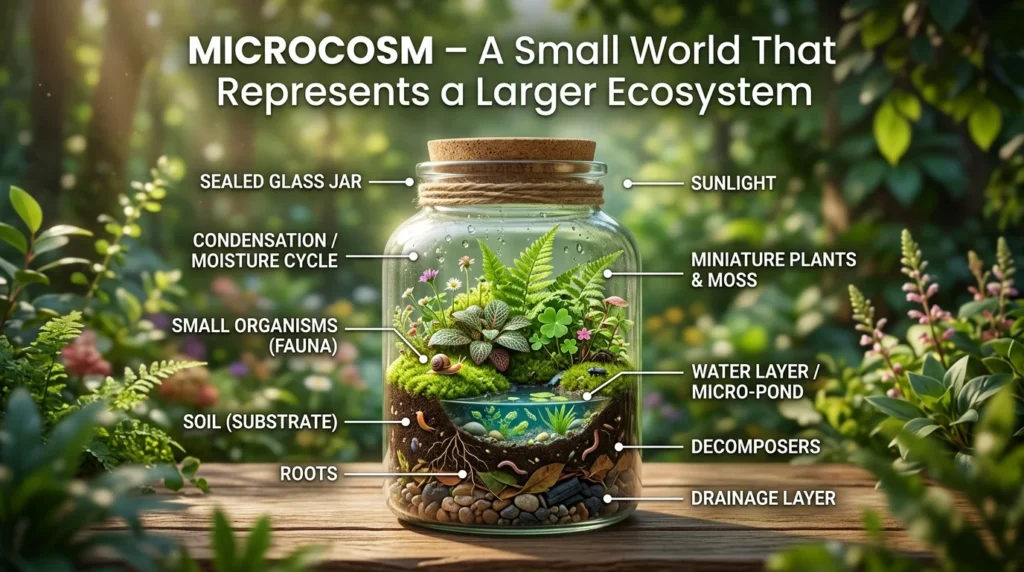
Synonym options for microcosm help writers describe small systems that represent larger worlds or communities accurately.
Imagine trying to explain how a single school cafeteria reflects society, but you keep repeating the exact same abstract noun over and over.
Learning the right synonym for microcosm helps you express miniature representations clearly. Consequently, your daily writing and storytelling become far more precise and engaging.
Finding a natural synonym for microcosm improves vocabulary for students, bloggers, and writers. Mastering these options helps you articulate structural models effortlessly today.
What Does “Microcosm” Really Mean?
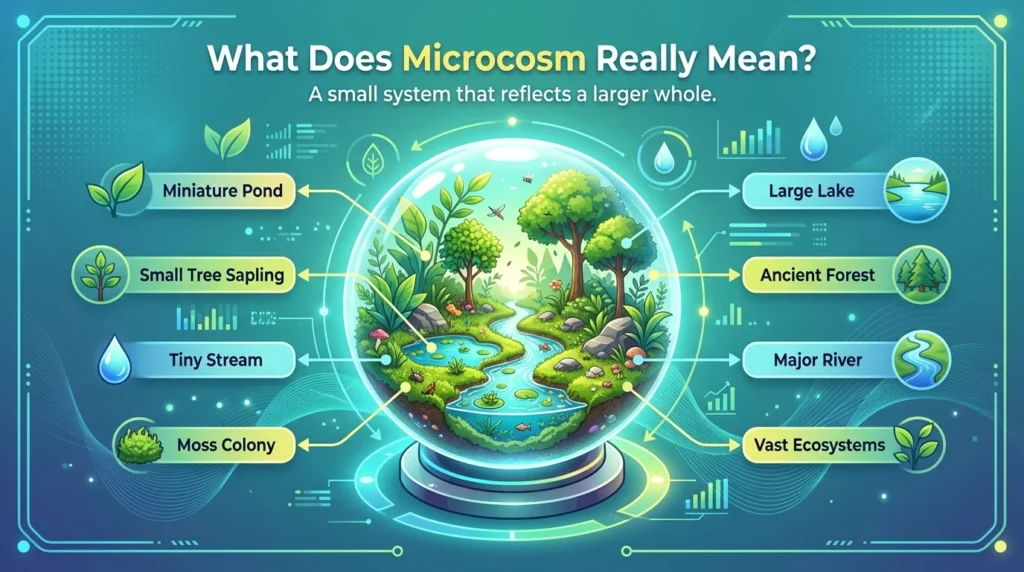
The term microcosm refers to a community, place, or situation that encapsulates in miniature the characteristics of something much larger. It highlights a small-scale reflection of a vast system.
Native speakers view the term as a sophisticated descriptive noun. It appears frequently in sociological essays, literary critiques, cultural analyses, and general intellectual discussions.
- Part of Speech: Noun
- Simple Definition: A small thing that represents a much larger system or world.
Connotative Meaning
(Connotation is the emotional feeling or cultural association that a word carries beyond its literal dictionary definition.)
- Positive tone: Strongly implies intellectual depth, elegant representation, organizational clarity, and insightful observation.
- Negative tone: Can occasionally suggest an isolated bubble, a restricted environment, or a closed-off echo chamber.
- Neutral tone: Describes an objective scaling down of a larger group or structure into a smaller observable format.
Etymology
The term derives from the Greek roots mikros (meaning “small”) and kosmos (meaning “world” or “universe”), entering English via medieval Latin philosophy.
- Old English (450–1100): The specific Greek compound did not exist. People used native descriptive phrases to explain small reflections of creation.
- Middle English (1100–1500): The scholarly Latin term microcosmus entered academic and theological texts to describe humanity as a little world.
- Modern English (1500–Present): The word evolved into microcosm, expanding into general usage for any small system reflecting a broader society.
Pronunciation (US & UK – IPA)
- US: /ˈmaɪ.krəˌkɑːz.əm/
- UK: /ˈmaɪ.krəˌkɒz.əm/
Syllables & Structure
- Syllables: mi-cro-cosm (3 syllables)
- Root: cosm- (from Greek kosmos)
- Prefix: micro- (small)
- Suffix: None (Compound noun stem)
Synonyms List
Epitome (Noun) — US: /ɪˈpɪt.ə.mi/ | UK: /ɪˈpɪt.ə.mi/
- Meaning: A person or thing that is a perfect example of a particular quality or type.
- Tone/Register: Formal / Literary
- Example 1: The historic hotel stood as the epitome of classic elegance.
- Example 2: Her leadership style served as the epitome of modern management.
Miniature (Noun) — US: /ˈmɪn.i.ə.tʃɚ/ | UK: /ˈmɪn.i.ə.tʃə/
- Meaning: A much smaller version or copy of an object or larger system.
- Tone/Register: General / Descriptive
- Example 1: The model railway presented a miniature of the regional landscape.
- Example 2: That lively neighborhood functions like a miniature of the entire city.
Reflection (Noun) — US: /rɪˈflɛk.ʃən/ | UK: /rɪˈflɛk.ʃən/
- Meaning: Something that manifests, embodies, or exhibits the characteristics of a larger entity.
- Tone/Register: General / Academic
- Example 1: The local market served as a clear reflection of changing consumer habits.
- Example 2: Student council debates offered a reflection of broader political divides.
Model (Noun) — US: /ˈmɑː.dəl/ | UK: /ˈmɒ.dəl/
- Meaning: A smaller or simplified representation of a system used to explain how it works.
- Tone/Register: Professional / Academic
- Example 1: Researchers built a working model of the regional economy.
- Example 2: The community center acted as a model for urban renewal projects.
Abstract (Noun) — US: /ˈæb.strækt/ | UK: /ˈæb.strækt/
- Meaning: A summary or concentrated representation of a larger body of work or concept.
- Tone/Register: Academic / Formal
- Example 1: The thesis introduction provided an abstract of the research findings.
- Example 2: Readers appreciated the clear abstract of the complex philosophical text.

Compendium (Noun) — US: /kəmˈpɛn.di.əm/ | UK: /kəmˈpɛn.di.əm/
- Meaning: A collection of concise information or items representing a larger category.
- Tone/Register: Formal / Academic
- Example 1: The library released a useful compendium of local historical records.
- Example 2: Botanists published a compendium detailing regional plant species.
Cross-section (Noun) — US: /ˈkrɔːsˌsɛk.ʃən/ | UK: /ˈkrɒsˌsɛk.ʃən/
- Meaning: A representative sample of a broader population or group.
- Tone/Register: Professional / Analytical
- Example 1: Survey participants represented a true cross-section of the town.
- Example 2: The festival drew a diverse cross-section of regional artists.
Sample (Noun) — US: /ˈsæm.pəl/ | UK: /ˈsɑːm.pəl/
- Meaning: A small part or quantity intended to show what the whole is like.
- Tone/Register: General / Scientific
- Example 1: Scientists analyzed a water sample from the mountain stream.
- Example 2: The gallery displayed a sample of modern ceramic sculptures.
Paradigm (Noun) — US: /ˈpɛr.ə.daɪm/ | UK: /ˈpær.ə.daɪm/
- Meaning: A typical example or pattern of something; a model framework.
- Tone/Register: Academic / Formal
- Example 1: The startup became a paradigm of modern remote-work culture.
- Example 2: Historians studied the economic paradigm of the post-war era.
Prototype (Noun) — US: /ˈproʊ.tə.taɪp/ | UK: /ˈprəʊ.tə.taɪp/
- Meaning: A first or preliminary model of something from which other forms develop.
- Tone/Register: Technical / Professional
- Example 1: Engineers tested the new solar car prototype on the track.
- Example 2: The software team released a prototype for user testing.
Mirror (Noun) — US: /ˈmɪr.ɚ/ | UK: /ˈmɪr.ə/
- Meaning: Something that accurately represents or exhibits the nature of a larger reality.
- Tone/Register: Literary / Expressive
- Example 1: Literature often acts as a mirror reflecting societal values.
- Example 2: The small town served as a mirror for national economic trends.
Miniature (Variant) -> Scale model (Noun) — US: /skeɪl ˈmɑː.dəl/ | UK: /skeɪl ˈmɒ.dəl/
- Meaning: A physical representation constructed accurately to a reduced scale.
- Tone/Register: Technical / Descriptive
- Example 1: Architects built an intricate scale model of the new civic center.
- Example 2: Museum visitors marveled at the historical scale model of the fort.
Specimen (Noun) — US: /ˈspɛs.ə.mən/ | UK: /ˈspɛs.ɪ.mən/
- Meaning: An individual animal, plant, or mineral used as an example of its species.
- Tone/Register: Scientific / Formal
- Example 1: Biologists collected a rare plant specimen during the expedition.
- Example 2: The museum displayed a preserved geological specimen.
Paradigm (Variant) -> Archetype (Noun) — US: /ˈɑːr.kə.taɪp/ | UK: /ˈɑː.kɪ.taɪp/
- Meaning: A very typical example of a certain person or thing.
- Tone/Register: Literary / Formal
- Example 1: The hero character served as an archetype in classic mythology.
- Example 2: Their family home was the archetype of traditional suburban design.
Essence (Noun) — US: /ˈɛs.əns/ | UK: /ˈɛs.əns/
- Meaning: The intrinsic nature or indispensable quality of something abstract.
- Tone/Register: Literary / Philosophical
- Example 1: The essay captured the true essence of urban street culture.
- Example 2: Music can distill the emotional essence of human experience.

Blueprint (Noun) — US: /ˈbluː.prɪnt/ | UK: /ˈbluː.prɪnt/
- Meaning: A design plan or pattern that serves as a guide for larger projects.
- Tone/Register: Professional / Technical
- Example 1: City planners drafted a blueprint for sustainable public transit.
- Example 2: The manual offered a clear blueprint for starting a business.
Quintessence (Noun) — US: /kwɪnˈtɛs.əns/ | UK: /kwɪnˈtɛs.əns/
- Meaning: The most perfect or typical example of a quality or class.
- Tone/Register: Formal / Literary
- Example 1: The vintage roadster was the quintessence of automotive style.
- Example 2: Her graceful speech was the quintessence of diplomacy.
Embodiment (Noun) — US: /ɪmˈbɑːd.i.mənt/ | UK: /ɪmˈbɒd.i.mənt/
- Meaning: A tangible or visible form of an idea, quality, or feeling.
- Tone/Register: Formal / Expressive
- Example 1: The charitable leader was the embodiment of selfless dedication.
- Example 2: The monument stands as an embodiment of national pride.
microcosm (Variant) -> Miniature world (Noun) — US: /ˈmɪn.i.ə.tʃɚ wɜːrld/ | UK: /ˈmɪn.i.ə.tʃə wɜːld/
- Meaning: A self-contained environment representing a larger universe.
- Tone/Register: Descriptive / Literary
- Example 1: The bustling market felt like a miniature world filled with color.
- Example 2: Board games create a miniature world of strategic competition.
Focal point (Noun) — US: /ˈfoʊ.kəl pɔɪnt/ | UK: /ˈfəʊ.kəl pɔɪnt/
- Meaning: The center of interest or activity that draws focus from surrounding areas.
- Tone/Register: Professional / General
- Example 1: The central plaza became the focal point for community festivals.
- Example 2: The fireplace served as the visual focal point of the living room.
Symbol (Noun) — US: /ˈsɪm.bəl/ | UK: /ˈsɪm.bəl/
- Meaning: A mark or character used as a conventional representation of an object.
- Tone/Register: General / Academic
- Example 1: The olive branch acts as an ancient symbol of peace.
- Example 2: The monument stands as a powerful symbol of freedom.
Vignette (Noun) — US: /vɪnˈjɛt/ | UK: /vɪnˈjɛt/
- Meaning: A brief evocative description, account, or episode illustrating a larger theme.
- Tone/Register: Literary / Formal
- Example 1: The novel opened with a charming vignette of rural village life.
- Example 2: Each chapter featured a historical vignette about local inventors.
microcosm (Variant) -> Summary (Noun) — US: /ˈsʌm.ɚ.i/ | UK: /ˈsʌm.ə.ri/
- Meaning: A brief statement or account of the main points of something larger.
- Tone/Register: Professional / Academic
- Example 1: The report concluded with a helpful summary of key findings.
- Example 2: Students wrote a brief summary of the historical text.
microcosm (Variant) -> Sample size (Noun) — US: /ˈsæm.pəl saɪz/ | UK: /ˈsɑːm.pəl saɪz/
- Meaning: The number of units in a population studied to represent the whole.
- Tone/Register: Scientific / Analytical
- Example 1: Researchers needed a larger sample size to verify test results.
- Example 2: Survey designers calculated the optimal sample size for accuracy.
Miniature Society (Noun) — US: /ˈmɪn.i.ə.tʃɚ səˈsaɪ.ə.ti/ | UK: /ˈmɪn.i.ə.tʃə səˈsaɪ.ə.ti/
- Meaning: A small community mirroring the social dynamics of a large nation.
- Tone/Register: Sociological / Formal
- Example 1: The boarding school operated like a miniature society.
- Example 2: Anthropologists studied the island community as a miniature society.

Synonyms by Tone
Understanding tone ensures you pick the exact right word for every situation. Consequently, your writing sounds far more natural and appropriate.
Positive Tone
- Epitome: Highlights perfect excellence and ideal representation.
- Quintessence: Expresses the purest and finest form of a quality.
- Embodiment: Suggests graceful and powerful manifestation of ideas.
Neutral Tone
- Miniature: Objective description of a smaller physical version.
- Cross-section: Analytical representation of a broader population.
- Sample: Factual portion representing a larger total set.
Negative Tone
- Isolation (Contextual): Can hint at an insular bubble or closed ecosystem.
Playful / Informal Tone
- Miniature world: Casual phrase for self-contained hobby environments.
Mini Comparison
Microcosm vs. Epitome vs. Cross-section
| Feature | Microcosm | Epitome | Cross-section |
| Primary Meaning | A small system reflecting a larger world or society. | A perfect, ideal example of a specific quality. | A representative sample taken from a broader population. |
| Tone | Intellectual, sociological, descriptive. | Formal, admiring, literary. | Analytical, statistical, professional. |
| Best Context | Social commentary, cultural studies, literature. | Fashion reviews, character descriptions, ideals. | Surveys, demographic studies, interviews. |
Context-Based Usage
Daily Conversation
In everyday speech, people prefer simple terms. Consequently, words like miniature, model, or reflection sound completely natural when chatting with friends.
Writing or Blogging
Bloggers often need sophisticated vocabulary to explore abstract themes. Therefore, replacing repetitive terms with epitome, vignette, or mirror makes articles compelling.
Professional or Academic Tone
Formal reports and academic papers demand analytical precision. As a result, researchers use exact terms like cross-section, paradigm, or compendium.
Common Mistakes & Native Usage
Common Mistakes Learners Make
- Confusing Microcosm with Macrocosm: A common error is mixing up the prefixes; macrocosm means the large universe, whereas microcosm means the small representation.
- Overusing Epitome: Using epitome for general physical models sounds incorrect. Reserve it for ideal conceptual examples.
- Misusing Specimen: Specimen applies strictly to biological or scientific items, not social systems.
Register Notes
In spoken English, native speakers frequently use reflection or miniature. In formal written essays or sociology papers, terms like paradigm, quintessence, or cross-section elevate your prose significantly.
For further vocabulary growth, exploring related structural description terms adds great depth to your communications.
Real-Life Mini Scenarios
- Workplace: “The team used the software pilot as a model for the nationwide rollout.”
- Social Situations: “The neighborhood street fair felt like a vibrant reflection of the entire city’s diversity.”
- Media / Pop Culture: “Critics praised the television series as a brilliant microcosm of modern corporate politics.”
- Writing or Storytelling: “The opening chapter provided a vivid vignette of life in the 19th-century port town.”
Conclusion
Learning a rich synonym for microcosm boosts your communication power instantly. Mastering these varied options enables you to describe scaled systems clearly in any setting today.
Exploring these expressive words helps you replace repetitive, dull phrasing. Consequently, your everyday writing naturally becomes far more precise, engaging, and professional over time.
We encourage you to practice these new nouns across your routine communications. Continuous daily practice builds lasting vocabulary confidence across all areas of your life.
Start using your favorite choice in your next email or essay! Share this free guide with friends to keep expanding your language skills together.
Interactive Practice Quiz
Test your vocabulary knowledge by picking the best word for each real-life scenario below.
- Which formal term describes a person or thing that serves as a perfect, ideal example of a quality?
- A) Epitome
- B) Blueprint
- C) Vignette
- D) Specimen
- A small physical model that accurately scales down a larger building or landscape is called a _____.
- A) miniature
- B) compendium
- C) paradigm
- D) symbol
- A diverse group of survey participants chosen to represent an entire town is known as a _____ of the population.
- A) cross-section
- B) sample size
- C) mirror
- D) abstract
- Which professional term refers to a preliminary working model used by engineers for testing?
- A) Prototype
- B) Summary
- C) Epitome
- D) Essence
- A brief evocative description or short scene in a novel that illustrates a larger theme is a _____.
- A) vignette
- B) specimen
- C) compendium
- D) blueprint
- What is the primary difference between microcosm and epitome?
- A) Microcosm reflects a larger system in miniature; epitome represents a perfect ideal example
- B) Microcosm means a large universe; epitome means a physical tool
- C) Both words refer exclusively to chemical elements
- D) Epitome is always a physical machine
- Which formal term describes the purest and most concentrated form of a quality?
- A) Quintessence
- B) Blueprint
- C) Model
- D) Vignette
- A detailed design plan that serves as a guide for constructing a large project is a _____.
- A) blueprint
- B) vignette
- C) mirror
- D) sample
Answer Key:
1: A | 2: A | 3: A | 4: A | 5: A | 6: A | 7: A | 8: A |
Frequently Asked Questions
1. What is the most formal synonym for microcosm?
The most formal synonyms for microcosm are epitome, quintessence, and paradigm. These terms fit academic essays, philosophical texts, and literary reviews.
2. Can microcosm be used to describe people?
While microcosm refers primarily to systems or places, related terms like epitome or embodiment work exceptionally well when describing individuals who represent broader qualities.
3. Which synonym for microcosm works best for statistical surveys?
The best term for statistical and demographic studies is cross-section or sample. They accurately denote representative portions of larger populations.
4. How does microcosm differ from macrocosm?
Microcosm represents a small system reflecting a larger world, whereas macrocosm refers to the entire complex universe or system itself.
5. What is a good casual synonym for microcosm?
Good casual synonyms include miniature, model, or reflection. These words fit naturally into everyday spoken conversations.
6. Can microcosm refer to physical objects?
Yes, physical models like scale architectural displays can function as a physical microcosm of planned urban environments.
7. Why is learning synonyms for microcosm useful for writers?
Learning these synonyms helps writers avoid repetitive phrasing, add intellectual depth to descriptions, and communicate complex structural relationships with absolute precision.

Aleesha Rani is a passionate language writer focused on making English vocabulary simple, useful, and engaging. She creates clear content on synonyms, word meanings, and practical language use.
Through vocaneest.com, Aleesha Rani shares original, reader-friendly resources that help students, writers, and English learners choose better words and communicate with confidence.