
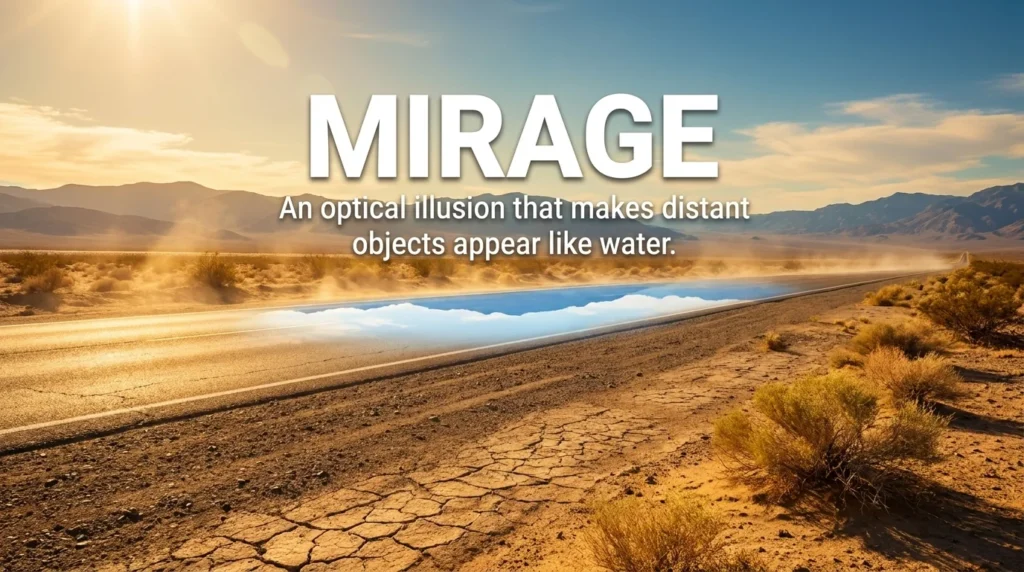
Synonym for mirage help writers describe optical illusions, deceptive appearances, or fleeting dreams accurately.
Imagine driving down a hot highway and seeing a shimmering pool of water that vanishes when you get close.
Learning the right synonym for mirage helps you express optical illusions or false hopes clearly. Consequently, your daily writing and storytelling become far more precise and engaging.
Finding a natural synonym for mirage improves vocabulary for students, bloggers, and writers. Mastering these options helps you articulate optical and figurative deceptions effortlessly today.
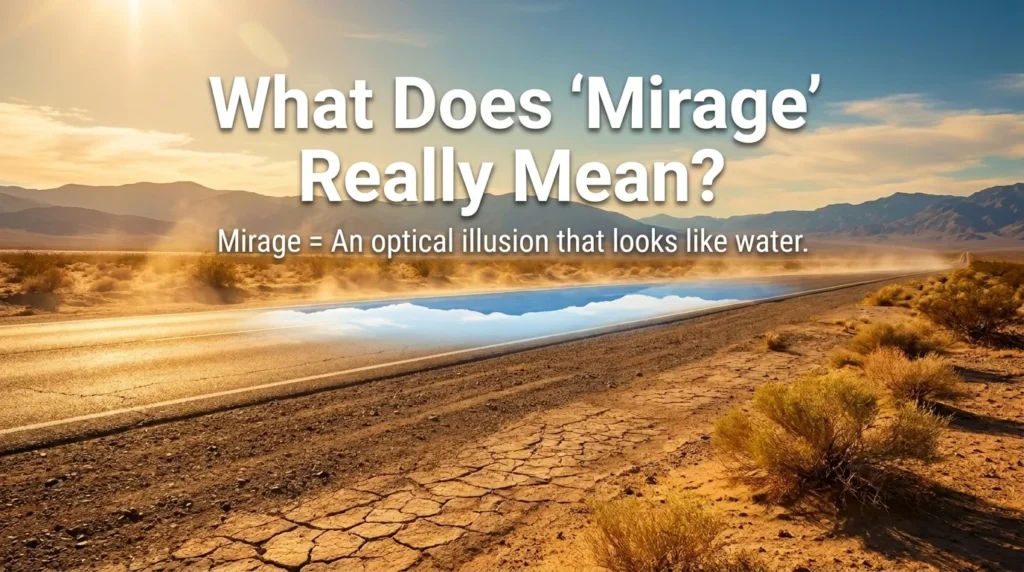
What Does “Mirage” Really Mean?
The term mirage refers to an optical illusion caused by atmospheric conditions, typically creating the appearance of a pool of water in a desert or on a hot road. It also metaphorically describes a false hope or unachievable dream.
Native speakers view the term as a striking descriptive noun. It appears frequently in travel writing, weather science, poetry, and psychological discussions.
- Part of Speech: Noun
- Simple Definition: An optical illusion of water caused by light refraction, or a false dream.
Connotative Meaning
(Connotation is the emotional feeling or cultural association that a word carries beyond its literal dictionary definition.)
- Positive tone: Can evoke imaginative wonder, creative fantasy, artistic inspiration, or magical desert landscapes.
- Negative tone: Strongly implies deception, disappointment, trickery, delusion, frustration, and fleeting false hope.
- Neutral tone: Describes objective scientific atmospheric phenomena or light refraction physics accurately.
Etymology
The term derives from French mirage, originating from the Latin verb mirari meaning to wonder at or look at with amazement.
- Old English (450–1100): The concept did not exist in early Germanic dialects; native speakers used descriptive phrases for heat haze.
- Middle English (1100–1500): The root Latin concepts traveled through Old French, paving the way for later visual science terms.
- Modern English (1500–Present): The exact word mirage entered English usage around the late eighteenth century to describe desert illusions.
Pronunciation (US & UK – IPA)
- US: /məˈrɑːʒ/
- UK: /ˈmɪr.ɑːʒ/
Syllables & Structure
- Syllables: mi-rage (2 syllables)
- Root: mirage (from Latin mirari)
- Prefix: None
- Suffix: None
Synonyms List
Phantasmagoria (Noun) — US: /ˌfæn.tæz.məˈɡɔːr.i.ə/ | UK: /ˌfæn.tɪz.məˈɡɔː.ri.ə/
- Meaning: A shifting sequence of complex optical illusions or bizarre images.
- Tone/Register: Literary / Formal
- Example 1: The desert heat created a shifting phantasmagoria of distant lakes.
- Example 2: Surrealist paintings often resemble a waking phantasmagoria.
Specter (Noun) — US: /ˈspɛk.tɚ/ | UK: /ˈspɛk.tə/
- Meaning: A ghost or a haunting, unsettling image lingering in the mind.
- Tone/Register: Literary / Formal
- Example 1: The persistent specter of failure haunted his career ambitions.
- Example 2: Travelers glimpsed a looming specter of fog across the moor.
Visionary flash (Noun) — US: /ˈvɪʒ.ə.nɛr.i flæʃ/ | UK: /ˈvɪʒ.ən.r̩i flæʃ/
- Meaning: A sudden, brilliant, but fleeting mental image or insight.
- Tone/Register: Descriptive / Literary
- Example 1: The artist experienced a visionary flash of color during the storm.
- Example 2: A brief visionary flash interrupted her long afternoon reverie.
Falsity (Noun) — US: /ˈfɑːl.sə.ti/ | UK: /ˈfɒl.sə.ti/
- Meaning: The quality of being untrue, deceptive, or illusory.
- Tone/Register: Formal / Philosophical
- Example 1: Detectives quickly exposed the sheer falsity of the alibi.
- Example 2: Philosophers debated the underlying falsity of the sensory data.
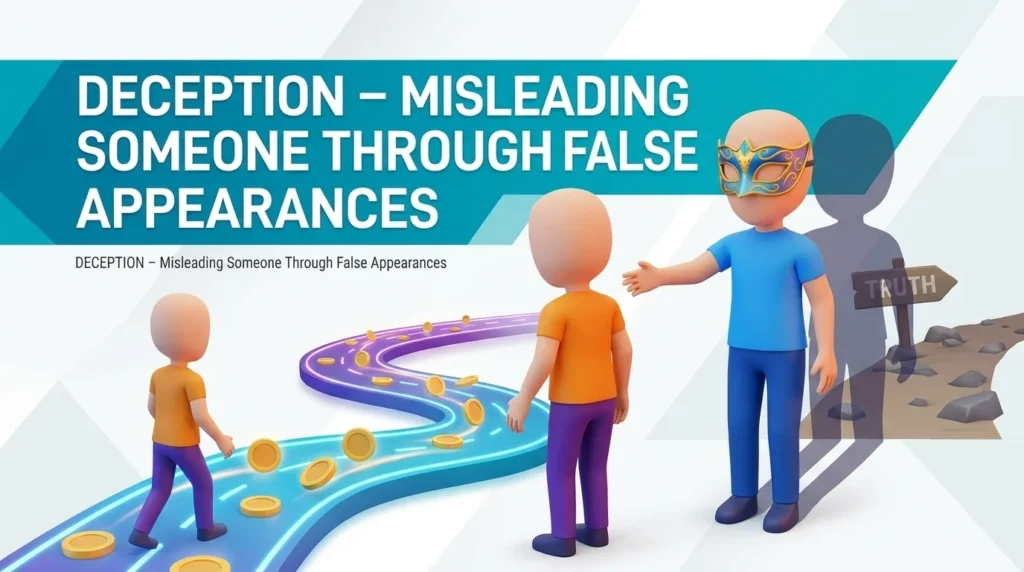
Deception (Noun) — US: /dɪˈsɛp.ʃən/ | UK: /dɪˈsɛp.ʃən/
- Meaning: The act of misleading someone through false appearances.
- Tone/Register: General / Formal
- Example 1: The merchant’s clever trickery amounted to absolute deception.
- Example 2: Optical tricks rely on visual deception to fool viewers.
Trick of the light (Noun phrase) — US: /ˈtrɪk əv ðə laɪt/ | UK: /ˈtrɪk əv ðə laɪt/
- Meaning: A visual misinterpretation caused by unusual lighting or shadows.
- Tone/Register: Conversational / Idiomatic
- Example 1: What looked like a ghost was just a harmless trick of the light.
- Example 2: She realized the strange shadow on the wall was a trick of the light.
Optical trickery (Noun phrase) — US: /ˈɑːp.tɪ.kəl ˈtrɪk.ər.i/ | UK: /ˈɒp.tɪ.kəl ˈtrɪk.ər.i/
- Meaning: Clever manipulation of visual elements to deceive the eye.
- Tone/Register: Technical / Descriptive
- Example 1: Stage performers specialize in elaborate optical trickery.
- Example 2: The desert landscape creates natural optical trickery at noon.
Visual deceit (Noun phrase) — US: /ˈvɪʒ.u.əl dɪˈsiːt/ | UK: /ˈvɪʒ.u.əl dɪˈsiːt/
- Meaning: Something that misleads or tricks visual perception.
- Tone/Register: Formal / Descriptive
- Example 1: Camouflage in nature relies entirely on visual deceit.
- Example 2: The shimmering road surface was an impressive piece of visual deceit.
Atmospheric illusion (Noun phrase) — US: /ˌæt.məsˈfɪr.ɪk ɪˈluː.ʒən/ | UK: /ˌæt.məsˈfɪə.rɪk ɪˈluː.ʒən/
- Meaning: An optical phenomenon produced by atmospheric refraction.
- Tone/Register: Scientific / Technical
- Example 1: Scientists categorized the desert phenomenon as a standard atmospheric illusion.
- Example 2: Sailors photographed an eerie atmospheric illusion over the ocean.
Superior mirage (Noun phrase) — US: /səˈpɪr.i.ɚ məˈrɑːʒ/ | UK: /suːˈpɪə.ri.ə mɪˈrɑːʒ/
- Meaning: A specific mirage where images appear elevated above the true horizon.
- Tone/Register: Scientific / Meteorological
- Example 1: The cold polar air produced a sharp superior mirage of distant icebergs.
- Example 2: Meteorologists tracked the superior mirage across the flat plain.
Inferior mirage (Noun phrase) — US: /ɪnˈfɪr.i.ɚ məˈrɑːʒ/ | UK: /ɪnˈfɪə.ri.ə mɪˈrɑːʒ/
- Meaning: A mirage where objects appear displaced downward, resembling water pools.
- Tone/Register: Scientific / Meteorological
- Example 1: Drivers frequently encounter an inferior mirage on sun-baked highways.
- Example 2: The hot desert floor generated a shimmering inferior mirage.
Fata morgana effect (Noun phrase) — US: /ˈfɑː.tə mɔːrˈɡɑː.nə ɪˈfɛkt/ | UK: /ˈfɑː.tə mɔːˈɡɑː.nə ɪˈfɛkt/
- Meaning: An optical phenomenon involving multiple distorted image layers.
- Tone/Register: Technical / Scientific
- Example 1: The coastal city looked distorted due to the fata morgana effect.
- Example 2: Observers studied the complex fata morgana effect over the bay.
Heat haze (Noun) — US: /ˈhiːt heɪz/ | UK: /ˈhiːt heɪz/
- Meaning: A shimmering blur in the air caused by hot air currents rising.
- Tone/Register: Descriptive / Conversational
- Example 1: Distant cars vanished behind a shimmering heat haze.
- Example 2: Athletes struggled to run through the intense midday heat haze.
Shimmer (Noun) — US: /ˈʃɪm.ɚ/ | UK: /ˈʃɪm.ə/
- Meaning: A soft, wavering light or a trembling optical distortion.
- Tone/Register: Descriptive / Literary
- Example 1: A golden shimmer rose from the hot desert sands.
- Example 2: Stars lost their sharp focus behind an atmospheric shimmer.
Glimmer (Noun) — US: /ˈɡlɪm.ɚ/ | UK: /ˈɡlɪm.ə/
- Meaning: A faint or unsteady gleam of light.
- Tone/Register: Literary / General
- Example 1: They held onto a tiny glimmer of hope during the crisis.
- Example 2: A distant glimmer of light signaled the end of the trail.
Glint (Noun) — US: /ɡlɪnt/ | UK: /ɡlɪnt/
- Meaning: A small flash of bright light reflected from a surface.
- Tone/Register: Descriptive / General
- Example 1: The detective noticed a sharp glint of metal in the grass.
- Example 2: Sunsets create a bright glint across ocean waves.
Glaze (Noun) — US: /ɡleɪz/ | UK: /ɡleɪz/
- Meaning: A thin, smooth coating or a glassy optical sheen.
- Tone/Register: Technical / Descriptive
- Example 1: Early morning frost left a slippery glaze across the road.
- Example 2: Ceramic pottery featured a smooth, reflective glaze.
Shroud of illusion (Noun phrase) — US: /ʃraʊd əv ɪˈluː.ʒən/ | UK: /ʃraʊd əv ɪˈluː.ʒən/
- Meaning: A concealing layer of false appearances.
- Tone/Register: Literary / Poetic
- Example 1: Propaganda created a thick shroud of illusion around the regime.
- Example 2: She tried to pierce through the shroud of illusion clouding her judgment.
Web of deceit (Noun phrase) — US: /wɛb əv dɪˈsiːt/ | UK: /wɛb əv dɪˈsiːt/
- Meaning: A complex system of lies and false impressions.
- Tone/Register: Literary / Idiomatic
- Example 1: The criminal enterprise unraveled as investigators exposed their web of deceit.
- Example 2: Political scandals often involve a tangled web of deceit.
Smoke and mirrors (Noun phrase) — US: /smoʊk ənd ˈmɪr.ɚz/ | UK: /sməʊk ənd ˈmɪr.əz/
- Meaning: Obfuscation, or a deceptive, fraudulent presentation of facts.
- Tone/Register: Idiomatic / Conversational
- Example 1: Critics dismissed the new corporate strategy as mere smoke and mirrors.
- Example 2: Campaign promises often felt like political smoke and mirrors.
Hollow promise (Noun phrase) — US: /ˈhɑː.loʊ ˈprɑː.mɪs/ | UK: /ˈhɒ.ləʊ ˈprɒ.mɪs/
- Meaning: An insincere commitment that will not be fulfilled.
- Tone/Register: Conversational / General
- Example 1: Investors realized the guaranteed returns were just a hollow promise.
- Example 2: Politicians often make hollow promise statements during elections.
Empty dream (Noun phrase) — US: /ˈɛmp.ti driːm/ | UK: /ˈɛmp.ti driːm/
- Meaning: An aspiration lacking any realistic chance of success.
- Tone/Register: Literary / General
- Example 1: Chasing sudden overnight fortune proved to be an empty dream.
- Example 2: He abandoned his empty dream of becoming a rock star.
Vain hope (Noun phrase) — US: /veɪn hoʊp/ | UK: /veɪn həʊp/
- Meaning: A useless or unproductive expectation.
- Tone/Register: Formal / Literary
- Example 1: She waited in vain hope that the train would arrive early.
- Example 2: Rescuers searched in vain hope despite the worsening storm.
False dawn (Noun) — US: /fɑːls dɔːn/ | UK: /fɒls dɔːn/
- Meaning: A premature brightening of the eastern sky before sunrise, or false success.
- Tone/Register: Literary / Metaphorical
- Example 1: The stock market recovery turned out to be a deceptive false dawn.
- Example 2: Early morning hikers mistook the planetary glow for a false dawn.
Ignis fatuus variant -> False light (Noun phrase) — US: /fɑːls laɪt/ | UK: /fɒls laɪt/
- Meaning: A misleading illumination or deceptive guidance.
- Tone/Register: Literary / Metaphorical
- Example 1: Following unverified market tips was like chasing a false light.
- Example 2: Sailors avoided the treacherous coastline signaled by the false light.
Wandering fire (Noun phrase) — US: /ˈwɑːn.dɚ.ɪŋ ˈfaɪ.ɚ/ | UK: /ˈwɒn.dər.ɪŋ ˈfaɪ.ə/
- Meaning: A poetic term for an elusive or deceptive light source.
- Tone/Register: Poetic / Literary
- Example 1: Folklore warned travelers against following the wandering fire in the marsh.
- Example 2: Youthful ambitions sometimes resemble a bright wandering fire.
Ghost light (Noun) — US: /ɡoʊst laɪt/ | UK: /ɡəʊst laɪt/
- Meaning: A single bulb left burning on a dark theater stage, or an eerie light.
- Tone/Register: Theatrical / Descriptive
- Example 1: A solitary ghost light illuminated the empty auditorium.
- Example 2: Actors whispered superstitions about the stage ghost light.
Optical Illusion (Noun phrase) — US: /ˈɑːp.tɪ.kəl ɪˈluː.ʒən/ | UK: /ˈɒp.tɪ.kəl ɪˈluː.ʒən/
- Meaning: Something that deceives the eye by appearing other than it is.
- Tone/Register: Scientific / General
- Example 1: The crooked lines in the painting were just a clever optical illusion.
- Example 2: Stage magicians rely heavily on physics and optical illusions to baffle audiences.
Optical Phenomenon (Noun phrase) — US: /ˈɑːp.tɪ.kəl fəˈnɑː.mə.nən/ | UK: /ˈɒp.tɪ.kəl fəˈnɒ.mɪ.nən/
- Meaning: Any observable event that results from the interaction of light and matter.
- Tone/Register: Scientific / Technical
- Example 1: A double rainbow is a stunning optical phenomenon visible after heavy rain.
- Example 2: Students studied how lenses bend light to create this unique optical phenomenon.
Atmospheric Refraction (Noun phrase) — US: /ˌæt.məsˈfɪr.ɪk rɪˈfræk.ʃən/ | UK: /ˌæt.məsˈfɪər.ɪk rɪˈfræk.ʃən/
- Meaning: The bending of light rays as they pass through air layers of different temperatures and densities.
- Tone/Register: Scientific / Technical
- Example 1: Sunset colors are intensified by atmospheric refraction bending the fading light.
- Example 2: Navigation errors can occur if atmospheric refraction distorts star positions.
Phantom Reflection (Noun phrase) — US: /ˈfæn.təm rɪˈflɛk.ʃən/ | UK: /ˈfæn.təm rɪˈflɛk.ʃən/
- Meaning: An illusory duplicate or mirror image caused by tricky lighting conditions.
- Tone/Register: Descriptive / Technical
- Example 1: The window glass created a phantom reflection of the desk lamp inside the room.
- Example 2: Photographers adjusted their polarizing filters to eliminate annoying phantom reflections.
Spectral Illusion (Noun phrase) — US: /ˈspɛk.trəl ɪˈluː.ʒən/ | UK: /ˈspɛk.trəl ɪˈluː.ʒən/
- Meaning: An eerie, ghost-like visual trick or light distortion.
- Tone/Register: Literary / Descriptive
- Example 1: Fog rolling across the moor created a spectral illusion of towering figures.
- Example 2: The stage lighting produced a spectral illusion that danced above the musicians.
Cognitive Mirage (Noun phrase) — US: /ˈkɑːɡ.nə.tɪv mɪˈrɑːʒ/ | UK: /ˈkɒɡ.nə.tɪv mɪˈrɑːʒ/
- Meaning: A flawed mental perception where an outcome appears certain when it is actually impossible.
- Tone/Register: Psychological / Formal
- Example 1: Analysts warned investors about falling for the cognitive mirage of guaranteed returns.
- Example 2: Confirmation bias often creates a cognitive mirage that distorts objective data.
Daydream (Noun) — US: /ˈdeɪˌdriːm/ | UK: /ˈdeɪˌdriːm/
- Meaning: A series of pleasant thoughts that distract one’s attention from the present reality.
- Tone/Register: Conversational / General
- Example 1: He lost track of time during an afternoon daydream about tropical beaches.
- Example 2: Teachers gently brought distracted students back from their mid-morning daydreams.
Pipe dream (Noun phrase) — US: /ˈpaɪp ˌdriːm/ | UK: /ˈpaɪp ˌdriːm/
- Meaning: An unrealistic hope, fantasy, or plan that is practically impossible to achieve.
- Tone/Register: Conversational / Idiomatic
- Example 1: Building a luxury mansion on a starting salary felt like a distant pipe dream.
- Example 2: Investors dismissed the founder’s overnight wealth projections as an impractical pipe dream.
Fata Morgana (Noun) — US: /ˌfɑː.tə mɔːrˈɡɑː.nə/ | UK: /ˌfɑː.tə mɔːˈɡɑː.nə/
- Meaning: A complex form of superior mirage that creates distorted, towering images of objects on the horizon.
- Tone/Register: Scientific / Literary
- Example 1: Desert travelers mistook the shimmering Fata Morgana for a towering mountain range.
- Example 2: Coastal residents marveled as a distant cargo ship appeared suspended in the sky via a Fata Morgana.
Atmospheric refraction (Noun phrase) — US: /ˌæt.məsˈfɪr.ɪk rɪˈfræk.ʃən/ | UK: /ˌæt.məsˈfɪə.rɪk rɪˈfræk.ʃən/
- Meaning: The bending of light rays as they pass through air layers of different temperatures.
- Tone/Register: Scientific / Technical
- Example 1: Atmospheric refraction causes stars to twinkle and creates desert mirages.
- Example 2: Scientists calculated the exact degree of atmospheric refraction for the experiment.
Thermal refraction (Noun phrase) — US: /ˈθɜːr.məl rɪˈfræk.ʃən/ | UK: /ˈθɜː.məl rɪˈfræk.ʃən/
- Meaning: Light bending driven by temperature differences in media.
- Tone/Register: Scientific / Technical
- Example 1: Thermal refraction over the hot pavement created fake water pools.
- Example 2: Students analyzed thermal refraction patterns in a physics lab.
Light bending (Noun phrase) — US: /laɪt ˈbɛn.dɪŋ/ | UK: /laɪt ˈbɛn.dɪŋ/
- Meaning: The physical deviation of light rays passing through varying densities.
- Tone/Register: Descriptive / Scientific
- Example 1: Light bending through hot air produces classic optical illusions.
- Example 2: Lenses and warm air layers both cause visible light bending.
Ray bending (Noun phrase) — US: /reɪ ˈbɛn.dɪŋ/ | UK: /reɪ ˈbɛn.dɪŋ/
- Meaning: The curved path light takes through uneven refractive indices.
- Tone/Register: Technical / Scientific
- Example 1: Ray bending accounts for seeing sunset after it has dipped below the horizon.
- Example 2: Atmospheric ray bending creates distorted horizon images.
Optical illusion (Noun) — US: /ˈɑːp.tɪk ɪˈluː.ʒən/ | UK: /ˈɒp.tɪk ɪˈluː.ʒən/
- Meaning: Something that deceives the eye by appearing different from reality.
- Tone/Register: General / Descriptive
- Example 1: Geometric drawings often function as a clever optical illusion.
- Example 2: The desert pool of water was an accidental optical illusion.
Visual trick (Noun phrase) — US: /ˈvɪʒ.u.əl trɪk/ | UK: /ˈvɪʒ.u.əl trɪk/
- Meaning: An arrangement or phenomenon fooling visual perception.
- Tone/Register: Conversational / General
- Example 1: Painters use perspective lines as a visual trick to add depth.
- Example 2: The wavy road reflection was just a natural visual trick.
Synonyms by Tone
Understanding tone ensures you pick the exact right word for every situation. Consequently, your writing sounds far more natural and appropriate.
Positive Tone
- Vision: Evokes creative inspiration and imaginative foresight.
- Reverie: Conveys peaceful, pleasant mental reflection.
Neutral Tone
- Illusion: Objective term for misleading sensory input.
- Heat shimmer: Scientific description of air distortion.
- Optical distortion: Technical term for physics anomalies.
Negative Tone
- Delusion: Strongly implies unhealthy psychological false beliefs.
- Pipe dream: Dismisses unachievable plans with frustration.
- Chimera: Denotes monstrously unreachable deceptions.
Playful / Informal Tone
- Daydream: Casual term for harmless mental wandering.
Mini Comparison
Mirage vs. Illusion vs. Chimera
| Feature | Mirage | Illusion | Chimera |
| Primary Meaning | Atmospheric optical illusion of water caused by heat. | Anything that deceives the mind or senses. | An unrealistic hope, illusion, or fire-breathing monster. |
| Tone | Scientific, geographical, visual. | General, psychological, broad. | Literary, mythological, unattainable. |
| Best Context | Desert travel, hot weather physics descriptions. | Magic tricks, sensory misinterpretations, cognitive errors. | Fanciful ambitions, literary critiques, impossible goals. |
Context-Based Usage
Daily Conversation
In everyday speech, people prefer simple terms. Consequently, words like daydream, illusion, or pipe dream sound completely natural when chatting with friends.
Writing or Blogging
Bloggers often need vivid descriptions to capture reader attention. Therefore, replacing repetitive terms with phantasm, chimera, or will-o’-the-wisp makes articles compelling.
Professional or Academic Tone
Formal reports and academic papers demand analytical precision. As a result, researchers use exact terms like optical distortion, delusion, or hallucination.
Common Mistakes & Native Usage
Common Mistakes Learners Make
- Confusing Mirage with Hallucination: A common error is using hallucination for a physical desert heat haze; actual mirages are objective physical events, whereas hallucinations occur inside the mind.
- Overusing Chimera: Using mythological terms like chimera for simple optical tricks sounds overly dramatic. Reserve it for conceptual illusions.
- Misusing Will-o’-the-wisp: Will-o’-the-wisp applies to deceptive lights or elusive goals, not physical desert water pools.
Register Notes
In spoken English, native speakers frequently use illusion or daydream. In formal written essays or scientific texts, terms like phantasm, fata morgana, or optical distortion elevate your prose significantly.
For further vocabulary growth, exploring related atmospheric description terms adds great depth to your communications.
Real-Life Mini Scenarios
- Workplace: “The executive board dismissed the unrealistic financial forecast as a dangerous corporate pipe dream.”
- Social Situations: “The sudden desert heat created a vivid heat shimmer along the distant highway lanes.”
- Media / Pop Culture: “Fantasy novels frequently utilize the ancient concept of a magical phantasm.”
- Writing or Storytelling: “The weary traveler mistook the shimmering desert road for a cool river mirage.”
Conclusion
Learning a rich synonym for mirage boosts your communication power instantly. Mastering these varied options enables you to describe optical illusions and false hopes clearly today.
Exploring these expressive words helps you replace repetitive, dull phrasing. Consequently, your everyday writing naturally becomes far more precise, engaging, and professional over time.
We encourage you to practice these new nouns across your routine communications. Continuous daily practice builds lasting vocabulary confidence across all areas of your life.
Start using your favorite choice in your next email or essay! Share this free guide with friends to keep expanding your language skills together.
Interactive Practice Quiz
Test your vocabulary knowledge by picking the best word for each real-life scenario below.
- Which scientific term describes an optical illusion caused by atmospheric refraction, like water on a hot road?
- A) Mirage
- B) Chimera
- C) Reverie
- D) Phantasm
- A false idea, belief, or sensory misinterpretation is broadly termed an _____.
- A) illusion
- B) ordnance
- C) colliery
- D) adit
- An unattainable, fanciful plan or hope that cannot possibly succeed is commonly called a _____.
- A) pipe dream
- B) shaft
- C) quarry
- D) lode
- Which literary term refers to a figment of the imagination or a ghostly phantom appearance?
- A) Phantasm
- B) Deposit
- C) Asset
- D) Trench
- A complex form of superior mirage visible right above the horizon is known scientifically as a _____.A) fata morgana
- B) colliery
- C) winze
- D) stope
- What is the primary difference between a mirage and a hallucination?
- A) A mirage is an objective physical optical phenomenon caused by light refraction; a hallucination is a psychological perception inside the mind
- B) A mirage only occurs underwater; a hallucination only occurs in deserts
- C) Both words refer exclusively to building foundations
- D) A hallucination is a type of mechanical mining tool
- A persistent false belief maintained despite contradictory evidence is classified as a psychological _____.
- A) delusion
- B) daydream
- C) haze
- D) seam
- A trembling optical distortion of air caused by heat rising from surfaces is called a _____.
- A) heat shimmer
- B) headframe
- C) hoist
- D) claim
- Which mythological and literary term describes a wildly unattainable hope or illusion?
- A) Chimera
- B) Cut
- C) Pit
- D) Tailings
- A state of being pleasantly lost in one’s daytime thoughts is known as a _____.
- A) reverie
- B) slag heap
- C) adit
- D) drift
Reflection Task
Write one original sentence using the word illusion or pipe dream to describe a real situation from your workplace or school.
Answer Key:
1: A | 2: A | 3: A | 4: A | 5: A | 6: A | 7: A | 8: A | 9: A | 10: A
Frequently Asked Questions
1. What is the difference between a mirage and a hallucination?
A mirage is an objective physical phenomenon created by light refracting through layers of warm and cool air. A hallucination, however, is a psychological perception generated entirely within an individual’s mind without any external physical stimulus.
2. Can a mirage be photographed?
Yes, because a mirage is caused by actual light bending through atmospheric temperature gradients, cameras and optical sensors can capture photographs of a mirage just like human eyes.
3. What is a fata morgana?
A fata morgana is an unusually complex and dramatic superior mirage. It frequently occurs over cold water surfaces, making distant objects like ships or coastlines appear elevated, stretched, or resembling floating castles.
4. Which synonym for mirage works best for unattainable goals?
For goals or plans that seem completely impossible to achieve, terms like pipe dream, chimera, or will-o’-the-wisp capture that sense of elusive deception perfectly.
5. How does a heat shimmer differ from a mirage?
A heat shimmer is a general visual waviness in air caused by rising thermal currents. A mirage is a specific optical illusion that projects distinct displaced images, such as reflecting the sky onto a road as water.
6. Can mirages occur in cold regions?
Yes, superior mirages frequently occur in polar regions or over cold ocean waters where cold air sits below warmer air layers, bending light downward to make objects appear floating above the horizon.
7. Why is learning synonyms for mirage useful for writers?
Learning these varied synonyms helps writers avoid repetitive vocabulary, choose exact scientific or literary terms for optical phenomena, and enrich descriptions of illusions and false hopes.

Aqsa Rani is the founder and lead writer at VocaNeest.com, a trusted platform dedicated to helping people improve their English vocabulary and communication skills. She creates well-researched, accurate, and easy-to-understand content covering synonyms, antonyms, word meanings, idioms, phrases, and everyday vocabulary. Her goal is to make learning English simple, practical, and accessible for students, writers, professionals, and lifelong learners.
At VocaNeest.com, every article is carefully researched, fact-checked, and written with a strong focus on accuracy, clarity, and real-world usage. Content is regularly reviewed and updated to ensure it remains helpful, relevant, and aligned with modern language standards. Through reliable vocabulary guides and practical examples, Aqsa aims to help readers write with confidence, expand their vocabulary, and communicate more effectively.