
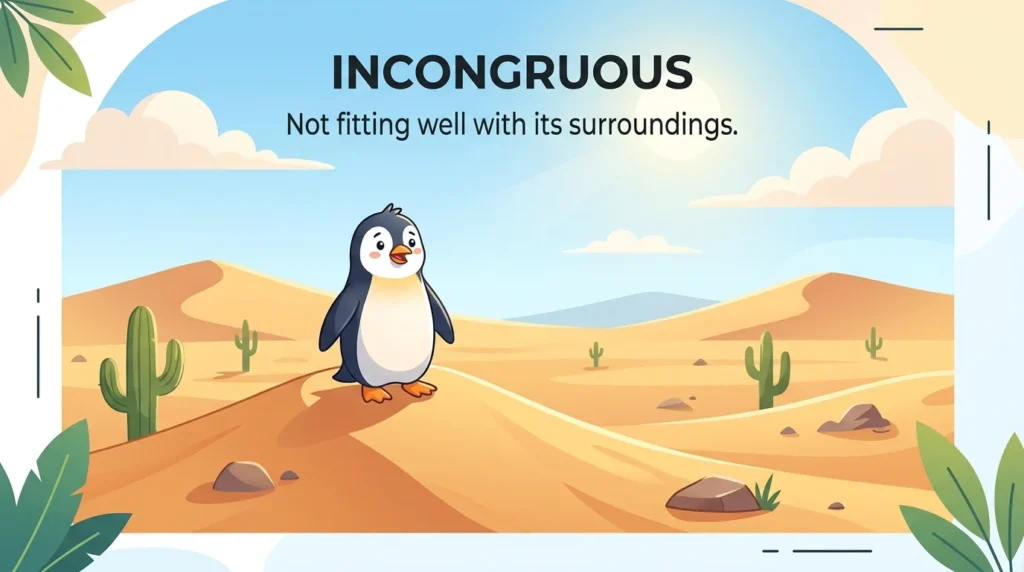
Synonym for incongruous help you describe mismatched elements, odd pairings, or jarring contrasts with much better precision. You feel completely amused when a high-tech modern drone flies directly above an old horse-drawn carriage in the village.
Rich synonyms make your writing pop and help you connect with your readers. Writers and speakers often use a synonym for incongruous to describe awkward design clashes, strange situational pairings, or mismatched aesthetic choices.
This synonym for incongruous gives students, bloggers, and content creators fresh options to elevate their work. Strong vocabulary keeps your daily English conversations colorful, engaging, and clear.
Expanding your word choice allows you to paint a vivid picture of stark contradictions and unexpected oddities. Choosing the right synonym for incongruous turns a plain sentence into a memorable communication experience.
What Does “Incongruous” Really Mean?
Meaning: Not in harmony or keeping with the surroundings or other aspects of something.Emotional Tone: Analytical, observational, or critical.Native Understanding: Native speakers use it when talking about strange design choices, weird outfits, or out-of-place remarks.Common Contexts: Architectural reviews, fashion critiques, literary analysis, and everyday observations.Part of Speech: Adjective. Simple definition: Out of place or not matching its surroundings.
Connotative Meaning
- Positive tone: Artistic irony, creative juxtaposition, and playful design contrast.
- Negative tone: Clashing ugliness, jarring awkwardness, and misplaced elements.
- Neutral tone: Objective descriptions of mismatched items or geometric irregularities.
- Connotation: (The emotional or cultural feeling a word carries beyond its literal dictionary definition.)
Etymology
- Origin: Derived from Latin in- (not) + congruus (suitable, agreeing), coming from congruere (to come together, meet).
- *Old English (450–1100): Germanic roots expressed matching or fitting before Latinate scholastic terminology spread.
- Middle English (1100–1500): Adopted into philosophical and rhetorical texts to describe elements failing to agree.
- Modern English (1500–Present): Standardized into common adjectives describing stylistic and situational mismatches.
Pronunciation (US & UK – IPA)
- US: /ɪnˈkɑːŋ.ɡru.əs/
- UK: /ɪnˈkɒŋ.ɡru.əs/
Syllables
- Syllables: in-con-gru-ous
- Affixation Pattern: Prefix (in-) + root (congruous)
- Root: congruere / to meet together
- Prefix: in- (not)
- Suffix: -ous (characterized by)
Synonyms List
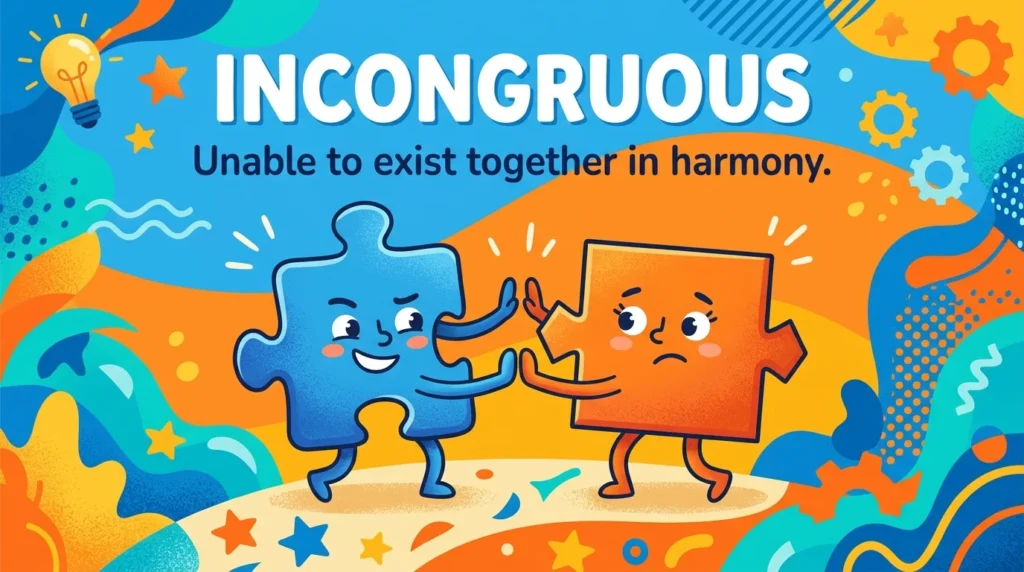
Incompatible (Adjective)
- Meaning: Incapable of existing together in harmony or operational agreement.
- Tone/Register: Technical / Formal
- Example 1: The new software update proved incompatible with older operating systems.
- Example 2: Their working styles were fundamentally incompatible on long projects.
Mismatched (Adjective)
- Meaning: Not matching properly in design, color, size, or style.
- Tone/Register: Conversational / Standard
- Example 1: She wore mismatched socks to support quirky school spirit day.
- Example 2: The living room decor featured mismatched vintage chairs and modern sofas.
Unsuited (Adjective)
- Meaning: Not right or appropriate for a particular person, purpose, or setting.
- Tone/Register: Formal / Standard
- Example 1: His casual outfit felt entirely unsuited for the gala dinner.
- Example 2: That candidate was unsuited for the rigorous engineering role.
Inappropriate (Adjective)
- Meaning: Not proper or suitable for the specific situation or context.
- Tone/Register: Professional / Social
- Example 1: Making jokes during the safety briefing was entirely inappropriate.
- Example 2: Casual language feels inappropriate in formal legal briefs.
Unbefitting (Adjective)
- Meaning: Not fitting or appropriate for a person of a certain status or role.
- Tone/Register: Formal / Literary
- Example 1: Such behavior was unbefitting a senior corporate executive.
- Example 2: The crude remarks felt unbefitting the solemn memorial service.
Discrepant (Adjective)
- Meaning: Showing a difference or lack of agreement between two things.
- Tone/Register: Academic / Business
- Example 1: Accountants investigated discrepant figures in the quarterly balance sheet.
- Example 2: Discrepant eyewitness accounts complicated the police investigation.
Discordant (Adjective)
- Meaning: Disagreeing or harsh in sound; lacking harmonious agreement.
- Tone/Register: Literary / Musical
- Example 1: A discordant note interrupted the orchestra’s smooth rehearsal.
- Example 2: Discordant opinions clashed during the town hall debate.
Dissonant (Adjective)
- Meaning: Lacking harmony; producing a jarring or clashing combination.
- Tone/Register: Academic / Literary
- Example 1: Dissonant architectural designs ruined the historic streetscape.
- Example 2: The modern sculpture created a dissonant visual impact in the garden.
Contradictory (Adjective)
- Meaning: Mutually opposed or inconsistent so that both cannot be true.
- Tone/Register: Academic / Formal
- Example 1: The witness provided contradictory statements to the jury.
- Example 2: Contradictory instructions left the programming team confused.
Contrasting (Adjective)
- Meaning: Differing strikingly when compared side by side.
- Tone/Register: Standard / Analytical
- Example 1: The designer used contrasting colors to highlight key menu features.
- Example 2: Two contrasting theories emerged during the panel discussion.
Unbalanced (Adjective)
- Meaning: Lacking structural equilibrium or proportional harmony.
- Tone/Register: Standard / Practical
- Example 1: An unbalanced tire caused the car to vibrate at high speeds.
- Example 2: The budget appeared heavily unbalanced toward marketing expenses.
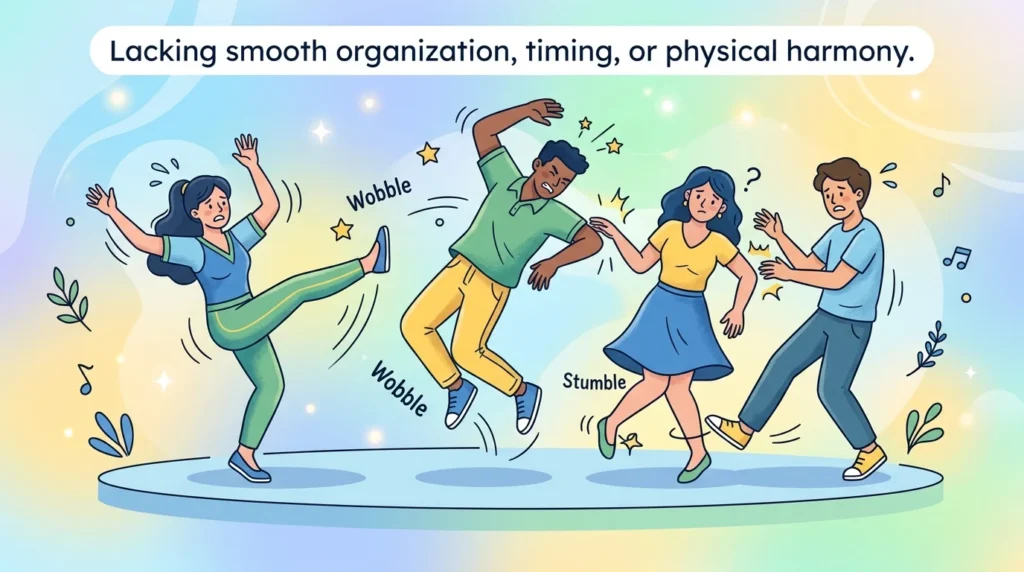
Uncoordinated (Adjective)
- Meaning: Lacking smooth organization, timing, or physical harmony.
- Tone/Register: Conversational / Standard
- Example 1: Uncoordinated team efforts led to duplicated work assignments.
- Example 2: His uncoordinated movements made dance routines difficult.
Out of place (Adjective Phrase)
- Meaning: Not appropriate or suitable for the current situation or setting.
- Tone/Register: Conversational / Standard
- Example 1: A snow jacket felt completely out of place on the tropical beach.
- Example 2: His formal speech felt out of place at the casual barbecue.
Ill-matched (Adjective)
- Meaning: Paired together poorly without proper consideration of fit or tone.
- Tone/Register: Literary / Descriptive
- Example 1: The ill-matched couple surprised guests with their wedding announcement.
- Example 2: An ill-matched pair of armchairs cluttered the small hallway.
Inharmonious (Adjective)
- Meaning: Lacking internal or external agreement, balance, or musical tone.
- Tone/Register: Literary / Formal
- Example 1: Inharmonious colors distracted viewers from the gallery painting.
- Example 2: Inharmonious board discussions stalled company policy reforms.
Disproportionate (Adjective)
- Meaning: Too large or too small in comparison to something else.
- Tone/Register: Formal / Analytical
- Example 1: A disproportionate amount of time was spent on minor formatting tasks.
- Example 2: The punishment seemed disproportionate to the minor infraction.
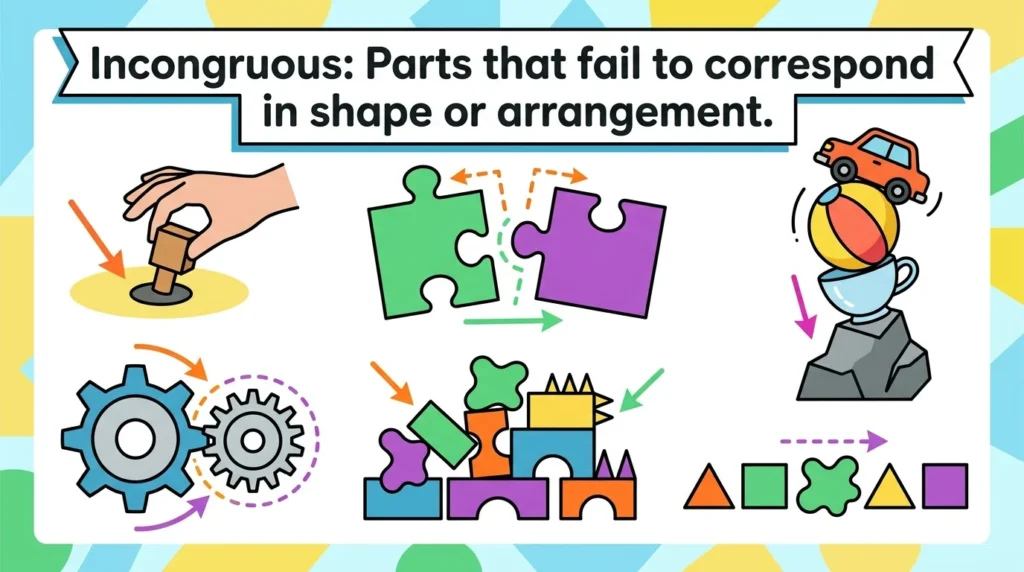
Asymmetrical (Adjective)
- Meaning: Having parts failing to correspond in shape or arrangement around an axis.
- Tone/Register: Technical / Design
- Example 1: Modern earrings featured an edgy, asymmetrical silver design.
- Example 2: The garden layout was intentionally asymmetrical for a wild look.
Divergent (Adjective)
- Meaning: Tending to be different or develop in separate directions.
- Tone/Register: Academic / Formal
- Example 1: Divergent paths forced the hikers to split into two groups.
- Example 2: Divergent marketing strategies yielded interesting consumer data.
Conflicting (Adjective)
- Meaning: Incompatible or opposing in requirements, goals, or statements.
- Tone/Register: Standard / Professional
- Example 1: Conflicting schedules made finding a meeting time challenging.
- Example 2: Conflicting reports left the news anchor seeking verification.
Anomalous (Adjective)
- Meaning: Deviating from what is standard, normal, or expected.
- Tone/Register: Academic / Scientific
- Example 1: Researchers studied the anomalous test results in the laboratory.
- Example 2: An anomalous spike in traffic crashed the web server.
Discordant (Adjective)
- Meaning: Lacking harmony or agreement with the surrounding environment.
- Tone/Register: Literary / Formal
- Example 1: A discordant neon sign ruined the rustic charm of the village inn.
- Example 2: Their discordant life goals eventually led them to separate paths.
Discrepant (Adjective)
- Meaning: Differing or disagreeing when compared side by side.
- Tone/Register: Academic / Business
- Example 1: Auditors flagged discrepant figures between the two ledger books.
- Example 2: Discrepant testimonies from witnesses confused the jury.
Dissonant (Adjective)
- Meaning: Producing a harsh or jarring combination of sounds or elements.
- Tone/Register: Academic / Literary
- Example 1: Dissonant musical chords created an eerie atmosphere in the film scene.
- Example 2: The modern glass pavilion formed a dissonant contrast against the castle ruins.
Unsuited (Adjective)
- Meaning: Not appropriate, fitting, or qualified for a specific context.
- Tone/Register: Formal / Standard
- Example 1: Heavy winter boots felt unsuited for walking on sandy beaches.
- Example 2: His quiet demeanor made him unsuited for high-pressure sales roles.
Unbefitting (Adjective)
- Meaning: Not appropriate or proper for someone of a certain standing.
- Tone/Register: Formal / Literary
- Example 1: Such childish tantrums were unbefitting a team captain.
- Example 2: The casual dress code felt unbefitting the diplomatic gala.
Inappropriate (Adjective)
- Meaning: Not fitting or suitable for a particular situation or standard.
- Tone/Register: Standard / Professional
- Example 1: Wearing shorts to the boardroom meeting was deemed inappropriate.
- Example 2: Making jokes during the somber briefing felt entirely inappropriate.
Unbecoming (Adjective)
- Meaning: Not flattering or socially acceptable for a person’s role.
- Tone/Register: Formal / Literary
- Example 1: Complaining about the award was behavior unbecoming of a champion.
- Example 2: The dark color proved unbecoming against her skin tone.
Untimely (Adjective)
- Meaning: Happening at an unsuitably early or awkward time.
- Tone/Register: Formal / Literary
- Example 1: A sudden power outage occurred at an untimely moment during the broadcast.
- Example 2: His untimely joke broke the serious mood of the presentation.
Inopportune (Adjective)
- Meaning: Occurring at a disadvantageous, inconvenient, or awkward time.
- Tone/Register: Formal / Professional
- Example 1: The phone call came at a most inopportune moment during dinner.
- Example 2: Making budget cuts right before product launch is inopportune.
Disproportionate (Adjective)
- Meaning: Out of proportion; too large or small compared to a standard.
- Tone/Register: Academic / Formal
- Example 1: A disproportionate amount of funding went to marketing over R&D.
- Example 2: The harsh penalty felt disproportionate to the minor infraction.
Asymmetrical (Adjective)
- Meaning: Having parts that fail to correspond in shape or arrangement.
- Tone/Register: Technical / Design
- Example 1: The modern coffee table featured an asymmetrical glass top.
- Example 2: Her haircut featured an asymmetrical fringe framing one eye.
Unbalanced (Adjective)
- Meaning: Lacking structural equilibrium, fairness, or proper proportion.
- Tone/Register: Standard / Practical
- Example 1: An unbalanced tire caused steering vibrations at highway speeds.
- Example 2: The debate panel looked unbalanced with four experts from one side.
Uncoordinated (Adjective)
- Meaning: Lacking smooth organization, timing, or physical movement.
- Tone/Register: Conversational / Standard
- Example 1: Uncoordinated efforts between departments stalled project delivery.
- Example 2: His uncoordinated footwork made learning martial arts difficult.
Ill-matched (Adjective)
- Meaning: Paired together poorly without considering mutual compatibility.
- Tone/Register: Literary / Descriptive
- Example 1: The movie paired an ill-matched detective duo for comedic effect.
- Example 2: An ill-matched set of curtains clashed with the wallpaper.
Inharmonious (Adjective)
- Meaning: Lacking internal balance, agreement, or aesthetic harmony.
- Tone/Register: Literary / Formal
- Example 1: Inharmonious color choices made the painting look chaotic.
- Example 2: Inharmonious views among board members delayed the merger.
Conflicting (Adjective)
- Meaning: Opposing or mutually exclusive in requirements or details.
- Tone/Register: Professional / Standard
- Example 1: Conflicting travel schedules made arranging a group meeting tough.
- Example 2: Conflicting eyewitness testimonies left detectives searching for clues.
Contradictory (Adjective)
- Meaning: Mutually opposed so that both assertions cannot possibly be true.
- Tone/Register: Academic / Formal
- Example 1: The suspect gave contradictory statements during the interrogation.
- Example 2: Contradictory instructions left the software engineering team confused.
Anomalous (Adjective)
- Meaning: Deviating from what is standard, normal, or expected.
- Tone/Register: Scientific / Formal
- Example 1: Scientists investigated anomalous temperature spikes in the Arctic ocean.
- Example 2: An anomalous credit card transaction triggered an instant security alert.
Aberrant (Adjective)
- Meaning: Departing from an accepted standard or normal behavior.
- Tone/Register: Academic / Technical
- Example 1: Biologists monitored aberrant migration patterns in local bird populations.
- Example 2: The software flagged aberrant network activity as potential malware.
Atypical (Adjective)
- Meaning: Not representative of a type, group, or common class.
- Tone/Register: Standard / Analytical
- Example 1: Mild winter weather was atypical for this mountainous region.
- Example 2: Her artistic style remained atypical compared to her peers.
Abnormal (Adjective)
- Meaning: Deviating from ordinary rules, types, or expected structures.
- Tone/Register: Standard / Technical
- Example 1: Blood tests showed abnormal iron levels requiring follow-up.
- Example 2: Abnormal traffic patterns delayed commuters all morning.
Unorthodox (Adjective)
- Meaning: Contrary to what is usual, traditional, or accepted in practice.
- Tone/Register: Professional / Creative
- Example 1: The chef used unorthodox methods to bake sourdough bread.
- Example 2: Her unorthodox management style surprised traditional corporate veterans.
Unconventional (Adjective)
- Meaning: Not based on what is generally done or believed.
- Tone/Register: Conversational / Creative
- Example 1: They chose an unconventional wedding venue inside an old warehouse.
- Example 2: His unconventional approach to problem-solving yielded brilliant results.
Eccentric (Adjective)
- Meaning: Unconventional and slightly strange in behavior or appearance.
- Tone/Register: Literary / Conversational
- Example 1: The artist lived in an eccentric house painted bright purple.
- Example 2: His eccentric fashion sense made him stand out in the office.
Bizarre (Adjective)
- Meaning: Strikingly out of the ordinary; exceptionally odd or whimsical.
- Tone/Register: Conversational / Expressive
- Example 1: A bizarre weather phenomenon brought snow in mid-July.
- Example 2: The sci-fi movie featured a bizarre plot twist at the end.
Grotesque (Adjective)
- Meaning: Comically or repulsively ugly, distorted, or absurdly mismatched.
- Tone/Register: Literary / Dramatic
- Example 1: The gargoyle featured grotesque features carved into stone.
- Example 2: Bureaucratic red tape created a grotesque delay for permits.
Absurd (Adjective)
- Meaning: Wildly unreasonable, illogical, or incongruous to common sense.
- Tone/Register: Conversational / Critical
- Example 1: Paying twenty dollars for a basic bottle of water felt absurd.
- Example 2: The idea that cats could run a corporation is completely absurd.
Ludicrous (Adjective)
- Meaning: So foolish, unreasonable, or out of place as to be laughable.
- Tone/Register: Expressive / Critical
- Example 1: Expecting the task to be finished in ten minutes was a ludicrous demand.
- Example 2: He wore a ludicrous neon suit to the formal dinner party.
Preposterous (Adjective)
- Meaning: Utterly absurd or ridiculous; completely contrary to reason.
- Tone/Register: Formal / Critical
- Example 1: The proposal to build a bridge over the mountains was preposterous.
- Example 2: She dismissed his wild excuse as entirely preposterous.
Far-fetched (Adjective)
- Meaning: Unlikely and unconvincing; lacking credible connection to reality.
- Tone/Register: Conversational / Standard
- Example 1: His excuse for missing the deadline sounded far-fetched.
- Example 2: The sci-fi storyline felt too far-fetched for general audiences.
Synonyms by Tone
- Positive tone: Contrasting, asymmetrical (when used in art or fashion design).
- Neutral tone: Mismatched, unsuited, discrepant, divergent.
- Negative tone: Incompatible, inappropriate, discordant, contradictory.
- Playful/informal tone: Out of place, ill-matched.
Tone matters because your word choice signals how sharply you judge a mismatch. Calling a design choice “contrasting” sounds modern and artistic. Calling a statement “contradictory” highlights logical error or falsehood.
Mini Comparison: Incongruous vs. Mismatched vs. Inappropriate
- Incongruous: Focuses on things that look jarringly out of place within an environment. Use it for artistic or contextual clashes.
- Mismatched: Focuses on items that fail to pair together by color, style, or size. Use it for physical objects or apparel.
- Inappropriate: Focuses on behavior or words that violate social norms or professional rules. Use it for etiquette violations.
Context-Based Usage
In daily conversation, native speakers say “That looks weird here” or “Those shoes don’t match.” Simple phrases fit casual chats best.
When writing blog posts or design guides, use “mismatched,” “contrasting,” or “out of place” to maintain clear instruction flow.
In academic or technical reports, choose “discrepant,” “anomalous,” or “incompatible” to keep the tone objective and precise.
Creative writers love “discordant,” “dissonant,” or “unbefitting” to build rich literary atmosphere.
Common Mistakes & Native Usage
- Mistake 1: Confusing “incongruous” (out of place) with “anonymous” (unknown identity).
- Mistake 2: Using “inappropriate” for physical design clashes instead of social behavior.
- Overuse warning: Repeating “incongruous” in every paragraph makes your critique sound monotonous. Mix in “dissonant” or “anomalous.”
In spoken English, people talk about things sticking out like a sore thumb. In written English, precise adjectives make your stylistic critique sharp.
Real-Life Mini Scenarios
- Workplace: The executive team discussed incompatible software systems during the merger.
- Social situations: Guests noticed the out-of-place Victorian sofa in the minimalist loft.
- Media / pop culture: Film critics praised the discordant soundtrack underlying the dramatic thriller scene.
- Writing or storytelling: The author wove anomalous historical clues into the fantasy plot.
Conclusion
Expanding your knowledge of a synonym for incongruous gives your writing and speaking a much richer, more authentic touch. Subtle upgrades in your everyday vocabulary turn ordinary paragraphs into memorable moments that instantly capture your reader’s attention.
Try weaving one of these descriptive terms into your next essay, message, or daily chat today to see how quickly your communication style transforms.
Which term will you test out first when you describe an odd contrast next? Take a moment to write a quick sentence in your notes or share your favorite pick with a friend right now. Building a stronger lexicon is a fun journey that opens up countless ways to express yourself more clearly and creatively every single day.
Interactive Practice Quiz
Which word best describes software or hardware systems that cannot work together?
- A) Incompatible
- B) Harmonious
- C) Identical
- D) Unified
What term fits items that fail to match properly in color, size, or style?
- A) Mismatched
- B) Matched
- C) Coordinated
- D) Paired
Which synonym refers to sounds or opinions that clash and lack agreement?
- A) Discordant
- B) Melodic
- C) Peaceful
- D) Silent
How would a formal critique describe behavior unworthy of an executive?
- A) Unbefitting
- B) Fitting
- C) Proper
- D) Gracious
Which term describes data or test results that deviate from expected norms?
- A) Anomalous
- B) Normal
- C) Standard
- D) Expected
What word means not proper or suitable for a specific social context?
- A) Inappropriate
- B) Polite
- C) Correct
- D) Decent
Which option describes elements showing differences in financial reports?
- A) Discrepant
- B) Balanced
- C) Equal
- D) Exact
What phrase or term works best for objects looking strange in an environment?
- A) Out of place
- B) Right at home
- C) Perfectly matched
- D) Seamlessly blended
Which term refers to lines or shapes lacking symmetry in modern design?
- A) Asymmetrical
- B) Balanced
- C) Symmetrical
- D) Uniform
What word describes opposing statements where both cannot be true?
- A) Contradictory
- B) Agreement
- C) Harmony
- D) Consensus
Task: Write one short sentence using the word incompatible in your notebook or reply below.
Answer Key: 1-A | 2-A | 3-A | 4-A | 5-A | 6-A | 7-A | 8-A | 9-A | 10-A
Frequently Asked Questions
What is the difference between incongruous and incompatible?
Incongruous means looking out of place or clashing aesthetically with surroundings, while incompatible means items cannot physically or operationally function together.
Can mismatched be used in professional writing?
Yes, mismatched is effective in business reports when describing uncoordinated data sets, marketing strategies, or apparel guidelines.
What is another word for a jarring visual contrast?
Common alternatives include dissonant, discordant, or out of place.
Is incongruous a formal or conversational term?
It is formal vocabulary that appears most frequently in literary critiques, design reviews, and academic essays.
Why do writers use synonyms for incongruous?
Using varied terms like anomalous, discrepant, or unsuited prevents repetition and provides precise stylistic nuance.

Aleesha Rani is a passionate language writer focused on making English vocabulary simple, useful, and engaging. She creates clear content on synonyms, word meanings, and practical language use.
Through vocaneest.com, Aleesha Rani shares original, reader-friendly resources that help students, writers, and English learners choose better words and communicate with confidence.