

Synonyms for nurture usually start when you want to describe giving care, guidance, or support to help someone grow into their best self.
Imagine planting a small seed in a pot, watering it daily, and watching it sprout into a healthy plant. That steady, loving care perfectly captures the essence of this word.
For example, a dedicated teacher works hard to nurture young minds in the classroom. Finding the right synonym for nurture makes your writing far more vivid and expressive without feeling repetitive.
Learning a new synonym for nurture keeps your content engaging and dynamic. Consequently, expanding your vocabulary strengthens your communication in essays, blog posts, and daily workplace conversations.
What Does “Nurture” Really Mean?
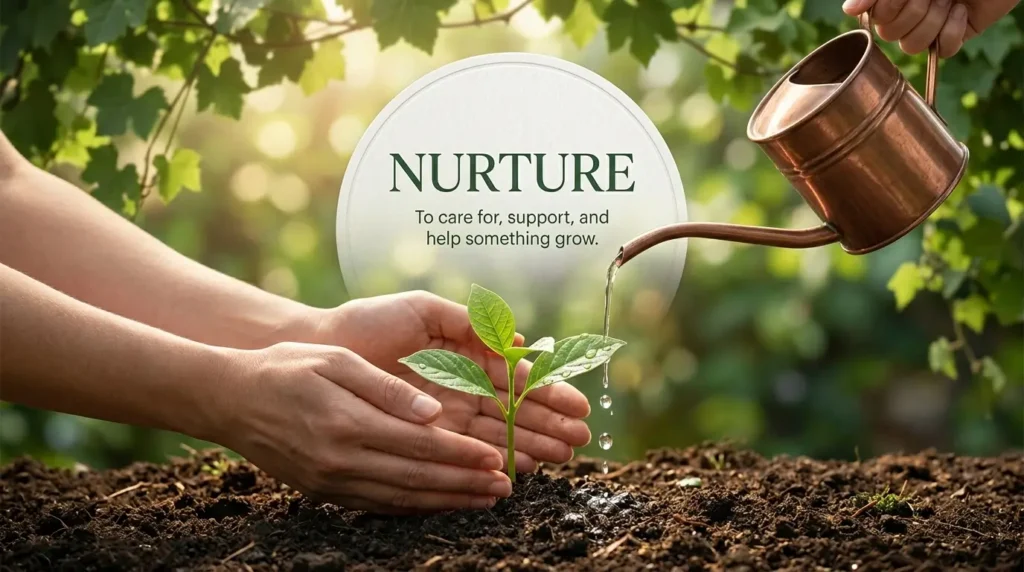
To nurture means to care for, feed, protect, and encourage the growth or development of someone or something over time. Native English speakers use this word when talking about raising children, developing talents, supporting ideas, or tending plants.
The word carries a gentle, supportive, and active tone. Furthermore, it appears frequently in parenting books, educational reports, business leadership guides, and personal development articles.
As a Part of Speech, “nurture” functions primarily as a verb (/ˈnɝː.tʃɚ/), but it can also be used as a noun.
- Simple Definition: To care for and encourage the growth or development of someone or something.
Connotative Meaning
(Connotation is the emotional feeling or cultural association that a word carries beyond its strict dictionary definition.)
- Positive tone: Extremely positive because it implies love, dedication, protection, positive growth, and patient effort.
- Negative tone: Rarely negative, although over-nurturing can sometimes imply smothering or hindering independence.
- Neutral tone: Used in scientific discussions like “nature versus nurture” to describe environmental influences on human growth.
Etymology
The word traces its origins back through French and classical Latin.
- Origin: Derived from the Old French norriture (nourishment) and the Latin nutritura, meaning “a feeding or nursing.”
- Old English (450–1100): Early Germanic speakers used words like fostrian (to nourish/feed) to describe child-rearing.
- Middle English (1100–1500): Adopted as norture or nurture, referring to proper breeding, good manners, and upbringing.
- Modern English (1500–Present): Expanded to describe fostering intellectual growth, business ideas, and personal talents.
Pronunciation & Syllables
- US: /ˈnɝː.tʃɚ/
- UK: /ˈnɜː.tʃər/
Syllable Breakdown: nur-ture (2 Syllables)
Affixation Pattern:
- Root: Nutri- / Nourish- (to feed or support)
- Prefix: None
- Suffix: -ure (forms nouns or verbs indicating action or process)
List of Synonyms
Foster (Verb) — US: /ˈfɑː.stɚ/ | UK: /ˈfɒs.tə/
- Meaning: To encourage the development or growth of an idea, feeling, or relationship in a supportive environment.
- Tone/Register: Professional / Academic
- Example 1: The team leader worked hard to foster open communication among new employees.
- Example 2: Consequently, good managers always foster creativity within their creative teams.
Cultivate (Verb) — US: /ˈkʌl.tə.veɪt/ | UK: /ˈkʌl.tɪ.veɪt/
- Meaning: To apply deliberate effort and care toward developing a skill, relationship, or crop.
- Tone/Register: Formal / Refined
- Example 1: She took several evening courses to cultivate her passion for landscape photography.
- Example 2: Therefore, successful diplomats learn to cultivate strong international relationships over time.
Nourish (Verb) — US: /ˈnɝː.ɪʃ/ | UK: /ˈnʌr.ɪʃ/
- Meaning: To provide food, care, or encouragement necessary for life, health, and emotional growth.
- Tone/Register: Warm / Expressive
- Example 1: Healthy meals and clean water nourish the physical body during early childhood.
- Example 2: In addition, reading good books can nourish your mind and imagination.
Rear (Verb) — US: /rɪr/ | UK: /rɪə/
- Meaning: To care for and train children or young animals until they are fully grown.
- Tone/Register: Traditional / Formal
- Example 1: They decided to buy a quiet farm in the country to rear their young family.
- Example 2: Similarly, wildlife reserves help rear endangered bird species safely in captivity.
Cherish (Verb) — US: /ˈtʃer.ɪʃ/ | UK: /ˈtʃer.ɪʃ/
- Meaning: To protect and care for someone or something lovingly and hold them dear.
- Tone/Register: Emotional / Warm
- Example 1: Parents deeply cherish the quiet moments spent reading with their children before bed.
- Example 2: Thus, she will always cherish the lifelong friendships formed during college.

Support (Verb) — US: /səˈpɔːrt/ | UK: /səˈpɔːt/
- Meaning: To give help, encouragement, or financial assistance to ensure success or survival.
- Tone/Register: Universal / General
- Example 1: Good friends always support your ambitious career dreams when times get tough.
- Example 2: Meanwhile, local citizens gathered to support the neighborhood library renovation project.
Sustain (Verb) — US: /səˈsteɪn/ | UK: /səˈsteɪn/
- Meaning: To supply necessary strength, nourishment, or resources to keep something alive or continuing.
- Tone/Register: Analytical / Formal
- Example 1: Regular rainfall is necessary to sustain deep forest ecosystems throughout hot summer months.
- Example 2: Furthermore, positive, encouraging words can sustain your confidence through difficult trials.
Encourage (Verb) — US: /ɪnˈkɝː.ɪdʒ/ | UK: /ɪnˈkʌr.ɪdʒ/
- Meaning: To give hope, courage, or confidence to someone so they take positive action.
- Tone/Register: Conversational / Friendly
- Example 1: The coach took a moment to encourage the young runners after a tough loss.
- Example 2: As a result, praise will always encourage students to try their very best.
Feed (Verb) — US: /fiːd/ | UK: /fiːd/
- Meaning: To supply physical food or fuel necessary to maintain life, growth, or energy.
- Tone/Register: Direct / General
- Example 1: Remember to feed the family dog before heading out for school today.
- Example 2: In addition, curiosity continues to feed his desire for scientific learning every day.
Tend (Verb) — US: /tend/ | UK: /tend/
- Meaning: To care for, look after, or attend to the needs of a person, animal, or garden.
- Tone/Register: Gentle / Practical
- Example 1: The gardener spends hours every weekend tending her rare rose bushes carefully.
- Example 2: Consequently, the nurse stayed late to tend the recovering surgical patients gently.
Mind (Verb) — US: /maɪnd/ | UK: /maɪnd/
- Meaning: To watch over, look after, or take care of someone or something temporarily.
- Tone/Register: Informal / Conversational
- Example 1: Could you please mind my luggage for two minutes while I grab water?
- Example 2: Furthermore, she agreed to mind her neighbor’s kids for the afternoon.
Protect (Verb) — US: /prəˈtekt/ | UK: /prəˈtekt/
- Meaning: To keep someone or something safe from harm, injury, illness, or damage.
- Tone/Register: Direct / Protective
- Example 1: Parents instinctively act to protect their young toddlers from household hazards.
- Example 2: Therefore, wearing proper helmets helps protect young cyclists from severe head injuries.
Champion (Verb) — US: /ˈtʃæm.pi.ən/ | UK: /ˈtʃæm.pi.ən/
- Meaning: To fight for, advocate strongly, or actively support a cause, person, or principle.
- Tone/Register: Professional / Inspiring
- Example 1: The director continues to champion equal opportunities for all new office workers.
- Example 2: Consequently, she chose to champion environmental conservation throughout her career.
Shelter (Verb) — US: /ˈʃel.t̬ɚ/ | UK: /ˈʃel.tə/
- Meaning: To protect someone or something from bad weather, danger, or harsh realities.
- Tone/Register: Protective / General
- Example 1: The large wooden shed helped shelter the stray farm animals during the thunderstorm.
- Example 2: However, overprotective parents sometimes shelter their teenagers from real-world challenges.
Guide (Verb) — US: /ɡaɪd/ | UK: /ɡaɪd/
- Meaning: To direct, show the way, or advise someone toward wise decisions and growth.
- Tone/Register: Educational / Friendly
- Example 1: A wise mentor will guide young entrepreneurs through early business mistakes.
- Example 2: Thus, clear street signage helps guide tourists safely through busy urban centers.

Mentor (Verb) — US: /ˈmen.tɔːr/ | UK: /ˈmen.tɔː/
- Meaning: To advise, train, and counsel an inexperienced person in professional or personal matters.
- Tone/Register: Professional / Business
- Example 1: Senior engineers volunteered to mentor college interns during their summer placements.
- Example 2: In addition, finding someone to mentor your career can speed up your progress.
Subsidize (Verb) — US: /ˈsʌb.sə.daɪz/ | UK: /ˈsʌb.sɪ.daɪz/
- Meaning: To support an activity, organization, or person by providing direct financial help.
- Tone/Register: Economic / Formal
- Example 1: Local government programs subsidize public transit costs.
- Example 2: As a result, university grants help subsidize advanced scientific research projects.
Back (Verb) — US: /bæk/ | UK: /bæk/
- Meaning: To give financial, moral, or political support to an individual, project, or plan.
- Tone/Register: Conversational / Business
- Example 1: Several private investors chose to back the promising tech startup early on.
- Example 2: Consequently, the entire community decided to back the mayor’s local park initiative.
Advance (Verb) — US: /ədˈvæns/ | UK: /ədˈvɑːns/
- Meaning: To help forward, promote, or assist the progress and development of something.
- Tone/Register: Formal / Strategic
- Example 1: Continuous education helps advance your professional career options in the long run.
- Example 2: Furthermore, modern medical trials work to advance our understanding of diseases.
Promote (Verb) — US: /prəˈmoʊt/ | UK: /prəˈməʊt/
- Meaning: To encourage the growth, popularity, adoption, or success of an idea or project.
- Tone/Register: Marketing / Public Policy
- Example 1: Daily exercise campaigns aim to promote better health habits across local schools.
- Example 2: Therefore, public libraries work hard to promote literacy among young children.
Strengthen (Verb) — US: /ˈstreŋ.θən/ | UK: /ˈstreŋ.θən/
- Meaning: To make someone or something stronger, more resilient, or more effective.
- Tone/Register: Practical / General
- Example 1: Daily physical training helped strengthen his leg muscles following knee surgery.
- Example 2: Similarly, open honesty will always strengthen trust between long-term business partners.
Educate (Verb) — US: /ˈedʒ.ə.keɪt/ | UK: /ˈedʒ.u.keɪt/
- Meaning: To train, instruct, or develop the intellectual and moral capabilities of someone.
- Tone/Register: Academic / General
- Example 1: Schools strive to educate students in both practical skills and ethical thinking.
- Example 2: In addition, community workshops educate residents on recycling and waste reduction.
Safeguard (Verb) — US: /ˈseɪf.ɡɑːrd/ | UK: /ˈseɪf.ɡɑːd/
- Meaning: To protect something valuable from harm, risk, or deterioration through preventive measures.
- Tone/Register: Legal / Formal
- Example 1: Strict cybersecurity measures safeguard sensitive customer data against online theft.
- Example 2: Thus, park rangers work around the clock to safeguard rare wildlife species.
Harbor (Verb) — US: /ˈhɑːr.bɚ/ | UK: /ˈhɑː.bə/
- Meaning: To keep thoughts, feelings, or ideas secretly in mind, supporting their growth over time.
- Tone/Register: Expressive / Literary
- Example 1: Young musicians often harbor secret ambitions of performing on famous world stages.
- Example 2: However, holding onto old grudges can harbor negative energy inside your heart.
Develop (Verb) — US: /dɪˈvel.əp/ | UK: /dɪˈvel.əp/
- Meaning: To grow, elaborate, or expand something into a fuller, more mature, or advanced state.
- Tone/Register: Universal / Technical
- Example 1: Consistent practice allows young athletes to develop their natural physical talents fully.
- Example 2: Consequently, software teams work tirelessly to develop innovative applications every year.
Mother (Verb) — US: /ˈmʌð.ɚ/ | UK: /ˈmʌð.ər/
- Meaning: To care for, protect, and treat someone with deep warmth and affectionate attention.
- Tone/Register: Warm / Informal
- Example 1: She always tends to mother her younger teammates whenever they feel overwhelmed.
- Example 2: Consequently, his grandmother loved to mother anyone who walked through her front door.
Shepherd (Verb) — US: /ˈʃep.ɚd/ | UK: /ˈʃep.əd/
- Meaning: To guide, protect, and direct a person or group carefully through a complex process.
- Tone/Register: Professional / Inspiring
- Example 1: The senior advisor agreed to shepherd the young delegation through the national conference.
- Example 2: Therefore, clear leadership helped shepherd the project safely to completion.
Nurturate (Verb) — US: /ˈnɝː.tʃɚ.eɪt/ | UK: /ˈnɜː.tʃər.eɪt/
- Meaning: To systematically supply supportive conditions to encourage sustained, long-term development.
- Tone/Register: Academic / Rare
- Example 1: The educational curriculum was specifically designed to nurture critical thinking skills.
- Example 2: In addition, modern policies aim to nurture sustainable business innovation across regions.
Incubate (Verb) — US: /ˈɪŋ.kjə.beɪt/ | UK: /ˈɪŋ.kjə.beɪt/
- Meaning: To protect and maintain ideal conditions for an idea, plan, or organism to develop.
- Tone/Register: Technical / Business
- Example 1: The local university created a special program to incubate early-stage technology startups.
- Example 2: Thus, taking quiet time allows you to incubate new creative concepts effectively.
Minister (Verb) — US: /ˈmɪn.ə.stɚ/ | UK: /ˈmɪn.ɪ.stər/
- Meaning: To attend to the needs, comfort, or health of someone in distress or weakness.
- Tone/Register: Formal / Compassionate
- Example 1: Volunteers gathered at the center to minister to families affected by the flood.
- Example 2: Furthermore, the home health nurse continued to minister to patients daily.
Wet-nurse (Verb) — US: /ˈwet.nɝːs/ | UK: /ˈwet.nɜːs/
- Meaning: To give excessive care or help to someone to the point of spoiling or overprotecting them.
- Tone/Register: Idiomatic / Informal
- Example 1: The new manager made it clear he would not wet-nurse employees through basic tasks.
- Example 2: As a result, team members learned self-reliance rather than expecting someone to wet-nurse them.
Patronize (Verb) — US: /ˈpeɪ.trə.naɪz/ | UK: /ˈpæt.rə.naɪz/
- Meaning: To give financial or moral support to an artist, cause, or institution over time.
- Tone/Register: Historical / Formal
- Example 1: Wealthy historical families chose to patronize young painters during the Renaissance.
- Example 2: Consequently, local art lovers continue to patronize community theater projects today.
Cosset (Verb) — US: /ˈkɑː.sɪt/ | UK: /ˈkɒs.ɪt/
- Meaning: To pamper, protect, and treat someone with indulge-heavy affection and extreme care.
- Tone/Register: Expressive / Literary
- Example 1: The prize-winning racehorse was cosseted by a full team of dedicated trainers.
- Example 2: However, overprotective parents who cosset their children may hinder their independence.
Coddle (Verb) — US: /ˈkɑː.dəl/ | UK: /ˈkɒd.əl/
- Meaning: To treat someone with excessive leniency, tenderness, and protective indulgence.
- Tone/Register: Everyday / Critical
- Example 1: The basketball coach refused to coddle star players when they missed morning practice.
- Example 2: Therefore, learning from failure is far better than having adults coddle you constantly.
Succor (Verb) — US: /ˈsʌk.ɚ/ | UK: /ˈsʌk.ər/
- Meaning: To go to the aid of someone in severe distress or hardship by offering comfort and help.
- Tone/Register: High Formal / Literary
- Example 1: Emergency workers rushed into the disaster zone to succor displaced residents immediately.
- Example 2: In addition, charitable organizations exist to succor communities facing unexpected crises.
Foster-parent (Verb) — US: /ˈfɑː.stɚ.ˌper.ənt/ | UK: /ˈfɒs.tə.ˌpeə.rənt/
- Meaning: To raise, shelter, and care for a child temporarily without full legal adoption.
- Tone/Register: Legal / Familial
- Example 1: They decided to foster-parent several children in need of a safe, stable home.
- Example 2: Consequently, social services work tirelessly to match children with families who can foster-parent.
Parent (Verb) — US: /ˈper.ənt/ | UK: /ˈpeə.rənt/
- Meaning: To guide, raise, and fulfill the duties of caring for a child throughout their development.
- Tone/Register: Universal / Direct
- Example 1: Learning how to parent effectively requires endless patience, empathy, and consistent boundaries.
- Example 2: Thus, modern workshops help young couples learn how to parent with confidence.
Upbring (Verb) — US: /ˈʌp.brɪŋ/ | UK: /ˈʌp.brɪŋ/
- Meaning: To train, educate, and raise a child toward adult maturity.
- Tone/Register: Traditional / Rare
- Example 1: Community elders emphasized the collective duty to upbring youth with strong moral values.
- Example 2: Furthermore, supportive environments make it much easier to raise healthy children.
Cradle (Verb) — US: /ˈkreɪ.dəl/ | UK: /ˈkreɪ.dəl/
- Meaning: To hold gently and protectively, creating a safe space for early growth or healing.
- Tone/Register: Poetic / Visual
- Example 1: The quiet coastal valley seemed to cradle the small fishing village from sea storms.
- Example 2: Similarly, gentle guidance helps cradle fragile confidence during early skill learning.
Enfold (Verb) — US: /ɪnˈfoʊld/ | UK: /ɪnˈfəʊld/
- Meaning: To surround, hug, or wrap someone in a protective and comforting embrace.
- Tone/Register: Warm / Literary
- Example 1: The loving grandmother opened her arms to enfold the crying child in a warm hug.
- Example 2: As a result, feeling safe helped enfold the young patient in deep, restful sleep.
Water (Verb) — US: /ˈwɑː.t̬ɚ/ | UK: /ˈwɔː.tər/
- Meaning: To supply liquid nourishment to plants or metaphorically feed growth in early stages.
- Tone/Register: Practical / Metaphorical
- Example 1: Be sure to water the kitchen herbs every morning so they continue to flourish.
- Example 2: In addition, encouragement serves to water the seeds of talent in young students.
Husband (Verb) — US: /ˈhʌz.bənd/ | UK: /ˈhʌz.bənd/
- Meaning: To manage, use, and protect resources carefully to ensure ongoing growth and survival.
- Tone/Register: Formal / Agricultural
- Example 1: Farmers must husband their water reserves wisely during long periods of summer drought.
- Example 2: Therefore, financial planners advise young clients to husband their early savings carefully.
Enshrine (Verb) — US: /ɪnˈʃraɪn/ | UK: /ɪnˈʃraɪn/
- Meaning: To preserve, protect, and hold something sacred so it remains safe over time.
- Tone/Register: High Formal / Legal
- Example 1: The national constitution works to enshrine fundamental human rights for every citizen.
- Example 2: Consequently, museum curators work to enshrine rare historical artifacts safely.
Fledge (Verb) — US: /fleʒ/ | UK: /fleʒ/
- Meaning: To care for a young bird or learner until they develop the necessary strength to fly or work independently.
- Tone/Register: Biological / Literary
- Example 1: The parent birds worked tirelessly all spring to fledge their young nestlings before winter.
- Example 2: Similarly, rigorous training helps fledge young pilot candidates into skilled professionals.
Seed (Verb) — US: /siːd/ | UK: /siːd/
- Meaning: To plant, initiate, or provide early funding and care to spark long-term growth.
- Tone/Register: Corporate / Metaphorical
- Example 1: The capital firm agreed to seed the green energy project with its initial investment.
- Example 2: Thus, early childhood experiences help seed lifelong interests in science and art.

Synonyms by Tone
Choosing the right tone ensures your vocabulary fits the situation naturally. Using formal terms in casual texting sounds unnatural, while using informal slang in research papers can lower your authority.
Positive / Emotional:
Nourish, Cherish, Foster, Cultivate, Champion (emphasizes care, warmth, and deliberate growth).
Neutral / Practical:
Develop, Support, Tend, Guide, Educate (focuses purely on action and assistance).
Formal / Academic:
Subsidize, Safeguard, Advance, Sustain, Promote (ideal for business reports and research papers).
Informal / Conversational:
Mind, Back, Feed, Encourage (perfect for casual talks and daily dialogue).
Mini Comparison: “Nurture” vs. Close Alternatives
| Word | Specific Focus | Best Context |
| Nurture | Holistic, loving care and long-term development of life or talent. | Parenting, education, personal growth, mentorship. |
| Foster | Encouraging conditions for growth without direct biological or ownership ties. | Business culture, teamwork, creative ideas, adoption. |
| Cultivate | Purposeful, structured effort to refine a specific skill or crop. | Skill development, hobbies, professional networking. |
How “Nurture” Changes by Context
In daily conversation, native speakers rarely use grand terms like “cultivate.” Instead, they rely on accessible verbs like encourage, look after, or help out.
Effective communication becomes stronger when you choose words that match your purpose and audience. In writing and blogging, vivid terms such as foster, nourish, and champion can keep readers engaged while creating smooth, mobile-friendly paragraphs.
In professional and academic contexts, precise vocabulary like subsidize, safeguard, and advance adds clarity and credibility to corporate reports, research papers, and formal essays.
For creative storytelling, expressive words such as cherish, harbor, and shelter can bring emotional depth, atmosphere, and stronger imagery to characters and their journeys.
Common Mistakes Learners Make
- Confusing “Nurture” with “Nature”: Nature refers to genetic inheritance, whereas nurture refers to environmental care and upbringing.
- Overusing “Nurture” for Objects: You nurture living things, talents, or ideas; you do not “nurture” a broken car; you repair it.
- Tone Mismatch: Avoid using harbor when you mean simple support, as harbor often implies hidden or secret thoughts.
(For additional vocabulary insights, explore our grammar guides to refine your everyday sentence flow.)
Real-Life Mini Scenarios
- Workplace: The manager built a quiet breakout space to foster spontaneous brainstorming sessions.
- Social Situations: Joining a weekend running club helped her cultivate lifelong healthy habits and friendships.
- Media / Pop Culture: The popular documentary series showed how wolf packs nourish and protect their young pups.
- Writing or Storytelling: The old wizard continued to guide the young prince through dark and treacherous lands.
Conclusion
Learning synonyms enriches your writing and helps you express subtle thoughts clearly. Expanding your vocabulary ensures your message stays fresh across all communication mediums.
Mastering words like foster, cultivate, and nourish gives your prose precision and confidence. Furthermore, choosing the right word ensures your writing connects deeply with readers.
Try practicing these new words today in your journal, email drafts, or essay writing. Developing consistent vocabulary habits builds strong, lifelong communication skills.
Interactive Practice Quiz
1. Which synonym fits best when describing a company encouraging innovation among staff?
a) Mind
b) Foster
c) Harbor
d) Rear
2. If you spend time every week refining a foreign language skill, you work to:
a) Cultivate
b) Subsidize
c) Mind
d) Harbor
3. What word best describes providing healthy food and love to a growing child?
a) Subsidize
b) Nourish
c) Back
d) Safeguard
4. When a government provides money to support renewable energy projects, it acts to:
a) Mind
b) Subsidize
c) Cherish
d) Rear
5. Which gentle verb fits best when caring for garden rose bushes on weekends?
a) Tend
b) Subsidize
c) Champion
d) Advance
6. What term works best when an experienced worker guides a new intern?
a) Harbor
b) Mentor
c) Subsidize
d) Mind
7. If you keep secret hopes of becoming a famous writer one day, you:
a) Safeguard
b) Subsidize
c) Harbor
d) Mind
8. Which word describes taking action to keep customer financial data completely safe?
a) Cherish
b) Safeguard
c) Rear
d) Feed
9. What casual word works best for watching a friend’s pet while they are away?
a) Subsidize
b) Mind
c) Champion
d) Cultivate
10. Which word fits best when publicly advocating for environmental protection laws?
a) Champion
b) Mind
c) Rear
d) Harbor
Answer Key: 1-b, 2-a, 3-b, 4-b, 5-a, 6-b, 7-c, 8-b, 9-b, 10-a,
Frequently Asked Questions
1. What is the most common synonym for nurture in everyday English?
The most common everyday alternatives are “care for,” “foster,” or “look after.” Native English speakers use these terms in casual conversations to describe supporting the growth of children, pets, gardens, or personal relationships.
2. Is “cultivate” identical in meaning to “nurture”?
While very close, “cultivate” implies deliberate, structured effort, often toward a skill, crop, or relationship. “Nurture” carries a warmer, more protective, and emotionally caring tone focused on holistic well-being.
3. How does “foster” differ from “nurture”?
“Nurture” involves direct, loving care and nourishment. In contrast, “foster” focuses on creating the ideal conditions, environment, or encouragement for an idea, skill, or relationship to develop successfully.
4. Can “nurture” be used as a noun?
Yes, “nurture” can function as a noun. It refers to environmental influences, upbringing, and care, as famously seen in the classic psychological debate of “nature versus nurture.”
5. What is the best business alternative for “nurture”?
In corporate settings, verbs like “foster,” “develop,” “champion,” or “cultivate” work best. These terms sound professional while clearly conveying growth, leadership, and strategic support.

Esha loves exploring English words and finding simple ways to explain them. She writes about synonyms, vocabulary, word meanings, and everyday language in a clear and friendly style. Through vocaneest.com, Esha shares useful tips and easy-to-follow language guides for students, writers, and anyone looking to improve their English. Her goal is simple: to help readers choose better words, express their ideas clearly, and feel more confident when writing or communicating.