
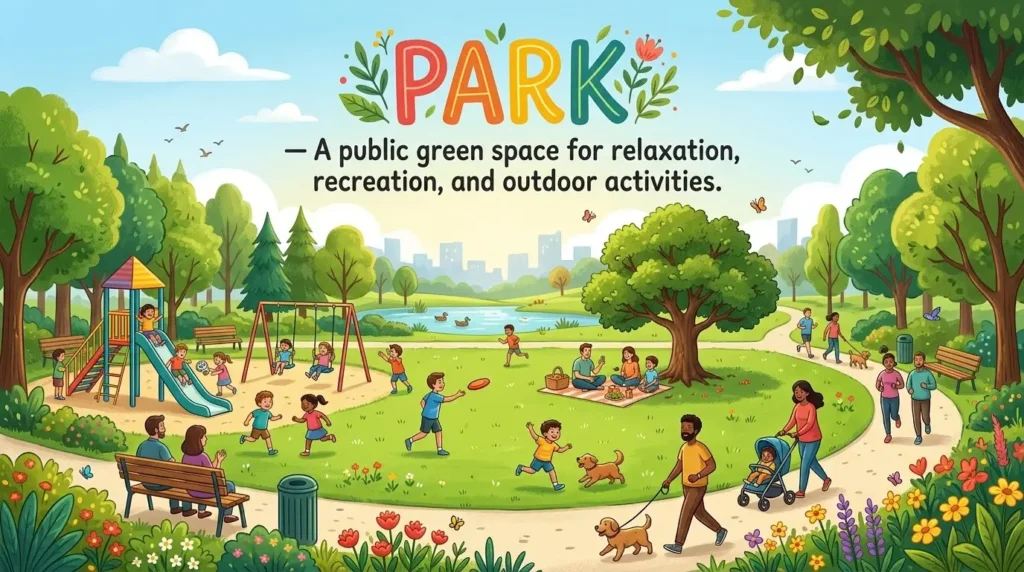
Some words quietly do two jobs at once, and park is one of them. A synonym for park might describe a leafy green space where children play and dogs race across the grass, or it might describe the simple act of leaving your car somewhere and walking away. Because one small word covers both a place and an action, it often needs a more precise partner.
Picture a message from a friend on a Saturday morning: “Meet me at the park.” Do they mean the botanical garden with its rose beds, the recreation area with the basketball courts, or the parking lot behind the library? Each choice paints a different picture, and the wrong one can send you to the wrong place entirely.
That is why writers, students, and travellers keep looking for a better synonym for park. A garden sounds cultivated and calm. A nature reserve promises wildlife and protection. A parking area, on the other hand, is purely practical, all asphalt and white lines. The meaning changes completely with the word you choose.
In this guide you will find alternatives for every sense of the word, grouped by tone and situation, with meanings and examples you can lift straight into your own sentences. Whether you are describing a family picnic, a city square, or the spot where you left your car, the right synonym for park will make your meaning land exactly.
One Word, Two Jobs: What “Park” Really Means
As a noun, a park is a piece of land set aside for people to enjoy. It may be a small neighbourhood green with a few benches, or a vast protected landscape of forests and lakes. As a verb, to park means to leave a vehicle in a particular place, usually for a short while. Context tells listeners which meaning is intended: nobody hears “We walked through the park” and pictures a car, and nobody hears “Park outside the shop” and imagines a picnic.
Parts of speech
- Noun: A public or private area kept for recreation, nature, or rest, such as a city park or a national park.
- Verb: To leave a vehicle in a suitable or designated place.
- Verb, informal: To set something aside for later, as in “Let’s park that question until tomorrow.”
The Feeling Behind the Word
Beyond its dictionary meaning, park carries feelings. Mention a park and most people think of open sky, shade trees, and unhurried afternoons. The words around it can warm that picture or cool it down:
- Warm and positive: garden, green space, and nature reserve suggest beauty, peace, and care for the environment.
- Cold or negative: parking lot can suggest noise, congestion, and grey concrete, even though the term itself is neutral.
- Plain and neutral: public park, recreation area, and parking area simply name the place without judging it.
In short, park itself is a neutral word. The emotion comes from the details you build around it.
Where “Park” Came From
The word travelled into English from French, and behind the French stands an older Germanic word for an enclosed piece of ground. For centuries, a park was not public at all: it was private land, fenced off so that deer and other game could be kept for hunting.
- Old English (450–1100): The modern word did not exist yet, though related Germanic words described enclosures and boundaries.
- Middle English (1100–1500): English borrowed parc from Anglo-Norman and Old French, meaning an enclosed area, often for animals or hunting.
- Modern English (1500–present): The meaning opened up to landscaped grounds and public green spaces, and later gained the verb sense of leaving a vehicle in place.
Pronunciation (US and UK – IPA)
US: /pɑːrk/ UK: /pɑːk/
Syllables
Park is a single, solid syllable: park.
Growing New Words From “Park”
Root: park. The base word carries no prefix or suffix of its own. English grows new forms simply by adding endings: parking (the activity or the space), parked (the finished action), and parks (more than one, or the third-person verb form).
The Complete List of Park Synonyms
The most accurate synonym depends on whether park refers to a recreational place or the action of leaving a vehicle. The following alternatives cover both meanings, with notes on when each word sounds natural.
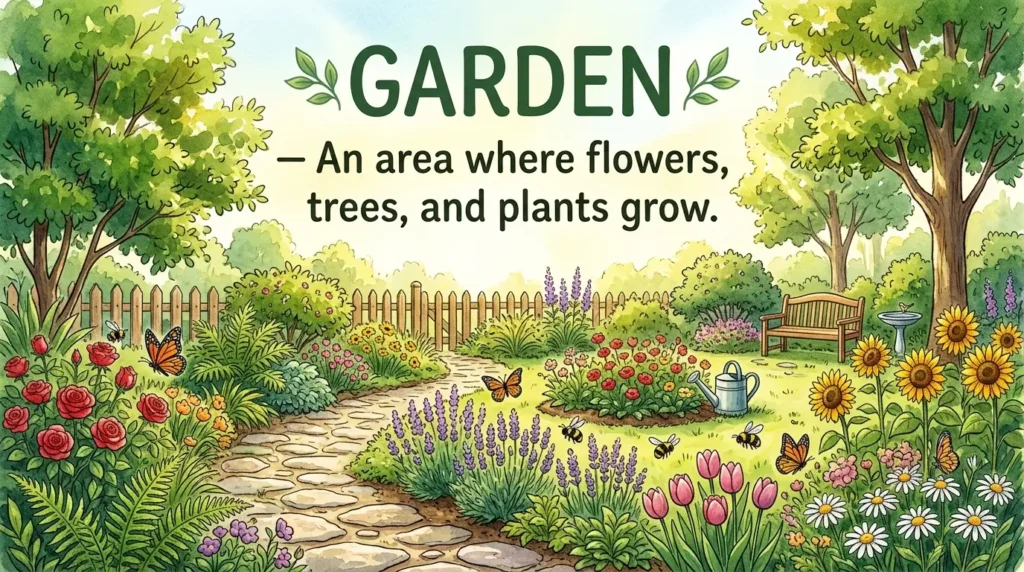
Garden (Noun) — US: /ˈɡɑːrdən/ | UK: /ˈɡɑːdən/
Meaning: A cultivated area where flowers, trees, or plants grow, sometimes open to public visitors.
Tone/Register: Neutral, pleasant, descriptive.
Examples:
We spent the morning walking through the botanical garden.
The children enjoyed the flowers and colorful butterflies.
Green Space (Noun) — US: /ˈɡriːn speɪs/ | UK: /ˈɡriːn speɪs/
Meaning: An open area with grass, trees, or other vegetation, especially in an urban environment.
Tone/Register: Neutral, environmental, urban planning.
Examples:
Our neighborhood needs more green space for families.
The new development will preserve a small green space.
Recreation Area (Noun) — US: /ˌriːkriˈeɪʃən ˈeriə/ | UK: /ˌrekriˈeɪʃən ˈeəriə/
Meaning: A place designed for leisure activities, sports, picnics, or outdoor entertainment.
Tone/Register: Neutral, formal, informational.
Examples:
We stopped at a recreation area beside the highway.
The recreation area has picnic tables and walking paths.
Public Garden (Noun) — US: /ˈpʌblɪk ˈɡɑːrdən/ | UK: /ˈpʌblɪk ˈɡɑːdən/
Meaning: A garden maintained for public enjoyment, often featuring flowers, trees, and landscaped paths.
Tone/Register: Neutral, formal, descriptive.
Examples:
The public garden attracts visitors throughout spring.
We took photographs beside the rose beds.
Botanical Garden (Noun) — US: /bəˈtænɪkəl ˈɡɑːrdən/ | UK: /bəˈtænɪkəl ˈɡɑːdən/
Meaning: A garden that grows and displays a variety of plants, often for education, conservation, or research.
Tone/Register: Academic, educational, descriptive.
Examples:
The university’s botanical garden contains rare plant species.
Students visited it to study medicinal plants.
Nature Reserve (Noun) — US: /ˈneɪtʃər rɪˌzɝːv/ | UK: /ˈneɪtʃə rɪˌzɜːv/
Meaning: An area protected to conserve wildlife, plants, and natural habitats.
Tone/Register: Environmental, formal, scientific.
Examples:
We spotted several bird species in the nature reserve.
The protected area provides shelter for native wildlife.
National Park (Noun) — US: /ˈnæʃənəl pɑːrk/ | UK: /ˈnæʃənəl pɑːk/
Meaning: A protected natural area managed for conservation and, often, public enjoyment.
Tone/Register: Formal, geographical, environmental.
Examples:
Our family plans to visit a national park this summer.
The park protects forests, rivers, and mountain habitats.
State Park (Noun) — US: /ˈsteɪt pɑːrk/ | UK: /ˈsteɪt pɑːk/
Meaning: A recreational or natural area managed by a state government, particularly in the United States.
Tone/Register: Neutral, geographical.
Examples:
We rented a cabin near the state park.
The area offers hiking trails and camping facilities.
Playground (Noun) — US: /ˈpleɪɡraʊnd/ | UK: /ˈpleɪɡraʊnd/
Meaning: An outdoor area equipped for children’s play, often located inside a larger park.
Tone/Register: Neutral, family-friendly.
Examples:
The children ran straight to the playground.
Parents watched them from nearby benches.
Picnic Area (Noun) — US: /ˈpɪknɪk ˈeriə/ | UK: /ˈpɪknɪk ˈeəriə/
Meaning: A designated outdoor space where people can sit and eat meals.
Tone/Register: Neutral, practical.
Examples:
We found a quiet picnic area near the lake.
Everyone unpacked their lunch beneath the trees.
Open Space (Noun) — US: /ˈoʊpən speɪs/ | UK: /ˈəʊpən speɪs/
Meaning: An area without dense buildings, often providing room for recreation, nature, or public use.
Tone/Register: Neutral, urban planning, descriptive.
Examples:
The town plans to protect its remaining open space.
Residents use the field for walking and informal games.
Commons (Noun) — US: /ˈkɑːmənz/ | UK: /ˈkɒmənz/
Meaning: An area of land available for shared community use, often grassland or a traditional village green.
Tone/Register: Traditional, geographical, sometimes British.
Examples:
Families gathered on the village commons.
The local council maintains the shared grounds.
Grounds (Noun) — US: /ɡraʊndz/ | UK: /ɡraʊndz/
Meaning: The land surrounding a building or institution, often including lawns, gardens, and trees.
Tone/Register: Neutral to formal.
Examples:
We walked around the museum grounds after lunch.
The university grounds look beautiful in autumn.
Estate Parkland (Noun) — US: /ɪˈsteɪt ˈpɑːrklænd/ | UK: /ɪˈsteɪt ˈpɑːklænd/
Meaning: Landscaped land associated with a large private estate or historic property.
Tone/Register: Formal, historical, descriptive.
Examples:
The historic house is surrounded by landscaped parkland.
Visitors can explore the grounds on foot.
Arboretum (Noun) — US: /ˌɑːrbəˈriːtəm/ | UK: /ˌɑːbəˈriːtəm/
Meaning: A place where many kinds of trees and woody plants are grown for study, conservation, or display.
Tone/Register: Academic, botanical, formal.
Examples:
The students identified several tree species at the arboretum.
We visited the collection during our field trip.
Preserve (Noun) — US: /ˈprɪzɝːv/ | UK: /ˈprɪzɜːv/
Meaning: A protected area of land or water managed to safeguard wildlife or natural features.
Tone/Register: Environmental, formal.
Examples:
The wildlife preserve protects endangered animals.
Visitors must stay on marked trails.
Parkland (Noun) — US: /ˈpɑːrklænd/ | UK: /ˈpɑːklænd/
Meaning: An area of open land with grass and trees, often designed for recreation or scenic enjoyment.
Tone/Register: Descriptive, formal.
Examples:
The new housing plan includes several acres of parkland.
Residents enjoy walking through the tree-lined area.
Leisure Area (Noun) — US: /ˈliːʒər ˈeriə/ | UK: /ˈleʒə ˈeəriə/
Meaning: A place intended for relaxation and recreational activities.
Tone/Register: Neutral, informational.
Examples:
The hotel has a leisure area beside the swimming pool.
Families gathered there after their afternoon activities.
Car Park (Noun) — US: /ˈkɑːr pɑːrk/ | UK: /ˈkɑː pɑːk/
Meaning: A designated area where vehicles can be left; this is the usual British English term for a parking lot.
Tone/Register: Neutral, everyday British English.
Examples:
We left the car in the car park near the station.
The car park becomes busy during the evening.
Parking Lot (Noun) — US: /ˈpɑːrkɪŋ lɑːt/ | UK: /ˈpɑːkɪŋ lɒt/
Meaning: A paved or designated area used for parking vehicles, especially in American English.
Tone/Register: Neutral, everyday American English.
Examples:
I found an empty space in the parking lot.
The store’s parking lot was nearly full.
Parking Area (Noun) — US: /ˈpɑːrkɪŋ ˈeriə/ | UK: /ˈpɑːkɪŋ ˈeəriə/
Meaning: A general term for a place designated for vehicles to stand.
Tone/Register: Neutral, practical, informational.
Examples:
Please use the marked parking area.
The parking area is behind the main building.
Position (Verb) — US: /pəˈzɪʃən/ | UK: /pəˈzɪʃən/
Meaning: To place something in a particular location or arrangement; it can describe carefully placing a vehicle.
Tone/Register: Neutral to formal, technical.
Examples:
Position the car beside the entrance.
The driver positioned the vehicle carefully between the lines.
Pull Over (Phrasal Verb), US: /pʊl ˈoʊvər/ | UK: /pʊl ˈəʊvə/
Meaning: To move a vehicle to the side of the road and stop, usually temporarily.
Tone/Register: Informal, conversational, driving-related.
Examples:
Please pull over if you need to answer that call.
The driver pulled over to check the directions.
Leave (Verb) — US: /liːv/ | UK: /liːv/
Meaning: To allow a vehicle to remain in a particular place, although the word does not specifically mean parking.
Tone/Register: Neutral, everyday.
Examples:
You can leave your bicycle beside the entrance.
She left her car at the station overnight.
Station (Verb) — US: /ˈsteɪʃən/ | UK: /ˈsteɪʃən/
Meaning: To place a vehicle, person, or piece of equipment in a designated location, often for a particular purpose.
Tone/Register: Formal, professional, operational.
Examples:
The security team stationed a vehicle near the gate.
Please station the equipment beside the control room.
Set Aside (Phrasal Verb), US: /set əˈsaɪd/ | UK: /set əˈsaɪd/
Meaning: To reserve something for later or temporarily stop dealing with it; this can replace the figurative expression “park an idea.”
Tone/Register: Neutral, conversational, professional.
Examples:
Let’s set aside that question until the next meeting.
I set aside the report to finish it tomorrow.
Store (Verb) — US: /stɔːr/ | UK: /stɔː/
Meaning: To keep something in a particular place until it is needed; sometimes used figuratively for temporarily keeping an item or resource somewhere.
Tone/Register: Neutral, practical.
Examples:
We store the bicycles in a secure shed.
The company stores its equipment in a nearby warehouse.Greenbelt (Noun), US: /ˈɡriːnˌbelt/ | UK: /ˈɡriːnˌbelt/
Public Gardenland (Noun) — US: /ˈpʌblɪk ˈɡɑːrdənlænd/ | UK: /ˈpʌblɪk ˈɡɑːdənlænd/
Meaning: Publicly accessible land developed with gardens and planted areas for visitors to enjoy.
Tone/Register: Descriptive, formal.
Examples:
The project will transform the unused land into landscaped public gardenland.
Visitors admired the carefully arranged flower beds.
Recreational Ground (Noun) — US: /ˌriːkriˈeɪʃənəl ɡraʊnd/ | UK: /ˌrekriˈeɪʃənəl ɡraʊnd/
Meaning: An open area used for sports, exercise, and other outdoor leisure activities.
Tone/Register: Neutral, British English, informational.
Examples:
The children played football on the recreational ground.
The village plans to improve its recreational ground.
Sports Ground (Noun) — US: /ˈspɔːrts ɡraʊnd/ | UK: /ˈspɔːts ɡraʊnd/
Meaning: An outdoor area designed or maintained for sporting activities.
Tone/Register: Neutral, professional, sports-related.
Examples:
The school built a new sports ground for its students.
Local teams practice on the sports ground every evening.
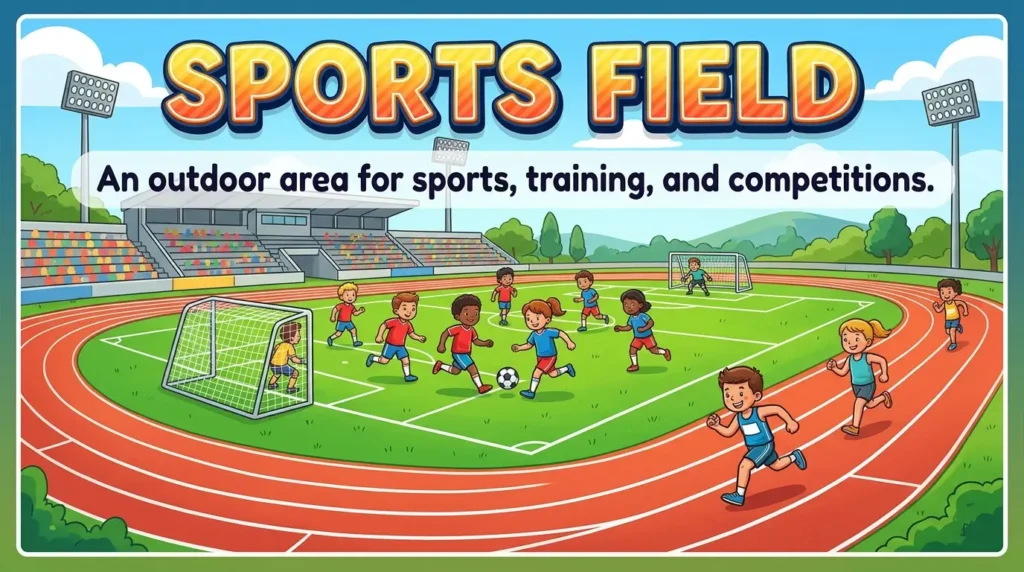
Athletic Field (Noun) — US: /æθˈletɪk fiːld/ | UK: /æθˈletɪk fiːld/
Meaning: An outdoor area used for sports, physical training, or athletic competitions.
Tone/Register: Neutral, educational, sports-related.
Examples:
The students gathered on the athletic field before practice.
The college renovated its athletic field last summer.
Village Green (Noun) — US: /ˈvɪlɪdʒ ɡriːn/ | UK: /ˈvɪlɪdʒ ɡriːn/
Meaning: A grassy public area in a village, traditionally used for community activities and relaxation.
Tone/Register: Traditional, descriptive, especially British English.
Examples:
Families gathered on the village green for the annual celebration.
The historic village green stands beside the old church.
Town Green (Noun) — US: /ˈtaʊn ɡriːn/ | UK: /ˈtaʊn ɡriːn/
Meaning: An open grassy area within a town that serves as a shared community space.
Tone/Register: Neutral, community-focused.
Examples:
The farmers’ market takes place on the town green.
Residents met there to celebrate the local festival.
Urban Park (Noun) — US: /ˈɝːbən pɑːrk/ | UK: /ˈɜːbən pɑːk/
Meaning: A recreational green area situated within a city or densely populated urban environment.
Tone/Register: Formal, geographical, urban planning.
Examples:
The new urban park gives residents space to exercise.
City officials want to add more trees to the urban park.
Pocket Park (Noun) — US: /ˈpɑːkɪt pɑːrk/ | UK: /ˈpɒkɪt pɑːk/
Meaning: A small public green space created within a built-up neighborhood.
Tone/Register: Urban planning, descriptive.
Examples:
The neighborhood converted an empty lot into a pocket park.
Office workers visit the pocket park during their lunch breaks.
Memorial Park (Noun) — US: /məˈmɔːriəl pɑːrk/ | UK: /məˈmɔːriəl pɑːk/
Meaning: A park established to honor people or commemorate important historical events.
Tone/Register: Formal, commemorative.
Examples:
The family visited the memorial park to pay their respects.
A stone monument stands at the center of the memorial park.
Heritage Park (Noun) — US: /ˈherɪtɪdʒ pɑːrk/ | UK: /ˈherɪtɪdʒ pɑːk/
Meaning: An outdoor area that preserves or presents historical buildings, cultural traditions, or local heritage.
Tone/Register: Historical, educational, formal.
Examples:
The heritage park displays traditional buildings from the region.
Students visited the site to learn about local history.
Sculpture Garden (Noun) — US: /ˈskʌlptʃər ˈɡɑːrdən/ | UK: /ˈskʌlptʃə ˈɡɑːdən/
Meaning: An outdoor landscaped area where sculptures and other works of art are displayed.
Tone/Register: Artistic, descriptive, cultural.
Examples:
We admired modern artwork in the sculpture garden.
The museum’s sculpture garden is open to visitors.
Formal Garden (Noun) — US: /ˈfɔːrməl ˈɡɑːrdən/ | UK: /ˈfɔːməl ˈɡɑːdən/
Meaning: A carefully designed garden with symmetrical layouts, trimmed hedges, and organized planting patterns.
Tone/Register: Formal, descriptive, architectural.
Examples:
The palace is surrounded by a beautiful formal garden.
Neatly trimmed hedges frame the formal garden’s central pathway.
Rose Garden (Noun) — US: /ˈroʊz ˌɡɑːrdən/ | UK: /ˈrəʊz ˌɡɑːdən/
Meaning: A garden devoted mainly to growing and displaying different varieties of roses.
Tone/Register: Pleasant, descriptive, horticultural.
Examples:
The rose garden looks spectacular in early summer.
Visitors stopped to admire the fragrant flowers.
Japanese Garden (Noun) — US: /ˌdʒæpəˈniːz ˈɡɑːrdən/ | UK: /ˌdʒæpəˈniːz ˈɡɑːdən/
Meaning: A landscaped garden inspired by Japanese design traditions, often featuring rocks, water, and carefully arranged plants.
Tone/Register: Cultural, descriptive, educational.
Examples:
The Japanese garden features a peaceful pond and stone paths.
We enjoyed the carefully designed landscape during our visit.
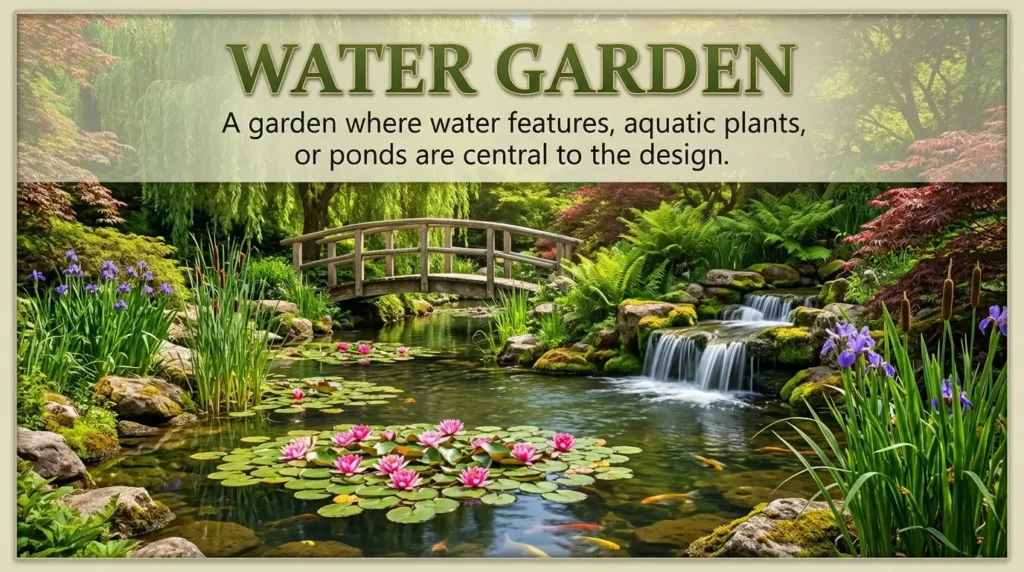
Water Garden (Noun) — US: /ˈwɔːtər ˌɡɑːrdən/ | UK: /ˈwɔːtə ˌɡɑːdən/
Meaning: A garden in which water features, aquatic plants, or ponds form an important part of the design.
Tone/Register: Descriptive, horticultural.
Examples:
The water garden attracts dragonflies throughout the summer.
A small fountain stands beside the aquatic plants.
Woodland Walk (Noun) — US: /ˈwʊdlənd wɔːk/ | UK: /ˈwʊdlənd wɔːk/
Meaning: A walking route through a wooded area, often provided for outdoor recreation and nature appreciation.
Tone/Register: Descriptive, outdoors, informal.
Examples:
We followed the woodland walk after breakfast.
The shaded route offers beautiful views of native trees.
Riverside Park (Noun) — US: /ˈrɪvərsaɪd pɑːrk/ | UK: /ˈrɪvəsaɪd pɑːk/
Meaning: A recreational green area situated beside a river.
Tone/Register: Descriptive, geographical.
Examples:
Cyclists gathered at the riverside park on Sunday morning.
The riverside park offers lovely views of the water.
Waterfront Park (Noun) — US: /ˈwɔːtərˌfrʌnt pɑːrk/ | UK: /ˈwɔːtəfrʌnt pɑːk/
Meaning: A public recreational area located beside a waterfront, such as a lake, river, or sea.
Tone/Register: Descriptive, urban planning, travel writing.
Examples:
Tourists enjoyed the sunset from the waterfront park.
The city added benches along the waterfront pathway.
Caravan Park (Noun) — US: /ˈkærəˌvæn pɑːrk/ | UK: /ˈkærəvæn pɑːk/
Meaning: An area where caravans or recreational vehicles can stay, usually with facilities for travelers.
Tone/Register: Travel-related, British English, informal.
Examples:
We booked a pitch at a caravan park near the coast.
The caravan park provides showers and shared cooking facilities.
RV Park (Noun) — US: /ˌɑːr ˈviː pɑːrk/ | UK: /ˌɑːr ˈviː pɑːk/
Meaning: A designated area where recreational vehicles can park overnight or for longer stays, often with utility connections.
Tone/Register: Informal, travel-related, American English.
Examples:
The travelers stayed at an RV park outside the city.
Each site at the RV park has an electrical hookup.
Lay-by (Noun) — US: /ˈleɪˌbaɪ/ | UK: /ˈleɪbaɪ/
Meaning: A space beside a road where drivers can stop temporarily, especially in British English.
Tone/Register: Neutral, driving-related, British English.
Examples:
The driver stopped in a lay-by to check the map.
We took a short break at a roadside lay-by.
Pull-Off (Noun) — US: /ˈpʊlˌɔːf/ | UK: /ˈpʊlˌɒf/
Meaning: A small area beside a road where vehicles can stop safely, often to rest or enjoy a view.
Tone/Register: Informal, American English, travel-related.
Examples:
We stopped at a scenic pull-off overlooking the valley.
The highway has a pull-off for drivers who need a break.
Garage (Noun) — US: /ɡəˈrɑːʒ/ | UK: /ˈɡærɑːʒ/
Meaning: A building or enclosed space where a vehicle is kept; it can serve as an alternative to a parking location in suitable contexts.
Tone/Register: Neutral, everyday.
Examples:
She keeps her car in the garage overnight.
We cleared the garage to make room for the new vehicle.
Depot (Noun) — US: /ˈdiːpoʊ/ | UK: /ˈdepəʊ/
Meaning: A place where vehicles, equipment, or supplies are stored or kept when not in use.
Tone/Register: Formal, business, transport-related.
Examples:
The delivery vans return to the depot every evening.
The transport company built a new depot outside town.
Greenbelt (Noun) — US: /ˈɡriːnˌbelt/ | UK: /ˈɡriːnˌbelt/
Meaning: An area of open land with grass, trees, or vegetation that separates developed areas or provides natural space.
Tone/Register: Environmental, formal, urban planning.
Examples:
The city plans to protect the greenbelt around its outskirts.
Residents enjoy walking along the tree-lined greenbelt.
Choosing by Mood: Park Words From Peaceful to Practical
Tone decides how a reader pictures your scene before you add a single detail. A word that sounds lovely in a poem can sound silly in a planning report, so pick from the group that matches your audience.
Words That Make a Place Sound Lovely
Garden: cultivated, flower-filled, and cared for. Green space: fresh and environmental, the language of healthy cities. Botanical garden: a place of plant collections, learning, and quiet paths. Nature reserve: protected land where wildlife comes first. Parkland: broad, scenic, and slightly grand, the word of country estates and sweeping views.
Plain, Factual Choices
Recreation area: built for leisure and activities. Public garden: a garden anyone may enter. Open space: land that has not been built on. Grounds: the land surrounding a building such as a school or hospital. Parking area and parking lot (American) or car park (British): purely functional words for leaving vehicles. Position and leave serve the verb sense without fuss.
For Reports, Essays, and Research
Arboretum: a scientific collection of trees. Preserve: land protected for its wildlife or scenery. National park and state park: official designations for protected areas managed by government. Station works as a formal verb when people, vehicles, or equipment are placed at a set point.
Everyday Talk
Pull over: bring a vehicle to the side of the road and stop. Leave: the all-purpose verb, as in “Leave the car at the station.” Set aside: park an idea, a task, or a disagreement until later. Store: keep something somewhere safe until it is needed.
Match the word to the moment and your sentence will sound natural instead of forced.
Park, Garden, or Recreation Area? The Real Differences
Three words are often treated as interchangeable, and they are not. The table below separates them:
| Word | Main difference | Best use |
|---|---|---|
| Park | A general term for a recreational place or the act of leaving a vehicle | Everyday conversation |
| Garden | A place where plants are cultivated | Flowers, landscaping, and botanical attractions |
| Recreation area | A place designed for leisure and activities | Travel guides, public information, and planning |
Read the examples closely. “We visited the park” is broad and friendly, good for almost any green outing. “We visited the garden” tells the reader to expect planted beds, paths, and deliberate design. “We visited the recreation area” points to facilities: courts, pitches, picnic shelters, perhaps a boating lake.
The verb side has its own traps. To park is to leave the vehicle and walk away. To pull over is only to stop at the roadside, engine often still running, usually for a moment. To position is to place something deliberately and precisely, which is why it sounds technical in everyday speech.
Same Word, Different Scene: Park in Daily Life
Talking With Friends and Family
At home, park needs no explanation. We arrange to meet at one, walk the dog in one, and argue about where to leave the car near one. “I’ll park by the gate” is all the detail a friend ever needs.
Travel Blogs and Articles
Travel writing lives on precision. A blogger who swaps park for garden, parkland, green space, or nature reserve gives readers four different photographs instead of one blurred image. “The botanical garden keeps a collection of native orchids” tells a traveller exactly why the trip is worth making.
Reports and Research Papers
Planners and scientists cannot afford the blur. An urban study will speak of public open space, an ecologist of a nature reserve or protected habitat, and a botanist of an arboretum. Each term carries a definition that other professionals can measure and cite.
Stories and Novels
Fiction writers use the choice of word to set a mood before anything happens. A couple meeting in a quiet garden promises romance; teenagers gathering at a recreation area promises noise and energy. The place word quietly writes the first paragraph of the scene.
Traps Learners Fall Into With “Park”
1. Calling Every Green Place a Park
A garden is planted and tended, an arboretum is a tree collection, and a nature reserve exists to protect wildlife. They may all be green, but they are not interchangeable. If the place is famous for its flower beds, botanical garden is the honest word.
2. Mixing Up “Park” and “Pull Over”
You park when you leave the vehicle, often for an hour or a day. You pull over when you stop briefly at the roadside and stay with the car. “I parked outside the office” covers the working day; “I pulled over to take the call” covers two minutes.
3. Forgetting the Atlantic Divide
Car park is the everyday British term; parking lot is the American one. Neither is wrong, but mixing them in one document looks careless. Choose the variety your readers speak and stay with it.
4. Sounding Like a Manual at the Dinner Table
Station and position belong to instructions and logistics. Telling a friend to “position the car near the entrance” sounds like a military briefing. “Park near the entrance” is what people actually say.
Register Notes
Formal writing leans on preserve, arboretum, recreation area, and open space. Informal speech runs on park, garden, parking lot, and pull over. British readers expect car park; American readers expect parking lot. Scientific writing prefers nature reserve, botanical garden, and protected area.
“Park” at Work in Four Short Scenes
Workplace
A facilities manager emails the whole office before a busy Monday: “From tomorrow, please use the staff parking area behind the main building.” One precise phrase ends a week of blocked driveways.
Social Situations
Two old friends plan a slow Sunday. “Let’s skip the mall and meet in the public garden after lunch,” one suggests, and the whole afternoon changes character.
Media and Travel Writing
A travel feature opens on a protected valley: “The nature reserve offers a peaceful escape from the crowded city, with marked trails and not a single souvenir stall.” Readers can already hear the quiet.
Writing and Storytelling
A novelist sets a farewell scene: “They sat on the same bench in the park where they had first met, watching the light go down over the lake.” The familiar word carries the whole history of the place.
Notice how each scene sharpens when the general word gives way to the exact one.
Frequently Asked Questions
1. What is the best synonym for park in formal writing?
The best alternative depends on the location being described. Recreation area suits places designed for leisure, while public open space works well in urban planning. Use nature reserve for protected natural habitats and botanical garden for collections of plants. In formal writing, choose the term that accurately describes the location rather than replacing park automatically.
2. What is another word for park when referring to a car?
Common alternatives depend on the action. Leave describes allowing a vehicle to remain somewhere, while position emphasizes where it is placed. Pull over means moving to the side of the road and stopping temporarily. For example, “Leave your car near the entrance” is natural, but “Pull over safely” describes a roadside stop.
3. What is the difference between a park and a nature reserve?
A park generally provides space for recreation, relaxation, and outdoor activities. A nature reserve focuses on protecting wildlife, plants, or natural habitats. Some parks also conserve nature, but their rules and purposes vary. A nature reserve may restrict certain activities to protect sensitive ecosystems, so the two terms should not be treated as exact equivalents.
4. What is the difference between a car park and a parking lot?
Both expressions describe a designated place for vehicles. Car park is standard in British English and is also used in several other English-speaking regions. Parking lot is the more familiar term in American English. Choose the expression that matches your audience, particularly when writing travel information, directions, or local guides.
5. Can park be used as a verb in professional English?
Yes. Park is common in professional English when discussing vehicles, equipment, or temporarily postponed topics. For example, a manager might say, “Let’s park that question until the next meeting.” This figurative expression is conversational and widely understood. In highly formal writing, defer discussion of the issue may be more suitable.
6. What is a good synonym for park in an environmental science essay?
The appropriate word depends on the subject. Use green space when discussing vegetation in urban areas, arboretum for a collection of trees, and nature reserve for protected habitats. Protected area is another useful general term when discussing conservation. Accurate terminology makes scientific writing clearer and avoids confusing recreational land with conservation sites.
7. How can I avoid repeating the word park in an essay?
First, identify what the word means in each sentence. If it describes a garden, use garden where appropriate. If it refers to a protected habitat, consider nature reserve. For a vehicle, use leave or pull over only when the meaning matches. Replacing words selectively improves variety without making your writing unnatural.
The Word to Take With You
Park is a useful word, but it is only the starting point. Garden, green space, nature reserve, and recreation area each hand your reader a different scene, and leave, position, and pull over describe three genuinely different actions. Choosing between them is not decoration; it is accuracy.
Try it today. Take one sentence you would normally write with park in it and rewrite it with the most exact alternative you can find. That single habit, repeated, is how a vocabulary quietly grows up.
External Link
For reliable definitions, pronunciation, and examples, consult these established English-language resources:
- Cambridge Dictionary, Look up meanings and British and American pronunciations.
- Merriam-Webster, Explore definitions, usage, and word history.
- Oxford Learner’s Dictionaries, Study learner-friendly definitions and examples.

Aleesha Rani is a passionate language writer focused on making English vocabulary simple, useful, and engaging. She creates clear content on synonyms, word meanings, and practical language use.
Through vocaneest.com, Aleesha Rani shares original, reader-friendly resources that help students, writers, and English learners choose better words and communicate with confidence.