

A synonym for patriot is a word or phrase that describes someone who loves, supports, or feels devoted to their country. Common alternatives include nationalist, loyal citizen, country lover, patriot-hearted citizen, and patriotic person. The best choice depends on the context and emotional tone.
Imagine a student standing proudly during the national anthem. They respect their country’s history and hope to contribute to its future. You might describe this student as a patriot or a devoted citizen.
The word patriot is commonly used in conversations about national identity, public service, history, and civic responsibility. Learning its alternatives helps you express these ideas more clearly.
If you are a student, blogger, or content writer, knowing another synonym for patriot can make your essays and articles more engaging. It also helps you avoid repeating the same word.
In daily English, synonyms help you choose words that express loyalty, pride, or devotion with greater accuracy. Understanding their differences makes your writing more natural and your conversations more meaningful.
What Does “Patriot” Really Mean?
A patriot is a person who loves their country and feels loyal to it. Patriots may show their commitment by serving their communities, respecting national traditions, protecting their country’s interests, or working to improve society.
The noun can describe anyone who feels a strong connection to their homeland. It does not require military service, political membership, or public recognition.
For example, a teacher who educates children, a volunteer who supports local communities, and a citizen who works to improve public services may all express patriotism.
Native English speakers generally understand patriot as a positive word. However, its meaning can depend on context. Some people use it to celebrate civic responsibility, while others may use it in political arguments about national identity.
Part of Speech
Patriot is a countable noun.
- Singular: patriot
- Plural: patriots
- Related noun: patriotism
- Related adjective: patriotic
- Related adverb: patriotically
Simple definition: A patriot is someone who loves their country and wants to support its well-being.
Examples:
- My grandfather was a patriot who served his community for decades.
- She considers honest public service an important part of being a patriot.
Connotative Meaning of Patriot
(Connotation is the emotional feeling or association a word carries beyond its basic dictionary meaning.)
Positive tone: Patriot often suggests courage, loyalty, sacrifice, public service, and love of country.
Negative tone: The word itself is not inherently negative. However, it can be used critically when someone claims patriotic motives to justify hostility, exclusion, or unquestioning obedience.
Neutral tone: In history books, news reports, and academic writing, patriot may simply describe a person who supports or identifies strongly with their country.
The key distinction is that patriotism does not automatically mean agreeing with every government decision. Someone may love their country while openly criticizing its policies.
Etymology of Patriot
The word patriot comes through French patriote from Latin and Greek word forms associated with one’s country, homeland, or ancestors. The Greek word patriōtēs referred to a fellow countryman.
The word’s historical development reflects the relationship between belonging to a community and feeling responsibility toward one’s homeland.
A Short History of Patriot
- Old English (450–1100): The modern word patriot was not established in Old English. Related ideas were expressed through words connected with kinship, native land, and belonging.
- Middle English (1100–1500): The word was not yet a common part of everyday English vocabulary. Expressions involving country, homeland, and loyalty conveyed similar ideas.
- Modern English (1500–present): Patriot entered English through French and became especially prominent in political discussions during the 17th and 18th centuries. It remains widely used in discussions of national identity, independence, and civic duty.
Pronunciation, Syllables, and Word Formation
US pronunciation: /ˈpeɪ.tri.ət/
UK pronunciation: /ˈpæt.ri.ət/ (a common British pronunciation; variants occur)
Syllables: pa-tri-ot
Affixation pattern
- Root: patri- — associated with a father, ancestors, or one’s homeland.
- Prefix: None in the word patriot.
- Suffix: The ending -ot belongs to the historical word form; it is not a productive English suffix in this word.
Related forms include patriotism, patriotic, and unpatriotic. In patriotism, the suffix -ism forms a noun describing a belief, principle, or attitude. In unpatriotic, the prefix un- expresses the opposite quality.
Synonyms List
The best synonym for patriot depends on what you want to emphasize. Some alternatives highlight love of country, while others focus on loyalty, public service, national identity, or political beliefs.
Not every alternative has exactly the same meaning. The notes below explain when each expression is appropriate.
Patriotic Person (Noun Phrase) — US / UK: /ˌpeɪ.triˈɑː.tɪk ˈpɝː.sən/ / /ˌpæt.riˈɒt.ɪk ˈpɜː.sən/
Meaning: A person who demonstrates love, pride, and commitment toward their country.
Tone/Register: Neutral, positive, everyday English.
Example:
She is a patriotic person who proudly celebrates her country’s history.
Being a patriotic person means caring about the nation’s future.

Loyal Citizen (Noun Phrase) — US / UK: /ˈlɔɪ.əl ˈsɪt̬.ə.zən/ / /ˈlɔɪ.əl ˈsɪt.ɪ.zən/
Meaning: A citizen who feels committed to their country and respects their civic responsibilities.
Tone/Register: Neutral, formal, civic.
Example:
He is a loyal citizen who always follows the law.
A loyal citizen can support the country while questioning unfair policies.
Devoted Citizen (Noun Phrase) — US / UK: /dɪˈvoʊ.t̬ɪd ˈsɪt̬.ə.zən/ / /dɪˈvəʊ.tɪd ˈsɪt.ɪ.zən/
Meaning: A citizen who gives time, effort, or service to the well-being of their country.
Tone/Register: Positive, respectful, slightly formal.
Example:
The devoted citizen spent years improving local schools.
Her volunteer work reflects the spirit of a devoted citizen.
Country Lover (Noun Phrase) — US / UK: /ˈkʌn.tri ˈlʌv.ɚ/ / /ˈkʌn.tri ˈlʌv.ə/
Meaning: A person who feels affection for their country and its people.
Tone/Register: Informal, simple, descriptive.
Example:
He is a country lover who enjoys learning about national traditions.
The phrase describes affection more than political beliefs.
Nationalist (Noun) — US / UK: /ˈnæʃ.ə.nəl.ɪst/ / /ˈnæʃ.ən.əl.ɪst/
Meaning: A person who strongly supports their nation’s interests, identity, or independence.
Tone/Register: Political, academic, context-dependent.
Example:
The nationalist argued that local industries should receive more support.
Historians studied the nationalist movement that sought independence.
Usage Note: A nationalist is not always identical to a patriot. Nationalism may involve political beliefs about national sovereignty or identity, and its tone can be positive or negative.
Ardent Patriot (Noun Phrase) — US / UK: /ˈɑːr.dənt ˈpeɪ.tri.ət/ / /ˈɑː.dənt ˈpæt.ri.ət/
Meaning: A person who feels intense love and loyalty toward their country.
Tone/Register: Formal, emphatic, positive.
Example:
The biography describes her as an ardent patriot.
An ardent patriot may dedicate years to public service.
Fervent Patriot (Noun Phrase) — US / UK: /ˈfɝː.vənt ˈpeɪ.tri.ət/ / /ˈfɜː.vənt ˈpæt.ri.ət/
Meaning: A patriot whose national pride and devotion are especially strong.
Tone/Register: Formal, expressive.
Example:
He remained a fervent patriot throughout his life.
Her speeches revealed the passion of a fervent patriot.
Public-Spirited Citizen (Noun Phrase) — US / UK: /ˌpʌb.lɪk ˈspɪr.ɪ.t̬ɪd ˈsɪt̬.ə.zən/ / /ˌpʌb.lɪk ˈspɪr.ɪ.tɪd ˈsɪt.ɪ.zən/
Meaning: A person who cares about the public good and actively contributes to the community.
Tone/Register: Formal, civic, positive.
Example:
The public-spirited citizen organized a neighborhood cleanup.
Public-spirited citizens can help communities become safer and stronger.
Civic-Minded Citizen (Noun Phrase) — US / UK: /ˈsɪv.ɪk ˌmaɪn.dɪd ˈsɪt̬.ə.zən/ / /ˈsɪv.ɪk ˌmaɪn.dɪd ˈsɪt.ɪ.zən/
Meaning: A person who takes an active interest in civic duties and the welfare of society.
Tone/Register: Academic, professional, positive.
Example:
The civic-minded citizen attended the town meeting.
Civic-minded citizens often participate in community projects.
Loyalist (Noun) — US / UK: /ˈlɔɪ.ə.lɪst/ / /ˈlɔɪ.ə.lɪst/
Meaning: A person who remains loyal to a particular government, ruler, institution, or cause.
Tone/Register: Historical, political, context-dependent.
Example:
The novel follows a loyalist during a period of political unrest.
Some loyalists defended the existing government during the conflict.
Usage Note: Loyalist is not a universal synonym for patriot. It identifies loyalty to a particular authority or cause.
Defender of the Homeland (Noun Phrase) — US / UK: /dɪˈfen.dɚ əv ðə ˈhoʊm.lænd/ / /dɪˈfen.də əv ðə ˈhəʊm.lænd/
Meaning: A person who protects their country from threats or works to safeguard its people.
Tone/Register: Respectful, formal, often military or historical.
Example:
The memorial honors every defender of the homeland.
She viewed protecting vulnerable communities as part of her duty as a defender of the homeland.
Homeland Defender (Noun Phrase) — US / UK: /ˈhoʊm.lænd dɪˈfen.dɚ/ / /ˈhəʊm.lænd dɪˈfen.də/
Meaning: Someone who actively protects their homeland and its security.
Tone/Register: Formal, patriotic, security-related.
Example:
The documentary tells the story of a homeland defender.
A homeland defender may serve in the military or another protective role.
Patriot at Heart (Noun Phrase) — US / UK: /ˈpeɪ.tri.ət æt hɑːrt/ / /ˈpæt.ri.ət ət hɑːt/
Meaning: Someone whose underlying feelings and values reflect love and devotion to their country.
Tone/Register: Warm, conversational, expressive.
Example:
Even after living abroad, she remained a patriot at heart.
His quiet community work showed that he was a patriot at heart.
Country-First Advocate (Noun Phrase) — US / UK: /ˈkʌn.tri fɝːst ˈæd.və.kət/ / /ˈkʌn.tri fɜːst ˈæd.və.kət/
Meaning: A person who argues that their country’s interests should take priority in policy decisions.
Tone/Register: Political, contemporary, context-dependent.
Example:
The country-first advocate called for changes to trade policy.
Her country-first position shaped her views on international agreements.
Usage Note: This expression describes a particular political outlook. It is not a neutral substitute for every use of patriot.
National Pride Supporter (Noun Phrase) — US / UK: /ˈnæʃ.ə.nəl praɪd səˈpɔːr.t̬ɚ/ / /ˈnæʃ.ən.əl praɪd səˈpɔː.tə/
Meaning: A person who encourages pride in a country’s history, culture, or achievements.
Tone/Register: Neutral, descriptive.
Example:
The national pride supporter organized a cultural exhibition.
She encourages national pride through educational programs.
Independence Supporter (Noun Phrase) — US / UK: /ˌɪn.dɪˈpen.dəns səˈpɔːr.t̬ɚ/ / /ˌɪn.dɪˈpen.dəns səˈpɔː.tə/
Meaning: A person who supports a country or territory becoming politically independent.
Tone/Register: Political, historical, academic.
Example:
The independence supporter joined peaceful demonstrations.
Many independence supporters believed self-government was essential.
Usage Note: This phrase fits contexts involving independence movements. It does not describe every patriot.
Freedom Fighter (Noun Phrase) — US / UK: /ˈfriː.dəm ˌfaɪ.t̬ɚ/ / /ˈfriː.dəm ˌfaɪ.tə/
Meaning: A person who fights against oppression or seeks political freedom for a group or nation.
Tone/Register: Political, historical, emotionally powerful.
Example:
The film portrays the freedom fighter’s struggle for independence.
Her grandfather was remembered by supporters as a freedom fighter.
Revolutionary (Noun) — US / UK: /ˌrev.əˈluː.ʃə.ner.i/ / /ˌrev.əˈluː.ʃən.ər.i/
Meaning: A person who seeks or takes part in major political or social change.
Tone/Register: Historical, political, formal.
Example:
The revolutionary challenged the old political system.
The museum displays letters written by revolutionary leaders.
Flag-Waver (Noun) — US / UK: /ˈflæɡˌweɪ.vɚ/ / /ˈflæɡˌweɪ.və/
Meaning: An informal term for someone who publicly displays great national pride, sometimes in an exaggerated or uncritical way.
Tone/Register: Informal, sometimes critical.
Example:
The columnist called the speech an example of flag-waving rhetoric.
He is a proud citizen, but he dislikes being labeled a flag-waver.
Jingoist (Noun) — US / UK: /ˈdʒɪŋ.ɡoʊ.ɪst/ / /ˈdʒɪŋ.ɡəʊ.ɪst/
Meaning: A person who aggressively supports their country’s power and often favors a hostile or belligerent foreign policy.
Tone/Register: Negative, political, critical.
Example:
The editorial criticized the jingoist’s aggressive rhetoric.
A jingoist may treat international disagreements as reasons for confrontation.
Chauvinist (Noun) — US / UK: /ˈʃoʊ.və.nɪst/ / /ˈʃəʊ.vɪ.nɪst/
Meaning: A person who shows excessive or prejudiced belief in the superiority of their own group, including their nation.
Tone/Register: Negative, critical.
Example:
The debate exposed the speaker’s chauvinist attitude toward other countries.
A chauvinist may dismiss other cultures without understanding them.
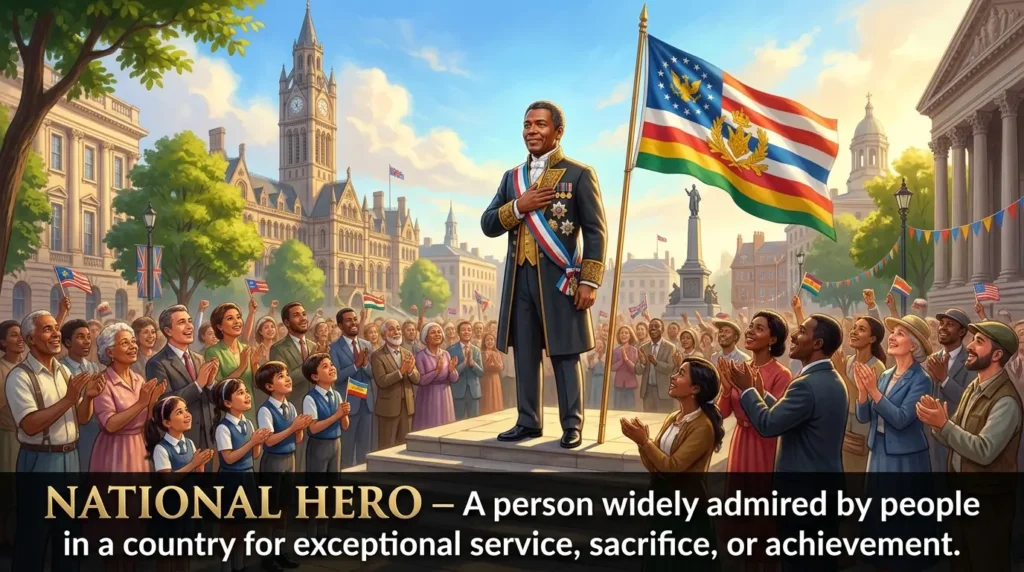
National Hero (Noun Phrase) — US / UK: /ˈnæʃ.ə.nəl ˈhɪr.oʊ/ / /ˈnæʃ.ən.əl ˈhɪə.rəʊ/
Meaning: A person widely admired by people in a country for exceptional service, sacrifice, or achievement.
Tone/Register: Respectful, celebratory.
Example:
The athlete became a national hero after the historic victory.
The history lesson explored how national heroes are remembered.
Devotee of the Nation (Noun Phrase) — US / UK: /ˌdev.əˈtiː əv ðə ˈneɪ.ʃən/ / /ˌdev.əˈtiː əv ðə ˈneɪ.ʃən/
Meaning: A person deeply devoted to their nation and its identity.
Tone/Register: Formal, literary, uncommon.
Example:
The historical account presents him as a devotee of the nation.
She wrote about the devotee of the nation who worked tirelessly for public welfare.
National Loyalist (Noun Phrase) — US / UK: /ˈnæʃ.ə.nəl ˈlɔɪ.ə.lɪst/ / /ˈnæʃ.ən.əl ˈlɔɪ.ə.lɪst/
Meaning: A person who strongly maintains allegiance to their nation or a national cause.
Tone/Register: Formal, political, context-dependent.
Example:
The novel follows a national loyalist during a constitutional crisis.
The national loyalist defended the country’s existing political arrangement.
Patriotic Citizen (Noun Phrase) — US / UK: /ˌpeɪ.triˈɑː.tɪk ˈsɪt̬.ə.zən/ / /ˌpæt.riˈɒt.ɪk ˈsɪt.ɪ.zən/
Meaning: A citizen who expresses love for their country through attitudes, actions, or public participation.
Tone/Register: Neutral, positive, everyday and formal.
Example:
A patriotic citizen respects the rights of fellow citizens.
The campaign encouraged every patriotic citizen to volunteer.
Country’s Well-Wisher (Noun Phrase) — US / UK: /ˈkʌn.triz ˌwelˈwɪʃ.ɚ/ / /ˈkʌn.triz ˌwelˈwɪʃ.ə/
Meaning: A person who sincerely hopes for their country’s peace, success, and prosperity.
Tone/Register: Warm, formal, slightly old-fashioned.
Example:
As a well-wisher of the country, she supported educational reform.
Every country’s well-wisher hopes for a peaceful future.
Patriot of the Homeland (Noun Phrase) — US / UK: /ˈpeɪ.tri.ət əv ðə ˈhoʊm.lænd/ / /ˈpæt.ri.ət əv ðə ˈhəʊm.lænd/
Meaning: A person whose loyalty and affection are directed toward their native land.
Tone/Register: Literary, formal, emphatic.
Example:
The poem celebrates the patriot of the homeland.
The author presents him as a patriot of the homeland who values peace.
National Servant (Noun Phrase) — US / UK: /ˈnæʃ.ə.nəl ˈsɝː.vənt/ / /ˈnæʃ.ən.əl ˈsɜː.vənt/
Meaning: A person who serves the public or national institutions in a role intended to benefit the country.
Tone/Register: Formal, civic, professional.
Example:
The national servant worked to improve rural education.
She described public service as an honor rather than a privilege.
Usage Note: A national servant may demonstrate patriotism, but the expression primarily describes service.
Patriot in Spirit (Noun Phrase) — US / UK: /ˈpeɪ.tri.ət ɪn ˈspɪr.ɪt/ / /ˈpæt.ri.ət ɪn ˈspɪr.ɪt/
Meaning: A person whose beliefs and actions reflect devotion to their country, even without formal recognition or public display.
Tone/Register: Warm, reflective, literary.
Example:
He never sought attention, yet he was a patriot in spirit.
Her commitment to fairness made her a patriot in spirit.
National Advocate (Noun Phrase) — US / UK: /ˈnæʃ.ə.nəl ˈæd.və.kət/ / /ˈnæʃ.ən.əl ˈæd.və.kət/
Meaning: A person who publicly supports the interests, welfare, or development of their nation.
Tone/Register: Formal, professional, political.
Example:
The national advocate called for better access to education.
As a national advocate, he promoted sustainable development.
Devotee /dɪˈvəʊ.tiː/ (UK) | /dɪˈvoʊ.tiː/ (US)
Meaning: A person who is deeply committed to a country, cause, or ideal.
Tone/Register: Positive; emphasizes strong dedication.
Example: She is a devotee of her country’s democratic values.
Nationalist /ˈnæʃ.ən.əl.ɪst/ (UK) | /ˈnæʃ.ən.əl.ɪst/ (US)
Meaning: A person who strongly supports their nation’s interests and identity.
Tone/Register: Political; can be positive or negative depending on context.
Example: The nationalist worked to protect the country’s independence.

Loyalist /ˈlɔɪ.ə.lɪst/ (UK) | /ˈlɔɪ.ə.lɪst/ (US)
Meaning: A person who remains faithful to a country, government, or leader.
Tone/Register: Formal; emphasizes loyalty.
Example: The loyalist defended his nation’s sovereignty.
Freedom Fighter /ˈfriː.dəm ˌfaɪ.tər/ (UK) | /ˈfriː.dəm ˌfaɪ.t̬ɚ/ (US)
Meaning: A person who fights to gain or protect freedom for their country or people.
Tone/Register: Respectful; associated with struggles for independence.
Example: The freedom fighter risked everything for national independence.
Independence Supporter /ˌɪn.dɪˈpen.dəns səˈpɔː.tər/ (UK) | /ˌɪn.dɪˈpen.dəns səˈpɔːr.t̬ɚ/ (US)
Meaning: A person who advocates for a nation’s freedom from foreign control.
Tone/Register: Neutral to positive; emphasizes self-government.
Example: The independence supporter organized peaceful demonstrations.
Countryman /ˈkʌn.tri.mən/ (UK) | /ˈkʌn.tri.mən/ (US)
Meaning: A person from the same country as another person.
Tone/Register: Neutral; expresses national connection rather than political devotion.
Example: He helped his countrymen during the national crisis.
National Advocate /ˈnæʃ.ən.əl ˈæd.və.kət/ (UK) | /ˈnæʃ.ən.əl ˈæd.və.kət/ (US)
Meaning: A person who actively supports and promotes their country’s interests.
Tone/Register: Formal; suitable for political and academic writing.
Example: The national advocate spoke about protecting local traditions.
Civic-Minded Citizen /ˌsɪv.ɪk ˈmaɪn.dɪd ˈsɪt.ɪ.zən/ (UK) | /ˌsɪv.ɪk ˈmaɪn.dɪd ˈsɪt̬.ə.zən/ (US)
Meaning: A person who takes an active interest in the welfare of their country and community.
Tone/Register: Positive; emphasizes public responsibility.
Example: A civic-minded citizen participates in community development.
Public-Spirited Citizen /ˌpʌb.lɪk ˈspɪr.ɪ.tɪd ˈsɪt.ɪ.zən/ (UK) | /ˌpʌb.lɪk ˈspɪr.ɪ.t̬ɪd ˈsɪt̬.ə.zən/ (US)
Meaning: A person who works for the benefit of society and the nation.
Tone/Register: Formal and complimentary.
Example: The public-spirited citizen volunteered to improve local schools.
National Defender /ˈnæʃ.ən.əl dɪˈfen.dər/ (UK) | /ˈnæʃ.ən.əl dɪˈfen.dɚ/ (US)
Meaning: A person who protects their country’s security, independence, or interests.
Tone/Register: Strong and respectful.
Example: The national defender stood firm during the conflict.
Homeland Defender /ˈhəʊm.lænd dɪˈfen.dər/ (UK) | /ˈhoʊm.lænd dɪˈfen.dɚ/ (US)
Meaning: Someone who protects their homeland against threats.
Tone/Register: Emotional and patriotic.
Example: The homeland defender inspired others with his courage.
Patriot at Heart /ˈpæt.ri.ət ət ˈhɑːt/ (UK) | /ˈpeɪ.tri.ət ət ˈhɑːrt/ (US)
Meaning: A person whose feelings and values reflect deep love for their country.
Tone/Register: Warm and expressive.
Example: Although she lived abroad, she remained a patriot at heart.
National Champion /ˈnæʃ.ən.əl ˈtʃæm.pi.ən/ (UK) | /ˈnæʃ.ən.əl ˈtʃæm.pi.ən/ (US)
Meaning: A person who actively promotes or defends their nation’s interests.
Tone/Register: Positive; often used in public or political contexts.
Example: The national champion campaigned for educational reform.
Country Advocate /ˈkʌn.tri ˈæd.və.kət/ (UK) | /ˈkʌn.tri ˈæd.və.kət/ (US)
Meaning: A person who speaks in support of their country and its welfare.
Tone/Register: Formal; emphasizes representation and support.
Example: As a country advocate, he promoted international cooperation.
Independence Activist /ˌɪn.dɪˈpen.dəns ˈæk.tɪ.vɪst/ (UK) | /ˌɪn.dɪˈpen.dəns ˈæk.tə.vɪst/ (US)
Meaning: A person who campaigns for national independence or freedom.
Tone/Register: Political; commonly associated with independence movements.
Example: The independence activist encouraged people to demand self-rule.
National Preservationist /ˈnæʃ.ən.əl ˌprez.əˈveɪ.ʃən.ɪst/ (UK) | /ˈnæʃ.ən.əl ˌprez.ɚˈveɪ.ʃən.ɪst/ (US)
Meaning: A person who seeks to preserve a nation’s cultural heritage, traditions, or identity.
Tone/Register: Formal; emphasizes cultural protection.
Example: The national preservationist worked to protect historical monuments.
Patriotic Supporter /ˌpæt.riˈɒt.ɪk səˈpɔː.tər/ (UK) | /ˌpeɪ.triˈɑː.t̬ɪk səˈpɔːr.t̬ɚ/ (US)
Meaning: A person who expresses strong support for their country.
Tone/Register: Positive and straightforward.
Example: Every patriotic supporter hoped for a peaceful future.
National Unity Advocate /ˈnæʃ.ən.əl ˈjuː.nɪ.ti ˈæd.və.kət/ (UK) | /ˈnæʃ.ən.əl ˈjuː.nə.t̬i ˈæd.və.kət/ (US)
Meaning: A person who promotes solidarity and cooperation among the people of a nation.
Tone/Register: Formal; emphasizes unity and social harmony.
Example: The national unity advocate encouraged people from different communities to work together.
Homeland Loyalist /ˈhəʊm.lænd ˈlɔɪ.ə.lɪst/ (UK) | /ˈhoʊm.lænd ˈlɔɪ.ə.lɪst/ (US)
Meaning: A person who demonstrates strong loyalty to their homeland.
Tone/Register: Expressive; emphasizes attachment and faithfulness.
Example: The homeland loyalist remained committed to serving his country.
Defender of National Interests /dɪˈfen.dər əv ˈnæʃ.ən.əl ˈɪn.trəsts/ (UK) | /dɪˈfen.dɚ əv ˈnæʃ.ən.əl ˈɪn.trəsts/ (US)
Meaning: A person who works to protect their country’s political, economic, or social interests.
Tone/Register: Formal; suitable for essays and political discussions.
Example: She became a defender of national interests during international negotiations.
Synonyms for Patriot by Tone
Word choice matters because two expressions can refer to similar ideas while creating different impressions.
Positive Synonyms
- Ardent patriot
- Fervent patriot
- Devoted citizen
- Patriotic person
- Public-spirited citizen
- Civic-minded citizen
- Patriot at heart
- Patriot in spirit
- Defender of the homeland
- Country’s well-wisher
These terms highlight affection, loyalty, sacrifice, civic responsibility, or commitment to national welfare.
Neutral Synonyms
- Loyal citizen
- Patriotic citizen
- National advocate
- National servant
- National pride supporter
- Patriot of the homeland
These expressions are useful for essays, educational materials, news writing, and general discussion.
Negative or Critical Terms
- Jingoist
- Chauvinist
- Flag-waver (sometimes critical)
These expressions should be used carefully. They suggest aggressive nationalism, prejudice, or exaggerated displays of national pride rather than ordinary love of country.
Political or Context-Specific Alternatives
- Nationalist
- Loyalist
- Independence supporter
- Freedom fighter
- Revolutionary
- Country-first advocate
These words describe particular political beliefs, allegiances, or historical roles. They are not interchangeable with patriot in every sentence.
Informal and Expressive Alternatives
- Country lover
- Patriot at heart
- Patriot in spirit
These phrases can work in personal conversations, speeches, and creative writing. Some are descriptive phrases rather than established one-word synonyms.
Patriot vs. Close Alternatives
| Word | Main meaning | Best use |
|---|---|---|
| Patriot | Someone who loves and supports their country | General conversation, essays, history |
| Nationalist | Someone who strongly supports national interests or identity | Political and historical discussion |
| Loyalist | Someone loyal to a particular authority or cause | Historical or political contexts |
| Jingoist | Someone who aggressively promotes national power | Criticism of hostile nationalism |
The main difference: A patriot can support their country’s welfare without believing it is superior to other countries. A nationalist emphasizes national identity or interests. A loyalist emphasizes allegiance, while a jingoist favors aggressive national assertiveness.
Which Word Should You Choose?
Use patriot when you want a familiar, broad term. Choose devoted citizen when civic service is central to the meaning.
Use nationalist when national identity or sovereignty is the main issue. Use jingoist only when you specifically mean aggressive or hostile nationalism.
How Patriot Synonyms Change by Context
Daily Conversation
In everyday speech, simple expressions sound the most natural. Patriotic person, loyal citizen, and devoted citizen are easy to understand.
For example, you might say, “My uncle is a devoted citizen who volunteers every weekend.” This sounds more specific than simply calling him a patriot.
Writing and Blogging
Bloggers can use patriot, patriotic citizen, and ardent patriot depending on the message. These words help avoid repetition while keeping the article focused.
For balanced writing, explain what the person actually does. Actions such as volunteering, helping communities, and supporting fair institutions give the word a clearer meaning.
Professional and Academic Writing
Academic writing benefits from precise terms. Civic-minded citizen works when discussing public participation, while nationalist is appropriate when analyzing national identity or sovereignty.
Avoid using emotionally charged words without evidence. Explain the person’s beliefs or actions instead of relying on labels alone.
Creative and Informal Writing
Stories, poems, and speeches allow more expressive alternatives. Patriot at heart creates a personal feeling, while defender of the homeland sounds dramatic and heroic.
In informal writing, country lover may be understandable, but it is less conventional than patriotic person. Choose an expression that fits the voice of your story.
Common Mistakes Learners Make
1. Treating Every Alternative as an Exact Synonym
Words such as nationalist, loyalist, and freedom fighter have specific meanings. They can describe patriots in some situations, but they do not mean exactly the same thing.
Better approach: Check whether the alternative describes love of country, political ideology, allegiance, or a particular action.
2. Assuming Patriot Means Military Hero
A patriot does not need to serve in the military. Teachers, doctors, volunteers, farmers, and ordinary citizens can demonstrate commitment to their country through their work.
Better approach: Consider civic service, community support, and responsible citizenship as well as military service.
3. Confusing Patriotism With Blind Loyalty
Loving a country does not require agreeing with every leader or government policy. Citizens may criticize harmful decisions because they want their country to improve.
Better approach: Distinguish loyalty to a country’s people and well-being from unconditional support for its government.
4. Using Negative Terms as Compliments
Calling someone a jingoist or chauvinist usually suggests criticism. These words are unsuitable when you simply want to praise someone’s love of country.
Better approach: Use devoted citizen, patriotic person, or ardent patriot for a positive meaning.
5. Overusing Patriot in an Essay
Repeating patriot in every paragraph makes writing sound limited. However, replacing it with a loosely related term can change the meaning.
Better approach: Alternate between the original word, accurate descriptions, and specific examples of the person’s actions.
Register Notes: Formal vs. Informal
- Formal: ardent patriot, civic-minded citizen, public-spirited citizen.
- Everyday: patriot, patriotic person, loyal citizen.
- Political: nationalist, loyalist, independence supporter.
- Critical: jingoist, chauvinist, sometimes flag-waver.
- Literary: patriot at heart, patriot in spirit, defender of the homeland.
In spoken English, patriot and patriotic person are familiar choices. In academic writing, more specific terms often communicate ideas with greater precision.
For more vocabulary practice, you can connect this topic to an internal article about synonyms for loyal, if that article is available on your website.
Real-Life Mini Scenarios Using Patriot
Workplace
A teacher gives extra time to students from disadvantaged backgrounds. Her colleagues describe her as a public-spirited citizen because she cares about the community’s future.
Social situations
A group of neighbors cleans a public park. One volunteer calls them devoted citizens who want to make their country a better place.
Media and history
A documentary examines a person who campaigned for independence. The narrator calls the person an independence supporter, explaining the political goal rather than assuming all patriots share it.
Writing and storytelling
A novelist describes a quiet character who serves the community without seeking praise. The phrase patriot at heart captures the character’s private devotion.
Interactive Practice Quiz
Test your understanding with these real-life situations. Select the word or phrase that best fits each sentence.
Reflection Task
Write one sentence about a person who contributes to their country. Use one synonym for patriot that fits the person’s actions. Then explain why you chose that word.
Answer key: 1. Patriot; 2. Public-spirited citizen; 3. Nationalist; 4. Jingoist; 5. Loyalist; 6. Devoted citizen; 7. Patriot in spirit; 8. Independence supporter; 9. Chauvinist; 10. Civic-minded citizens; 11. National hero; 12. Patriot.
Conclusion
Learning a synonym for patriot helps you express love of country with greater accuracy. Words such as devoted citizen and ardent patriot add meaning and variety to your writing.
The right vocabulary can make essays, blogs, speeches, and daily conversations more engaging. It also helps you explain the difference between patriotism, nationalism, and civic responsibility.
Remember that words carry different emotional tones. Choose expressions that match your message, and use examples to show what loyalty and service mean in real life.
Keep practicing by using these synonyms in your emails, essays, and conversations. Try writing one sentence each day and discover how a richer vocabulary makes communication clearer.
Frequently Asked Questions
1. What is the best synonym for patriot in an essay?
The best synonym depends on your essay’s subject. Devoted citizen works well when discussing public service, while ardent patriot emphasizes strong love of country. If your essay explores political identity, nationalist may be suitable, but explain the specific beliefs involved. For general academic writing, patriotic citizen is a clear and accessible alternative.
2. What is a synonym for patriot that describes someone who serves their country?
Devoted citizen and public-spirited citizen are useful expressions for someone who contributes to their country’s welfare. A person may demonstrate patriotism through teaching, healthcare, volunteering, public service, or community development. These terms emphasize practical contributions rather than simply expressing national pride.
3. Is patriot a positive or negative word?
Patriot is generally positive or neutral. It often suggests love of country, loyalty, and civic responsibility. However, the surrounding context can affect how readers interpret it. If someone uses patriotic language to justify discrimination or aggression, the message may be viewed critically. The word itself does not automatically imply extreme nationalism.
4. What is the difference between patriotism and nationalism?
Patriotism generally refers to love of or devotion to one’s country. Nationalism emphasizes national identity, sovereignty, or the interests of a nation. The two ideas can overlap, but they are not identical. Nationalism can take different forms, ranging from independence movements to exclusionary political ideologies. Context is essential when interpreting either term.
5. What is a one-word synonym for patriot?
Nationalist is one possible alternative, but it is not an exact synonym in every context. A nationalist typically emphasizes national identity or interests. Loyalist is another option when allegiance to a particular authority or cause matters. For a straightforward, positive meaning, patriot itself or the phrase patriotic person is often more accurate.
6. What is a synonym for patriot in a historical context?
Historical writing may use independence supporter, loyalist, revolutionary, or freedom fighter, depending on the person’s role. These terms are not interchangeable. An independence supporter favors political independence, while a loyalist supports a particular authority or cause. A revolutionary seeks major political or social change. Always consider the historical circumstances.
7. Can someone criticize their government and still be a patriot?
Yes. Patriotism does not require unquestioning support for every government or political leader. A person may criticize policies because they believe those policies harm the public or undermine national values. Peaceful participation, honest discussion, and efforts to improve society can all reflect commitment to a country’s long-term well-being.
External Link
For a reliable educational reference, link to the Merriam-Webster dictionary entry for patriot. It can help readers explore the word’s definition, pronunciation, and usage.

Aqsa Rani is the founder and lead writer at VocaNeest.com, a trusted platform dedicated to helping people improve their English vocabulary and communication skills. She creates well-researched, accurate, and easy-to-understand content covering synonyms, antonyms, word meanings, idioms, phrases, and everyday vocabulary. Her goal is to make learning English simple, practical, and accessible for students, writers, professionals, and lifelong learners.
At VocaNeest.com, every article is carefully researched, fact-checked, and written with a strong focus on accuracy, clarity, and real-world usage. Content is regularly reviewed and updated to ensure it remains helpful, relevant, and aligned with modern language standards. Through reliable vocabulary guides and practical examples, Aqsa aims to help readers write with confidence, expand their vocabulary, and communicate more effectively.