
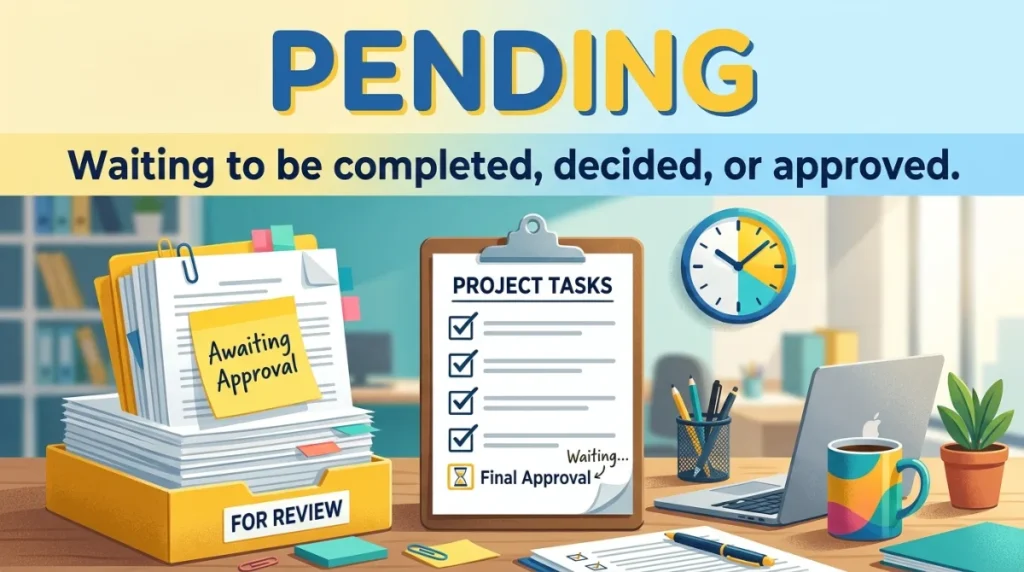
The best synonym for pending depends on what is waiting: use awaiting for a decision not yet made, outstanding for unfinished work or payments, unresolved for a dispute with no answer, and tentative for a plan that may change. Choose the word that fits the delay, and your sentence shows exactly how unfinished things are.
A synonym for pending is a word or phrase that describes something waiting to happen, awaiting a decision, or not yet completed. Common alternatives include awaiting, outstanding, unresolved, forthcoming, and undecided. The best choice depends on the situation and the intended meaning.
A synonym for pending is a useful search when you want to express that something has not been completed yet. Imagine waiting for a job application result. Your application is still pending, but you can also say it is awaiting a decision.
The word pending appears frequently in emails, online orders, bank transactions, legal documents, and academic writing. Learning alternatives helps you explain delays and unfinished tasks more clearly.
For students and bloggers, choosing the right synonym makes writing more precise. Content writers can avoid repetition, while everyday English users can communicate updates naturally in conversations and messages.
When you understand each synonym’s meaning and tone, you can choose words that fit formal reports, friendly conversations, or professional emails. Let’s explore the most useful alternatives and learn how to use them correctly.
What Does “Pending” Really Mean?
Pending means waiting for something to happen, receive approval, reach a decision, or become complete. It describes a situation that remains unfinished because an action, response, or outcome is still expected.
For example, if your university application is pending, the university has not yet announced its final decision. If a payment is pending, the transaction may still be processing or awaiting confirmation.
Part of Speech
- Adjective: A pending application needs further review.
- Preposition: The meeting was postponed pending further investigation. In this use, pending means “until” or “while waiting for” a particular event or decision.
How Native Speakers Understand It
Native English speakers generally understand pending as a neutral word. It does not automatically mean that something has gone wrong. It simply indicates that a process, decision, or event has not reached its expected outcome.
Common contexts include pending payments, pending approvals, pending cases, pending requests, pending decisions, and pending changes.
Connotative Meaning of Pending
Connotation (the emotional or cultural associations connected with a word beyond its basic definition) helps explain how a word feels to readers.
- Positive tone: Pending may suggest that a desirable result is approaching, such as a pending promotion.
- Negative tone: It can create concern when connected with a delayed payment, unresolved complaint, or pending court case.
- Neutral tone: In most professional contexts, it simply describes an unfinished process without expressing approval or criticism.
The surrounding context determines the emotional effect. The word itself is not inherently positive or negative.
Etymology of Pending
The word pending comes through French from Latin pendere, meaning “to hang.” The underlying idea is that something remains suspended or unsettled while awaiting an outcome.
Historical Development
- Old English (450–1100): The modern word pending was not a regular part of Old English vocabulary. English used other expressions to describe waiting and unfinished situations.
- Middle English (1100–1500): French and Latin influences expanded English vocabulary, especially in law and administration. Related forms associated with hanging, suspension, and dependence became more established.
- Modern English (1500–present): Pending developed into a common term for matters awaiting action or resolution. It remains widely used in legal, financial, administrative, and everyday communication.
Pronunciation, Syllables, and Word Structure
- US IPA: /ˈpɛn.dɪŋ/
- UK IPA: /ˈpen.dɪŋ/
- Syllables: pend-ing
- Root: pend, associated with hanging or suspension.
- Prefix: None in the modern word.
- Suffix: -ing, forming the present participle of pend and functioning as an adjective in modern usage.
Synonyms List
The best synonym depends on whether something is waiting for approval, remains unfinished, or has not yet been decided. These alternatives are grouped by meaning to help you choose accurately.
Awaiting (Verb) — US / UK: /əˈweɪ.tɪŋ/ / /əˈweɪ.tɪŋ/
Meaning: Waiting for an event, response, decision, or action to happen.
Tone/Register: Neutral, professional, and conversational.
Example:
Your application is awaiting approval.
I am awaiting a reply from the admissions office.

Outstanding (Adjective) — US / UK: /aʊtˈstæn.dɪŋ/ / /aʊtˈstæn.dɪŋ/
Meaning: Not yet paid, completed, or resolved.
Tone/Register: Professional and business-oriented.
Example:
You still have two outstanding assignments.
The company contacted us about an outstanding payment.
Unresolved (Adjective) — US / UK: /ˌʌn.rɪˈzɑːlvd/ / /ˌʌn.rɪˈzɒlvd/
Meaning: Not yet settled or brought to a satisfactory conclusion.
Tone/Register: Formal, academic, and professional.
Example:
The investigation revealed several unresolved questions.
We need to address this unresolved complaint.
Unsettled (Adjective) — US / UK: /ʌnˈset̬.əld/ / /ʌnˈset.əld/
Meaning: Not yet decided, resolved, or finalized.
Tone/Register: Neutral to formal.
Example:
The details of the agreement remain unsettled.
Several issues are still unsettled after the meeting.
Undecided (Adjective) — US / UK: /ˌʌn.dɪˈsaɪ.dɪd/ / /ˌʌn.dɪˈsaɪ.dɪd/
Meaning: Not yet determined because a decision has not been made.
Tone/Register: Neutral and conversational.
Example:
The committee is still undecided about the proposal.
I am undecided about which course to choose.
Unconfirmed (Adjective) — US / UK: /ˌʌn.kənˈfɝːmd/ / /ˌʌn.kənˈfɜːmd/
Meaning: Not officially verified or confirmed yet.
Tone/Register: Neutral, formal, and administrative.
Example:
The interview date is still unconfirmed.
We cannot publish the unconfirmed results yet.
Incomplete (Adjective) — US / UK: /ˌɪn.kəmˈpliːt/ / /ˌɪn.kəmˈpliːt/
Meaning: Not finished or not containing all the required parts.
Tone/Register: Neutral and academic.
Example:
Your application is incomplete because one document is missing.
The report remains incomplete until we add the final section.
Unfinished (Adjective) — US / UK: /ʌnˈfɪn.ɪʃt/ / /ʌnˈfɪn.ɪʃt/
Meaning: Not yet brought to completion.
Tone/Register: Neutral and informal.
Example:
I have several unfinished tasks to complete today.
The renovation is still unfinished.
Unprocessed (Adjective) — US / UK: /ˌʌnˈprɑː.sest/ / /ˌʌnˈprəʊ.sest/
Meaning: Not yet handled or processed by the relevant system or person.
Tone/Register: Technical and administrative.
Example:
Your refund request is still unprocessed.
The office received several unprocessed applications this morning.
Unapproved (Adjective) — US / UK: /ˌʌn.əˈpruːvd/ / /ˌʌn.əˈpruːvd/
Meaning: Not yet given official permission or approval.
Tone/Register: Formal and professional.
Example:
The manager cannot release funds for an unapproved project.
Our travel request remains unapproved.

Unfinalized (Adjective) — US / UK: /ˌʌnˈfaɪ.nə.laɪzd/ / /ˌʌnˈfaɪ.nə.laɪzd/
Meaning: Not yet completed or confirmed in its final form.
Tone/Register: Professional and administrative.
Example:
The event schedule is still unfinalized.
We will share the unfinalized draft with the team for review.
Provisional (Adjective) — US / UK: /prəˈvɪʒ.ən.əl/ / /prəˈvɪʒ.ən.əl/
Meaning: Arranged or accepted temporarily until a final decision is made.
Tone/Register: Formal and academic.
Example:
The university issued a provisional admission letter.
These are provisional dates, so please check before booking.
Tentative (Adjective) — US / UK: /ˈten.tə.tɪv/ / /ˈten.tə.tɪv/
Meaning: Planned or suggested but not yet firmly confirmed.
Tone/Register: Neutral and professional.
Example:
We have a tentative meeting date for Friday.
The launch schedule is tentative until the director approves it.
Conditional (Adjective) — US / UK: /kənˈdɪʃ.ən.əl/ / /kənˈdɪʃ.ən.əl/
Meaning: Dependent on a particular requirement or event being satisfied.
Tone/Register: Formal, legal, and academic.
Example:
Her admission is conditional on submitting the final transcript.
The offer remains conditional until the documents are verified.
Unconcluded (Adjective) — US / UK: /ˌʌn.kənˈkluː.dɪd/ / /ˌʌn.kənˈkluː.dɪd/
Meaning: Not yet brought to a conclusion.
Tone/Register: Formal and relatively uncommon.
Example:
The discussion remained unconcluded after the allotted time.
Several matters were left unconcluded in the final report.
Outstanding (Adjective, for tasks or issues) — US / UK: /aʊtˈstæn.dɪŋ/ / /aʊtˈstæn.dɪŋ/
Meaning: Still requiring attention, action, or completion.
Tone/Register: Professional and administrative.
Example:
Please list the outstanding issues before the next meeting.
One outstanding question needs an answer.
In Abeyance (Phrase) — US / UK: /ɪn əˈbeɪ.əns/ / /ɪn əˈbeɪ.əns/
Meaning: Temporarily suspended or left undecided until further action is possible.
Tone/Register: Formal, legal, and administrative.
Example:
The application was held in abeyance during the review.
The committee kept the proposal in abeyance until more evidence arrived.
On Hold (Phrase) — US / UK: /ɑːn hoʊld/ / /ɒn həʊld/
Meaning: Temporarily paused while waiting for a decision or action.
Tone/Register: Common, conversational, and professional.
Example:
The project is on hold until funding is available.
My delivery has been put on hold because of a stock issue.
In Progress (Phrase) — US / UK: /ɪn ˈprɑː.ɡres/ / /ɪn ˈprəʊ.ɡres/
Meaning: Currently being worked on but not yet finished.
Tone/Register: Neutral and professional.
Example:
Your document is still in progress.
The research project is in progress, and the team expects more results soon.
In Review (Phrase) — US / UK: /ɪn rɪˈvjuː/ / /ɪn rɪˈvjuː/
Meaning: Being examined before a decision or approval is given.
Tone/Register: Professional and administrative.
Example:
Your scholarship application is in review.
The editor has placed the article in review.
Under Consideration (Phrase) — US / UK: /ˈʌn.dɚ kənˌsɪd.əˈreɪ.ʃən/ / /ˈʌn.də kənˌsɪd.əˈreɪ.ʃən/
Meaning: Being carefully considered before a final decision is made.
Tone/Register: Formal and professional.
Example:
Your research proposal is under consideration.
Several candidates are under consideration for the position.
Awaiting Approval (Phrase) — US / UK: /əˈweɪ.tɪŋ əˈpruː.vəl/ / /əˈweɪ.tɪŋ əˈpruː.vəl/
Meaning: Waiting for an authorized person or body to approve something.
Tone/Register: Professional and administrative.
Example:
The budget is awaiting approval from the director.
My leave request is awaiting approval.

Awaiting Confirmation (Phrase) — US / UK: /əˈweɪ.tɪŋ ˌkɑːn.fɚˈmeɪ.ʃən/ / /əˈweɪ.tɪŋ ˌkɒn.fəˈmeɪ.ʃən/
Meaning: Waiting for official verification that something is definite.
Tone/Register: Neutral and professional.
Example:
The venue booking is awaiting confirmation.
Our appointment time is awaiting confirmation from the clinic.
Unresolved Pending Matter (Phrase) — US / UK: /ˌʌn.rɪˈzɑːlvd ˈmæt̬.ɚ/ / /ˌʌn.rɪˈzɒlvd ˈmæt.ə/
Meaning: An issue that remains unsettled and still requires attention.
Tone/Register: Formal and administrative.
Example:
The manager discussed each unresolved pending matter.
We cannot close the file while an unresolved matter remains.
Outstanding Decision (Phrase) — US / UK: /aʊtˈstæn.dɪŋ dɪˈsɪʒ.ən/ / /aʊtˈstæn.dɪŋ dɪˈsɪʒ.ən/
Meaning: A decision that still needs to be made.
Tone/Register: Professional and neutral.
Example:
The team cannot proceed until the outstanding decision is made.
One outstanding decision concerns the final project deadline.
Not Yet Decided (Phrase) — US / UK: /nɑːt jet dɪˈsaɪ.dɪd/ / /nɒt jet dɪˈsaɪ.dɪd/
Meaning: Still awaiting a decision or final choice.
Tone/Register: Simple and conversational.
Example:
The location for our trip is not yet decided.
Her application outcome is not yet decided.
Not Yet Finalized (Phrase) — US / UK: /nɑːt jet ˈfaɪ.nə.laɪzd/ / /nɒt jet ˈfaɪ.nə.laɪzd/
Meaning: Not yet completed or formally settled.
Tone/Register: Neutral and professional.
Example:
The annual report is not yet finalized.
The guest list is not yet finalized, so we may add more names.
Unresolved Case (Noun Phrase) — US / UK: /ˌʌn.rɪˈzɑːlvd keɪs/ / /ˌʌn.rɪˈzɒlvd keɪs/
Meaning: A case that has not reached a final outcome or resolution.
Tone/Register: Legal, administrative, and formal.
Example:
The lawyer reviewed the unresolved case.
The department is working to close every unresolved case.
Pending Decision (Noun Phrase) — US / UK: /ˈpen.dɪŋ dɪˈsɪʒ.ən/ / /ˈpen.dɪŋ dɪˈsɪʒ.ən/
Meaning: A decision that has not yet been made.
Tone/Register: Neutral and professional.
Example:
The team is waiting for a pending decision from management.
The pending decision will determine the next stage of the project.
Yet to Be Determined (Phrase) — US / UK: /jet tə bi dɪˈtɝː.mɪnd/ / /jet tə bi dɪˈtɜː.mɪnd/
Meaning: Not known or decided at the present time.
Tone/Register: Formal and neutral.
Example:
The final date is yet to be determined.
The cause of the delay is yet to be determined.
Forthcoming (Adjective) — US / UK: /ˈfɔːrθˌkʌm.ɪŋ/ / /ˈfɔːθˌkʌm.ɪŋ/
Meaning: Expected to happen or appear in the near future.
Tone/Register: Neutral to formal.
Example:
The forthcoming announcement may clarify the situation.
We are preparing for the forthcoming examination.
Note: Forthcoming usually refers to something expected in the future. It is not a direct substitute for pending in every situation.
Imminent (Adjective) — US / UK: /ˈɪm.ə.nənt/ / /ˈɪm.ɪ.nənt/
Meaning: About to happen very soon.
Tone/Register: Formal and often urgent.
Example:
The company expects an imminent announcement.
Dark clouds suggested that a storm was imminent.
Note: Imminent suggests that something is very close to happening. A pending decision may still take a long time.
Unfinished Business (Noun Phrase) — US / UK: /ʌnˈfɪn.ɪʃt ˈbɪz.nəs/ / /ʌnˈfɪn.ɪʃt ˈbɪz.nəs/
Meaning: Tasks, issues, or matters that have not been completed or resolved.
Tone/Register: Conversational and professional.
Example:
We still have unfinished business before we can close the project.
She returned to the office to deal with some unfinished business.
Pending Clearance (Noun Phrase) — US / UK: /ˈpen.dɪŋ ˈklɪr.əns/ / /ˈpen.dɪŋ ˈklɪə.rəns/
Meaning: Waiting for official permission or authorization before proceeding.
Tone/Register: Formal, administrative, and professional.
Example:
The shipment is awaiting enuhuwa virnxsuvc.
The documents cannot be released until clearance is granted.
Deferred (Adjective) — US / UK: /dɪˈfɝːd/ / /dɪˈfɜːd/
Meaning: Delayed or postponed until a later time.
Tone/Register: Formal and professional.
Example:
The committee deferred its decision until next week.
Payment has been deferred until the next billing cycle.
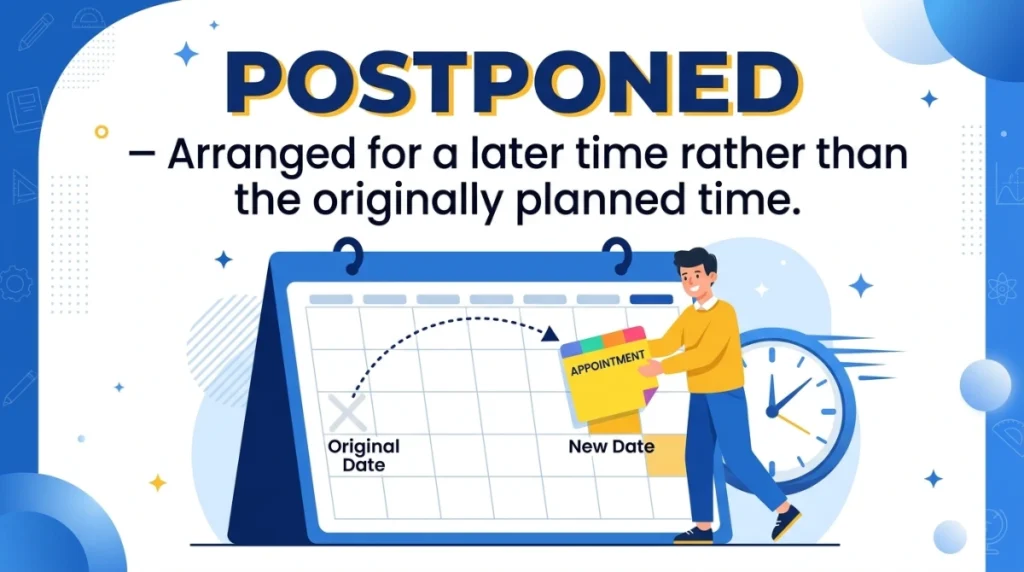
Postponed (Adjective) — US / UK: /poʊstˈpoʊnd/ / /pəʊstˈpəʊnd/
Meaning: Arranged for a later time rather than the originally planned time.
Tone/Register: Neutral and widely used.
Example:
The postponed meeting will take place on Monday.
Suspended (Adjective) — US / UK: /səˈspen.dɪd/ / /səˈspen.dɪd/
Meaning: Temporarily stopped until a condition is met or a decision is reached.
Tone/Register: Formal, administrative, and legal.
Example:
The review process remains suspended until further notice.
The investigation was suspended while officials gathered additional evidence.
Awaiting Resolution (Phrase) — US / UK: /əˈweɪ.tɪŋ ˌrez.əˈluː.ʃən/ / /əˈweɪ.tɪŋ ˌrez.əˈluː.ʃən/
Meaning: Waiting for a problem or issue to be settled.
Tone/Register: Professional, formal, and administrative.
Example:
The customer complaint is awaiting resolution.
Several technical issues are awaiting resolution.
Pending Settlement (Phrase) — US / UK: /ˈpen.dɪŋ ˈset̬.əl.mənt/ / /ˈpen.dɪŋ ˈset.əl.mənt/
Meaning: Waiting for an agreement, payment, or dispute settlement to be completed.
Tone/Register: Financial, legal, and professional.
Example:
The dispute remains pending settlement between both parties.
The payment is pending settlement by the bank.
Dormant (Adjective) — US / UK: /ˈdɔːr.mənt/ / /ˈdɔː.mənt/
Meaning: Temporarily inactive, although it may become active again later.
Tone/Register: Neutral, technical, and professional.
Example:
The project has remained dormant while funding is reviewed.
The account became dormant after a long period of inactivity.
Note: Dormant describes inactivity rather than a matter simply awaiting a decision, so it is suitable only in certain contexts.
In Limbo (Phrase) — US / UK: /ɪn ˈlɪm.boʊ/ / /ɪn ˈlɪm.bəʊ/
Meaning: In an uncertain situation without a clear decision or outcome.
Tone/Register: Conversational, expressive, and sometimes informal.
Example:
Our travel plans are in limbo until the visa decision arrives.
The employees were left in limbo after the company announced its restructuring.
Unsettled in Court (Phrase) — US / UK: /ʌnˈset̬.əld ɪn kɔːrt/ / /ʌnˈset.əld ɪn kɔːt/
Meaning: Still awaiting a legal decision or resolution in court.
Tone/Register: Legal and formal.
Example:
The dispute remains unsettled in court.
The parties are waiting for the unsettled case to receive a final ruling.
Note: This is a context-specific phrase, not a general synonym for pending.
Unadjudicated (Adjective) — US / UK: /ˌʌn.əˈdʒuː.dɪ.keɪ.tɪd/ / /ˌʌn.əˈdʒuː.dɪ.keɪ.tɪd/
Meaning: Not yet formally judged or decided by a court or authorized body.
Tone/Register: Highly formal and legal.
Example:
The court still has several unadjudicated claims to review.
The unadjudicated application remains in the tribunal’s records.
Undetermined (Adjective) — US / UK: /ˌʌn.dɪˈtɝː.mɪnd/ / /ˌʌn.dɪˈtɜː.mɪnd/
Meaning: Not yet established, identified, or decided.
Tone/Register: Neutral, academic, and professional.
Example:
The final cost remains undetermined.
The cause of the delay is still undetermined.
Unresolved in Principle (Phrase) — US / UK: /ˌʌn.rɪˈzɑːlvd ɪn ˈprɪn.sə.pəl/ / /ˌʌn.rɪˈzɒlvd ɪn ˈprɪn.sɪ.pəl/
Meaning: Not fully settled, even if some general agreement or understanding exists.
Tone/Register: Formal and analytical.
Example:
The main proposal was accepted, but several details remain unresolved in principle.
The two departments reached an understanding, although the policy is not fully settled.
Note: This is a descriptive phrase rather than a common direct synonym for pending.
Awaiting Processing (Phrase) — US / UK: /əˈweɪ.tɪŋ ˈprɑː.ses.ɪŋ/ / /əˈweɪ.tɪŋ ˈprəʊ.ses.ɪŋ/
Meaning: Waiting to be handled by a person, department, or system.
Tone/Register: Administrative, technical, and professional.
Example:
Your application is awaiting processing by the admissions office.
The refund request is awaiting processing.
Awaiting Review (Phrase) — US / UK: /əˈweɪ.tɪŋ rɪˈvjuː/ / /əˈweɪ.tɪŋ rɪˈvjuː/
Meaning: Waiting to be examined or assessed before further action.
Tone/Register: Professional, academic, and administrative.
Example:
The research paper is awaiting review by the editor.
Your documents are awaiting review by the selection committee.
Awaiting a Verdict (Phrase) — US / UK: /əˈweɪ.tɪŋ ə ˈvɝː.dɪkt/ / /əˈweɪ.tɪŋ ə ˈvɜː.dɪkt/
Meaning: Waiting for a formal judgment or final decision.
Tone/Register: Legal and formal.
Example:
The case is awaiting a verdict from the judge.
The accused remained in court while everyone awaited the verdict.
Unratified (Adjective) — US / UK: /ʌnˈræt̬.ə.faɪd/ / /ʌnˈræt.ɪ.faɪd/
Meaning: Not yet formally approved or confirmed by the required authority.
Tone/Register: Formal, legal, and political.
Example:
The agreement remains unratified by the participating countries.
The committee discussed the unratified treaty.
Note: Unratified applies specifically to agreements, treaties, and similar formal decisions.
Unendorsed (Adjective) — US / UK: /ˌʌn.ɪnˈdɔːrst/ / /ˌʌn.ɪnˈdɔːst/
Meaning: Not yet officially supported, approved, or endorsed.
Tone/Register: Formal and professional.
Example:
The proposal remains unendorsed by the board.
The organization will not implement an unendorsed policy.
Note: Unendorsed emphasizes a lack of approval; it does not always mean approval is still pending.
Awaiting Authorization (Phrase) — US / UK: /əˈweɪ.tɪŋ ˌɔː.θɚ.əˈzeɪ.ʃən/ / /əˈweɪ.tɪŋ ˌɔː.θə.raɪˈzeɪ.ʃən/
Meaning: Waiting for official permission to carry out an action.
Tone/Register: Formal, administrative, and technical.
Example:
The transfer is awaiting authorization from the finance manager.
The team cannot access the restricted files while authorization is pending.
In the Pipeline (Phrase) — US / UK: /ɪn ðə ˈpaɪp.laɪn/ / /ɪn ðə ˈpaɪp.laɪn/
Meaning: Being planned, developed, or prepared for future completion or release.
Tone/Register: Informal to professional, especially in business.
Example:
Several new features are in the pipeline.
The company has a major announcement in the pipeline.
Note: This phrase suggests future development rather than a decision or task that is simply pending.
Awaiting Finalization (Phrase) — US / UK: /əˈweɪ.tɪŋ ˌfaɪ.nəl.aɪˈzeɪ.ʃən/ / /əˈweɪ.tɪŋ ˌfaɪ.nəl.aɪˈzeɪ.ʃən/
Meaning: Waiting for the last steps needed to make something complete or official.
Tone/Register: Professional, formal, and administrative.
Example:
The contract is awaiting finalization by the legal team.
The event schedule is awaiting finalization before publication.

Synonyms for Pending by Tone
Not every alternative suits every situation. Choose a word based on the message, audience, and level of formality.
Positive or Reassuring
- Forthcoming: Useful when an event or announcement is expected.
- In progress: Shows that work is actively moving forward.
- Awaiting approval: Clearly explains that the next step is approval.
These words can sound reassuring when the reader wants to know that a process is continuing.
Neutral
- Awaiting
- Unconfirmed
- Tentative
- Under consideration
- Not yet finalized
- Pending decision
These are useful in everyday updates, formal messages, and status reports.
Negative or Problem-Focused
- Unresolved
- Outstanding
- Unprocessed
- Incomplete
- Unfinished
These words highlight work or issues that still need attention. They do not always imply failure, but they may sound more serious in a report.
Formal or Legal
- In abeyance
- Conditional
- Unconcluded
- Unresolved case
Use these alternatives when the subject involves legal proceedings, official decisions, or formal documentation.
Informal or Conversational
- On hold
- Not yet decided
- Unfinished business
These expressions are natural in conversations, messages, and informal workplace updates.
“Pending” vs. Close Alternatives
Several words have similar meanings but are not interchangeable in every sentence.
| Word | Main difference | Best use |
|---|---|---|
| Pending | Waiting for an action, decision, or outcome | Applications, payments, cases |
| Awaiting | Emphasizes waiting for something specific | Replies, approval, confirmation |
| Unresolved | Emphasizes that an issue has not been settled | Complaints, disputes, questions |
| Outstanding | Highlights something that remains due or requires attention | Bills, tasks, obligations |
| Tentative | Means a plan is not firmly confirmed | Meetings, schedules, arrangements |
| On hold | Indicates a temporary pause | Projects, orders, plans |
Example comparison:
- “My application is pending.” The application has not reached a final outcome.
- “My application is awaiting approval.” Approval is the specific step still required.
- “My application is unresolved.” The matter has not been settled, possibly because of a problem.
These distinctions make your English more precise and natural.
How “Pending” Changes by Context
Daily Conversation
In everyday English, pending often appears in discussions about plans, decisions, and personal matters. However, simpler expressions may sound more natural in casual speech.
Instead of saying, “My plans are pending,” you could say, “My plans are not finalized yet.”
Writing and Blogging
Writers can use alternatives to avoid repeating pending throughout an article. For example, an article about application status might use awaiting a decision, under review, and not yet finalized when each phrase accurately describes the situation.
This variation improves readability without changing the intended meaning.
Professional and Academic Communication
In workplaces, universities, and official correspondence, words such as awaiting approval, under consideration, and outstanding can communicate specific status updates.
For example, “The research proposal is under consideration” sounds professional and explains that the proposal is being evaluated.
Creative and Informal Writing
Creative writers can use expressions such as on hold or unfinished business to add a conversational feel. These expressions may also create suspense when a character is waiting for an important decision.
Choose the phrase that matches the situation instead of using a synonym only for variety.
Common Mistakes Learners Make
Using “Pending” When Something Is Already Confirmed
Incorrect: “The meeting is pending for Monday,” when the meeting has already been confirmed.
Better: “The meeting is scheduled for Monday.”
Use pending when the outcome or next step remains unsettled.
Confusing “Pending” With “Delayed”
A pending payment has not necessarily been delayed. It may be processing normally.
A delayed payment, however, has taken longer than expected. Use delayed when the timing itself is the problem.
Confusing “Pending” With “Upcoming”
An upcoming event is expected to happen in the future. A pending matter is usually waiting for an action, decision, or resolution.
For example, an upcoming exam is scheduled for a future date, while a pending exam result has not yet been released.
Using “Outstanding” Without Checking the Context
Outstanding can mean something unfinished or unpaid. It can also mean exceptionally good, as in “an outstanding performance.”
The surrounding sentence determines its meaning.
Overusing Formal Expressions
Phrases such as in abeyance may sound unnatural in a friendly message. In most everyday situations, on hold or not decided yet is clearer.
Register Notes: Formal vs. Informal English
Formal English often favors awaiting approval, under consideration, and unresolved. These expressions suit reports, academic documents, and professional emails.
Informal English often favors on hold, not decided yet, and still waiting. These alternatives sound natural in everyday conversation.
Spoken English also tends to favor shorter expressions. Written English can accommodate more precise phrases when the context requires them.
For additional vocabulary practice, you can explore related VocaNeest articles about synonyms for words such as outstanding and unresolved.
Real-Life Examples Using Pending
Workplace
A manager is waiting for permission to begin a project. The project is awaiting approval, so the team cannot start yet.
Student life
A student has submitted an application but has not received a result. The application remains under consideration.
Online transactions
A customer sees that a transfer has not been completed. The payment is still processing, although this phrase is most suitable when the transaction is actively being handled.
Writing and storytelling
A writer has not resolved a character’s problem by the end of a chapter. The character still has unfinished business, which can keep readers interested.
Interactive Practice Quiz
Choose the best answer for each real-life situation.
1. Your job application has not received a decision. Which phrase fits best?
A. Already approved
B. Awaiting a decision
C. Successfully completed
D. Recently published
2. A bill has not been paid yet. Which word is most suitable?
A. Outstanding
B. Imminent
C. Forthcoming
D. Tentative
3. A meeting date is planned but not confirmed. Which word fits?
A. Unresolved
B. Incomplete
C. Tentative
D. Unprocessed
4. A complaint has not been settled. Which word is best?
A. Upcoming
B. Unresolved
C. Provisional
D. Forthcoming
5. A project has temporarily stopped because of a funding issue. Which phrase fits?
A. On hold
B. In progress
C. Imminent
D. Outstanding
7. A document is missing important sections. Which word describes it?
A. Unconfirmed
B. Imminent
C. Incomplete
D. Conditional
8. The final event date has not been chosen. Which phrase is clearest?
A. Not yet decided
B. Outstanding payment
C. In abeyance only
D. Already finalized
9. A transaction is being handled by a payment system. Which phrase fits?
A. Still processing
B. Tentative date
C. Unresolved case
D. Forthcoming event
10. An offer depends on submitting your transcript. Which word fits?
A. Unfinished
B. Conditional
C. Outstanding
D. Imminent
Try to explain the situation clearly without using the word pending. This will help you build a more flexible vocabulary.
Answer key: 1-B, 2-A, 3-C, 4-B, 5-A, 6-B, 7-C, 8-A, 9-A
Conclusion
Learning a synonym for pending helps you describe unfinished tasks, waiting periods, and undecided matters more precisely. Each alternative adds a different shade of meaning to your English.
Words such as awaiting, outstanding, and unresolved can improve your emails, essays, blog posts, and workplace communication. The right choice makes your message clearer.
You do not need to memorize every synonym at once. Start with a few common expressions and notice how native speakers use them in real situations.
Keep practicing these words in your daily conversations, emails, and writing exercises. Choose one new synonym today and create your own sentence to strengthen your vocabulary.
External link source:
Merriam-Webster Dictionary — for checking the definition, pronunciation, and usage of pending.
Frequently Asked Questions
1. What is the best synonym for pending in a professional email?
The best alternative depends on what you are waiting for. Use awaiting approval when a manager must approve something, under review when someone is examining a request, and not yet finalized when details remain incomplete. These phrases explain the exact status and help your email sound clear and professional.
2. What is another word for pending approval?
Useful alternatives include awaiting approval, awaiting authorization, and subject to approval. Each has a slightly different emphasis. Awaiting approval means a decision is still expected, while subject to approval means something depends on receiving permission. Choose the phrase that accurately describes the stage of the process.
3. What does pending mean in a bank account?
In banking, pending generally means a transaction has been initiated but has not yet been fully completed or posted. The money may be temporarily unavailable, depending on the transaction and bank. It does not automatically mean the payment has failed. Check your bank’s transaction details if you need to understand a particular payment.
4. What is the difference between pending and processing?
Pending is a broad status that indicates something is awaiting an action, decision, or completion. Processing suggests that a system or person is actively handling it. For example, a request may be pending approval while a payment is processing. The precise meaning can vary between websites, institutions, and financial services.
5. Which synonym for pending is best for academic writing?
Under consideration, unresolved, outstanding, and not yet finalized can work well in academic writing. Use under consideration for a proposal being evaluated, unresolved for a question that remains unanswered, and outstanding for work that still requires attention. Select the term that describes the research or administrative situation accurately.
6. Can pending mean something will happen soon?
Not necessarily. Pending means that an action, decision, or outcome is still awaited, but it does not tell you exactly when it will happen. Imminent is more suitable when something is expected very soon, while forthcoming describes something expected in the future. Always check whether the context indicates timing or simply an unfinished process.
7. What is the opposite of pending?
Possible opposites include completed, resolved, approved, confirmed, and finalized. The correct choice depends on the context. A pending application may become approved or rejected, while a pending payment may become completed or declined. There is no single opposite that fits every use of pending, so choose the word that describes the final status.

Aqsa Rani is the founder and lead writer at VocaNeest.com, a trusted platform dedicated to helping people improve their English vocabulary and communication skills. She creates well-researched, accurate, and easy-to-understand content covering synonyms, antonyms, word meanings, idioms, phrases, and everyday vocabulary. Her goal is to make learning English simple, practical, and accessible for students, writers, professionals, and lifelong learners.
At VocaNeest.com, every article is carefully researched, fact-checked, and written with a strong focus on accuracy, clarity, and real-world usage. Content is regularly reviewed and updated to ensure it remains helpful, relevant, and aligned with modern language standards. Through reliable vocabulary guides and practical examples, Aqsa aims to help readers write with confidence, expand their vocabulary, and communicate more effectively.

Pingback: ⏳45 Synonym for Limbo: Best Words & Meanings (2026)