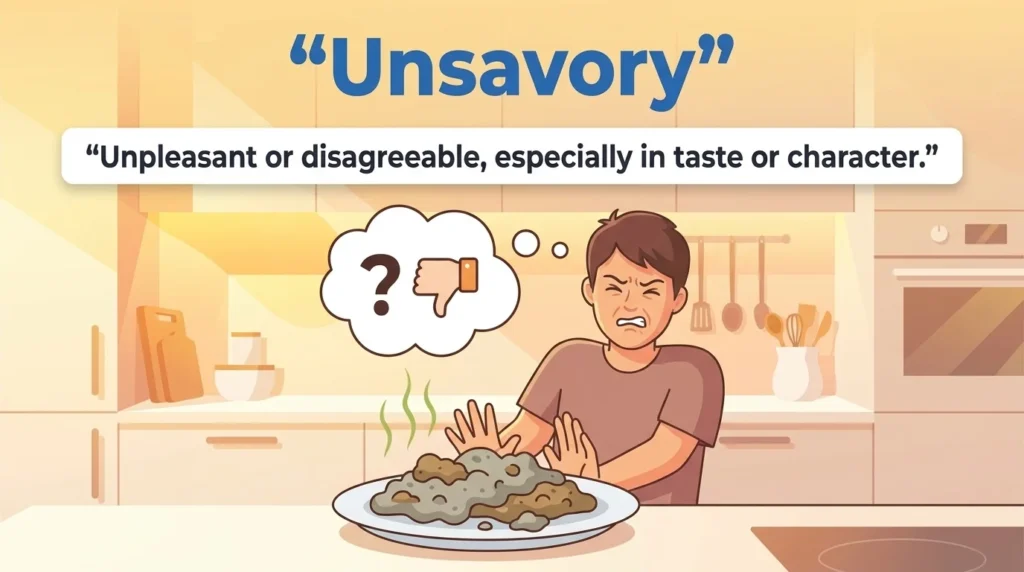
A synonym for unsavory helps you describe shady characters or suspicious places with much better precision. You feel uneasy when a dark alleyway hides an unsavory crowd at midnight.
Rich synonyms make your writing pop and help you connect with your readers. Writers and speakers often use this term to describe bad reputations, shady deals, or unpleasant moral vibes.
A synonym for unsavory gives students, bloggers, and content creators fresh options to elevate their work. Strong vocabulary keeps your daily English conversations colorful, engaging, and clear.
Expanding your word choice allows you to paint a vivid picture of a morally doubtful environment. Choosing the right term turns a plain sentence into a memorable, thrilling narrative experience.
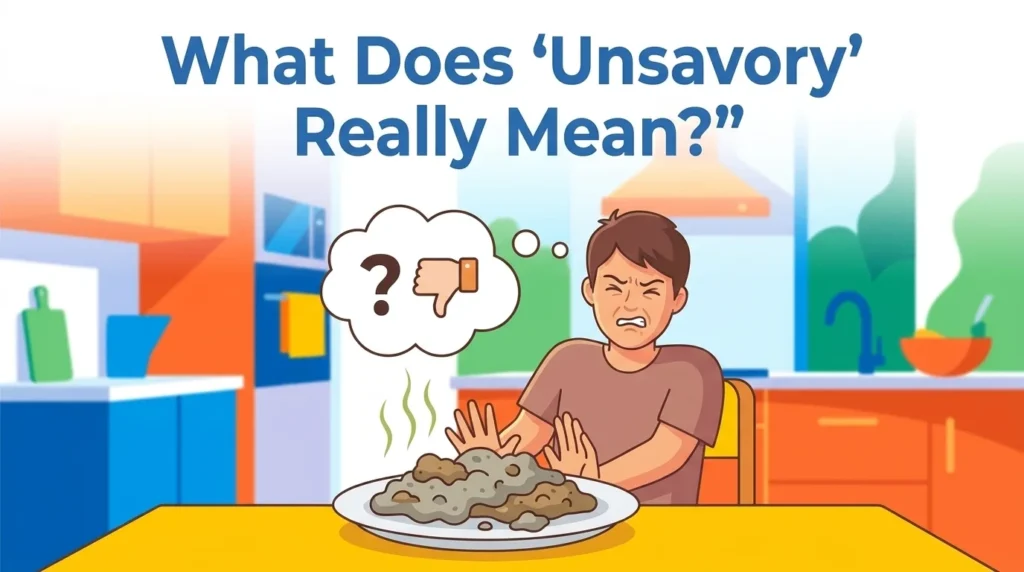
What Does “Unsavory” Really Mean?
Meaning: Disagreeable to taste, smell, or moral character; morally offensive or disreputable. Emotional Tone: Moderately to strongly negative. Native Understanding: Native speakers use it when talking about shady people, dishonest business deals, or morally questionable situations. Common Contexts: Mystery novels, investigative journalism, daily social warnings, and personal safety chats. Part of Speech: Adjective. Simple definition: Morally bad, shady, or disagreeable.
Connotative Meaning
- Positive tone: Not applicable directly, though exposing an unsavory secret serves a righteous purpose.
- Negative tone: Shady, disreputable, repulsive, untrustworthy, or sleazy vibes.
- Neutral tone: Factual descriptions of bad tastes or unappealing conditions.
- Connotation: (The emotional or cultural feeling a word carries beyond its literal dictionary definition.)
Etymology
- Origin: Formed in Middle English from the prefix un- (not) combined with savory, stemming from Old French savouré and Latin sapere (to taste of).
- *Old English (450–1100): Germanic roots handled notions of bad taste or unpalatable food before Romance forms blended in.
- Middle English (1100–1500): Emerged as unsavouri, denoting food lacking flavor or morally distasteful behavior.
- Modern English (1500–Present): Standardized to describe anything morally offensive, disreputable, or repulsive to the senses.
Pronunciation (US & UK – IPA)
- US: /ʌnˈseɪ.vɚ.i/
- UK: /ʌnˈseɪ.vər.i/
Syllables
- Syllables: un-sa-vor-y
- Affixation Pattern: Prefix (un-) + root (flavor/savor) + suffix (-y)
- Root: savor-
- Prefix: un-
- Suffix: -y
Synonyms List
Disreputable (Adjective) — US: /dɪsˈrɛp.jə.t̬ə.bəl/ | UK: /dɪsˈrep.jə.tə.bəl/
- Meaning: Not respectable; having a bad reputation for honesty or morality.
- Tone/Register: Formal / Descriptive
- Example 1: He was known to hang out with disreputable characters downtown.
- Example 2: The investors avoided the disreputable financial firm entirely.
Shady (Adjective) — US: /ˈʃeɪ.di/ | UK: /ˈʃeɪ.di/
- Meaning: Situated in the shade, or informally, of questionable honesty or legality.
- Tone/Register: Informal / Conversational
- Example 1: She refused to sign the contract because the terms looked shady.
- Example 2: A group of shady individuals loitered near the abandoned warehouse.
Distasteful (Adjective) — US: /dɪsˈteɪst.fəl/ | UK: /dɪsˈteɪst.fəl/
- Meaning: Causing dislike, aversion, or moral offense; disagreeable.
- Tone/Register: Critical / Literary
- Example 1: He found the gossip about his coworkers entirely distasteful.
- Example 2: Cleaning up the political scandal proved a distasteful task.
Repulsive (Adjective) — US: /rɪˈpʌl.sɪv/ | UK: /rɪˈpʌl.sɪv/
- Meaning: Arousing intense aversion or disgust; deeply unpleasant.
- Tone/Register: Strong / Direct
- Example 1: The spoiled meat gave off a truly repulsive odor.
- Example 2: His arrogant behavior proved repulsive to everyone at the table.
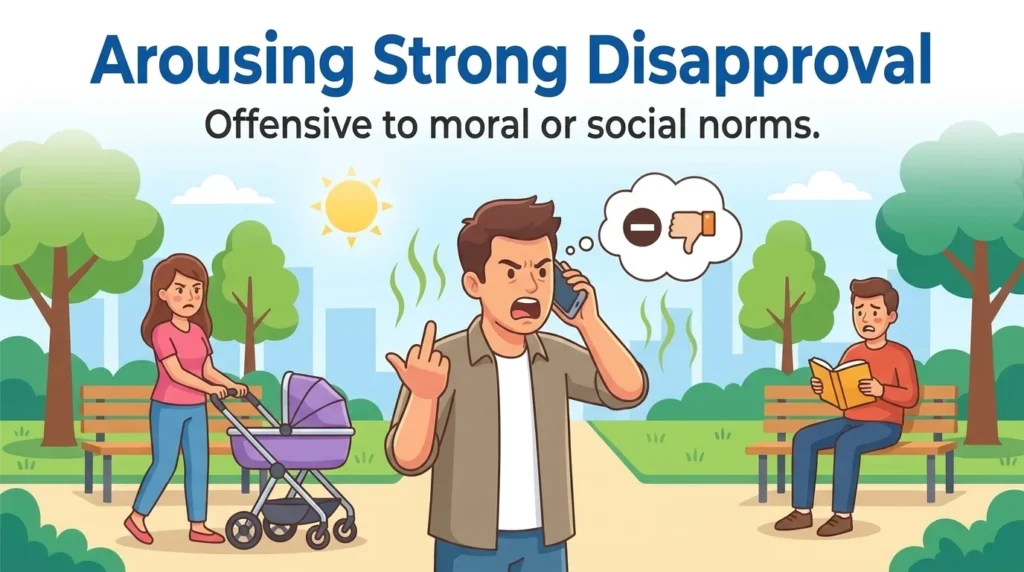
Objectionable (Adjective) — US: /əbˈdʒɛk.ʃə.nə.bəl/ | UK: /əbˈdʒek.ʃə.nə.bəl/
- Meaning: Arousing strong disapproval; offensive to moral or social norms.
- Tone/Register: Formal / Professional
- Example 1: The committee banned the book due to objectionable language.
- Example 2: Customers walked out over objectionable remarks made on air.
Sleazy (Adjective) — US: /ˈsliː.zi/ | UK: /ˈsliː.zi/
- Meaning: Sordid, corrupt, or lacking moral integrity and cleanliness.
- Tone/Register: Informal / Derogatory
- Example 1: The detective investigated a sleazy motel on the city outskirts.
- Example 2: He wore a sleazy suit and made dishonest promises.
Sordid (Adjective) — US: /ˈsɔːr.dɪd/ | UK: /ˈsɔː.dɪd/
- Meaning: Involving ignoble actions and motives; arousing moral distaste.
- Tone/Register: Literary / Serious
- Example 1: The newspaper exposed the sordid details of the bribery scheme.
- Example 2: They lived in sordid conditions before moving downtown.
Questionable (Adjective) — US: /ˈkwɛs.tʃə.nə.bəl/ | UK: /ˈkwes.tʃə.nə.bəl/
- Meaning: Doubtful as regards truth, quality, or moral character.
- Tone/Register: Formal / Analytical
- Example 1: The startup made questionable claims about its revenue growth.
- Example 2: He associated with people of highly questionable integrity.
Suspect (Adjective) — US: /ˈsʌs.pɛkt/ | UK: /ˈsʌs.pekt/
- Meaning: Having an air of suspicion; not to be relied upon as honest.
- Tone/Register: Cautious / Conversational
- Example 1: The company’s safety credentials looked deeply suspect.
- Example 2: She grew suspicious of his sudden, overly generous offer.
Dubious (Adjective) — US: /ˈduː.bi.əs/ | UK: /ˈdjuː.bi.əs/
- Meaning: Hesitating or doubting; of an unlikely ca lcxsbdvohlo quality.
- Tone/Register: Academic / Formal
- Example 1: He made some dubious claims about winning the lottery.
- Example 2: Investors viewed the overseas expansion plan with dubious eyes.
Undesirable (Adjective) — US: /ˌʌn.dɪˈzaɪ.rə.bəl/ | UK: /ˌʌn.dɪˈzaɪ.rə.bəl/
- Meaning: Not wanted or approved of; unwelcome in society or a setting.
- Tone/Register: Standard / Formal
- Example 1: Police tried to clear the neighborhood of undesirable elements.
- Example 2: The chemical plant had undesirable effects on local water.
Repellent (Adjective) — US: /rɪˈpɛl.ənt/ | UK: /rɪˈpel.ənt/
- Meaning: Causing intense aversion or disgust to the senses or mind.
- Tone/Register: Strong / Literary
- Example 1: The dictator’s ideology was repellent to democratic nations.
- Example 2: A repellent smell drifted from the chemical dump site.
Loathsome (Adjective) — US: /ˈloʊð.səm/ | UK: /ˈləʊð.səm/
- Meaning: Causing feelings of hatred or disgust; detestable.
- Tone/Register: Literary / Strong
- Example 1: The villain committed loathsome crimes against the town.
- Example 2: He felt a loathsome urge to betray his closest friend.
Contemptible (Adjective) — US: /kənˈtɛmp.tə.bəl/ | UK: /kənˈtemp.tə.bəl/
- Meaning: Deserving contempt; despicable and morally worthless.
- Tone/Register: Formal / Critical
- Example 1: Cheating on the vulnerable client was a contemptible act.
- Example 2: She viewed his petty lies as entirely contemptible.
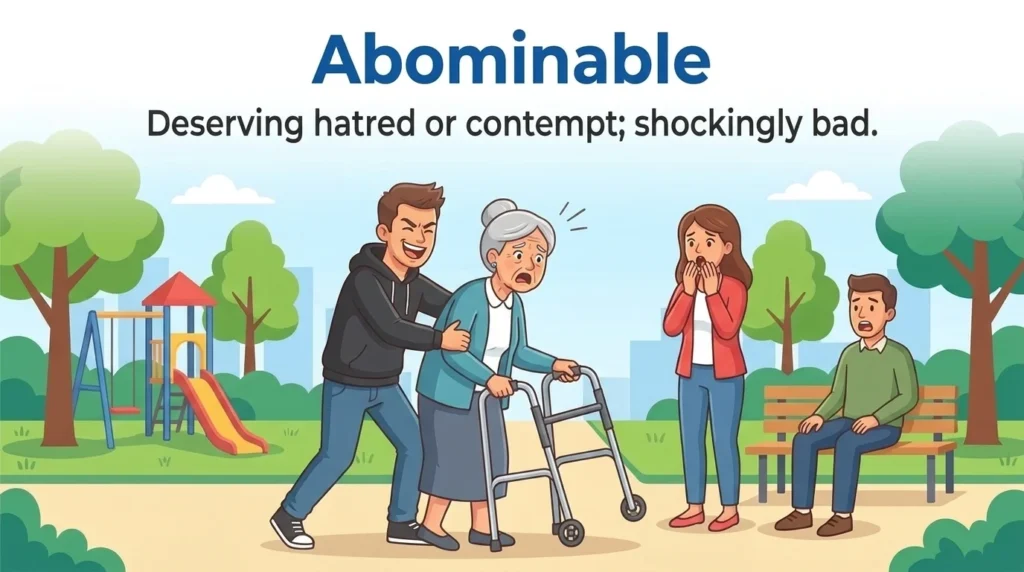
Despicable (Adjective) — US: /dɪˈspɪk.ə.bəl/ | UK: /dɪˈspɪk.ə.bəl/
- Meaning: Deserving hatred or contempt; shockingly bad.
- Tone/Register: Strong / Serious
- Example 1: Vandals caused despicable damage to the historic memorial.
- Example 2: He faced public backlash for his despicable remarks.
Base (Adjective) — US: /beɪs/ | UK: /beɪs/
- Meaning: Without moral principles; ignoble and dishonorable.
- Tone/Register: Archaic / Literary
- Example 1: He acted out of base motives like greed and envy.
- Example 2: Betraying his mentor was a base betrayal of trust.
Ignoble (Adjective) — US: /ɪɡˈnoʊ.bəl/ | UK: /ɪɡˈnəʊ.bəl/
- Meaning: Not honorable in character or purpose; morally low.
- Tone/Register: Formal / Literary
- Example 1: Stealing funds from the charity was an ignoble scheme.
- Example 2: He harbored ignoble ambitions of seizing total control.
Vile (Adjective) — US: /vaɪl/ | UK: /vaɪl/
- Meaning: Extremely unpleasant, wicked, or morally repulsive.
- Tone/Register: Expressive / Strong
- Example 1: The criminal received a long sentence for his vile deeds.
- Example 2: A vile storm ruined our camping trip plans.
Wicked (Adjective) — US: /ˈwɪk.ɪd/ | UK: /ˈwɪk.ɪd/
- Meaning: Evil or morally very bad; mischievous or severe.
- Tone/Register: Common / Expressive
- Example 1: Folklore stories feature wicked witches living in the woods.
- Example 2: He suffered a wicked sprain playing soccer yesterday.
Degraded (Adjective) — US: /dɪˈɡreɪ.dɪd/ | UK: /dɪˈɡreɪ.dɪd/
- Meaning: Reduced in quality, value, or moral standing; corrupt.
- Tone/Register: Formal / Critical
- Example 1: Corruption left the political institution deeply degraded.
- Example 2: Living in squalor left them feeling degraded and forgotten.
Corrupt (Adjective) — US: /kəˈrʌpt/ | UK: /kəˈrʌpt/
- Meaning: Having or showing a willingness to act dishonestly for money.
- Tone/Register: Professional / Serious
- Example 1: Investigators exposed a corrupt network of local politicians.
- Example 2: The data files became corrupt after the system crash.
Venal (Adjective) — US: /ˈviː.nəl/ | UK: /ˈviː.nəl/
- Meaning: Showing or motivated by susceptibility to bribery; corrupt.
- Tone/Register: Academic / Formal
- Example 1: The corrupt judge proved entirely venal during the trial.
- Example 2: Citizens protested against venal lawmakers taking kickbacks.
Dank (Adjective) — US: /dæŋk/ | UK: /dæŋk/
- Meaning: Disagreeably damp, musty, and typically cold.
- Tone/Register: Descriptive / Atmospheric
- Example 1: They explored the dank, dark castle dungeons.
- Example 2: The basement smelled dank after heavy spring rains.
Musty (Adjective) — US: /ˈmʌs.ti/ | UK: /ˈmʌs.ti/
- Meaning: Having a stale, moldy smell or taste from lack of fresh air.
- Tone/Register: Sensory / Descriptive
- Example 1: Old books filled the attic with a musty scent.
- Example 2: The vintage jacket felt musty after years in storage.
Stale (Adjective) — US: /steɪl/ | UK: /steɪl/
- Meaning: No longer fresh and pleasant; lacking novelty or creativity.
- Tone/Register: Everyday / Common
- Example 1: Eating stale bread for breakfast was disappointing.
- Example 2: The marketing team’s strategy grew stale over time.
Rotten (Adjective) — US: /ˈrɑː.tən/ | UK: /ˈrɒt.ən/
- Meaning: Suffering from decay, or morally corrupt and despicable.
- Tone/Register: Casual / Direct
- Example 1: Throw away the rotten apples in the fruit bowl.
- Example 2: He exposed a rotten system of fraud within the office.
Sleazy-looking (Adjective) — US: /ˈsliː.zi ˈlʊk.ɪŋ/ | UK: /ˈsliː.zi ˈlʊk.ɪŋ/
- Meaning: Having an appearance that suggests dishonesty or low morals.
- Tone/Register: Informal / Conversational
- Example 1: A sleazy-looking salesman tried to sell fake watches.
- Example 2: They avoided the sleazy-looking tavern on the corner.
Lowdown (Adjective) — US: /ˈloʊ.daʊn/ | UK: /ˈləʊ.daʊn/
- Meaning: Despicable, mean, or unfair; low in character.
- Tone/Register: Informal / Idiomatic
- Example 1: Stealing her reward money was a lowdown trick.
- Example 2: He felt betrayed by his friend’s lowdown behavior.
Shickered / Disreputable-looking (Adjective) — US: /dɪsˈrɛp.jə.t̬ə.bəl ˈlʊk.ɪŋ/ | UK: /dɪsˈrep.jə.tə.bəl ˈlʊk.ɪŋ/
- Meaning: Looking scruffy, untrustworthy, or morally compromised.
- Tone/Register: Descriptive / Casual
- Example 1: A disreputable-looking stranger knocked on the door.
- Example 2: He wore a disreputable-looking coat to the interview.
Bad (Adjective) — US: /bæd/ | UK: /bæd/
- Meaning: Of poor quality or low moral standard; unfavorable.
- Tone/Register: Basic / Everyday
- Example 1: Making bad choices can ruin your career path.
- Example 2: They suffered bad weather throughout the voyage.
Ill-reputed (Adjective) — US: /ˌɪl rɪˈpjuː.tɪd/ | UK: /ˌɪl rɪˈpjuː.tɪd/
- Meaning: Having a bad reputation; disreputable.
- Tone/Register: Formal / Archaic
- Example 1: The ill-reputed tavern was avoided by locals at night.
- Example 2: He stayed away from ill-reputed gambling clubs.
Off-color (Adjective) — US: /ˌɑːf ˈkʌl.ɚ/ | UK: /ˌɒf ˈkʌl.ə(r)/
- Meaning: Slightly unwell, or offensive and inappropriate in humor.
- Tone/Register: Conversational / Idiomatic
- Example 1: He told an off-color joke that offended guests.
- Example 2: She felt a bit off-color after eating seafood.
Untrustworthy (Adjective) — US: /ʌnˈtrʌsˌwɝː.ði/ | UK: /ʌnˈtrʌsˌwɜː.ði/
- Meaning: Not able to be relied upon to be honest or truthful.
- Tone/Register: Standard / Common
- Example 1: Never lend money to untrustworthy acquaintances.
- Example 2: The witness proved untrustworthy under cross-examination.
Dishonest (Adjective) — US: /dɪsˈɑː.nɪst/ | UK: /dɪsˈɒn.ɪst/
- Meaning: Behaving or prone to behave in an untrustworthy or fraudulent way.
- Tone/Register: Direct / Common
- Example 1: Dishonest employees were fired immediately after the audit.
- Example 2: He gave a dishonest answer to hide his mistake.
Shifty (Adjective) — US: /ˈʃɪf.ti/ | UK: /ˈʃɪf.ti/
- Meaning: Appearing deceitful or evasive; untrustworthy.
- Tone/Register: Casual / Descriptive
- Example 1: The salesman gave a shifty glance when asked about refunds.
- Example 2: She distrusted his shifty eyes and nervous smile.
Distasteful-looking / Unpalatable (Adjective) — US: /ʌnˈpæl.ə.tə.bəl/ | UK: /ʌnˈpæl.ə.tə.bəl/
- Meaning: Not pleasant to taste, or difficult to accept regarding ideas or choices.
- Tone/Register: Formal / Literary
- Example 1: They faced the unpalatable truth about the company’s financial debt.
- Example 2: The medicine had an unpalatable bitter flavor.
Sleazy-acting / Sullied (Adjective) — US: /ˈsʌl.id/ | UK: /ˈsʌl.ɪd/
- Meaning: Made dirty, impure, or morally stained by bad actions.
- Tone/Register: Literary / Formal
- Example 1: His reputation remained sullied long after the scandal cleared.
- Example 2: The pristine white fabric was sullied by mud.
Tainted (Adjective) — US: /ˈteɪn.tɪd/ | UK: /ˈteɪn.tɪd/
- Meaning: Contaminated, spoiled, or morally compromised by association.
- Tone/Register: Standard / Critical
- Example 1: Health inspectors condemned the tainted batch of meat.
- Example 2: His political campaign felt tainted by anonymous donations.
Baudy (Adjective) — US: /ˈbɑː.di/ | UK: /ˈbɔː.di/
- Meaning: Dealing with sexual matters in a comical, crude, or socially improper way.
- Tone/Register: Informal / Descriptive
- Example 1: The tavern patrons laughed at the comedian’s baudy jokes.
- Example 2: Old plays often featured baudy humor to entertain crowds.
Smutty (Adjective) — US: /ˈsmʌt.i/ | UK: /ˈsmʌt.i/
- Meaning: Indecent, obscene, or suggestive of illicit sexual behavior.
- Tone/Register: Casual / Derogatory
- Example 1: Teachers confiscated the magazine containing smutty jokes.
- Example 2: He was reprimanded for sharing smutty remarks online.
Unclean (Adjective) — US: /ʌnˈkliːn/ | UK: /ʌnˈkliːn/
- Meaning: Morally impure or physically dirty and unwashed.
- Tone/Register: Common / Religious
- Example 1: Ancient traditions viewed certain contact as ceremonially unclean.
- Example 2: The kitchen workspace felt unclean and unsafe for cooking.
Impure (Adjective) — US: /ɪmˈpjʊr/ | UK: /ɪmˈpjʊə(r)/
- Meaning: Mixed with extraneous matter, or morally unchaste and debased.
- Tone/Register: Formal / Academic
- Example 1: Chemical tests revealed impure elements in the water supply.
- Example 2: He acted out of impure motives to gain advantage.
Base-born / Degenerate (Adjective) — US: /dɪˈdʒɛn.ɚ.ət/ | UK: /dɪˈdʒen.ər.ət/
- Meaning: Having lost the physical, mental, or moral qualities considered normal and desirable.
- Tone/Register: Formal / Harsh
- Example 1: Society condemned the degenerate behavior of the thieves.
- Example 2: The once-great empire sank into a degenerate state.
Scummy (Adjective) — US: /ˈskʌm.i/ | UK: /ˈskʌm.i/
- Meaning: Covered with a layer of scum, or contemptible and low in character.
- Tone/Register: Informal / Derogatory
- Example 1: A scummy layer formed on top of the stagnant pond water.
- Example 2: He despised the scummy tactics his rival used.
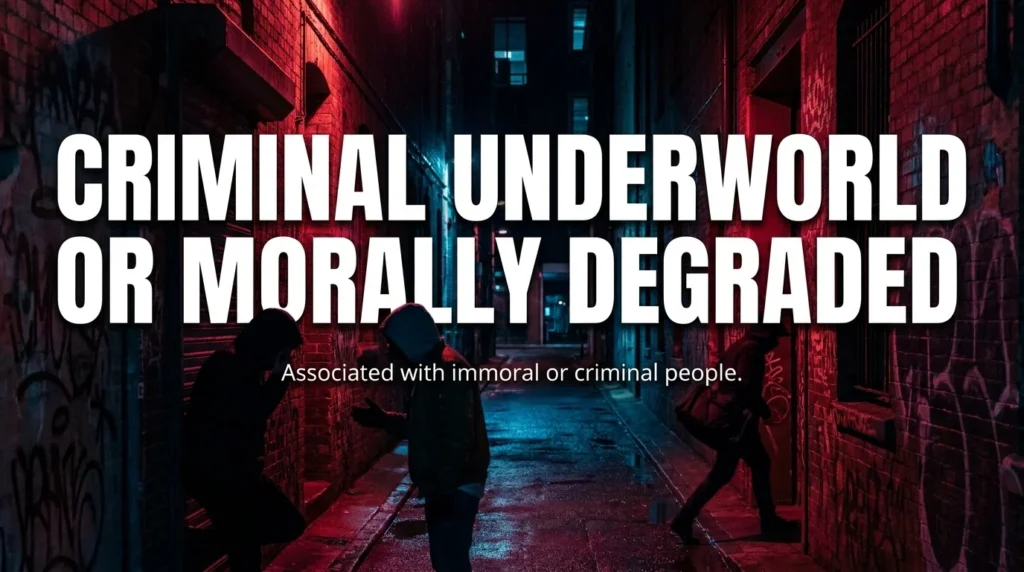
Low-life (Adjective) — US: /ˈloʊ.laɪf/ | UK: /ˈləʊ.laɪf/
- Meaning: Characteristic of the criminal underworld or morally degraded people.
- Tone/Register: Slang / Critical
- Example 1: The detective tracked down a low-life informant in the alley.
- Example 2: She wanted nothing to do with that low-life crowd.
Synonyms by Tone
Positive tone:
None directly, though exposing shady deals serves a good cause.
Neutral tone:
Questionable, suspect, dubious, stale, musty.
Negative tone:
Disreputable, repulsive, despicable, vile, corrupt, venal.
Playful/informal tone:
Shady, sleazy, lowdown, shifty.
Tone matters because your word choice signals your exact moral or social boundary. Calling a deal “questionable” sounds cautious and analytical. Calling a person “vile” or “despicable” shows intense moral condemnation.
Mini Comparison: Unsavory vs. Shady vs. Repulsive
- Unsavory: Focuses broadly on moral impurity or a bad social reputation. Use it for shady characters or morally doubtful environments.
- Shady: Focuses informally on suspicious legality or hidden dishonesty. Use it for casual descriptions of untrustworthy business deals.
- Repulsive: Focuses on intense physical or moral disgust that pushes people away. Use it when something triggers deep revulsion.
Context-Based Usage
In daily conversation, native speakers say “That neighborhood looks a bit unsavory” or “He seems like a shady character.” Simple words fit casual coffee chats best.
When writing blog posts or investigative reviews, use “disreputable,” “questionable,” or “corrupt” to paint a precise picture of ethics.
In academic or professional reports, choose “venal,” “dubious,” or “undesirable” to keep the tone objective and exact.
Creative writers love “sordid,” “vile,” or “loathsome” to build intense suspense in a story.
Common Mistakes & Native Usage
- Mistake 1: Using “unsavory” strictly to describe bad-tasting food. (While it stems from taste, native speakers almost exclusively use it for moral character or shady situations today.)
- Mistake 2: Confusing “unsavory” (morally questionable) with “unsavoured” or incorrect variations.
- Overuse warning: Repeating “unsavory” in every paragraph makes your writing monotonous. Mix in “disreputable” or “shady.”
In spoken English, people talk about sketchy places. In written English, precise adjectives make your critique sharp.
Real-Life Mini Scenarios
- Workplace: The auditor uncovered a corrupt financial scheme hidden by the manager.
- Social situations: She felt uneasy walking past a group of disreputable individuals outside the venue.
- Media / pop culture: Investigative journalists exposed the sordid details of the political cover-up.
- Writing or storytelling: The hero navigated a dank, dangerous alleyway filled with shady characters.
Conclusion
Expanding your knowledge of a synonym for unsavory gives your writing and speaking a much richer, more authentic touch. Subtle upgrades in your everyday vocabulary turn ordinary paragraphs into memorable, vivid moments that instantly capture your reader’s attention.
Try weaving one of these descriptive terms into your next essay, message, or daily chat today to see how quickly your communication style transforms.
Which word will you test out first when you describe a tricky situation next? Take a moment to write a quick sentence in your notes or share your favorite pick with a friend right now. Building a stronger lexicon is a fun journey that opens up countless ways to express yourself more clearly and creatively every single day.
Interactive Practice Quiz
Which word best describes a person or place with a bad reputation for honesty?
- A) Disreputable
- B) Honorable
- C) Noble
- D) Upstanding
What informal term fits a business deal that looks suspicious or dishonest?
- A) Shady
- B) Pristine
- C) Pure
- D) Clear
Which synonym is best for an action that arouses intense moral disgust?
- A) Repulsive
- B) Delightful
- C) Charming
- D) Sweet
How would an official report describe a politician taking bribes?
- A) Venal
- B) Altruistic
- C) Generous
- D) Honest
Which synonym describes information or claims that seem doubtful?
- A) Questionable
- B) Certain
- C) Proven
- D) Verified
What term fits a basement or dungeon that smells damp and musty?
- A) Dank
- B) Airy
- C) Fragrant
- D) Fresh
Which option describes a crime that is shockingly evil and despicable?
- A) Despicable
- B) Praiseworthy
- C) Kind
- D) Gentle
What word works best for an underground network of criminal fraud?
- A) Corrupt
- B) Pure
- C) Clean
- D) Honest
Which term refers to behavior that lacks moral cleanliness and is sleazy?
- A) Sordid
- B) Polished
- C) Refined
- D) Elegant
What word describes a person whose intentions and character cannot be trusted?
- A) Untrustworthy
- B) Faithful
- C) Loyal
- D) Reliable
Task: Write one short sentence using the word disreputable in your notebook or reply below.
Answer Key: 1-A | 2-A | 3-A | 4-A | 5-A | 6-A | 7-A | 8-A | 9-A | 10-A
Frequently Asked Questions
What is the difference between unsavory and disreputable?
Unsavory broadly describes anything morally offensive, shady, or unpleasant. Disreputable specifically points toward a bad public reputation regarding honesty, morality, or social standing.
Can unsavory describe food?
Originally yes, but in modern English, it is almost exclusively used metaphorically to describe people, places, behaviors, or business dealings that lack moral integrity.
What is another word for a shady neighborhood?
Common alternatives include a disreputable district, rough neighborhood, or unsavory part of town.
Is unsavory a formal or informal word?
Unsavory is standard English that fits comfortably in both formal writing and descriptive narrative conversation.
Why do writers use synonyms for unsavory?
Using varied terms like sordid, dubious, or repulsive helps prevent repetition and sets an exact emotional tone for readers.

Aleesha Rani is a passionate language writer focused on making English vocabulary simple, useful, and engaging. She creates clear content on synonyms, word meanings, and practical language use.
Through vocaneest.com, Aleesha Rani shares original, reader-friendly resources that help students, writers, and English learners choose better words and communicate with confidence.