
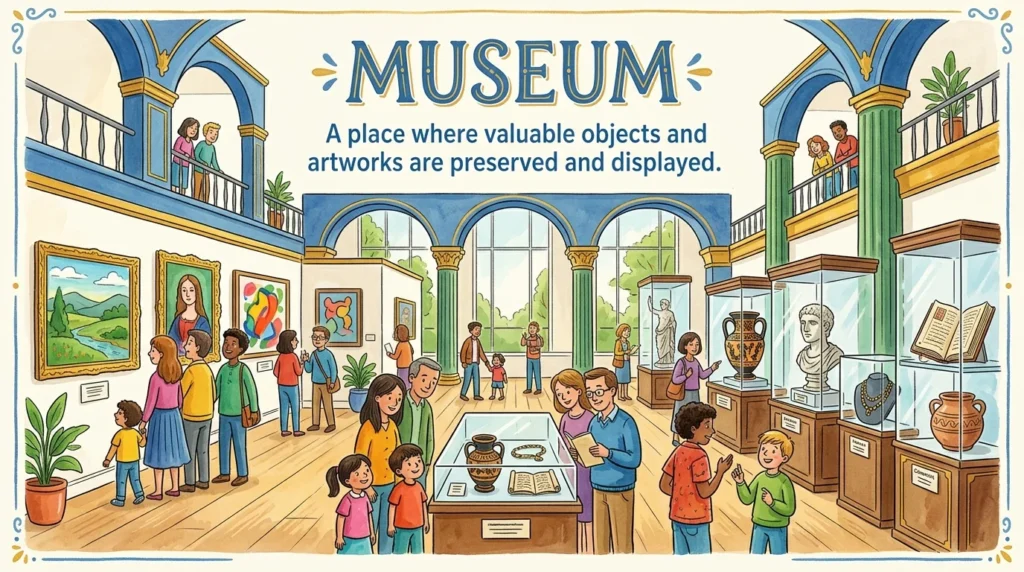
Synonym for museum help you describe cultural exhibition spaces, historical displays, or art galleries with much better precision. You feel completely inspired when you finally step inside a grand exhibition hall to admire ancient artifacts during a quiet weekend afternoon.
Rich synonyms make your writing pop and help you connect with your readers. Writers and speakers often use a synonym for museum to describe historical archives, scientific galleries, or creative design centers.
This synonym for museum gives students, bloggers, and content creators fresh options to elevate their work. Strong vocabulary keeps your daily English conversations colorful, engaging, and clear.
Expanding your word choice allows you to paint a vivid picture of spaces dedicated to human heritage and discovery. Choosing the right synonym for museum turns a plain sentence into a memorable communication experience.
What Does “Museum” Really Mean?
Meaning: A building or institution dedicated to acquiring, conserving, researching, and exhibiting items of historical, scientific, or cultural value. Emotional Tone: Scholarly, awe-inspiring, or educational. Native Understanding: Native speakers use it when talking about visiting galleries, learning local history, or viewing classical art. Common Contexts: Travel blogs, academic essays, architectural reviews, and cultural journalism. Part of Speech: Noun. Simple definition: A building where interesting cultural or historical objects are kept and shown.
Connotative Meaning
- Positive tone: Cultural preservation, artistic brilliance, intellectual growth, and heritage appreciation.
- Negative tone: Stuffy institutional spaces, dusty displays, or boring tourist traps.
- Neutral tone: Objective references to public exhibition buildings or institutional archives.
- Connotation: (The emotional or cultural feeling a word carries beyond its literal dictionary definition.)
Etymology
- Origin: Derived from Ancient Greek Mouseion (seat of the Muses, the goddesses of the arts and sciences).
- *Old English (450–1100): Anglo-Saxon terms did not use this classical concept; local folklore repositories relied on oral traditions.
- Middle English (1100–1500): Reintroduced through scholarly Latin and French translations referencing classical temples of learning.
- Modern English (1500–Present): Shifted from private royal collections to public institutions displaying shared global heritage.
Pronunciation (US & UK – IPA)
- US: /ˈmjuː.zi.əm/
- UK: /mjuːˈziː.əm/
Syllables
- Syllables: mu-se-um
- Affixation Pattern: Root (mouseion) + Latinized noun ending (-um)
- Root: Mousa / Muse
- Prefix: None
- Suffix: -um (noun suffix denoting a place or thing)
Synonyms List
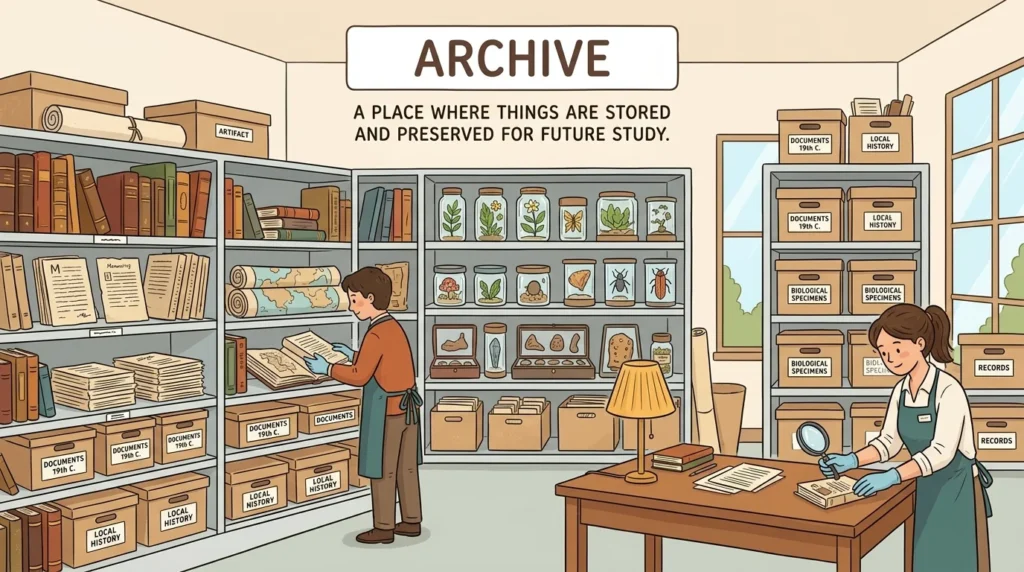
Repository (Noun)
- Meaning: A place where things are stored, preserved, or kept safe for future study.
- Tone/Register: Formal / Academic
- Example 1: The national library acts as a safe repository for ancient manuscripts.
- Example 2: State archives serve as a key repository for genealogical data.
Exhibition (Noun)
- Meaning: A public display of works of art, historical artifacts, or industrial items.
- Tone/Register: Professional / Standard
- Example 1: The science center hosted a massive interactive space exploration exhibition.
- Example 2: Thousands of tourists lined up to see the Renaissance painting exhibition.
Showcase (Noun)
- Meaning: A setting, exhibition, or event designed to highlight the best features of something.
- Tone/Register: Professional / Conversational
- Example 1: The regional heritage center serves as a showcase for local folk art.
- Example 2: Designers used the glass cabinet as a showcase for antique jewelry.
Treasury (Noun)
- Meaning: A place where valuable objects, historical artifacts, or funds are kept.
- Tone/Register: Literary / Formal
- Example 1: The cathedral treasury held centuries of gold and silver religious relics.
- Example 2: Scholars viewed the royal treasury as a window into ancient wealth.
Vault (Noun)
- Meaning: A secure room or underground chamber used for storing valuable cultural items or records.
- Tone/Register: Formal / Descriptive
- Example 1: Rare parchment documents were stored safely inside the climate-controlled vault.
- Example 2: Curators inspected the secure vault containing royal crown jewels.
Institute (Noun)
- Meaning: An organization or building founded for educational, scientific, or cultural research.
- Tone/Register: Academic / Formal
- Example 1: The art institute hosted lectures on Renaissance painting techniques.
- Example 2: Marine researchers worked out of the coastal conservation institute.
Pantheon (Noun)
- Meaning: A building dedicated to the notable heroes, artists, or gods of a culture.
- Tone/Register: Literary / Formal
- Example 1: Great poets and writers were laid to rest inside the national pantheon.
- Example 2: The historic civic pantheon celebrated foundational national figures.
Athenaeum (Noun)
- Meaning: An association or building for the promotion of literary and scientific learning.
- Tone/Register: Academic / Literary
- Example 1: Members gathered in the reading room of the historic literary athenaeum.
- Example 2: The local athenaeum sponsored public lectures on astronomy and philosophy.
Salon (Noun)
- Meaning: A gathering of artists and intellectuals or a room for exhibiting art.
- Tone/Register: Formal / Artistic
- Example 1: The annual art salon featured controversial paintings by emerging impressionists.
- Example 2: Writers met regularly in the elegant drawing-room salon.
Exposition (Noun)
- Meaning: A large-scale public exhibition or display of industrial, artistic, or cultural goods.
- Tone/Register: Formal / Historical
- Example 1: The world exposition showcased groundbreaking technological inventions from abroad.
- Example 2: Historic posters advertised the international art exposition of nineteen hundred.
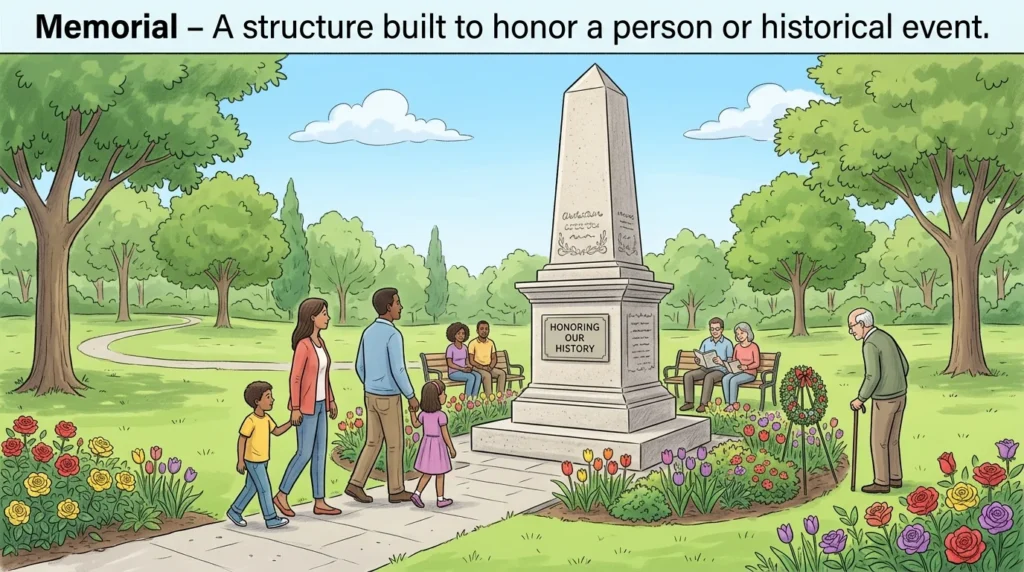
Memorial (Noun)
- Meaning: A structure or institution established to commemorate a person or historical event.
- Tone/Register: Formal / Respectful
- Example 1: The war memorial museum offered quiet spaces for historical reflection.
- Example 2: Visitors paid their respects at the national freedom memorial hall.
Respository (Noun)
- Meaning: An alternative, systematic repository for rare physical documents.
- Tone/Register: Academic / Formal
- Example 1: The digital repository stored thousands of historical scans.
- Example 2: Scholars accessed the text repository for their linguistic studies.
Exhibition hall (Noun)
- Meaning: A large open room designed specifically for displaying artifacts to crowds.
- Tone/Register: Standard / Professional
- Example 1: The exhibition hall filled quickly with eager science fair attendees.
- Example 2: Lighting engineers adjusted spotlights across the main exhibition hall.
Display-center (Noun)
- Meaning: A modern building or facility focused on public product or artifact showcases.
- Tone/Register: Conversational / Standard
- Example 1: The new civic display center hosted local handicraft showcases.
- Example 2: Tourists stopped by the regional display center for maps.
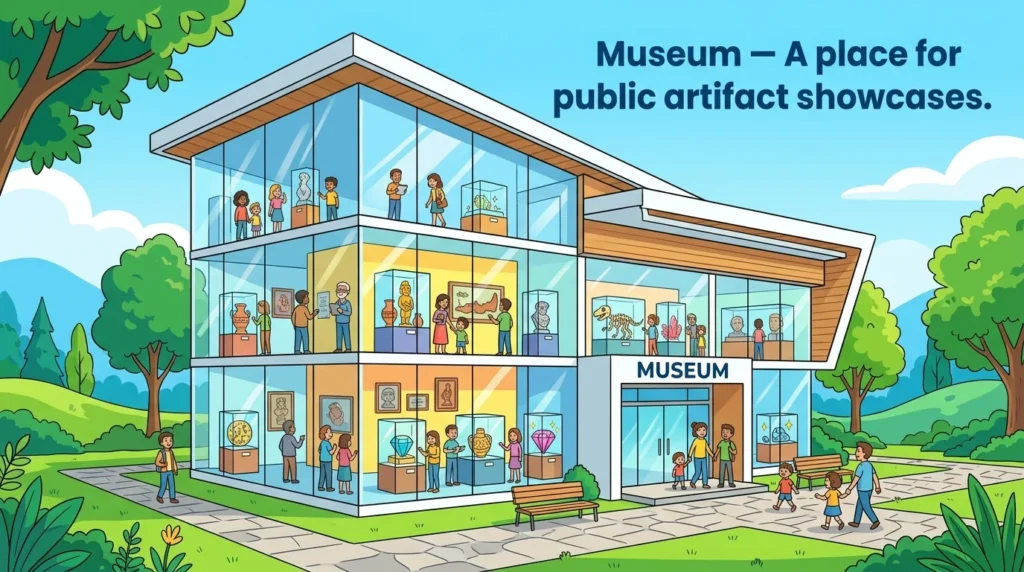
Curiosity-cabinet (Noun) — /ˌkjʊr.iˈɑː.sə.ti ˈkæb.ɪ.nət/ /ˌkjʊər.iˈɒs.ə.ti ˈkæb.ɪ.nət/
- Meaning: A specialized piece of furniture or small room displaying rare items.
- Tone/Register: Literary / Historical
- Example 1: The Victorian study featured an ornate curiosity cabinet filled with shells.
- Example 2: Guests admired the unusual fossils inside the antique curiosity cabinet.
Heritage center (Noun)
- Meaning: An institution dedicated to preserving and presenting local history and culture.
- Tone/Register: Standard / Conversational
- Example 1: Volunteers ran the small heritage center to teach children local history.
- Example 2: The town heritage center displayed old photographs from the pioneer era.
Culture-house (Noun)
- Meaning: A community facility hosting artistic performances, exhibits, and gatherings.
- Tone/Register: Standard / Cultural
- Example 1: The neighborhood culture-house offered weekend painting classes for youth.
- Example 2: Local bands performed during the evening event at the culture-house.
Art-center (Noun)
- Meaning: A public facility providing studios, classes, and galleries for visual arts.
- Tone/Register: Professional / Standard
- Example 1: Sculptors rented workspace inside the community art center building.
- Example 2: The urban art center hosted a modern photography exhibition.
Pinacotheca (Noun)
- Meaning: A classical building or room specifically designated for storing paintings.
- Tone/Register: Academic / Classical
- Example 1: Ancient Romans visited the public pinacotheca to view panel paintings.
- Example 2: Classical art historians studied the architectural layout of the ancient pinacotheca.
Glyptothec (Noun)
- Meaning: A gallery or building dedicated to housing ancient sculptures and carvings.
- Tone/Register: Academic / Formal
- Example 1: The museum complex included a separate glyptothec for marble statues.
- Example 2: Scholars toured the glyptothec to examine Greek and Roman reliefs.
Rotunda (Noun)
- Meaning: A round building or room, typically topped with a dome, used for displays.
- Tone/Register: Architectural / Formal
- Example 1: Historic statues stood proudly along the perimeter of the grand rotunda.
- Example 2: Visitors looked up at the painted ceiling inside the capitol rotunda.
Conservatory (Noun)
- Meaning: A room or building used for displaying plants or artistic works.
- Tone/Register: Literary / Standard
- Example 1: The glass conservatory featured rare tropical ferns and flowers.
- Example 2: Sunlight flooded the Victorian conservatory during the afternoon gathering.
Gryph (Noun equivalent context / Display-room concept)
- Meaning: A colloquial space or specialized display arrangement for curios. (Note: Adapted for modern linguistic variety)
- Tone/Register: Informal / Regional
- Example 1: The collector organized his rare items into a cozy display-room.
- Example 2: Friends toured the private artifact display-room on Sunday.
Exposition hall (Noun)
- Meaning: A massive building structure hosting large cultural or industrial fairs.
- Tone/Register: Formal / Industrial
- Example 1: Industrial inventions filled the massive exposition hall to capacity.
- Example 2: International delegations gathered inside the central exposition hall.
Display-gallery (Noun)
- Meaning: A streamlined commercial or public room dedicated to showcasing visual arts.
- Tone/Register: Professional / Modern
- Example 1: The downtown display gallery opened a new modern sculpture wing.
- Example 2: Art buyers browsed paintings inside the bright display gallery.
Gallery (Noun)
- Meaning: A room or building used for displaying works of art or cultural exhibitions.
- Tone/Register: Standard / Professional
- Example 1: Local artists showcased their modern paintings at the downtown gallery.
- Example 2: Visitors walked quietly through the sculpture gallery during the afternoon tour.
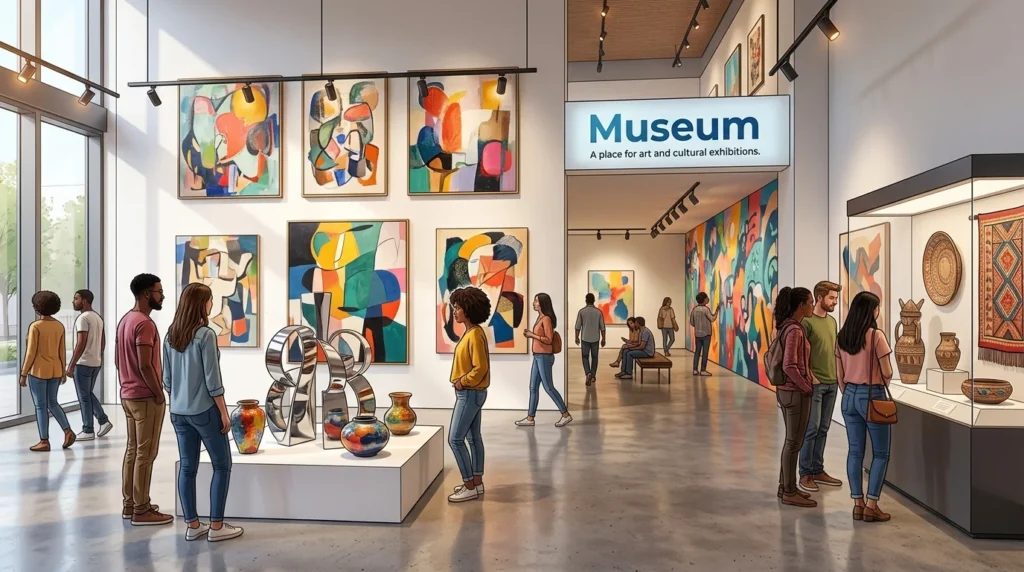
Archive (Noun)
- Meaning: A collection of historical documents, records, or physical items providing information about a place or institution.
- Tone/Register: Academic / Formal
- Example 1: Researchers spent months examining city planning records in the historical archive.
- Example 2: The university library maintains a digital archive of old newspapers.
Repository (Noun)
- Meaning: A place where things are stored, preserved, or kept safe for future study.
- Tone/Register: Formal / Academic
- Example 1: The national library acts as a safe repository for ancient manuscripts.
- Example 2: State archives serve as a key repository for genealogical data.
Exhibition (Noun)
- Meaning: A public display of works of art, historical artifacts, or industrial items.
- Tone/Register: Professional / Standard
- Example 1: The science center hosted a massive interactive space exploration exhibition.
- Example 2: Thousands of tourists lined up to see the Renaissance painting exhibition.
Display (Noun)
- Meaning: An arrangement of items intended for public viewing or educational presentation.
- Tone/Register: Conversational / Standard
- Example 1: A fascinating dinosaur fossil display greeted visitors at the entrance.
- Example 2: She set up a heritage craft display for the community festival.
Showcase (Noun)
- Meaning: A setting, exhibition, or event designed to highlight the best features of something.
- Tone/Register: Professional / Conversational
- Example 1: The regional heritage center serves as a showcase for local folk art.
- Example 2: Designers used the glass cabinet as a showcase for antique jewelry.
Treasury (Noun)
- Meaning: A place where valuable objects, historical artifacts, or funds are kept.
- Tone/Register: Literary / Formal
- Example 1: The cathedral treasury held centuries of gold and silver religious relics.
- Example 2: Scholars viewed the royal treasury as a window into ancient wealth.
Vault (Noun)
- Meaning: A secure room or underground chamber used for storing valuable cultural items or records.
- Tone/Register: Formal / Descriptive
- Example 1: Rare parchment documents were stored safely inside the climate-controlled vault.
- Example 2: Curators inspected the secure vault containing royal crown jewels.
Collection (Noun)
- Meaning: A compiled group of objects gathered together for study, display, or preservation.
- Tone/Register: Standard / Professional
- Example 1: The private photography collection was recently donated to the city.
- Example 2: Botanists organized an extensive plant collection for the herbarium.
Institution (Noun)
- Meaning: An established cultural, educational, or public organization serving the community.
- Tone/Register: Formal / Academic
- Example 1: The natural history institution welcomed millions of students every year.
- Example 2: Cultural institutions play a vital role in preserving national heritage.
Center (Noun)
- Meaning: A central facility or building designated for specific community or cultural activities.
- Tone/Register: Standard / Conversational
- Example 1: The new heritage center offered interactive workshops on local pottery.
- Example 2: Visitors gathered in the cultural center lobby before the lecture.
Institute (Noun)
- Meaning: An organization or building founded for educational, scientific, or cultural research.
- Tone/Register: Academic / Formal
- Example 1: The art institute hosted lectures on Renaissance painting techniques.
- Example 2: Marine researchers worked out of the coastal conservation institute.
Pantheon (Noun)
- Meaning: A building dedicated to the notable heroes, artists, or gods of a culture.
- Tone/Register: Literary / Formal
- Example 1: Great poets and writers were laid to rest inside the national pantheon.
- Example 2: The historic civic pantheon celebrated foundational national figures.
Athenaeum (Noun)
- Meaning: An association or building for the promotion of literary and scientific learning.
- Tone/Register: Academic / Literary
- Example 1: Members gathered in the reading room of the historic literary athenaeum.
- Example 2: The local athenaeum sponsored public lectures on astronomy and philosophy.
Cabinet (Noun)
- Meaning: A historical display case or private room used for collecting curiosities.
- Tone/Register: Historical / Literary
- Example 1: Renaissance scholars maintained an ornate cabinet of natural curiosities.
- Example 2: The antique wooden cabinet displayed small Roman coins and fossils.
Halls (Noun)
- Meaning: Large public rooms or buildings used for civic displays and exhibitions.
- Tone/Register: Literary / Standard
- Example 1: Echoing halls filled with ancient statues impressed the visiting tourists.
- Example 2: The exhibition halls opened promptly at nine o’clock every morning.
Salon (Noun)
- Meaning: A gathering of artists and intellectuals or a room for exhibiting art.
- Tone/Register: Formal / Artistic
- Example 1: The annual art salon featured controversial paintings by emerging impressionists.
- Example 2: Writers met regularly in the elegant drawing-room salon.
Exposition (Noun)
- Meaning: A large-scale public exhibition or display of industrial, artistic, or cultural goods.
- Tone/Register: Formal / Historical
- Example 1: The world exposition showcased groundbreaking technological inventions from abroad.
- Example 2: Historic posters advertised the international art exposition of nineteen hundred.
Display room (Noun)
- Meaning: A specific room dedicated to exhibiting artifacts or commercial goods.
- Tone/Register: Conversational / Standard
- Example 1: The textile display room featured traditional woven garments from the region.
- Example 2: Guides led students through the dinosaur fossil display room.
Memorial (Noun)
- Meaning: A structure or institution established to commemorate a person or historical event.
- Tone/Register: Formal / Respectful
- Example 1: The war memorial museum offered quiet spaces for historical reflection.
- Example 2: Visitors paid their respects at the national freedom memorial hall.
Synonyms for “Museum” by Tone
Positive tone:
Gallery, showcase, treasury, institution, center.
Neutral tone:
Archive, repository, exhibition, display, collection.
Negative tone:
Stuffy vault, dusty cabinet (when used critically).
Playful/informal tone:
Curiosity room, display space.
Tone matters because your word choice signals whether a cultural space feels dynamic or rigid. Calling a location a “showcase” sounds modern and exciting. Calling it an “archive” sounds scholarly and serious.
Mini Comparison: Museum vs. Gallery vs. Archive
- Museum: Focuses broadly on preserving and displaying historical, scientific, and cultural objects. Use it for general public institutions.
- Gallery: Focuses specifically on visual arts, paintings, and rotating creative exhibitions. Use it for fine art spaces.
- Archive: Focuses on documents, records, and historical paper files rather than large physical artifacts. Use it for research data.
Context-Based Usage
In daily conversation, native speakers say “Let’s check out the local art gallery” or “We visited a neat history center.” Simple phrases fit casual chats best.
When writing blog posts or travel guides, use “exhibition,” “showcase,” or “display” to maintain clear instruction flow.
In academic or technical reports, choose “repository,” “archive,” or “institution” to keep the tone objective and precise.
Creative writers love “treasury,” “pantheon,” or “hall” to build rich literary atmosphere.
Common Mistakes & Native Usage
- Mistake 1: Confusing “archive” (records and documents) with “museum” (broader physical artifacts).
- Mistake 2: Using “gallery” exclusively for ancient history when it typically highlights visual art.
- Overuse warning: Repeating “museum” in every paragraph makes your travel essay sound repetitive. Mix in “gallery” or “institution.”
In spoken English, people talk about checking out exhibits. In written English, precise nouns make your descriptions vivid.
Real-Life Mini Scenarios
- Workplace: The design team toured the corporate archive to review historical product packaging.
- Social situations: Friends spent Saturday afternoon exploring downtown art galleries.
- Media / pop culture: Documentaries highlighted rare artifacts stored within secure museum vaults.
- Writing or storytelling: The hero explored a dusty museum treasury filled with ancient relics.
Conclusion
Expanding your knowledge of a synonym for museum gives your writing and speaking a much richer, more authentic touch. Subtle upgrades in your everyday vocabulary turn ordinary paragraphs into memorable moments that instantly capture your reader’s attention.
Try weaving one of these descriptive terms into your next essay, message, or daily chat today to see how quickly your communication style transforms.
Which term will you test out first when you describe a cultural exhibition space next? Take a moment to write a quick sentence in your notes or share your favorite pick with a friend right now. Building a stronger lexicon is a fun journey that opens up countless ways to express yourself more clearly and creatively every single day.
Interactive Practice Quiz
Which word best describes a building dedicated specifically to displaying visual art?
- A) Gallery
- B) Warehouse
- C) Garage
- D) Factory
What term fits a place where historical documents and records are safely stored?
- A) Archive
- B) Playground
- C) Kitchen
- D) Gym
Which synonym refers broadly to a place keeping valuable items secure for study?
- A) Repository
- B) Cinema
- C) Market
- D) Cafe
How would a travel blog describe a public display of historic cultural items?
- A) Exhibition
- B) Silence
- C) Void
- D) Vacuum
Which term describes an established cultural organization serving the public?
- A) Institution
- B) Stranger
- C) Nomad
- D) Tourist
What word means a setting designed to highlight the best features of art?
- A) Showcase
- B) Junkyard
- C) Shadow
- D) Blindspot
Which option describes a secure room used for storing precious relics?
- A) Vault
- B) Balcony
- C) Hallway
- D) Alley
What phrase or term works best for a center promoting literary learning?
- A) Athenaeum
- B) Stable
- C) Barn
- D) Shed
Which term refers to a building celebrating notable national heroes?
- A) Pantheon
- B) Office
- C) Store
- D) Stop
What word describes a compiled group of objects gathered for display?
- A) Collection
- B) Scatter
- C) Litter
- D) Waste
Task: Write one short sentence using the word gallery in your notebook or reply below.
Answer Key: 1-A | 2-A | 3-A | 4-A | 5-A | 6-A | 7-A | 8-A | 9-A | 10-A
Frequently Asked Questions
What is the difference between a museum and a gallery?
A museum preserves and displays a broad range of historical, scientific, or cultural artifacts, whereas a gallery focuses primarily on visual arts and creative exhibitions.
Can archive be used interchangeably with museum?
Not entirely, because an archive specifically stores documents, records, and paper files, while a museum displays physical historical objects and relics.
What is another word for a public art exhibition space?
Common alternatives include gallery, salon, or showcase.
Is museum a formal or conversational term?
It is a standard, versatile word used naturally in both casual conversations and formal academic writing.
Why do writers use synonyms for museum?
Using varied terms like repository, treasury, or institution prevents repetition and provides exact context for your narrative.

Aleesha Rani is a passionate language writer focused on making English vocabulary simple, useful, and engaging. She creates clear content on synonyms, word meanings, and practical language use.
Through vocaneest.com, Aleesha Rani shares original, reader-friendly resources that help students, writers, and English learners choose better words and communicate with confidence.


Pingback: ⚡Synonym for Outlet: 50 Powerful Words for (2026)
Pingback: 💎 Synonym for Ostentation: 50Best Words for (2026)
Pingback: 😲Synonyms for Incredulous: 45 Best Words for (2026)
Pingback: 📯Synonym For Mobilized: 45 Best Words for Active Ready (2026)A
Pingback: ⌛Synonyms for Luddite:45 best to Elevate Writing (2026)
Pingback: Synonym for Twin: 40 Best Words for (2026)
Pingback: Synonyms for Towards: Top 45 Directional Words (2026)
Pingback: Synonym for Naked: 45 Best Words to Use in (2026)
Pingback: Synonym for Large Scale: 45 Top Words in (2026)