
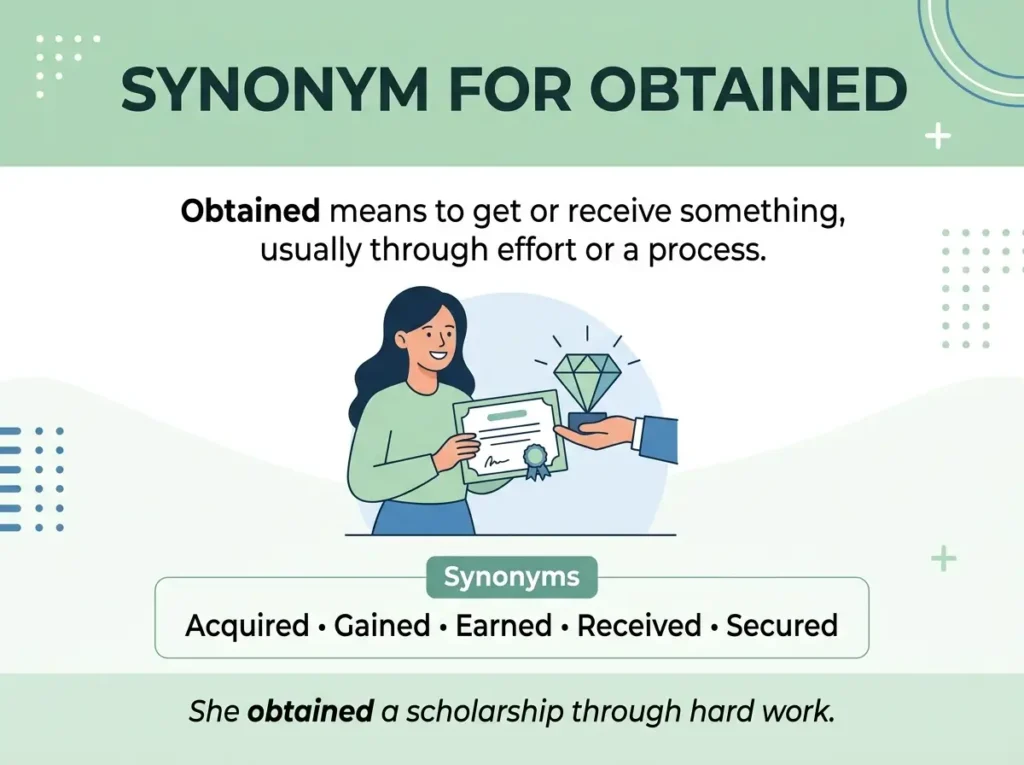
Synonym for obtained are usually best when you need a precise alternative to describe getting or securing something successfully.
Imagine working tirelessly on a major project for months, only to finally secure the approval you needed. In that moment, saying you merely got it feels inadequate.
For example, a researcher searching for a synonym for obtained might proudly announce that they secured crucial scientific data through meticulous laboratory experiments.
Finding the right synonym for obtained makes your prose far more engaging, dynamic, and polished for any audience. Consequently, learning semantic variations strengthens your vocabulary for academic essays, professional emails, and creative stories.
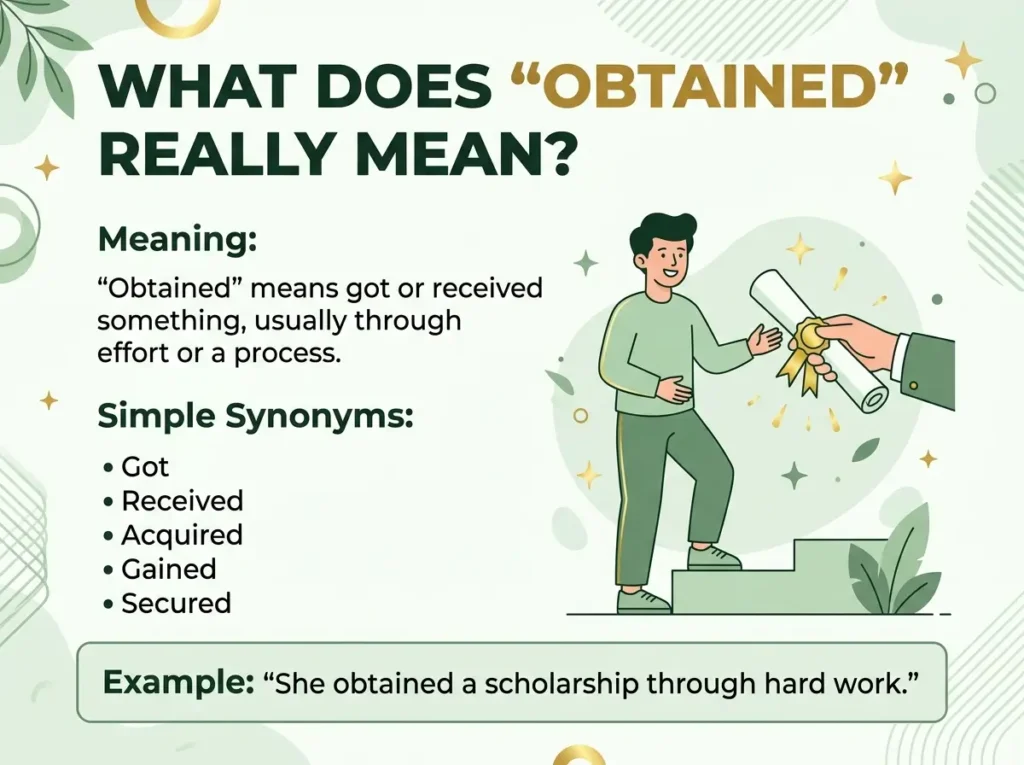
What Does “Obtained” Really Mean?
To obtain means to get, acquire, or secure something through deliberate effort, request, or formal procedure. Native English speakers naturally use this word when talking about official documents, hard-earned achievements, or specific physical items.
The word carries a formal, objective, and matter-of-fact tone across various disciplines. Furthermore, it appears continuously in news reports, legal contracts, scientific papers, and corporate correspondence.
As a Part of Speech, “obtained” functions primarily as the past tense and past participle of the verb obtain (/əbˈteɪn/), but it can also act as a participial adjective.
- Simple Definition: Got or secured something through effort, planning, or official request.
Connotative Meaning
(Connotation is the emotional feeling or cultural association that a word carries beyond its literal dictionary definition.)
- Positive tone: Moderately positive when associated with earning awards, degrees, or long-sought goals through honest dedication.
- Negative tone: Rarely negative on its own, though context can make it sound slightly cold, detached, or bureaucratic.
- Neutral tone: Predominantly neutral because it simply states the fact that an object or outcome was successfully secured.
Etymology
The term has a rich linguistic history originating from classical Latin before entering the English language.
- Origin: Derived from the Latin verb obtinēre, combining ob- (toward or at) and tenēre (to hold).
- Old English (450–1100): Early Germanic dialects relied instead on native verbs like getan (to get) or gearnian (to earn).
- Middle English (1100–1500): Adopted during the 14th century via Old French obtenir, meaning to hold or possess.
- Modern English (1500–Present): Settled as a standard formal verb used widely across academic, legal, and professional contexts.
Pronunciation & Syllables
- US: /əbˈteɪnd/
- UK: /əbˈteɪnd/
Syllable Breakdown: ob-tained (2 Syllables)
Affixation Pattern:
- Root: tain (from Latin tenēre, meaning to hold)
- Prefix: ob- (toward or completely)
- Suffix: -ed (past tense verbal suffix)
List Synonyms
Acquired (Verb) — US: /əˈkwaɪɚd/ | UK: /əˈkwaɪəd/
- Meaning: Gained possession of something through personal effort, purchase, or gradual experience over time.
- Tone/Register: Formal / Professional
- Example 1: The company recently acquired a prominent software business to expand its digital services.
- Example 2: Consequently, she acquired valuable fluency in French while living abroad in Paris.
Secured (Verb) — US: /səˈkjʊrd/ | UK: /sɪˈkjʊəd/
- Meaning: Fixed or made sure of gaining something valuable after overcoming competition or uncertainty.
- Tone/Register: Business / Official
- Example 1: The diplomatic team successfully secured a historic agreement before the deadline passed.
- Example 2: Therefore, early applicants secured the best seats for the upcoming summer concert.
Procured (Verb) — US: /prəˈkjʊrd/ | UK: /prəˈkjʊəd/
- Meaning: Obtained something with care, special effort, or through formal administrative systems.
- Tone/Register: Corporate / Legal
- Example 1: The logistics manager procured all necessary raw materials for the factory floor.
- Example 2: In addition, the library procured rare historical manuscripts for the research exhibition.
Gained (Verb) — US: /ɡeɪnd/ | UK: /ɡeɪnd/
- Meaning: Increased or added something desirable such as knowledge, weight, advantage, or profit.
- Tone/Register: Universal / General
- Example 1: He gained significant confidence after presenting his research to the international board.
- Example 2: Furthermore, the young startup gained many loyal customers through excellent service.
Earned (Verb) — US: /ɝːnd/ | UK: /ɜːnd/
- Meaning: Received deserving reward, merit, or financial payment as a direct result of effort.
- Tone/Register: Warm / Personal
- Example 1: She earned a well-deserved promotion after completing the challenging engineering project.
- Example 2: Consequently, honest dedication earned him the enduring respect of his peers.

Attained (Verb) — US: /əˈteɪnd/ | UK: /əˈteɪnd/
- Meaning: Reached or accomplished a high goal, state, or standard through sustained effort.
- Tone/Register: Academic / Inspirational
- Example 1: The athlete attained her personal best score during the final championship round.
- Example 2: Thus, relentless practice helped the student attain mastery over complex mathematics.
Fetched (Verb) — US: /fetʃt/ | UK: /fetʃt/
- Meaning: Went somewhere to collect and bring something back, or sold for a specific price.
- Tone/Register: Conversational / Commercial
- Example 1: The old painting fetched a surprisingly high price at the weekend auction.
- Example 2: Meanwhile, the assistant fetched the confidential files from the archive room upstairs.
Garnered (Verb) — US: /ˈɡɑːr.nɚd/ | UK: /ˈɡɑː.nəd/
- Meaning: Gathered, collected, or accumulated something valuable such as support, attention, or praise.
- Tone/Register: Journalism / Media
- Example 1: The independent film garnered widespread praise from critics across the globe.
- Example 2: As a result, the candidate garnered strong public support following the debate.
Derived (Verb) — US: /dɪˈraɪvd/ | UK: /dɪˈraɪvd/
- Meaning: Extracted or received something such as pleasure, value, or meaning from a specific source.
- Tone/Register: Analytical / Academic
- Example 1: Scientists derived a novel compound from rainforest plants to treat infections.
- Example 2: In addition, many students derive great satisfaction from community volunteer work.
Reaped (Verb) — US: /riːpt/ | UK: /riːpt/
- Meaning: Received benefits or consequences as the natural harvest or result of previous actions.
- Tone/Register: Expressive / Figurative
- Example 1: The long-term investors reaped substantial financial profits after years of patience.
- Example 2: Therefore, careful planning allowed the team to reap maximum rewards later on.
Collected (Verb) — US: /kəˈlek.tɪd/ | UK: /kəˈlek.tɪd/
- Meaning: Brought together or accumulated physical items, funds, or information from various places.
- Tone/Register: General / Direct
- Example 1: The charity collected thousands of canned goods for local emergency shelters.
- Example 2: Consequently, researchers collected detailed feedback from hundreds of survey participants.
Retrieved (Verb) — US: /rɪˈtriːvd/ | UK: /rɪˈtriːvd/
- Meaning: Found and brought back something that was stored, lost, or misplaced earlier.
- Tone/Register: Technical / Practical
- Example 1: The IT technician easily retrieved the deleted files from the cloud server.
- Example 2: Meanwhile, the dog quickly retrieved the thrown tennis ball from the tall grass.
Snatched (Verb) — US: /snætʃt/ | UK: /snætʃt/
- Meaning: Seized or took something quickly, eagerly, or suddenly in a fast-moving situation.
- Tone/Register: Informal / Dramatic
- Example 1: She snatched the last available seat on the crowded morning commute train.
- Example 2: However, the underdog team snatched a dramatic victory in the final seconds.
Bagged (Verb) — US: /bæɡd/ | UK: /bæɡd/
- Meaning: Captured, won, or secured something desirable, often in a competitive environment.
- Tone/Register: Informal / Colloquial
- Example 1: The talented young actor bagged the lead role in the upcoming Hollywood blockbuster.
- Example 2: Consequently, the retail store bagged its highest seasonal revenue in five years.
Landed (Verb) — US: /læn.dɪd/ | UK: /læn.dɪd/
- Meaning: Successfully won or secured a coveted job, deal, contract, or position after effort.
- Tone/Register: Conversational / Business
- Example 1: After four intense interviews, he finally landed his dream job at the tech firm.
- Example 2: Furthermore, the agency landed a major client contract that doubled their budget.

Elicited (Verb) — US: /iˈlɪs.ɪ.tɪd/ | UK: /iˈlɪs.ɪ.tɪd/
- Meaning: Drew out or evoked a specific reaction, response, or information from someone.
- Tone/Register: Formal / Psychological
- Example 1: The comedian’s hilarious opening joke elicited loud laughter from the audience.
- Example 2: Consequently, the survey questions elicited honest responses regarding customer service.
Extracted (Verb) — US: /ɪkˈstræk.tɪd/ | UK: /ɪkˈstræk.tɪd/
- Meaning: Removed or obtained something by using physical force, effort, or specialized processes.
- Tone/Register: Scientific / Technical
- Example 1: Engineers extracted mineral deposits from deep beneath the mountain surface safely.
- Example 2: Thus, investigators extracted key forensic evidence from the damaged hard drive.
Sourced (Verb) — US: /sɔːrst/ | UK: /sɔːst/
- Meaning: Found and obtained materials, products, or information from a specific supplier or location.
- Tone/Register: Business / Commercial
- Example 1: The local restaurant sourced all its organic vegetables from nearby family farms.
- Example 2: In addition, the firm sourced high-grade steel for the new bridge construction.
Clinched (Verb) — US: /klɪntʃt/ | UK: /klɪntʃt/
- Meaning: Settled, concluded, or secured a deal, victory, or agreement beyond any remaining doubt.
- Tone/Register: Media / Sports
- Example 1: A brilliant late goal clinched the national championship for the home team.
- Example 2: Therefore, the impressive sales pitch clinched the international partnership deal completely.
Scooped (Verb) — US: /skuːpt/ | UK: /skuːpt/
- Meaning: Picked up or won something quickly, or published news before rival organizations.
- Tone/Register: Informal / Journalism
- Example 1: The investigative reporter scooped every major network with her exclusive front-page story.
- Example 2: Furthermore, the young prodigy scooped up several trophies at the music festival.
Seized (Verb) — US: /siːzd/ | UK: /siːzd/
- Meaning: Took hold of something eagerly, forcefully, or suddenly when an opportunity arose.
- Tone/Register: Dynamic / Expressive
- Example 1: She eagerly seized the rare chance to study environmental science abroad.
- Example 2: As a result, the military forces seized the strategic outpost without delay.
Nabbed (Verb) — US: /næbd/ | UK: /næbd/
- Meaning: Caught, grabbed, or secured something quickly or unexpectedly before anyone else could.
- Tone/Register: Informal / Slang
- Example 1: He nabbed the discount concert tickets just seconds after they went on sale.
- Example 2: Meanwhile, sharp security officers quickly nabbed the fleeing suspect near the exit.
Captured (Verb) — US: /ˈkæp.tʃɚd/ | UK: /ˈkæp.tʃəd/
- Meaning: Recorded, represented, or took control of something desirable, like market share or attention.
- Tone/Register: Universal / Strategic
- Example 1: The stunning photograph perfectly captured the radiant colors of the mountain sunset.
- Example 2: Thus, the new smartphone model captured a massive portion of the global market.
Amassed (Verb) — US: /əˈmæst/ | UK: /əˈmæst/
- Meaning: Accumulated or collected a large quantity of wealth, materials, or information over time.
- Tone/Register: Formal / Descriptive
- Example 1: The wealthy collector amassed a vast array of ancient coins over thirty years.
- Example 2: Consequently, scientists amassed an impressive archive of climate data over decades.
Realized (Verb) — US: /ˈriː.ə.laɪzd/ | UK: /ˈrɪə.laɪzd/
- Meaning: Made a goal, profit, or vision become real and actualized through focused action.
- Tone/Register: Financial / Formal
- Example 1: The property owner realized a substantial profit after selling the downtown apartment.
- Example 2: Furthermore, she finally realized her lifelong dream of publishing a fantasy novel.
Inherited (Verb) — US: /ɪnˈher.ɪ.t̬ɪd/ | UK: /ɪnˈher.ɪ.tɪd/
- Meaning: Received property, traits, or rights from a predecessor, relative, or previous holder upon their departure.
- Tone/Register: Legal / Familial
- Example 1: The young entrepreneur inherited the family textile business after her father retired.
- Example 2: In addition, he inherited a passion for classical music from his grandfather.
Annexed (Verb) — US: /əˈnekst/ | UK: /əˈnekst/
- Meaning: Took control or possession of a territory, land, or resource, often without formal permission.
- Tone/Register: Historical / Political
- Example 1: The expanding empire annexed neighboring borderlands to secure vital trade routes.
- Example 2: Consequently, the university annexed several adjacent lots to build new research labs.
Appropriated (Verb) — US: /əˈproʊ.pri.eɪ.t̬ɪd/ | UK: /əˈprəʊ.pri.eɪ.tɪd/
- Meaning: Set aside or take control of money, assets, or property for a specific purpose or use.
- Tone/Register: Governmental / Formal
- Example 1: Parliament appropriated funds specifically to construct emergency relief facilities.
- Example 2: Therefore, the city council appropriated public land for the new community park.
Reclaimed (Verb) — US: /rɪˈkleɪmd/ | UK: /rɪˈkleɪmd/
- Meaning: Recovered or took back something that was previously lost, damaged, or surrendered.
- Tone/Register: Restorative / Environmental
- Example 1: Engineers successfully reclaimed unused coastal wetlands for sustainable agriculture.
- Example 2: Furthermore, she reclaimed her title as world champion during the final match.
Commandeered (Verb) — US: /ˌkɑː.mənˈdɪrd/ | UK: /ˌkɒm.ənˈdɪəd/
- Meaning: Took official or forceful control of vehicles, equipment, or spaces for emergency or official use.
- Tone/Register: Urgent / Authority
- Example 1: Emergency workers commandeered several private boats to evacuate flooded residents.
- Example 2: Meanwhile, the director commandeered the main conference room for a crisis meeting.
Copped (Verb) — US: /kɑːpt/ | UK: /kɒpt/
- Meaning: Caught, grabbed, or bought something quickly, often casually or unexpectedly.
- Tone/Register: Slang / Informal
- Example 1: He copped a rare vinyl record at the flea market for just five dollars.
- Example 2: Thus, fans copped ticket passes within minutes of the online release.
Cornered (Verb) — US: /ˈkɔːr.nɚd/ | UK: /ˈkɔː.nəd/
- Meaning: Gained exclusive control or dominant possession of a market, resource, or trade.
- Tone/Register: Financial / Business
- Example 1: The trading company cornered the regional coffee market through smart supply deals.
- Example 2: As a result, the firm cornered high-tech manufacturing patents early in the decade.
Glommed (Verb) — US: /ɡlɑːmd/ | UK: /ɡlɒmd/
- Meaning: Took hold of, grabbed, or attached oneself to something desirable quickly.
- Tone/Register: Colloquial / Informal
- Example 1: The media glommed onto the viral story as soon as it broke online.
- Example 2: In addition, collectors glommed onto the limited-edition shoes before stock ran out.
Intercepted (Verb) — US: /ˌɪn.t̬ɚˈsep.tɪd/ | UK: /ˌɪn.təˈsep.tɪd/
- Meaning: Stopped, seized, or received a physical object, message, or signal before it reached its destination.
- Tone/Register: Tactical / Direct
- Example 1: Security officers intercepted the unauthorized package before it reached the main office.
- Example 2: Therefore, sharp defense players intercepted the pass to turn the game around.
Requisitioned (Verb) — US: /ˌrek.wəˈzɪʃ.ənd/ | UK: /ˌrek.wɪˈzɪʃ.ənd/
- Meaning: Formally requested or demanded essential supplies or equipment for official or military duties.
- Tone/Register: Bureaucratic / Military
- Example 1: The relief agency requisitioned medical supplies to treat the isolated mountain villages.
- Example 2: Furthermore, the captain requisitioned extra fuel supplies before launching the voyage.
Monopolized (Verb) — US: /məˈnɑː.pə.laɪzd/ | UK: /məˈnɒp.əl.aɪzd/
- Meaning: Took exclusive ownership or complete control of a commodity, service, or conversation.
- Tone/Register: Commercial / Critical
- Example 1: A single telecom provider monopolized regional phone services for several years.
- Example 2: However, one loudspeaker monopolized the Q&A session after the lecture.
Swiped (Verb) — US: /swaɪpt/ | UK: /swaɪpt/
- Meaning: Took, grabbed, or stole something quickly without permission or through sudden movement.
- Tone/Register: Casual / Informal
- Example 1: Someone swiped her unattended jacket from the back of the coffee shop chair.
- Example 2: Meanwhile, the playful puppy swiped a shoe from the hallway rug.
Snagged (Verb) — US: /snæɡd/ | UK: /snæɡd/
- Meaning: Caught or secured something desirable quickly in a competitive or limited situation.
- Tone/Register: Conversational / Everyday
- Example 1: She snagged a front-row ticket to the theatre performance right before it sold out.
- Example 2: Thus, the team snagged a valuable sponsorship deal with an international brand.
Commenced (Verb) — US: /kəˈmenst/ | UK: /kəˈmenst/
- Meaning: Took possession of a status, task, or role through official initiation.
- Tone/Register: High Formal / Legal
- Example 1: The new board chairman commenced his administrative duties early Monday morning.
- Example 2: In addition, the research group commenced data collection following grant approval.
Assumed (Verb) — US: /əˈsuːmd/ | UK: /əˈsjuːmd/
- Meaning: Took upon oneself a role, position, title, or responsibility formally.
- Tone/Register: Professional / Official
- Example 1: The newly appointed director assumed control of the operations division this week.
- Example 2: Consequently, she assumed full responsibility for leading the multi-state marketing campaign.
Harvested (Verb) — US: /ˈhɑːr.və.stɪd/ | UK: /ˈhɑː.vɪ.stɪd/
- Meaning: Gathered crops, natural products, or raw data systematically from a rich source.
- Tone/Register: Agricultural / Technical
- Example 1: Local farmers harvested tons of organic wheat following a favorable growing season.
- Example 2: Thus, data analysts harvested consumer trend metrics to build better retail algorithms.
Possessed (Verb) — US: /pəˈzest/ | UK: /pəˈzest/
- Meaning: Came into ownership, control, or holding of a particular physical object or rare quality.
- Tone/Register: Descriptive / Literary
- Example 1: The old library possessed ancient maps documenting trade routes from centuries past.
- Example 2: Furthermore, the seasoned leader possessed remarkable calm during high-stress crises.

Synonyms by Tone
Choosing the right tone ensures your vocabulary fits the situation naturally. Using formal terms in casual texting sounds unnatural, while using informal slang in research papers lowers authority.
Positive / Triumphant:
Earned, Attained, Clinched, Realized, Reaped (highlights hard work, victory, and success).
Neutral / Objective:
Acquired, Collected, Sourced, Derived, Retrieved (focuses purely on facts, processes, and data).
Formal / Academic:
Procured, Elicited, Amassed, Extracted, Secured (ideal for research papers, contracts, and business reports).
Playful / Informal:
Landed, Bagged, Nabbed, Scooped, Snatched (perfect for casual dialogue, social media, and stories).
Mini Comparison: “Obtained” vs. Close Alternatives
| Word | Specific Focus | Best Context |
| Obtained | Getting something through official requests, rules, or general effort. | Legal forms, certificates, general facts, official records. |
| Acquired | Gaining possession permanently through effort, purchase, or habit. | Business buyouts, learning skills, buying property. |
| Procured | Sourcing something hard to get using specialized administrative systems. | Military supplies, corporate purchasing, rare items. |
How “Obtained” Changes by Context
In daily conversation, native speakers rarely use grand terms like “procured.” Instead, they rely on accessible verbs like got, landed, or picked up.
Across different types of writing, selecting vivid terms like garnered, reaped, or clinched keeps readers engaged while making paragraphs smooth and easy to read on mobile screens.
For professional and academic communication, precise vocabulary such as procured, amassed, or elicited adds clarity and credibility to corporate reports and research essays.
When crafting creative stories, expressive choices like snatched, seized, or nabbed create dramatic urgency and bring character actions to life.
Common Mistakes Learners Make
- Overusing “Obtained” in Casual Speech: Saying “I obtained a coffee” sounds unnatural; use “got” or “bought” instead.
- Confusing “Procured” with “Purchased”: Procure implies effort and arrangement; purchase focuses purely on spending money.
- Tone Mismatch: Avoid using nabbed in academic research papers, as casual slang undermines professional credibility.
(For additional vocabulary insights, explore our academic writing guides to refine your everyday sentence flow.)
Real-Life Mini Scenarios
- Workplace: The purchasing agent successfully procured all necessary components before the factory line opened.
- Social Situations: She quickly nabbed a great table near the window before the restaurant filled up.
- Media / Pop Culture: The blockbuster video game captured the interest of millions of gamers worldwide.
- Writing or Storytelling: The detective slowly extracted crucial information from the mysterious key witness.
Conclusion
Learning synonyms enriches your writing and helps you express subtle thoughts clearly. Expanding your vocabulary ensures your message stays fresh across all communication mediums.
Mastering words like acquired, secured, and procured gives your prose precision and confidence. Furthermore, choosing the right word ensures your writing connects deeply with readers.
Try practicing these new words today in your journal, email drafts, or essay writing. Developing consistent vocabulary habits builds strong, lifelong communication skills.
Interactive Practice Quiz
1. Which synonym fits best when describing a company buying out a competitor?
a) Nabbed
b) Acquired
c) Scooped
d) Fetched
2. If you work hard for years to complete your doctorate, you have:
a) Nabbed
b) Earned
c) Scooped
d) Fetched
3. What word best describes getting military equipment through official systems?
a) Snatched
b) Procured
c) Scooped
d) Nabbed
4. When a movie receives widespread praise from top critics, it has:
a) Derived
b) Garnered
c) Scooped
d) Fetched
5. Which casual verb fits best when landing a great job after several interviews?
a) Extracted
b) Landed
c) Procured
d) Elicited
6. What term works best when an IT worker recovers lost data from a backup server?
a) Retrieved
b) Garnered
c) Clinched
d) Reaped
7. If you draw out a strong emotional reaction from an audience, you have:
a) Nabbed
b) Elicited
c) Scooped
d) Fetched
8. Which word describes closing a major business agreement beyond any doubt?
a) Clinched
b) Fetched
c) Scooped
d) Nabbed
9. What slang word works best for quickly grabbing the last slice of pizza?
a) Procured
b) Snatched
c) Amassed
d) Derived
10. Which word fits best when accumulating a huge collection of rare books over decades?
a) Nabbed
b) Amassed
c) Scooped
d) Fetched
11. What word describes a farmer harvesting great financial rewards after years of labor?
a) Reaped
b) Nabbed
c) Scooped
d) Fetched
12. Which word best describes a local bakery sourcing flour from local farms?
a) Sourced
b) Nabbed
c) Scooped
d) Fetched
Application Task: Write one original sentence using secured or garnered to describe an accomplishment or goal from your week.
Answer Key: 1-b, 2-b, 3-b, 4-b, 5-b, 6-a, 7-b, 8-a, 9-b, 10-b, 11-a, 12-a
Frequently Asked Questions
1. What is the most common synonym for obtained in everyday English?
The most common everyday alternative is simply “got.” In casual speech, native speakers almost always use “got,” “found,” or “picked up” instead of “obtained” when referring to daily items or tasks.
2. Is “acquired” identical in meaning to “obtained”?
While closely related, “acquired” usually implies getting possession of something permanently through effort, purchase, or habit. “Obtained” focuses more broadly on the simple act of securing something, often through formal requests.
3. When should I use “procured” instead of “obtained”?
Use “procured” when describing items, services, or materials that required special effort, administrative coordination, or formal purchasing systems to get, such as in government, corporate, or military settings.

Aqsa Rani is the founder and lead writer at VocaNeest.com, a trusted platform dedicated to helping people improve their English vocabulary and communication skills. She creates well-researched, accurate, and easy-to-understand content covering synonyms, antonyms, word meanings, idioms, phrases, and everyday vocabulary. Her goal is to make learning English simple, practical, and accessible for students, writers, professionals, and lifelong learners.
At VocaNeest.com, every article is carefully researched, fact-checked, and written with a strong focus on accuracy, clarity, and real-world usage. Content is regularly reviewed and updated to ensure it remains helpful, relevant, and aligned with modern language standards. Through reliable vocabulary guides and practical examples, Aqsa aims to help readers write with confidence, expand their vocabulary, and communicate more effectively.


Pingback: 📚Synonym for Normalize: 50 Ways to Elevate Your Writing in (2026)