
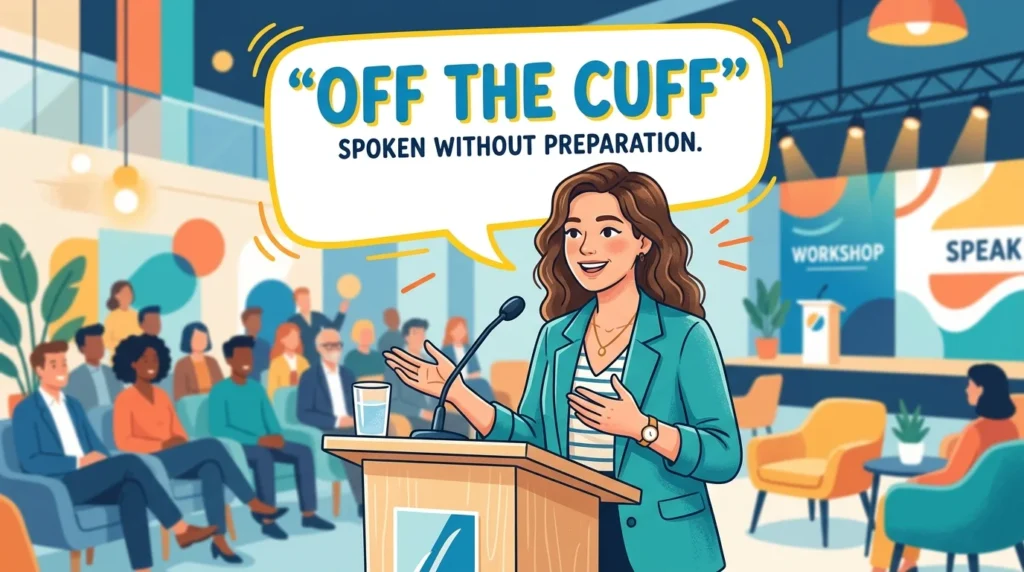
An off-the-cuff comment is something you say spontaneously without any prior preparation or script. Imagine stepping onto a stage when a microphone is suddenly handed to you unexpectedly. You must share your thoughts immediately.
Instead of freezing up, you rely purely on your mind during such an off-the-cuff moment. A common real-life example occurs during impromptu job interview questions. Exploring a synonym for an off-the-cuff remark helps elevate your everyday conversation. Speakers love this concept because it sounds authentic.
Naturally, mastering a synonym for off-the-cuff expressions empowers students, bloggers, and content writers globally. Daily English users also benefit heavily from expanding these lexical choices. Ultimately, varying your vocabulary prevents your writing from sounding repetitive or robotic
What Does “Off the Cuff” Really Mean?
The phrase off the cuff means speaking or acting spontaneously without any rehearsal, script, or advance preparation.
Native speakers understand this idiom as a sign of genuine, unscripted thought. It often appears in casual conversations, press conferences, board meetings, and live comedy.
As an idiom or prepositional phrase functioning adverbially or adjectivally, it describes impromptu communication.
Connotative Meaning
(Connotation refers to the wide array of positive, negative, or neutral emotional associations a word or phrase carries beyond its literal definition.)
- Positive tone: Implies cleverness, quick thinking, agility, and natural charm.
- Negative tone: Can occasionally suggest carelessness, lack of proper research, or irresponsibility.
- Neutral tone: Simply describes unscripted or extemporaneous delivery without judgment.
Etymology
The term originates from 19th-century theatrical and public speaking customs. Actors or speakers supposedly jotted quick notes onto their shirt cuffs before stepping onto a stage.
- Old English (450–1100): The root nouns like “cuff” did not carry this idiomatic meaning yet.
- Middle English (1100–1500): The physical word referred strictly to the lower part of a sleeve.
- Modern English (1500–Present): The phrase evolved around the mid-1900s to describe spontaneous remarks.
Pronunciation & Syllables
- US: /ˌɒf ðə ˈkʌf/
- UK: /ˌɒf ðə ˈkʌf/
- Syllables: off-the-cuff
- Affixation Pattern: Idiomatic prepositional phrase. Root: cuff. No prefixes or suffixes apply.
Synonyms List
Impromptu (Adjective) — /ɪmˈprɒm.tjuː/ /ɪmˈprɒm.tuː/
- Meaning: Done or said without any prior preparation or planning.
- Tone: Formal / Professional
- Example: She delivered an impromptu speech that moved the entire audience.
- Example: The team held an impromptu meeting in the hallway.
Extemporaneous (Adjective) — /ɪkˌstɛm.pəˈreɪ.ni.əs/ /ɪkˌstɛm.pəˈreɪ.ni.əs/
- Meaning: Spoken or done without preparation, though often requiring skill.
- Tone: Academic / Formal
- Example: Professors appreciate students who can offer extemporaneous analyses.
- Example: His extemporaneous remarks impressed the university board members.
Unrehearsed (Adjective) — /ˌʌn.rɪˈhɜːst/ /ˌʌn.rɪˈhɜːst/
- Meaning: Not practiced or rehearsed beforehand.
- Tone: Neutral / Conversational
- Example: The actors gave an unrehearsed demonstration of stage combat.
- Example: Her laughter during the comedy show was completely unrehearsed.
Spontaneous (Adjective) — /spɒnˈteɪ.ni.əs/ /spɒnˈteɪ.ni.əs/
- Meaning: Performed or occurring as a result of a sudden inner impulse.
- Tone: Positive / Energetic
- Example: They made a spontaneous decision to drive to the beach.
- Example: A spontaneous wave of applause swept through the room.
Ad-lib (Adjective / Verb) — /ˌædˈlɪb/ /ˌædˈlɪb/
- Meaning: Spoken or performed spontaneously without a written script.
- Tone: Informal / Creative
- Example: The comedian threw in an ad-lib line that made everyone laugh.
- Example: Actors often ad-lib when someone forgets a crucial line.
Unscripted (Adjective) — /ʌnˈskrɪp.tɪd/ /ʌnˈskrɪp.tɪd/
- Meaning: Not written down or planned in advance.
- Tone: Media / Professional
- Example: The documentary captured an unscripted moment between friends.
- Example: Talk show hosts thrive during unscripted live television interviews.
Improvisational (Adjective) — /ɪmˌprɒv.aɪˈzeɪ.ʃən.əl/ /ɪmˌprɒv.əˈzeɪ.ʃən.əl/
- Meaning: Created or performed spontaneously without preparation.
- Tone: Artistic / Creative
- Example: Jazz music relies heavily on improvisational skill and talent.
- Example: Drama classes teach students wonderful improvisational techniques.
Unprepared (Adjective) — /ˌʌn.prɪˈpeərd/ /ˌʌn.prɪˈpeəd/
- Meaning: Not ready or equipped for a specific situation.
- Tone: Neutral / Direct
- Example: He felt completely unprepared for the sudden pop quiz.
- Example: Arriving unprepared to a client meeting looks unprofessional.
Unplanned (Adjective) — /ʌnˈplænd/ /ʌnˈplænd/
- Meaning: Occurring without any prior design or intention.
- Tone: Casual / Standard
- Example: Our afternoon walk turned into an unplanned picnic.
- Example: Unplanned expenses can sometimes disrupt a monthly budget.
On the fly (Idiomatic Phrase) — /ɒn ðə flaɪ/ /ɒn ðə flaɪ/
- Meaning: Deciding or doing something immediately while busy with other tasks.
- Tone: Conversational / Business
- Example: We had to invent a new strategy on the fly.
- Example: Good project managers solve problems efficiently on the fly.
At short notice (Idiomatic Phrase) — /æt ʃɔːt ˈnəʊ.tɪs/ /æt ʃɔːt ˈnɒt.ɪs/
- Meaning: With very little advance warning or preparation time.
- Tone: Professional / Urgent
- Example: The photographer arrived at short notice for the event.
- Exampleзм: Employees can rarely travel abroad at short notice.
Freehand (Adjective) — /ˈfriː.hænd/ /ˈfriː.hænd/
- Meaning: Drawn or done without the use of instruments or guides.
- Tone: Artistic / Technical
- Example: She sketched a portrait freehand with remarkable accuracy.
- Example: The carpenter cut the curved wood completely freehand.
On the spur of the moment (Idiomatic Phrase) — /ɒn ðə spɜːr əv ðə ˈməʊ.mənt/ /ɒn ðə spɜː v ə ðə ˈməʊ.mənt/
- Meaning: Done suddenly without any prior planning or forethought.
- Tone: Informal / Conversational
- Example: They booked a vacation on the spur of the moment.
- Example: I bought the jacket on the spur of the moment.
Freewheeling (Adjective) — /ˈfriːˌwiː.lɪŋ/ /ˈfriːˌwiː.lɪŋ/
- Meaning: Acting without rigid rules, plans, or controls.
- Tone: Casual / Descriptive
- Example: The discussion remained freewheeling and highly creative.
- Example: He enjoyed a freewheeling lifestyle after college graduation.
Catchpenny (Adjective) — /ˈkætʃˌpɛn.i/ /ˈkætʃˌpɛn.i/
- Meaning: Quick and superficial, designed to attract immediate attention.
- Tone: Literary / Archaic
- Example: The market stall sold catchy, low-quality tourist novelties.
- Example: Avoid catchpenny solutions when building a lasting website.
Ex tempore (Adverb / Adjective) — /ɛks ˈtɛm.pə.ri/ /ɛks ˈtɛm.pə.ri/
- Meaning: Spoken or composed without any preparation.
- Tone: Scholarly / Formal
- Example: The scholar translated the ancient text ex tempore.
- Example: Her extemporaneous lecture amazed the visiting professors.
Improvised (Adjective) — /ˈɪm.prə.vaɪzd/ /ˈɪm.prə.vaɪzd/
- Meaning: Built or made from whatever is available, without planning.
- Tone: Practical / Conversational
- Example: We built an improvised shelter during the sudden storm.
- Example: The band used improvised instruments for the street performance.
Offhand (Adjective) — /ˈɒf.hænd/ /ˈɒf.hænd/
- Meaning: Ungracefully or casually; without careful thought.
- Tone: Casual / Critical
- Example: His offhand comment hurt her feelings unintentionally.
- Example: I cannot give you exact figures offhand right now.
On the spot (Idiomatic Phrase) — /ɒn ðə spɒt/ /ɒn ðə spɒt/
- Meaning: Doing something immediately where you stand or right now.
- Tone: Direct / Conversational
- Example: The manager hired her on the spot after the interview.
- Example: Reporters put the politician on the spot with hard questions.
Winging it (Idiomatic Phrase) — /ˈwɪŋ.ɪŋ ɪt/ /ˈwɪŋ.ɪŋ ɪt/
- Meaning: Improvising or managing a situation without preparation.
- Tone: Informal / Slang
- Example: I forgot my presentation notes and ended up winging it.
- Example: She felt nervous because she was basically winging it.
Tossed off (Verb Phrase) — /tɒst ɒf/ /tɒst ɒf/
- Meaning: Written or produced quickly and effortlessly.
- Tone: Literary / Casual
- Example: He tossed off a poem in less than ten minutes.
- Example: The journalist tossed off a quick article before lunch.
Extempore (Adjective) — /ɛkˈstɛm.pə.ri/ /ɛkˈstɛm.pə.ri/
- Meaning: Spoken or done without advance preparation.
- Tone: Formal / Academic
- Example: The student gave an extempore speech in history class.
- Example: Judges evaluated competitors based on extempore delivery skills.
Impulsive (Adjective) — /ɪmˈpʌl.sɪv/ /ɪmˈpʌl.sɪv/
- Meaning: Acting or done without forethought.
- Tone: Psychological / Standard
- Example: Buying the expensive gadget was an impulsive choice.
- Example: Impulse decisions often lead to unexpected regrets.
Uncalculated (Adjective) — /ʌnˈkæl.kjʊ.leɪ.tɪd/ /ʌnˈkæl.kjʊ.leɪ.tɪd/
- Meaning: Not thought out or planned ahead of time.
- Tone: Formal / Literary
- Example: Her reaction was uncalculated and entirely genuine.
- Example: He made an uncalculated remark during the debate.
Off-the-top-of-one’s-head (Idiomatic Phrase) — /ˌɒf ðə tɒp əv wʌnz hɛd/ /ˌɒf ðə tɒp əv wʌnz hɛd/
- Meaning: Stated from memory without checking facts first.
- Tone: Conversational / Standard
- Example: Off the top of my head, I think attendance was fifty.
- Example: She gave an estimate off the top of her head.
Unmeditated (Adjective) — /ʌnˈmɛd.ɪ.teɪ.tɪd/ /ʌnˈmɛd.ɪ.teɪ.tɪd/
- Meaning: Done without advance thought, deliberation, or rehearsal.
- Tone: Formal / Literary
- Example 1: His unmeditated response revealed his true feelings about the new policy.
- Example 2: The poet delivered an unmeditated verse during the evening gathering.
Unpremeditated (Adjective) — /ˌʌn.prɪˈmɛd.ɪ.teɪ.tɪd/ /ˌʌn.prɪ.ˈmɛd.ɪ.teɪ.tɪd/
- Meaning: Planned or thought out beforehand; occurring on the spot.
- Tone: Legal / Formal
- Example 1: Prosecutors argued that the sudden altercation was entirely unpremeditated.
- Example 2: An unpremeditated outburst interrupted the quiet courtroom proceedings.
Unconned (Adjective) — /ʌnˈkɒnd/ /ʌnˈkɒnd/
- Meaning: Not studied, memorized, or practiced beforehand.
- Tone: Literary / Archaic
- Example 1: The actor recited his lines unmemorized when the script went missing.
- Example 2: She approached the difficult performance with an unstudied mind.
Unstudied (Adjective) — /ʌnˈstʌd.ɪd/ /ʌnˈstʌd.ɪd/
- Meaning: Natural and artless; not affected or carefully rehearsed.
- Tone: Literary / Expressive
- Example 1: Her unstudied elegance made her stand out at the gala.
- Example 2: He possessed an unstudied charm that won over every client.

Casual (Adjective) — /ˈkæʒ.u.əl/ /ˈkæʒ.u.əl/
- Meaning: Done without deep seriousness, forethought, or rigid structure.
- Tone: Conversational / Standard
- Example 1: They made a casual remark about moving to a different city.
- Example 2: A casual conversation led to an exciting business partnership.
Unreflective (Adjective) — /ˌʌn.rɪˈflɛk.tɪv/ /ˌʌn.rɪˈflɛk.tɪv/
- Meaning: Acting or speaking quickly without deep thought or analysis.
- Tone: Critical / Neutral
- Example 1: An unreflective choice often leads to avoidable complications later.
- Example 2: She regretted her unreflective reply during the heated argument.
Uncalculatedly (Adverb) — /ʌnˈkæl.kjʊ.leɪ.tɪd.li/ /ʌnˈkæl.kjʊ.leɪ.tɪd.li/
- Meaning: In a manner that lacks deliberate planning or premeditation.
- Tone: Academic / Formal
- Example 1: He reacted uncalculatedly when he heard the unexpected news.
- Example 2: The funds were distributed uncalculatedly across several local charities.
Ad-libbed (Verb / Adjective) — /ˈæd.lɪbd/ /ˈæd.lɪbd/
- Meaning: Spoken or performed spontaneously without an established script.
- Tone: Entertainment / Informal
- Example 1: The host delivered an ad-libbed joke that delighted the audience.
- Example 2: Much of their humorous dialogue was entirely ad-libbed.
Off-the-record (Idiomatic Adjective) — /ˌɒf ðə ˈrɛk.ɔːd/ /ˌɒf ðə ˈrɛk.ɔːd/
- Meaning: Spoken informally and spontaneously without official attribution.
- Tone: Journalism / Professional
- Example 1: The politician offered an off-the-record opinion to reporters.
- Example 2: Journalists appreciate off-the-record insights during complex investigations.
On the spur of the moment (Idiomatic Phrase) — /ɒn ðə spɜːr əv ðə ˈməʊ.mənt/ /ɒn ðə spɜː v ə ðə ˈməʊ.mənt/
- Meaning: Acting instantly on a sudden urge without prior planning.
- Tone: Casual / Conversational
- Example 1: They planned a weekend road trip on the spur of the moment.
- Example 2: Buying the vintage painting was done on the spur of the moment.
Quick-witted (Adjective) — /ˌkwɪkˈwɪt.ɪd/ /ˌkwɪkˈwɪt.ɪd/
- Meaning: Able to reply or think clearly and cleverly in an instant.
- Tone: Positive / Expressive
- Example 1: Her quick-witted response saved the presentation from awkward silence.
- Example 2: The moderator proved quick-witted during the live debate session.
Ready-made (Adjective) — /ˌrɛd.iˈmeɪd/ /ˌrɛd.iˈmeɪd/
- Meaning: Instantly available for use without needing assembly or thought.
- Tone: Conversational / Standard
- Example 1: He lacked a ready-made excuse for missing the morning meeting.
- Example 2: She offered a ready-made solution to the technical glitch.
Free-flowing (Adjective) — /ˈfriːˌfləʊ.ɪŋ/ /ˈfriːˌfləʊ.ɪŋ/
- Meaning: Proceeding naturally and easily without rigid constraints.
- Tone: Conversational / Creative
- Example 1: The evening featured a free-flowing discussion on modern art.
- Example 2: Brainstorming sessions work best when kept open and free-flowing.
On-the-hoof (Idiomatic Adjective) — /ɒn ðə ˈhuːf/ /ɒn ðə ˈhuːf/
- Meaning: Done quickly while moving or busy with other tasks.
- Tone: British / Conversational
- Example 1: We grabbed a quick lunch on the hoof between client appointments.
- Example 2: Managers often make decisions on the hoof during busy shifts.
Winged (Verb / Adjective) — /wɪŋd/ /wɪŋd/
- Meaning: Handled a situation dynamically through improvisation.
- Tone: Informal / Slang
- Example 1: He winged his part of the dialogue when his memory failed.
- Example 2: She successfully winged her way through the complex interview.
Synonyms for “Off the Cuff” by Tone
Positive Tone:
Spontaneous, improvisational, freewheeling, ad-lib. These highlight creativity and agility.
Neutral Tone:
Unscripted, unrehearsed, impromptu, extempore. These simply denote a lack of prior planning.
Negative Tone:
Unprepared, offhand, impulsive. These can imply recklessness or poor organization.
Playful / Informal Tone:
Winging it, on the fly, on the spur of the moment. These fit casual friend groups or relaxed settings.
“Off the Cuff” vs Close Alternatives
Compare three popular variations to choose correctly every time:
- Off the Cuff: Conversational, idiomatic, implies casual spoken remarks. Use it in daily chats or interviews.
- Impromptu: Professional and slightly more formal. Use it for speeches, meetings, or organized performances.
- Extemporaneous: Academic or scholarly. Use it when describing sophisticated public speaking or formal academic debates.
How “Off the Cuff” Changes by Context
Daily conversations welcome idioms naturally. Friends often say, “I said that right off the cuff.”
Writing or blogging requires more precise vocabulary. Authors swap idioms for words like unscripted to maintain professional polish.
Professional or academic settings demand formal terms like extemporaneous or impromptu.
Creative storytelling thrives on informal phrasing like winging it or ad-libbing.
Common Mistakes & Native Usage
Common Mistakes Learners Make
Learners frequently overuse idioms in formal academic essays where precise adjectives belong.
Another error involves mixing up offhand with off the cuff. While similar, offhand can sometimes sound dismissive or rude.
Furthermore, speakers must avoid using spontaneous when they specifically mean unprepared speech, as spontaneous often refers to sudden natural actions.
Register Notes
Informal phrases work wonderfully in speech. Formal documents require academic register alternatives.
Real-Life Examples Using “Off the Cuff”
- Workplace: The CEO made an off-the-cuff remark about expanding into new markets next year.
- Social Situations: During dinner, she shared an off-the-cuff joke that had everyone laughing.
- Media / Pop Culture: The actor gave an off-the-cuff interview on the red carpet.
- Writing or Storytelling: The author added an off-the-cuff subplot to the novel.
Conclusion
Learning powerful synonyms transforms your writing, blogging, speaking, and everyday communication. Expanding your vocabulary lets you express precise shades of meaning effortlessly without sounding repetitive or dull.
Encourage yourself to practice these words in professional emails, academic essays, and casual daily conversations. Consistent practice builds natural confidence and long-term linguistic fluency.
Start integrating a brand-new synonym into your daily speech today. Master your communication skills now!
Interactive Practice Quiz
1. Which synonym best fits a formal academic speech delivered without notes?
- A) Winging it
- B) Extemporaneous
- C) Offhand
- D) Tossed off
2. What does an ad-lib line in a play signify?
- A) A rehearsed script
- B) A memorized poem
- C) Spontaneous dialogue
- D) A written contract
3. If a comedian makes a joke on the spot, how are they acting?
- A) Impromptu
- B) Scripted
- C) Preplanned
- D) Formal
4. Which phrase describes doing something immediately while busy?
- A) On the fly
- B) In advance
- C) Carefully scheduled
- D) Extempore
5. What emotional connotation does the word spontaneous usually carry?
- A) Negative
- B) Positive
- C) Hostile
- D) Rigid
6. When someone says they are “winging it,” what register are they using?
- A) Academic
- B) Informal
- C) Legal
- D) Archaic
7. Which term describes art drawn without guidelines or instruments?
- A) Freehand
- B) Pre-requisite
- C) Scripted
- D) Calculated
8. Why do native speakers enjoy using idioms like off the cuff?
Answer Key: 1-B, 2-C, 3-A, 4-A, 5-B, 6-B, 7-A, 8-B,
Frequently Asked Questions
What is the origin of the idiom off the cuff?
The expression dates back to the nineteenth century. Public speakers and actors supposedly jotted quick reminder notes directly onto their shirt cuffs before stepping onto a stage.
Can I use off the cuff in formal academic writing?
Writers generally avoid idioms in formal research papers. Academic contexts prefer precise terms like extemporaneous or impromptu instead of informal idioms.
What is the difference between offhand and off the cuff?
While both mean spontaneous, offhand can sometimes carry a negative connotation implying rudeness or carelessness, whereas off the cuff usually feels casual and harmless.
How can ESL learners practice these synonyms effectively?
Learners should practice substituting one synonym per day in casual emails, journaling entries, or conversational practice with native speakers to build active retention.
Are impromptu and spontaneous synonyms?
They share similarities, but impromptu specifically means unplanned communication or performance, while spontaneous can describe any sudden natural event or action.

Aleesha Rani is a passionate language writer focused on making English vocabulary simple, useful, and engaging. She creates clear content on synonyms, word meanings, and practical language use.
Through vocaneest.com, Aleesha Rani shares original, reader-friendly resources that help students, writers, and English learners choose better words and communicate with confidence.