
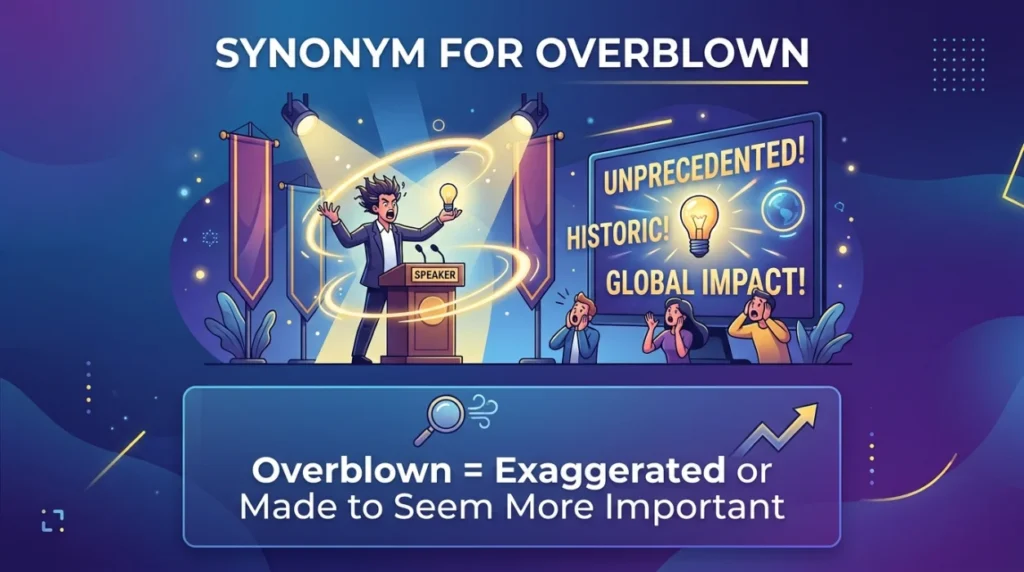
A synonym for overblown is a word or phrase that describes something exaggerated, excessive, inflated, or more important than it really is. Common alternatives include exaggerated, overstated, inflated, excessive, sensationalized, bombastic, and melodramatic.
Synonym for overblown becomes useful when you want to describe an idea, claim, story, style, reaction, or piece of writing that goes beyond what seems reasonable. For example, a writer might call an exaggerated news report “overblown.”
Imagine a friend tells you that a small delay ruined an entire event. You might say the reaction seems exaggerated or disproportionate. Both words can express the idea behind overblown.
Learning a synonym for overblown helps students, bloggers, content writers, and everyday English users choose words that match the exact level of exaggeration.
What Does “Overblown” Really Mean?
Overblown means exaggerated, excessive, or made to seem more important, impressive, serious, or dramatic than it really is.
For example:
The media coverage was overblown.
This suggests that the coverage made the situation seem more significant than it actually was.
The word can also describe writing, speeches, performances, emotions, designs, or expectations that feel excessive.
The speech sounded overblown.
Here, overblown suggests that the language was too dramatic, grand, or elaborate.
Native speakers usually understand overblown as a critical or disapproving word. It often suggests that something has gone beyond a reasonable level.
Part of Speech
Overblown is primarily an adjective when used in its modern figurative sense.
It can describe:
- an overblown claim
- an overblown reaction
- an overblown story
- an overblown speech
- an overblown sense of importance
- an overblown description
It is also the past participle of the verb overblow.
Connotative Meaning
Connotation (the feeling or association connected with a word beyond its basic meaning) is important with overblown because the word usually carries criticism.
Positive Tone
Overblown is rarely positive. However, in artistic discussion, something may be described as deliberately overblown to create humor, drama, or theatrical effect.
Negative Tone
The negative meaning is the most common.
The article made an overblown claim about the discovery.
The sentence suggests that the claim was too exaggerated.
Neutral Tone
The word can sometimes be used descriptively when discussing style or scale, but it still often carries a mild critical feeling.
Etymology of “Overblown”
Overblown comes from the verb overblow, formed from over- + blow.
The verb overblow has Middle English roots. Historical sources record overblowen from around the 14th century. The figurative sense connected with something being inflated or exaggerated developed much later.
Old English: 450–1100
The word did not yet exist in its modern form during Old English. However, its building blocks have deep Germanic roots.
Blow is related to Old English blāwan, meaning to blow, breathe, create an air current, or inflate.
The element over- comes from Old English ofer and could carry meanings related to above, beyond, or excessive degree.
Middle English: 1100–1500
The compound overblowen appeared during Middle English. Early uses were connected with blowing over, passing over, or being affected by wind.
The figurative meaning developed later from these physical ideas.
Modern English: 1500–Present
By the early modern period, overblown had developed additional meanings connected with flowers that had passed full bloom.
Later, its figurative sense expanded. By the 19th century, overblown could describe something inflated, excessive, or puffed up in a figurative sense.
Pronunciation
US: /ˌoʊ.vɚˈbloʊn/
UK: /ˌəʊ.vəˈbləʊn/
Syllables
o-ver-blown
Affixation Pattern
Root: blow
Prefix: over-
Suffix: none
The prefix over- contributes the idea of excess or going beyond a normal level.
Synonyms List
The best synonym depends on what is being described. A word that works for an exaggerated claim may not be the best choice for overly dramatic writing.
Overstatedly (Adverb) — US /ˌoʊvərˈsteɪtɪdli/ | UK /ˌəʊvəˈsteɪtɪdli/
Meaning: In an exaggerated or excessively emphatic manner.
Tone/Register: Formal.
Example:
The benefits were overstatedly presented.
The issue was described overstatedly in the report.
Amplified (Adjective) — US /ˈæmplɪfaɪd/ | UK /ˈæmplɪfaɪd/
Meaning: Made to seem stronger, larger, or more significant than before.
Tone/Register: Neutral, formal.
Example:
Social media amplified the controversy.
The small problem became amplified online.
Embellished (Adjective) — US /ɪmˈbelɪʃt/ | UK /ɪmˈbelɪʃt/
Meaning: Made more interesting or impressive by adding details that may not be completely factual.
Tone/Register: Neutral, literary.
Example:
His account was heavily embellished.
She told an embellished version of the story.
Magniloquent (Adjective) — US /mæɡˈnɪləkwənt/ | UK /mæɡˈnɪləkwənt/
Meaning: Using grand, impressive, or elevated language, often excessively.
Tone/Register: Formal, literary.
Example:
His magniloquent speech lasted an hour.
The announcement sounded unnecessarily magniloquent.
Rhetorical (Adjective) — US /rɪˈtɔrɪkəl/ | UK /rɪˈtɒrɪkəl/
Meaning: Relating to persuasive or elaborate language, especially when emphasis matters more than literal meaning.
Tone/Register: Academic, formal.
Example:
The article relied on rhetorical exaggeration.
His rhetorical style made the argument seem larger than it was.
Extravagant (Adjective) — US /ɪkˈstrævəɡənt/ | UK /ɪkˈstrævəɡənt/
Meaning: Excessive, elaborate, or far beyond what is reasonable or necessary.
Tone/Register: Neutral, formal.
Example:
The promises sounded extravagant.
The celebration featured extravagant decorations.
Lavish (Adjective) — US /ˈlævɪʃ/ | UK /ˈlævɪʃ/
Meaning: Excessively elaborate, abundant, or impressive in appearance or amount.
Tone/Register: Neutral.
Example:
The ceremony received lavish praise.
The article gave a lavish description of the event.
Magnified (Adjective) — US /ˈmæɡnɪfaɪd/ | UK /ˈmæɡnɪfaɪd/
Meaning: Made to appear larger, more serious, or more important than it originally was.
Tone/Register: Neutral, formal.
Example:
The disagreement was magnified by social media.
The report magnified a minor concern.
Amped-Up (Adjective) — US /ˌæmpt ˈʌp/ | UK /ˌæmpt ˈʌp/
Meaning: Made more intense, exciting, or dramatic than usual.
Tone/Register: Informal.
Example:
The movie uses an amped-up version of the original story.
The event had an amped-up atmosphere.
Hyperbolical (Adjective) — US /ˌhaɪpərˈbɑlɪkəl/ | UK /ˌhaɪpəˈbɒlɪkəl/
Meaning: Characterized by deliberate or extreme exaggeration.
Tone/Register: Formal, literary.
Example:
The writer uses hyperbolical language for humor.
His description was intentionally hyperbolic.
Exaggerated (Adjective) — US /ɪɡˈzædʒəreɪtɪd/ | UK /ɪɡˈzædʒəreɪtɪd/
Meaning: Exaggerated describes something presented as greater, stronger, or more important than it really is.
Tone/Register: Neutral, very common.
Example:
The story contained several exaggerated details.
His description of the problem sounded exaggerated.
Overstated (Adjective) — US /ˌoʊvərˈsteɪtɪd/ | UK /ˌəʊvəˈsteɪtɪd/
Meaning: Overstated means expressed as more important, serious, or impressive than the facts support.
Tone/Register: Formal, academic, professional.
Example:
The report overstated the benefits of the program.
Her concerns may have been overstated.
Inflated (Adjective) — US /ɪnˈfleɪtɪd/ | UK /ɪnˈfleɪtɪd/
Meaning: Inflated describes something made to seem larger, more valuable, or more important than it really is.
Tone/Register: Neutral, professional.
Example:
The article used an inflated estimate.
He has an inflated sense of his own importance.
Excessive (Adjective) — US /ɪkˈsesɪv/ | UK /ɪkˈsesɪv/
Meaning: Excessive means greater than what is reasonable, necessary, or appropriate.
Tone/Register: Neutral, formal.
Example:
The criticism was excessive.
The design uses excessive decoration.
Sensationalized (Adjective) — US /senˈseɪʃənəlaɪzd/ | UK /senˈseɪʃənəlaɪzd/
Meaning: Sensationalized describes information presented in an exciting or shocking way to attract attention.
Tone/Register: Journalism, media.
Example:
The story was heavily sensationalized.
Readers questioned the sensationalized coverage.
Bombastic (Adjective) — US /bɑmˈbæstɪk/ | UK /bɒmˈbæstɪk/
Meaning: Bombastic describes language that sounds grand, important, or impressive but may lack real substance.
Tone/Register: Formal, critical.
Example:
The speech was full of bombastic language.
His bombastic style distracted from the main point.
Melodramatic (Adjective) — US /ˌmelədrəˈmætɪk/ | UK /ˌmelədrəˈmætɪk/
Meaning: Melodramatic describes emotions or behavior that are more dramatic than the situation requires.
Tone/Register: Neutral, conversational.
Example:
Her reaction was a little melodramatic.
The ending felt too melodramatic.
Grandiose (Adjective) — US /ˈɡrændioʊs/ | UK /ˈɡrændiəʊs/
Meaning: Grandiose describes ideas, plans, or language that seem excessively ambitious or impressive.
Tone/Register: Formal, critical.
Example:
The proposal contains some grandiose promises.
He presented a grandiose vision for the future.
Pretentious (Adjective) — US /prɪˈtenʃəs/ | UK /prɪˈtenʃəs/
Meaning: Pretentious describes behavior, language, or style that tries too hard to appear important, intelligent, or sophisticated.
Tone/Register: Informal to neutral, critical.
Example:
The review sounded unnecessarily pretentious.
Her writing became pretentious in places.
Pompous (Adjective) — US /ˈpɑmpəs/ | UK /ˈpɒmpəs/
Meaning: Pompous describes speech or behavior that seems overly important, self-important, or formal.
Tone/Register: Informal to neutral.
Example:
His introduction sounded pompous.
The article uses a rather pompous tone.
Flamboyant (Adjective) — US /flæmˈbɔɪənt/ | UK /flæmˈbɔɪənt/
Meaning: Flamboyant describes something highly noticeable, dramatic, or extravagant in style.
Tone/Register: Neutral, descriptive.
Example:
The designer created a flamboyant display.
Her flamboyant style attracted attention.
Hyperbolic (Adjective) — US /ˌhaɪpərˈbɑlɪk/ | UK /ˌhaɪpəˈbɒlɪk/
Meaning: Hyperbolic describes language that deliberately uses extreme exaggeration.
Tone/Register: Academic, formal.
Example:
The headline was clearly hyperbolic.
His description sounded intentionally hyperbolic.
Disproportionate (Adjective) — US /ˌdɪsprəˈpɔrʃənət/ | UK /ˌdɪsprəˈpɔːʃənət/
Meaning: Disproportionate means too large, serious, or intense compared with the situation.
Tone/Register: Formal, academic.
Example:
The punishment seemed disproportionate.
The reaction was disproportionate to the mistake.
Immoderate (Adjective) — US /ɪˈmɑdərət/ | UK /ɪˈmɒdərət/
Meaning: Immoderate means excessive and lacking reasonable limits.
Tone/Register: Formal.
Example:
The proposal received immoderate criticism.
His immoderate response surprised everyone.
Overdone (Adjective) — US /ˌoʊvərˈdʌn/ | UK /ˌəʊvəˈdʌn/
Meaning: Overdone describes something taken too far, especially a style, joke, performance, or emotional effect.
Tone/Register: Neutral, conversational.
Example:
The dramatic effect felt overdone.
The joke became overdone after several repetitions.
Overwrought (Adjective) — US /ˌoʊvərˈrɔt/ | UK /ˌəʊvəˈrɔːt/
Meaning: Overwrought describes writing, emotion, or expression that is excessively elaborate or emotionally intense.
Tone/Register: Formal, literary.
Example:
The novel’s final chapter felt overwrought.
His speech became overwrought and emotional.
Florid (Adjective) — US /ˈflɔrɪd/ | UK /ˈflɒrɪd/
Meaning: Florid describes language or style that is excessively elaborate or decorated.
Tone/Register: Formal, literary.
Example:
The essay uses florid language.
Her florid description slowed the story.
Turgid (Adjective) — US /ˈtɜrdʒɪd/ | UK /ˈtɜːdʒɪd/
Meaning: Turgid describes writing or speech that is excessively complicated, pompous, or difficult to read.
Tone/Register: Formal, critical.
Example:
The article was criticized for its turgid prose.
His explanation became turgid and difficult to follow.
Grandiloquent (Adjective) — US /ɡrænˈdɪləkwənt/ | UK /ɡrænˈdɪləkwənt/
Meaning: Grandiloquent describes language that uses impressive or complicated words to sound important.
Tone/Register: Formal, literary.
Example:
The announcement was unnecessarily grandiloquent.
His grandiloquent speech lacked a clear message.
Overdramatic (Adjective) — US /ˌoʊvərdrəˈmætɪk/ | UK /ˌəʊvədrəˈmætɪk/
Meaning: Overdramatic describes a reaction or presentation that is more emotional or dramatic than necessary.
Tone/Register: Informal, conversational.
Example:
You’re being a little overdramatic.
The scene felt overdramatic for such a simple event.
Overemphasized (Adjective) — US /ˌoʊvərˈemfəsaɪzd/ | UK /ˌəʊvərˈemfəsaɪzd/
Meaning: Overemphasized means given more attention or importance than it deserves.
Tone/Register: Academic, professional.
Example:
The report overemphasized minor risks.
The advertisement overemphasized one feature.
Overestimated (Adjective) — US /ˌoʊvərˈestəmeɪtɪd/ | UK /ˌəʊvərˈestɪmeɪtɪd/
Meaning: Overestimated means judged or calculated as greater than the actual amount, value, ability, or importance.
Tone/Register: Neutral, academic.
Example:
The project’s impact was overestimated.
His ability may have been overestimated.
Overinflated (Adjective) — US /ˌoʊvərɪnˈfleɪtɪd/ | UK /ˌəʊvərɪnˈfleɪtɪd/
Meaning: Overinflated means made to seem much larger, more important, or more valuable than it really is.
Tone/Register: Neutral, professional.
Example:
The company had an overinflated reputation.
The estimate appears overinflated.
Overhyped (Adjective) — US /ˌoʊvɚˈhaɪpt/ | UK /ˌəʊvəˈhaɪpt/
Meaning: Overhyped describes something promoted or discussed so enthusiastically that it seems better or more important than it really is.
Tone/Register: Informal, media.
Example:
The movie was seriously overhyped.
The product seems overhyped online.
Overplayed (Adjective) — US /ˌoʊvərˈpleɪd/ | UK /ˌəʊvəˈpleɪd/
Meaning: Overplayed describes something given more emphasis or importance than it deserves.
Tone/Register: Neutral, conversational.
Example:
The importance of the issue was overplayed.
The media may have overplayed the controversy.
Distorted (Adjective) — US /dɪˈstɔrtɪd/ | UK /dɪˈstɔːtɪd/
Meaning: Distorted describes information or an impression that has been changed so that it no longer accurately represents reality.
Tone/Register: Neutral, formal.
Example:
The report presented a distorted picture of events.
The story created a distorted impression.
Sensational (Adjective) — US /senˈseɪʃənəl/ | UK /senˈseɪʃənəl/
Meaning: Sensational describes something designed to create strong excitement, shock, or public interest.
Tone/Register: Media, journalism.
Example:
The headline used sensational language.
The article made a sensational claim.
Overblown (Adjective) — US /ˌoʊvɚˈbloʊn/ | UK /ˌəʊvəˈbləʊn/
Meaning: Overblown describes something presented as more important, dramatic, impressive, or serious than it should be.
Tone/Register: Neutral to formal, usually critical.
Example:
The concerns seem overblown.
The speech was emotional but not overblown.
Synonyms for “Overblown” by Tone
Positive or Mild
Some alternatives can be relatively neutral or even appreciative when discussing creative style:
flamboyant, extravagant, grand, magnified
For example, flamboyant can describe a striking artistic style without necessarily criticizing it.
Neutral
These words are useful when you simply want to identify exaggeration:
exaggerated, overstated, inflated, excessive, disproportionate, overestimated, magnified, distorted
Negative
These words usually carry stronger criticism:
bombastic, pretentious, pompous, turgid, grandiloquent, overwrought, overdramatic, sensationalized
Informal
For casual conversation and modern media language:
overdone, overhyped, overplayed, overdramatic
Tone matters because overblown itself often signals that the speaker thinks something has gone too far. A softer synonym can make criticism less harsh, while a stronger synonym can make the judgment more obvious.
⚖️ “Overblown” vs. Close Alternatives
Overblown vs. Exaggerated
Exaggerated is the broadest and most common choice. It means something has been made greater than reality.
Overblown adds a stronger feeling that the exaggeration has become excessive or unreasonable.
The story was exaggerated.
This simply identifies exaggeration.
The story was overblown.
This suggests that the exaggeration went too far.
Overblown vs. Overstated
Overstated is especially useful for claims, arguments, reports, or conclusions.
The benefits were overstated.
It sounds precise and professional.
Overblown is broader and can describe emotions, style, reactions, stories, expectations, and rhetoric as well.
Overblown vs. Bombastic
Bombastic specifically focuses on grand, inflated, or impressive-sounding language.
The speech was overblown.
This could refer to excessive emotion, length, drama, or importance.
The speech was bombastic.
This more strongly suggests grandiose and impressive-sounding language.
🧠 How “Overblown” Changes by Context
Daily Conversation
In everyday English, overblown is useful when someone believes a reaction or concern is too strong.
“I think his reaction was overblown.”
This sounds natural when discussing arguments, news, social situations, or expectations.
Writing and Blogging
Bloggers often use overblown to evaluate claims, headlines, reviews, and public reactions.
The headline makes an overblown claim.
A writer can replace it with exaggerated, sensationalized, or overstated, depending on the intended meaning.
Professional or Academic Writing
Academic writing often benefits from more precise alternatives.
Overstated works well for conclusions.
Disproportionate works well for reactions or effects.
Inflated works well for figures, estimates, expectations, or perceptions.
Hyperbolic works well for deliberate exaggeration.
Creative or Informal Use
Creative writing may use overblown to describe dramatic language, emotional scenes, costumes, performances, or descriptions.
The villain’s speech was intentionally overblown.
In this context, the exaggeration may actually be part of the artistic style.
Common Mistakes & Native Usage
Mistake 1: Treating Every Synonym as Identical
Overblown, exaggerated, bombastic, and sensationalized overlap, but they are not interchangeable in every sentence.
For example, sensationalized is especially suitable for media coverage, while bombastic is more suitable for grand or inflated language.
Mistake 2: Using “Overblown” for Every Large Object
Overblown does not simply mean “big.”
❌ The building is overblown.
This sounds unusual if you only mean that the building is large.
A better choice would be huge, massive, or enormous, depending on the context.
Mistake 3: Confusing “Overblown” With “Overwhelming”
These words are different.
Overblown means exaggerated or excessive.
Overwhelming means extremely powerful, intense, or difficult to manage.
The criticism was overblown.
The amount of work was overwhelming.
Register Notes
Overblown works in both spoken and written English, but it is especially common in reviews, journalism, essays, commentary, and discussions of rhetoric.
In academic writing, exaggerated, excessive, amplified, and overblown may sometimes express the intended meaning more precisely.
In casual conversations, too much, overhyped, and dramatic can sound more natural.
For related vocabulary, readers can explore other synonym guides on your site through a relevant internal link.
🧩 Real-Life Mini Scenarios Using “Overblown”
Workplace
A manager reads a report claiming that a minor issue could destroy the entire project.
“That risk assessment seems overblown.”
The speaker believes the problem has been made more serious than it really is.
Social Situation
A friend becomes extremely upset because someone replied late to a message.
“That reaction feels a little overblown.”
The word suggests that the emotional response is larger than the situation warrants.
Media and Pop Culture
A movie receives huge amounts of online praise before its release.
“The hype surrounding the movie may be overblown.”
The speaker thinks expectations have become unrealistic.
Writing and Storytelling
A novelist uses highly dramatic descriptions for a simple event.
“The scene feels intentionally overblown.”
Here, the exaggeration may be a deliberate creative choice.
✍️ How to Choose the Right Synonym
If you mean more important than reality, choose:
exaggerated, overstated, inflated, magnified
If you mean too dramatic, choose:
melodramatic, overdramatic, overwrought, overdone
If you mean too grand or impressive in language, choose:
bombastic, grandiloquent, pompous, grandiose
If you mean too exciting or shocking in media, choose:
sensationalized, sensational, overhyped
If you mean too large compared with the situation, choose:
disproportionate, excessive, immoderate
If you mean too elaborate in writing, choose:
florid, turgid, overwrought
This approach helps you choose a synonym based on meaning rather than simply replacing one word with another.
Interactive Practice Quiz
Choose the best answer for each sentence.
1. The article made an ___ claim about the effects of the new policy.
A) overstated
B) tiny
C) ordinary
D) hidden
2. The journalist was criticized for ___ the story to attract attention.
A) sensationalizing
B) simplifying
C) shortening
D) organizing
3. Which word best describes language that sounds grand and self-important?
A) bombastic
B) quiet
C) modest
D) casual
4. The child’s reaction seemed ___ compared with the small mistake.
A) disproportionate
B) invisible
C) ordinary
D) unrelated
5. Which word best describes something promoted too heavily in the media?
A) overhyped
B) understated
C) hidden
D) forgotten
6. The writer’s style was beautiful but slightly ___.
A) florid
B) basic
C) factual
D) brief
7. The report used an ___ estimate of the project’s success.
A) inflated
B) modest
C) exact
D) limited
8. Which word best describes a deliberately extreme statement?
A) hyperbolic
B) ordinary
C) factual
D) restrained
9. The final scene was so emotional that it felt ___.
A) overwrought
B) concise
C) neutral
D) factual
10. Which word is most suitable for professional criticism of a claim?
A) overstated
B) flashy
C) hilarious
D) tiny
Reflection Task: Write one sentence about a news story, movie, conversation, speech, or reaction using one synonym for overblown.
Answer Key: 1-A | 2-A | 3-A | 4-A | 5-A | 6-A | 7-A | 8-A | 9-A | 10-A
Frequently Asked Questions
1. What is the best synonym for overblown in writing?
Exaggerated is usually the safest general synonym for overblown because it clearly communicates that something has been made greater or more important than reality. However, overstated is often better for formal claims, while bombastic is better for grand language. The best choice depends on whether you are describing facts, emotions, style, or rhetoric.
2. What is a synonym for overblown when describing a story?
When describing a story that has been made more dramatic or important than it deserves, useful alternatives include exaggerated, sensationalized, overstated, inflated, and magnified. If the story is deliberately designed to shock readers or attract attention, sensationalized is especially precise.
3. What is the difference between overblown and exaggerated?
Both words describe something presented beyond its actual size, importance, or seriousness. However, exaggerated is broader and can describe any increase beyond reality. Overblown often carries a stronger sense of excess and criticism. It can also describe style, rhetoric, emotional reactions, expectations, and presentation.
4. Is overblown a negative word?
Usually, yes. Overblown commonly suggests that something has gone beyond a reasonable or appropriate level. It is often used critically for claims, reactions, stories, speeches, expectations, and artistic styles. However, an artist may intentionally create an overblown style for humor, drama, satire, or theatrical effect.
5. What is a formal synonym for overblown?
Several formal alternatives are available. Overstated works well for claims and conclusions. Disproportionate is useful for reactions or effects. Inflated can describe estimates or perceptions. Hyperbolic is suitable for deliberate exaggeration, while grandiloquent works particularly well for excessively grand language.
6. Can overblown describe writing style?
Yes. Overblown is frequently used to criticize writing that feels too dramatic, elaborate, emotional, or grand. For example, someone may describe a speech as having an “overblown style.” Depending on the exact problem, florid, turgid, bombastic, overwrought, or grandiloquent may be more precise.
7. Is overhyped the same as overblown?
They overlap but are not identical. Overhyped usually describes something promoted or discussed too enthusiastically, especially in media, entertainment, or marketing. Overblown has a broader meaning and can describe exaggerated claims, reactions, expectations, writing, rhetoric, or perceived importance.
8. What is the opposite of overblown?
Depending on context, useful opposites include understated, restrained, measured, moderate, realistic, proportionate, and modest. For example, an overblown reaction can have a measured reaction as its opposite. An overblown description might contrast with an understated description.
Conclusion
Understanding a synonym for overblown helps you describe exaggeration with greater precision. Instead of repeating one word, you can choose an alternative that matches the exact context.
Words such as exaggerated, overstated, inflated, disproportionate, bombastic, and overdramatic each highlight a different type of excess. This makes your vocabulary more flexible.
For students and writers, learning these distinctions can improve essays, articles, reviews, conversations, and creative work. Precise vocabulary helps readers understand your meaning quickly.
Try using one new synonym in an email, essay, blog paragraph, or daily conversation today. Regular practice will make these words feel natural and improve your confidence.

Aqsa Rani is the founder and lead writer at VocaNeest.com, a trusted platform dedicated to helping people improve their English vocabulary and communication skills. She creates well-researched, accurate, and easy-to-understand content covering synonyms, antonyms, word meanings, idioms, phrases, and everyday vocabulary. Her goal is to make learning English simple, practical, and accessible for students, writers, professionals, and lifelong learners.
At VocaNeest.com, every article is carefully researched, fact-checked, and written with a strong focus on accuracy, clarity, and real-world usage. Content is regularly reviewed and updated to ensure it remains helpful, relevant, and aligned with modern language standards. Through reliable vocabulary guides and practical examples, Aqsa aims to help readers write with confidence, expand their vocabulary, and communicate more effectively.