
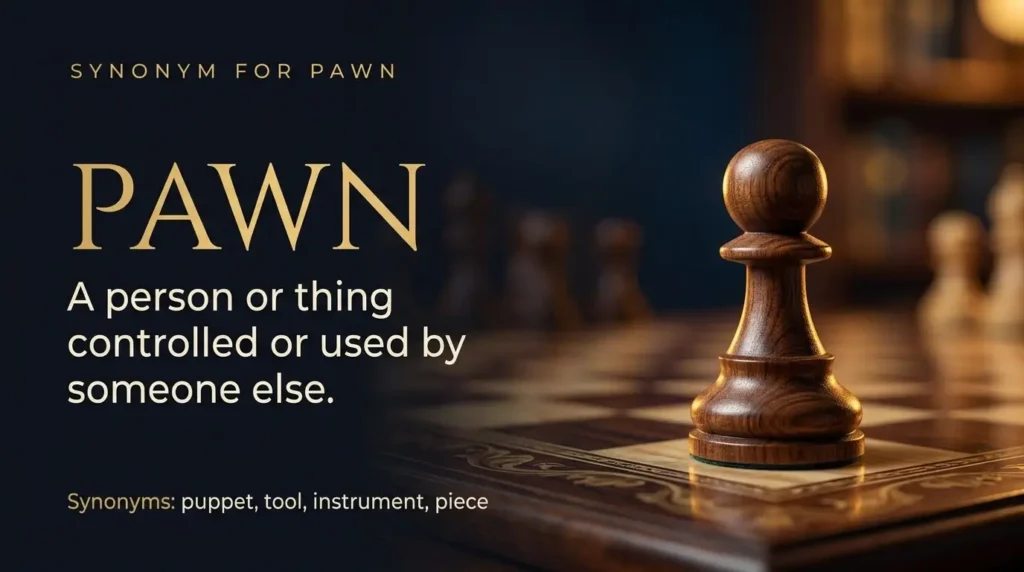
The best synonym for pawn depends on the sense you mean: use puppet or stooge for a person controlled by someone else, dupe for someone tricked, and hock for an item left as security for a loan. Match the word to the meaning, and your sentence makes the role or the deal clear at once.
A synonym for pawn depends on the context. In chess, alternatives include chess piece and, more generally, game piece. When describing a person controlled by someone else, useful alternatives include puppet, tool, dupe, and stooge. As a verb, pawn can mean to pledge an item as security for a loan, so pledge may fit.
The word pawn has several meanings. Imagine someone making decisions for another person without realizing they are being manipulated. You might describe that person as a pawn in someone else’s plan.
The word also appears in everyday financial situations. Someone may pawn a watch to obtain money temporarily. Understanding the context helps you choose the right alternative.
Learning a synonym for pawn can improve your vocabulary and make your writing more precise. Students, bloggers, content writers, and everyday English users can all benefit from understanding its different meanings.
In this guide, you will explore the meaning, pronunciation, history, and most useful alternatives to pawn. You will also learn how to select the right word for conversations, essays, stories, and professional writing.
What Does “Pawn” Really Mean?
The word pawn is a noun and a verb. Its meaning changes according to the situation in which it appears.
As a noun, a pawn can be a chess piece that usually moves forward and captures diagonally. It can also describe a person who is used by another person or organization to achieve a goal.
As a verb, to pawn means to leave a valuable item with a pawnbroker in exchange for a loan. The item can usually be reclaimed by repaying the loan and any applicable charges.
Native English speakers understand the intended meaning from context
Connotative Meaning
Connotation (the emotional or cultural associations connected with a word beyond its basic definition) helps explain why pawn can sound negative in certain situations.
- Positive tone: The word itself rarely has a strongly positive connotation, although a chess pawn can represent progress, strategy, or an unexpected victory.
- Negative tone: When describing a person, pawn often suggests manipulation, exploitation, weakness, or a lack of independence.
- Neutral tone: In chess and financial transactions, the word can be neutral and factual.
Etymology of Pawn
The noun pawn, meaning a chess piece or a person used by someone else, entered English through Old French paon, meaning a foot soldier or pawn in chess. Its history is connected with medieval chess terminology and the idea of a lower-ranking piece.
Historical Development
Old English (450–1100): The modern chess-related word pawn was not an established Old English term. Chess entered Western Europe later, so the word’s history should not be traced directly to Old English.
Middle English (1100–1500): The word entered English through Anglo-French and Old French forms during the medieval period. It became associated with the chess piece representing a foot soldier.
Modern English (1500–Present): The meaning expanded figuratively. A person controlled or manipulated by someone more powerful came to be described as a pawn. The verb pawn, meaning to deposit an item as security for a loan, developed through a related but distinct historical route.
Pronunciation, Syllables, and Word Structure
- US pronunciation: /pɑːn/
- UK pronunciation: /pɔːn/
- Syllables: pawn
- Part of speech: Noun and verb
- Root: pawn
- Prefix: None
- Suffix: None
The word has one syllable. Its pronunciation varies by accent, particularly in the vowel sound. The base word can also form related words and phrases, such as pawned, pawning, and pawnshop.
Synonyms List
There is no single synonym that fits every meaning of pawn. Some alternatives describe a person who is manipulated, others refer to chess, and a few describe pledging property for a loan.
Puppet (Noun) — US / UK: /ˈpʌp.ɪt/ / /ˈpʌp.ɪt/
Meaning: A person controlled by someone else who makes the important decisions.
Tone/Register: Negative; conversational, political, and literary.
Example:
The manager treated him like a puppet.
Critics called the leader a puppet of powerful business interests.
Tool (Noun) — US / UK: /tuːl/ / /tuːl/
Meaning: A person used by someone else to achieve a particular purpose, often without fully understanding the plan.
Tone/Register: Negative; informal to formal, depending on context.
Example:
She felt like a tool in their argument.
He refused to become a tool for someone else’s revenge.
Stooge (Noun) — US / UK: /stuːdʒ/ / /stuːdʒ/
Meaning: A person who acts on behalf of someone more powerful, often appearing foolish or obedient.
Tone/Register: Informal; strongly negative.
Example:
The audience saw him as the director’s stooge.
She would not play stooge for her dishonest colleagues.
Dupe (Noun) — US / UK: /duːp/ / /duːp/
Meaning: A person who is tricked into believing something false or helping someone else’s scheme.
Tone/Register: Neutral to negative; common in news and everyday writing.
Example:
He became an unwitting dupe in the online scam.
The fraudsters searched for another dupe to deceive.
Patsy (Noun) — US / UK: /ˈpæt.si/ / /ˈpæt.si/
Meaning: A person who is easily blamed, deceived, or used by others.
Tone/Register: Informal; often associated with crime, blame, or deception.
Example:
The investigators suspected that he was a patsy.
She worried that the team would make her the patsy.
Lackey (Noun) — US / UK: /ˈlæk.i/ / /ˈlæk.i/
Meaning: A person who obeys a powerful individual and carries out their wishes, often without question.
Tone/Register: Negative; informal to literary.
Example:
The dictator surrounded himself with loyal lackeys.
He refused to act as a lackey for the wealthy executive.
Minion (Noun) — US / UK: /ˈmɪn.jən/ / /ˈmɪn.jən/
Meaning: A follower or subordinate who carries out the orders of a powerful person.
Tone/Register: Negative or humorous; informal and literary.
Example:
The villain sent his minions to guard the entrance.
Online jokes portrayed the boss’s assistants as obedient minions.
Instrument (Noun) — US / UK: /ˈɪn.strə.mənt/ / /ˈɪn.strə.mənt/
Meaning: A person used as a means of achieving another person’s aims.
Tone/Register: Formal; academic, political, and literary.
Example:
The report described him as an instrument of political control.
She did not want to become an instrument of revenge.
Pawn in Someone’s Game (Noun Phrase) — US / UK: /pɑːn ɪn ˈsʌm.wʌnz ɡeɪm/ / /pɔːn ɪn ˈsʌm.wʌnz ɡeɪm/
Meaning: A person manipulated as part of a larger plan.
Tone/Register: Neutral to negative; conversational and literary.
Example:
He realized he was a pawn in their family dispute.
The journalist uncovered how ordinary people became pawns in the conflict.
Proxy (Noun) — US / UK: /ˈprɑːk.si/ / /ˈprɒk.si/
Meaning: A person who acts or represents someone else, sometimes serving another person’s interests indirectly.
Tone/Register: Formal; legal, political, and business contexts.
Example:
The director sent a proxy to the meeting.
The conflict developed into a proxy struggle between rival powers.
Note: A proxy is not necessarily manipulated. The word emphasizes representation or indirect action.
Scapegoat (Noun) — US / UK: /ˈskeɪp.ɡoʊt/ / /ˈskeɪp.ɡəʊt/
Meaning: A person unfairly blamed for a problem or mistake caused partly or entirely by others.
Tone/Register: Negative; common in workplace discussions and social commentary.
Example:
The company made the junior employee a scapegoat.
She refused to accept blame for a decision made by the entire team.
Note: A scapegoat is specifically blamed, while a pawn may be manipulated in many other ways.
Front (Noun) — US / UK: /frʌnt/ / /frʌnt/
Meaning: A person or organization used to conceal the identity or activities of someone else.
Tone/Register: Informal to formal; business, crime reporting, and political discussion.
Example:
Investigators suspected the business was a front for illegal activity.
The group allegedly used a front to hide its real operations.
Note: A front is not a general synonym for a manipulated person. It refers to concealment or a false appearance.
Chess Piece (Noun Phrase) — US / UK: /tʃes piːs/ / /tʃes piːs/
Meaning: Any piece used in a chess game, including a pawn.
Tone/Register: Neutral; everyday and educational.
Example:
She moved a chess piece to protect her king.
The pawn is one of the most numerous pieces on a chessboard.
Note: This is a broader term than pawn, because it includes other chess pieces.
Game Piece (Noun Phrase) — US / UK: /ɡeɪm piːs/ / /ɡeɪm piːs/
Meaning: An object moved or used by a player during a board or tabletop game.
Tone/Register: Neutral; casual and instructional.
Example:
He placed each game piece in its starting position.
The small game piece slipped beneath the table.
Note: Use this term when the exact type of piece is unimportant.
Chessman (Noun) — US / UK: /ˈtʃes.mæn/ / /ˈtʃes.mæn/
Meaning: One of the pieces used in chess, including a pawn.
Tone/Register: Neutral; slightly more formal or traditional.
Example:
The carved chessman had a detailed wooden base.
She picked up a chessman and studied the board.
Foot Soldier (Noun) — US / UK: /ˈfʊt ˌsoʊl.dʒɚ/ / /ˈfʊt ˌsəʊl.dʒə/
Meaning: An ordinary soldier who fights on foot; figuratively, a person carrying out the work of a larger organization.
Tone/Register: Neutral to negative; military, political, and metaphorical contexts.
Example:
The campaign relied on hundreds of foot soldiers.
He described himself as a foot soldier in the movement.
Note: The expression is related to the historical imagery behind the chess pawn, but it does not always mean a manipulated person.
Expendable Person (Noun Phrase) — US / UK: /ɪkˈspen.də.bəl ˈpɝː.sən/ / /ɪkˈspen.də.bəl ˈpɜː.sən/
Meaning: Someone regarded as replaceable or unimportant to the people making decisions.
Tone/Register: Negative; workplace, political, and dramatic writing.
Example:
The workers felt like expendable people during the crisis.
She refused to join a project that treated staff as expendable.
Hock (Verb) — US / UK: /hɑːk/ / /hɒk/
Meaning: To pawn or pledge a valuable possession to obtain money.
Tone/Register: Informal; especially common in American English.
Example:
He had to hock his watch to cover the emergency bill.
She considered hocking an old guitar rather than selling it permanently.
Pledge (Verb) — US / UK: /pledʒ/ / /pledʒ/
Meaning: To offer an asset as security for a loan or obligation.
Tone/Register: Formal; financial, legal, and business writing.
Example:
They agreed to pledge the property as security for the loan.
The borrower pledged valuable jewelry to secure the debt.
Note: Pledging is broader than pawning and does not always involve a pawnbroker.
Put Up as Collateral (Verb Phrase) — US / UK: /pʊt ʌp əz kəˈlæt̬.ɚ.əl/ / /pʊt ʌp əz kəˈlæt.ər.əl/
Meaning: To offer property or another asset as security for borrowed money.
Tone/Register: Neutral to formal; financial and professional.
Example:
He put up his car as collateral for the loan.
The bank required the business to put up an asset as security.
Deposit (Verb) — US / UK: /dɪˈpɑː.zɪt/ / /dɪˈpɒz.ɪt/
Meaning: To place something in a designated location or with an institution; in some financial arrangements, to leave an item as security.
Tone/Register: Neutral; everyday and financial.
Example:
She deposited the documents with the solicitor for safekeeping.
The museum accepted the valuable object on deposit.
Note: Deposit is not a direct synonym for pawning in every financial situation.
Mortgage (Verb) — US / UK: /ˈmɔːr.ɡɪdʒ/ / /ˈmɔː.ɡɪdʒ/
Meaning: To use property, typically real estate, as security for a loan.
Tone/Register: Formal; legal and financial.
Example:
They decided to mortgage their house to finance the business.
The property was mortgaged to secure the borrowing.
Note: A mortgage usually concerns real estate and is not interchangeable with pawning a watch or other movable possession.
Sell (Verb) — US / UK: /sel/ / /sel/
Meaning: To transfer ownership of something in exchange for money.
Tone/Register: Neutral; everyday and business contexts.
Example:
She sold her old camera to pay for a course.
He decided to sell the watch rather than borrow against it.
Note: Selling is not the same as pawning. A pawn transaction normally gives the owner a way to reclaim the item by repaying the loan.
Lend Against (Verb Phrase) — US / UK: /lend əˈɡenst/ / /lend əˈɡenst/
Meaning: To provide money with an asset serving as security for repayment.
Tone/Register: Neutral to formal; financial contexts.
Example:
The lender agreed to lend against the value of the jewelry.
Some financial institutions lend against eligible assets.
Note: This phrase describes the lender’s action, while pawn usually describes the owner’s action of obtaining a loan using an item.
Manipulated Person (Noun Phrase) — US / UK: /məˈnɪp.jə.leɪ.tɪd ˈpɝː.sən/ / /məˈnɪp.jʊ.leɪ.tɪd ˈpɜː.sən/
Meaning: Someone whose choices or behavior are influenced unfairly or deceptively by another person.
Tone/Register: Neutral to negative; psychological, academic, and everyday contexts.
Example:
The investigation revealed that he was a manipulated person in the scheme.
She finally understood how the group had influenced her decisions.
Note: This phrase explains the situation more directly than pawn, although it is less concise.
Instrument of Another’s Will (Noun Phrase) — US / UK: /ˈɪn.strə.mənt əv əˈnʌð.ɚz wɪl/ / /ˈɪn.strə.mənt əv əˈnʌð.əz wɪl/
Meaning: A person whose actions serve another person’s intentions rather than their own independent judgment.
Tone/Register: Formal; literary, philosophical, and academic.
Example:
The novel portrays the prince as an instrument of his father’s will.
She feared becoming an instrument of another person’s ambition.
Victim of Manipulation (Noun Phrase) — US / UK: /ˈvɪk.tɪm əv məˌnɪp.jəˈleɪ.ʃən/ / /ˈvɪk.tɪm əv məˌnɪp.jʊˈleɪ.ʃən/
Meaning: A person who suffers because someone else deceives or controls them.
Tone/Register: Neutral to negative; formal, educational, and conversational.
Example:
The documentary followed a victim of manipulation.
He realized that his trust had made him vulnerable to exploitation.
Note: This phrase emphasizes harm suffered, rather than the person’s role in a plan.
Plaything (Noun) — US / UK: /ˈpleɪ.θɪŋ/ / /ˈpleɪ.θɪŋ/
Meaning: A person treated as an object for someone else’s amusement, control, or personal advantage.
Tone/Register: Negative; conversational and literary.
Example:
- She refused to remain a plaything in his complicated relationships.
- The novel portrays the prince as a plaything of the royal court.
Cat’s-Paw (Noun) — US / UK: /ˈkæts.pɔː/ / /ˈkæts.pɔː/
Meaning: A person manipulated into doing something for another person’s benefit, often without realizing it.
Tone/Register: Negative; literary and formal.
Example:
- He became a cat’s-paw in the politician’s secret plan.
- The investigation revealed that the assistant had been used as a cat’s-paw.
Dupe Victim (Noun Phrase) — US / UK: /duːp ˈvɪk.tɪm/ / /duːp ˈvɪk.tɪm/
Meaning: A person who suffers after being deceived or misled by another individual.
Tone/Register: Explanatory; journalistic and conversational.
Example:
- The online fraud left another dupe victim searching for answers.
- She helped a dupe victim report the suspicious transaction.
Subordinate (Noun) — US / UK: /səˈbɔːr.dən.ət/ / /səˈbɔː.dɪ.nət/
Meaning: A person who works under someone else’s authority and may have limited decision-making power.
Tone/Register: Neutral; professional and academic.
Example:
- The supervisor asked a subordinate to deliver the documents.
- A good manager encourages every subordinate to share ideas.
Underling (Noun) — US / UK: /ˈʌn.dɚ.lɪŋ/ / /ˈʌn.də.lɪŋ/
Meaning: A person with a lower position who follows the orders of someone more powerful.
Tone/Register: Negative or dismissive; informal and literary.
Example:
- The crime boss sent an underling to collect the package.
- He disliked being treated as a mere underling.
Henchman (Noun) — US / UK: /ˈhentʃ.mən/ / /ˈhentʃ.mən/
Meaning: A trusted follower who helps a powerful person carry out questionable or harmful actions.
Tone/Register: Negative; informal, fictional, and journalistic.
Example:
- The villain ordered his henchman to guard the secret entrance.
- The article portrayed the official as the leader’s political henchman.
Flunky (Noun) — US / UK: /ˈflʌŋ.ki/ / /ˈflʌŋ.ki/
Meaning: A person who performs menial tasks or obeys a powerful individual without much independence.
Tone/Register: Informal; insulting or dismissive.
Example:
- He refused to spend his career as a wealthy executive’s flunky.
- The comedian joked about the mayor’s obedient flunkies.
Pawned-Off Responsibility (Noun Phrase) — US / UK: /pɔːnd ɔːf rɪˌspɑːn.səˈbɪl.ə.ti/ / /pɔːnd ɔːf rɪˌspɒn.səˈbɪl.ə.ti/
Meaning: A duty or burden unfairly passed to another person to avoid dealing with it oneself.
Tone/Register: Informal; workplace and everyday English.
Example:
- The unfinished project became a pawned-off responsibility for the new employee.
- She complained about the pawned-off duties that no one wanted to handle.
Note: This phrase describes a transferred responsibility, not a person directly. Use it only when discussing the verb pawn off.
Fall Guy (Noun Phrase) — US / UK: /ˈfɔːl ˌɡaɪ/ / /ˈfɔːl ˌɡaɪ/
Meaning: A person who is made to accept blame for someone else’s actions.
Tone/Register: Informal; negative and journalistic.
Example:
- The director tried to make the assistant the fall guy for the failure.
- Nobody wanted to be the fall guy when the investigation began.
Patsy Figure (Noun Phrase) — US / UK: /ˈpæt.si ˈfɪɡ.jɚ/ / /ˈpæt.si ˈfɪɡ.ə/
Meaning: A person presented as an easy target for deception or blame.
Tone/Register: Informal; critical.
Example:
- The detective suspected that the suspect was a patsy figure in the scheme.
- The story follows a patsy figure who gradually uncovers the truth.
Note: This phrase is less idiomatic than patsy alone, so use it sparingly.
Figurehead (Noun) — US / UK: /ˈfɪɡ.jɚ.hed/ / /ˈfɪɡ.ə.hed/
Meaning: A person who holds an official position but has little real power or authority.
Tone/Register: Neutral to negative; political, business, and academic.
Example:
- The board appointed a figurehead while others controlled the company.
- Critics argued that the president had become a figurehead.
Titular Head (Noun Phrase) — US / UK: /ˈtɪtʃ.ə.lɚ hed/ / /ˈtɪtʃ.ə.lə hed/
Meaning: A person who formally holds a leadership title but may not exercise much actual authority.
Tone/Register: Formal; organizational and political writing.
Example:
- Although she was the titular head, the committee made the major decisions.
- The organization needed more than a titular head to guide its reform.
Yes-Man (Noun) — US / UK: /ˈjes.mæn/ / /ˈjes.mæn/
Meaning: A person who agrees with a powerful individual to gain approval rather than expressing independent opinions.
Tone/Register: Informal; negative.
Example:
- The director preferred honest advisers over yes-men.
- He became known as a yes-man who never questioned the chairman.
Echo (Noun) — US / UK: /ˈek.oʊ/ / /ˈek.əʊ/
Meaning: A person who simply repeats another person’s opinions or ideas without independent thought.
Tone/Register: Figurative; neutral to negative.
Example:
- She did not want to be an echo of her influential mentor.
- His speech sounded like an echo of the party leader’s words.
Note: This is a figurative alternative that emphasizes repetition rather than manipulation.
Mouthpiece (Noun) — US / UK: /ˈmaʊθ.piːs/ / /ˈmaʊθ.piːs/
Meaning: A person who communicates the views or messages of another individual or organization.
Tone/Register: Neutral to negative; media, political, and professional.
Example:
- The spokesperson acted as the company’s mouthpiece during the crisis.
- Critics accused the commentator of becoming a mouthpiece for powerful interests.
Emissary (Noun) — US / UK: /ˈem.ə.ser.i/ / /ˈem.ɪ.sər.i/
Meaning: A person sent to represent another individual or group and communicate a message.
Tone/Register: Formal; diplomatic and professional.
Example:
- The ambassador sent an emissary to begin the negotiations.
- An emissary arrived with a proposal from the opposing side.
Note: An emissary is not necessarily controlled or exploited, so this word fits only certain contexts.
Agent (Noun) — US / UK: /ˈeɪ.dʒənt/ / /ˈeɪ.dʒənt/
Meaning: A person who acts on behalf of another person or organization.
Tone/Register: Neutral; business, legal, and everyday use.
Example:
- The company appointed an agent to represent its interests abroad.
- He acted as an agent for a powerful political group.
Operative (Noun) — US / UK: /ˈɑː.pɚ.ə.tɪv/ / /ˈɒp.ər.ə.tɪv/
Meaning: A person who carries out specific activities for an organization, especially in political or intelligence settings.
Tone/Register: Formal; political, military, and intelligence contexts.
Example:
- The investigation uncovered an operative working behind the scenes.
- The organization sent an operative to gather information.
Recruit (Noun) — US / UK: /rɪˈkruːt/ / /rɪˈkruːt/
Meaning: A person newly brought into an organization, team, or activity.
Tone/Register: Neutral; professional, military, and everyday use.
Example:
- The group recruited new members for its campaign.
- The young recruit soon discovered the risks of the assignment.
Note: A recruit is not necessarily manipulated, so this term works only when the context supports the connection.
Pawn Broker’s Customer (Noun Phrase) — US / UK: /ˈpɔːnˌbroʊ.kɚz ˈkʌs.tə.mɚ/ / /ˈpɔːnˌbrəʊ.kəz ˈkʌs.tə.mə/
Meaning: A person who uses a pawnbroker’s services to obtain a loan against a valuable possession.
Tone/Register: Neutral; financial and explanatory.
Example:
- The pawn broker’s customer returned to reclaim the watch.
- A pawn broker’s customer must understand the repayment conditions.
Note: This describes a person involved in pawning, rather than serving as a synonym for the financial verb.
Borrower (Noun) — US / UK: /ˈbɑːr.oʊ.ɚ/ / /ˈbɒr.əʊ.ə/
Meaning: A person who receives money or property with an obligation to return it under agreed conditions.
Tone/Register: Neutral; financial and everyday.
Example:
- The borrower reviewed the repayment schedule before signing.
- Each borrower must understand the terms of the agreement.
Debtor (Noun) — US / UK: /ˈdet̬.ɚ/ / /ˈdet.ə/
Meaning: A person who owes money to another person or institution.
Tone/Register: Formal; financial and legal.
Example:
- The debtor contacted the lender to discuss repayment.
- The agreement clearly explained the debtor’s obligations.
Security (Noun) — US / UK: /sɪˈkjʊr.ə.ti/ / /sɪˈkjʊə.rə.ti/
Meaning: An asset or property pledged to protect a lender if a borrower fails to repay a loan.
Tone/Register: Formal; financial and legal.
Example:
- The lender required additional security before approving the loan.
- The property served as security for the outstanding debt.
Note: This is a financial term related to pawning, not a synonym for a person who is manipulated.
Encumbered Owner (Noun Phrase) — US / UK: /ɪnˈkʌm.bɚd ˈoʊ.nɚ/ / /ɪnˈkʌm.bəd ˈəʊ.nə/
Meaning: A person whose property is subject to a financial claim, restriction, or obligation.
Tone/Register: Formal; legal and financial.
Example:
- The encumbered owner could not transfer the property freely.
- The lawyer explained the obligations affecting the encumbered owner’s assets.
Note: This is a specialized expression, not a direct synonym for someone who pawns an item.
Collateralized Borrower (Noun Phrase) — US / UK: /kəˈlæt̬.ɚ.ə.laɪzd ˈbɑːr.oʊ.ɚ/ / /kəˈlæt.ər.ə.laɪzd ˈbɒr.əʊ.ə/
Meaning: A borrower whose loan is secured by an asset.
Tone/Register: Technical; financial and academic.
Example:
- The collateralized borrower provided documentation for the secured loan.
- The lender evaluated the asset before approving the application.
Indebted Person (Noun Phrase) — US / UK: /ɪnˈdet̬.ɪd ˈpɝː.sən/ / /ɪnˈdet.ɪd ˈpɜː.sən/
Meaning: A person who owes money or has financial obligations to another party.
Tone/Register: Neutral to formal; everyday, financial, and academic.
Example:
- The indebted person created a realistic repayment plan.
- Financial advice helped the indebted person understand available options.
Pawn Off (Phrasal Verb) — US / UK: /pɔːn ɔːf/ / /pɔːn ɔːf/
Meaning: To get rid of something unwanted by passing it to another person, often through persuasion or deception.
Tone/Register: Informal; conversational.
Example:
He tried to pawn off the broken equipment on his neighbor.
She would not let the seller pawn off an inferior product on her.
Note: This is a different expression from pawn, meaning to obtain a loan. Its object is usually something unwanted or a responsibility.
Synonyms for Pawn by Tone
The best alternative depends on the message you want to communicate. A word that sounds humorous in conversation may sound insulting in a formal report.
Positive or Constructive Contexts
There are few genuinely positive synonyms for pawn when it describes a person being controlled. However, you can use more neutral expressions when you want to avoid judgment.
- Foot soldier: Emphasizes active participation in a larger effort.
- Proxy: Highlights representation or acting on someone’s behalf.
- Chess piece: Works in a neutral discussion about a game.
These words are not automatically positive. Their effect depends on the sentence.
Neutral Contexts
Use these terms when you want to describe a situation without implying blame or manipulation.
- Chess piece: A general term for an object used in chess.
- Game piece: A broader term for a playing object.
- Chessman: A traditional term for a chess piece.
- Proxy: Someone representing another person.
- Pledge: To offer an asset as security for a loan.
- Deposit: To place something with an institution or in a designated location.
Negative Contexts
These alternatives emphasize manipulation, exploitation, or unfair treatment.
- Puppet: A person controlled by someone else.
- Tool: Someone used to achieve another person’s goal.
- Stooge: An obedient person who helps someone more powerful.
- Dupe: Someone who has been deceived.
- Patsy: Someone who is easily exploited or blamed.
- Lackey: A subordinate who obeys another person.
- Minion: A follower who carries out another person’s orders.
- Scapegoat: Someone blamed for another person’s mistake.
- Expendable person: Someone treated as replaceable.
Playful or Informal Contexts
These options work in casual conversations, humorous writing, or informal storytelling.
- Stooge: Useful for describing a foolish or obedient helper.
- Minion: Often used humorously for a loyal assistant.
- Hock: An informal verb for pawning an item.
- Pawn off: Useful when someone passes an unwanted object or responsibility to another person.
Why tone matters: Choosing the right word helps readers understand whether you are describing a neutral role, criticizing manipulation, or making a joke.
Pawn vs. Close Alternatives
Three alternatives are particularly useful when describing people who are influenced or controlled by others.
| Word | Main meaning | Typical tone | Best use |
|---|---|---|---|
| Pawn | Someone used in another person’s plan | Negative or neutral | Strategy, politics, relationships |
| Puppet | Someone controlled by another person | Strongly negative | Leadership, manipulation, fiction |
| Dupe | Someone tricked or deceived | Negative | Scams, fraud, misleading claims |
| Stooge | An obedient helper, often made to look foolish | Negative or humorous | Informal speech, comedy |
Pawn vs. Puppet
A pawn is someone used to advance another person’s interests. A puppet suggests more direct control, as if the person cannot act independently.
Example: “He was a pawn in the dispute” suggests he was part of a larger strategy. “He was a puppet of the chairman” suggests the chairman controlled his actions.
Pawn vs. Dupe
A pawn may know what they are doing or may be unaware of the larger plan. A dupe is specifically someone who has been tricked.
Use dupe when deception is central to the situation. Use pawn when a person is being used to achieve someone else’s objective.
Pawn vs. Stooge
A stooge usually suggests an obedient or foolish helper. A pawn does not have to be foolish or obedient; someone can become a pawn without understanding the full situation.
Use stooge in informal criticism or humorous writing. Use pawn when the focus is on manipulation or strategy.
How “Pawn” Changes by Context
Daily Conversation
In everyday English, pawn often describes a person who is being used unfairly.
For example, “I don’t want to be a pawn in their argument” communicates that you do not want to be involved in someone else’s conflict.
When talking about money, someone might say, “I had to pawn my watch.” This means they used the watch to obtain a loan.
Writing and Blogging
Writers can use pawn, puppet, dupe, and stooge to create different impressions of a person.
A blog about manipulation might use pawn to describe someone caught in a larger scheme. An article about online fraud might use dupe because it emphasizes deception.
Choose words that accurately reflect the facts rather than simply using dramatic alternatives.
Professional and Academic English
Formal writing often benefits from precise descriptions. Instrument, proxy, and victim of manipulation may fit certain academic or professional contexts.
For example, a researcher could write, “The study examines how individuals become instruments of political influence.”
In financial writing, pledge, collateral, and mortgage are more precise than treating every transaction as pawning.
Creative and Informal Writing
In stories, pawn can create suspense because the reader may wonder who is controlling the situation.
Puppet makes the control seem stronger. Minion may add humor, while patsy can suggest a character who is unfairly blamed.
For casual financial conversations, hock is a useful alternative: “He hocked his old guitar to cover the bill.”
Common Mistakes Learners Make
Using Every Synonym Interchangeably
Not every alternative means exactly the same thing. A dupe has been deceived, a scapegoat is blamed, and a proxy represents another person. A pawn can occupy a wider range of roles.
Confusing Pawn With Sell
Pawning an item generally means using it to secure a loan. Selling it means transferring ownership in exchange for money. These actions have different financial consequences.
Using Puppet in Neutral Situations
Calling someone a puppet can sound insulting. If you only mean that a person represents another person, proxy may be more accurate.
Treating Pawn as Always Negative
The word is neutral when discussing chess or a financial transaction. Its negative connotation usually appears when it describes a person being used by someone else.
Overusing Dramatic Alternatives
Words such as stooge, lackey, and minion can make writing sound judgmental. Use them when the context supports that attitude, not merely to avoid repeating pawn.
Register Notes
- Formal writing: Prefer instrument, proxy, or a precise description of the person’s role.
- Informal speech: Puppet, stooge, and hock may sound natural in the right context.
- Academic writing: Explain the specific relationship or action instead of relying on emotionally loaded labels.
- Financial writing: Use pledge, collateral, or mortgage only when the transaction matches the term’s meaning.
For additional vocabulary practice, you can link this article internally to a related VocaNeest guide about synonyms for manipulation or control.
Real-Life Examples Using Pawn
Workplace Scenario
A junior employee discovers that a manager has been using their name to support a decision they never approved. The employee might say, “I won’t be a pawn in office politics.”
Social Situation
Two friends argue and try to make another friend take sides. That friend might explain, “I don’t want to be a pawn in your disagreement.”
Media and Pop Culture
A film character secretly follows a powerful villain’s orders. Viewers might describe the character as a puppet if the villain controls their actions, or a pawn if the character is part of a larger plan.
Writing and Storytelling
A novelist wants to reveal that a character has been deceived by a criminal group. The phrase unwitting dupe emphasizes the deception, while pawn in a larger scheme emphasizes the character’s role in the plan.
These scenarios show why the surrounding details matter more than simply replacing a word with another word from a synonym list.
Interactive Practice Quiz:
Test your understanding with these everyday scenarios. Choose the option that best fits the meaning and tone of each sentence.
Synonym for Pawn: Practice Quiz
- A spy or agent carries out a secret plan without knowing the king’s real intentions. Which expression fits best?
A. A financial debtor
B. A chess champion
C. A pawn in a larger scheme
D. A property owner - A worker agrees with every opinion her boss expresses, even when she disagrees. Which informal term best describes this behavior?
A. Emissary
B. Figurehead
C. Yes-man
D. Borrower - A spokesperson communicates a company’s official position to the public. Which word may describe this role?
A. Underling
B. Fall guy
C. Dupe
D. Mouthpiece - A borrower uses a house as security for a loan. Which verb most precisely describes this arrangement?
A. Deposit
B. Recruit
C. Hock
D. Mortgage - A person carries out questionable tasks for a crime boss and is trusted to follow orders. Which term fits best?
A. Henchman
B. Figurehead
C. Debtor
D. Emissary - Which TWO terms are associated with using an asset to secure a financial obligation? Select both.
A. Collateral
B. Yes-man
C. Pledge
D. Mouthpiece - A “figurehead” may hold an official leadership title while having little actual decision-making power.
True
False
Reflection Task
Write one original sentence using pawn, puppet, dupe, or pledge. Explain why your chosen word fits the situation better than the other alternatives.
Conclusion
Learning a synonym for pawn helps you express ideas about manipulation, chess, and financial transactions with greater accuracy. The right choice depends on the meaning.
Words such as puppet, dupe, and stooge describe different kinds of influence or deception. Meanwhile, pledge and hock relate to using possessions to obtain money.
A strong vocabulary makes essays, blogs, professional messages, and everyday conversations clearer. It also helps you recognize differences in tone and avoid unintended criticism.
Practice these alternatives by writing your own examples in emails, essays, and daily conversations. Small vocabulary exercises can gradually make your English more natural and confident.
Frequently Asked Questions
1. What is the best synonym for pawn when describing a person?
Puppet is often the closest alternative when you mean someone who is controlled by another person. However, pawn is more suitable when the person is being used as part of a wider plan. Choose dupe if the person has been tricked, or stooge if the emphasis is on obedient or foolish behavior.
2. What does it mean to be a pawn in someone’s game?
Being a pawn in someone’s game means being used to achieve another person’s goal, often without understanding the full situation. For example, a person might be drawn into a disagreement because someone else wants to gain an advantage. The expression usually suggests limited control, manipulation, or exploitation.
3. Is pawn a negative word when referring to a person?
Yes, it usually carries a negative connotation when it describes a person. It suggests that someone is being used by a more powerful individual or group. However, pawn is neutral when discussing chess or using an item to secure a loan. The surrounding sentence determines its intended meaning.
4. What is the difference between pawn and pledge in finance?
To pawn an item usually means to leave a valuable possession with a pawnbroker in exchange for a loan. To pledge an asset means to offer it as security for an obligation. Pledging can occur in a wider range of financial arrangements, so the two words are not interchangeable in every situation.
5. What is the difference between a pawn and a scapegoat?
A pawn is someone used to advance another person’s interests. A scapegoat is someone blamed for a mistake, problem, or failure, often unfairly. A person may be both a pawn and a scapegoat, but the terms describe different roles. Use scapegoat when unfair blame is the central idea.
6. Can pawn be used as both a noun and a verb?
Yes. As a noun, pawn can refer to a chess piece or a person used by someone else. As a verb, it means to leave an item with a pawnbroker in exchange for a loan. For example, “The pawn moved forward” uses the noun, while “She pawned her ring” uses the verb.
7. What is a formal alternative to pawn in academic writing?
Instrument may work when describing a person used to achieve another person’s objectives. Proxy is more suitable when someone represents another person or acts on their behalf. In academic writing, a specific phrase such as a person subjected to political manipulation may be clearer than a figurative label.
8. Is hock the same as pawn?
In informal English, hock is a close synonym for the financial verb pawn. Both can describe using a valuable item to obtain a loan. Hock is especially familiar in American informal speech. Neither word normally means selling an item outright, because a pawn transaction generally involves an opportunity to reclaim it.
External Link Source
For additional learning about chess terminology and the role of pawns, explore the official FIDE website: International Chess Federation (FIDE).

Aqsa Rani is the founder and lead writer at VocaNeest.com, a trusted platform dedicated to helping people improve their English vocabulary and communication skills. She creates well-researched, accurate, and easy-to-understand content covering synonyms, antonyms, word meanings, idioms, phrases, and everyday vocabulary. Her goal is to make learning English simple, practical, and accessible for students, writers, professionals, and lifelong learners.
At VocaNeest.com, every article is carefully researched, fact-checked, and written with a strong focus on accuracy, clarity, and real-world usage. Content is regularly reviewed and updated to ensure it remains helpful, relevant, and aligned with modern language standards. Through reliable vocabulary guides and practical examples, Aqsa aims to help readers write with confidence, expand their vocabulary, and communicate more effectively.